
Quick answer: A digital detox is a planned period of reduced or removed screen use — phones, laptops, TV, gaming, email — taken to recover attention, sleep, or headspace.
The strongest evidence is not for going cold turkey. In a month-long randomized controlled trial, blocking mobile internet for two weeks improved mental health, wellbeing, and measured attention, with 91% of participants improving on at least one of those three.
A separate meta-analysis of complete abstinence from social platforms found no effect at all on mood or life satisfaction.
That contrast is the useful part, and almost nobody writes about it. The kind of detox you choose appears to matter more than how long you do it.

What does digital detox mean?
A digital detox is a deliberate, time-limited reduction in screen and device use, undertaken to change how you feel, focus, or sleep.
For most people the goal is not less technology in principle — the importance of the internet to work, money and family life is not really in dispute. The goal is less of the idle kind.
The word “detox” is borrowed and slightly misleading. Nothing toxic is being flushed out of you, and the framing implies a purge followed by a return to normal. In practice the useful version looks more like a controlled experiment on your own habits.
Digital detox meaning, in one line: a planned break from screens, for a set period, with a purpose.
Three things separate it from simply using your phone less. It has a start and an end, and it covers devices rather than one app.
It is also undertaken deliberately, rather than happening because you lost your charger.
What a digital detox is not
It is not permanent renunciation of technology. It is not a productivity hack. And it is not treatment for anxiety or depression, though it may sit alongside treatment usefully.
It also does not have to be total. As the research below shows, the trials with the clearest results tested sharp reductions rather than complete cutoff.
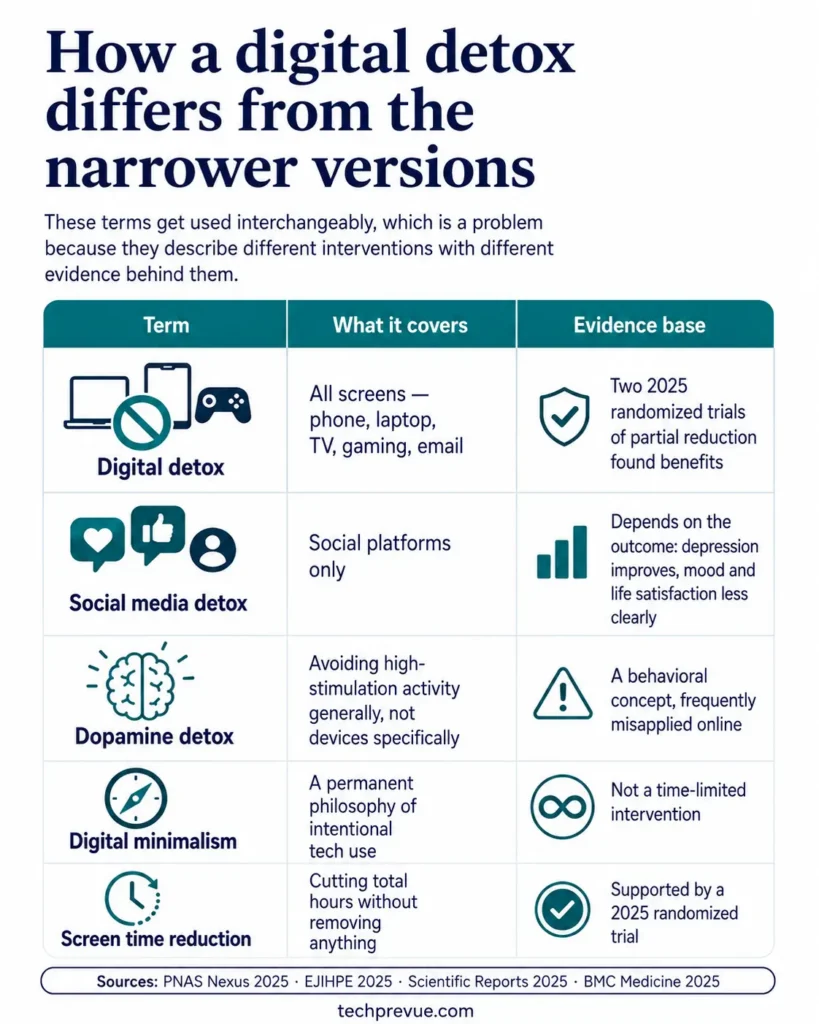
How a digital detox differs from the narrower versions
These terms get used interchangeably, which is a problem because they describe different interventions with different evidence behind them.
| Term | What it covers | Evidence base |
|---|---|---|
| Digital detox | All screens — phone, laptop, TV, gaming, email | Two 2025 randomized trials of partial reduction found benefits |
| Social media detox | Social platforms only | Depends on the outcome: depression improves, mood and life satisfaction less clearly |
| Dopamine detox | Avoiding high-stimulation activity generally, not devices specifically | A behavioral concept, frequently misapplied online |
| Digital minimalism | A permanent philosophy of intentional tech use | Not a time-limited intervention |
| Screen time reduction | Cutting total hours without removing anything | Supported by a 2025 randomized trial |
If your concern is one platform rather than screens generally, the narrower platform-specific version is the more precise tool. This guide covers the wider one.
What the research actually shows — by type of detox
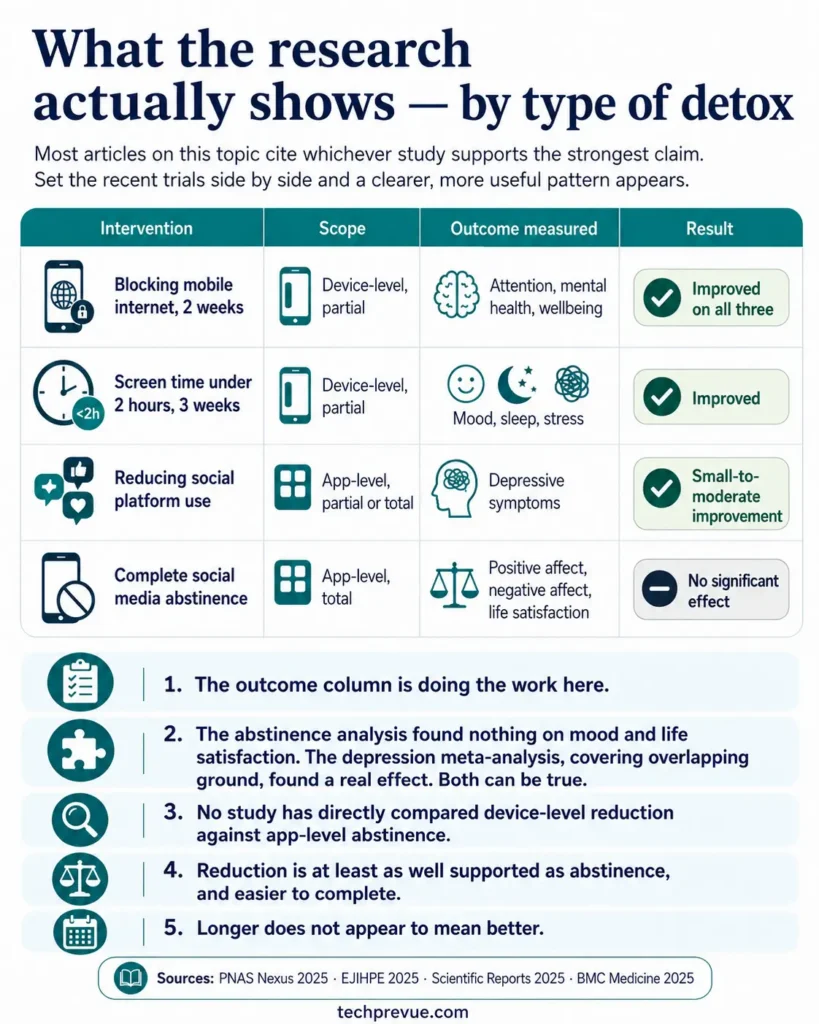
Most articles on this topic cite whichever study supports the strongest claim. Set the recent trials side by side and a clearer, more useful pattern appears.
Blocking mobile internet: strong evidence
The strongest test of a device-level detox to date is a preregistered randomized controlled trial published in PNAS Nexus in February 2025 by Castelo, Kushlev and colleagues.
An app blocked all mobile internet on participants’ phones for two weeks. Calls, texts, and desktop internet still worked, so the intervention removed constant connectivity rather than the phone itself. Compliance was tracked objectively rather than self-reported.
The intervention improved mental health, subjective wellbeing, and objectively measured sustained attention. 91% of participants improved on at least one of those three outcomes.
The mechanism is more specific than most summaries suggest. Changes in how people spent their time — more in-person socializing, more exercise, more time outdoors — along with social connectedness, self-control and sleep, helped explain the gains in wellbeing and mental health.
They did not explain the attention gain. None of those mediators accounted for the improvement in sustained attention, which the authors suggest may come more directly from removing a constant opportunity for distraction.
So there are two separate effects here, not one. What you do with the recovered time appears to drive the mood benefit; simply having fewer interruptions appears to drive the focus benefit.
Three caveats the authors raise. There was no active control group, so expectancy effects cannot be ruled out, and plenty of participants found full compliance difficult.
The moderator they identified was baseline fear of missing out — people who felt more FoMO beforehand improved more — not overall screen time or baseline mood.
Reducing screen time: promising
A separate 2025 randomized controlled trial by Pieh and colleagues asked participants to hold smartphone screen time under two hours a day for three weeks. It reported improvements in wellbeing, depressive symptoms, sleep quality, and stress, though as a single trial it varies in weight from the pooled analyses above.
Notably, that study deliberately avoided complete abstinence, on the reasoning that total cutoff risks adding stress and isolation rather than relieving them.
Reducing social platform use: modest but real
A third 2025 meta-analysis, by May, Malouff and Meynadier in EJIHPE, pooled 10 randomized controlled trials covering 1,491 people and looked specifically at depressive symptoms.
Reducing social media use significantly decreased depression symptoms, at g = 0.25 (95% CI 0.10–0.41) after adjusting for publication bias. That is a small-to-moderate effect.
One finding in that paper deserves attention, because it is the closest thing to a direct comparison anyone has published. Interventions aimed at reducing use had twice the depression effect size of interventions aimed at abstinence — but the difference was not statistically significant.
Intervention length was also a non-significant moderator. Longer did not mean better.
Social media abstinence alone: weaker on mood
Lemahieu and colleagues, writing in Scientific Reports, pooled 10 studies covering 4,674 participants — all of them examining complete abstinence from social media, which may be a narrower question than it first appears.
They found no significant effect on positive affect, negative affect, or life satisfaction. Duration made no difference either; four weeks performed no better than one.
The limitation worth noting is that this analysis measured mood and life satisfaction specifically, not depression, attention, or sleep. A null result on those three outcomes is not a null result on everything — as the meta-analysis above shows, depressive symptoms are a different question with a different answer.
How to read all this
| Intervention | Scope | Outcome measured | Result |
|---|---|---|---|
| Blocking mobile internet, 2 weeks | Device-level, partial | Attention, mental health, wellbeing | Improved on all three |
| Screen time under 2 hours, 3 weeks | Device-level, partial | Mood, sleep, stress | Improved |
| Reducing social platform use | App-level, partial or total | Depressive symptoms | Small-to-moderate improvement |
| Complete social media abstinence | App-level, total | Positive affect, negative affect, life satisfaction | No significant effect |
The outcome column is doing the work here. These are different research teams, different interventions, and different populations, but the important difference is what each one measured.
The abstinence analysis found nothing on mood and life satisfaction. The depression meta-analysis, covering overlapping ground, found a real effect. Both can be true.
So the honest reading is narrower than “one method beats another.” No study has directly compared device-level reduction against app-level abstinence, and the one paper that came closest — comparing reduction against abstinence for depression — found reduction had twice the effect size but could not rule out chance.
Two things do repeat across the set, and both are useful:
Reduction is at least as well supported as abstinence, and easier to complete. Nothing in this literature suggests you need to go cold turkey to get an effect, and the trial that tracked compliance objectively found many people could not manage total cutoff anyway.
Longer does not appear to mean better. Intervention length was a non-significant moderator in two separate 2025 meta-analyses, and a third found four weeks performed no better than one. If you were choosing between doing a month badly and two weeks properly, the evidence favors two weeks properly.
One useful piece of grounding from the mobile-internet trial itself: its authors note that blocking Facebook alone is known to improve wellbeing, but at roughly 20% of the effect size they measured from blocking all mobile internet. That is their cross-study comparison rather than a trial result, but it is the most direct statement available that scope matters.
Digital detox benefits — and their limits
Here are the benefits with reasonable support, and the ones commonly claimed without it.
What the evidence supports
- Improved sustained attention. The clearest finding in the mobile internet trial, and measured objectively rather than self-reported.
- Better mood and mental health. Reported across both device-level trials, though effect sizes vary.
- Better sleep. Reported as a significant improvement in the three-week screen time reduction trial.
- More offline activity. More in-person time, exercise, and time outdoors — which appears to be the mechanism rather than a side effect.
- A greater sense of self-control. Reported by participants and worth having in itself.
What is claimed but not well supported
- Fixing loneliness. Removing screens does not, by itself, put people in your life.
- Permanent change. Measured effects are short-term. There is some evidence gains persist a couple of weeks after returning, but nobody has shown a one-off detox holds for months.
- Productivity transformation. Attention improves; that is not the same as output.
- Curing anxiety or depression. A detox is not treatment and should not replace it.
The honest summary of digital detox benefits: real, measurable, meaningful for many people, and smaller than the internet suggests.
It is also worth saying what an average conceals. A modest mean effect across hundreds of participants is entirely compatible with some people improving a great deal and others noticing nothing.
Which is why your own before-and-after matters more here than any published figure. Run it as an experiment on yourself and the question stops being whether it works in general.
How long should a digital detox last?
Long enough to notice something, short enough to finish.
| Format | Length | What it realistically does |
|---|---|---|
| Evening reset | 3–4 hours | Breaks the after-work default. Good first test |
| Screen-free day | 24 hours | Reveals how much of your day had no plan in it |
| Weekend | 2 days | Long enough to notice the quiet. The most common starting point |
| Two weeks, partial | 14 days | The length used in the strongest single trial |
| Month, partial | 30 days | More room for new routines, though no trial has shown longer works better |
How long does a digital detox take to show results? In the two-week trial, measurable change appeared within the fortnight, and the three-week reduction trial reported effects over its own period. Nothing in the research establishes a reliable order in which sleep, attention and mood improve, so treat any day-by-day timeline you read with caution.
If you want the version closest to what has actually been tested, do the two-week partial: reduce sharply, don’t eliminate, and keep calls and essential tools running. Two 2025 meta-analyses found intervention length made no significant difference, so a longer attempt is not obviously a better one. If a shorter, repeatable format suits you better, a regular break from social platforms is a lower-commitment place to start.
How to do a digital detox
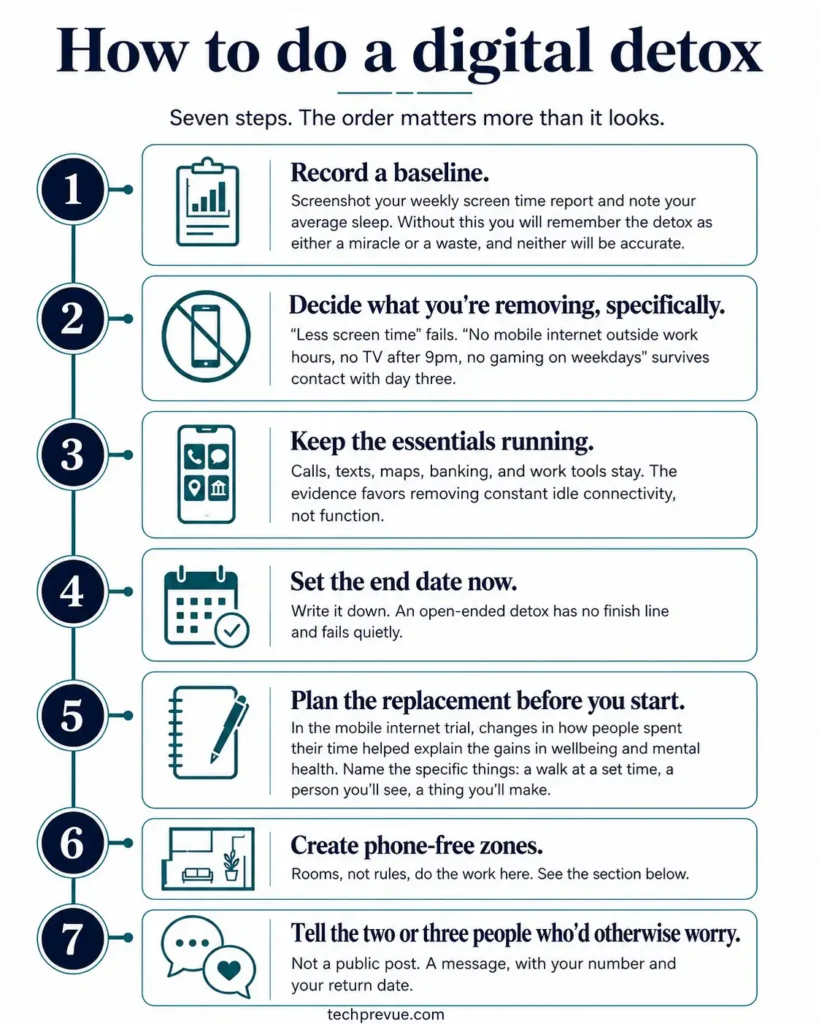
Seven steps. The order matters more than it looks.
1. Record a baseline. Screenshot your weekly screen time report and note your average sleep. Without this you will remember the detox as either a miracle or a waste, and neither will be accurate.
Your Google activity history is a second, often more uncomfortable record of the same habits.
2. Decide what you’re removing, specifically. “Less screen time” fails. “No mobile internet outside work hours, no TV after 9pm, no gaming on weekdays” survives contact with day three.
3. Keep the essentials running. Calls, texts, maps, banking, and work tools stay. The evidence favors removing constant idle connectivity, not function.
4. Set the end date now. Write it down. An open-ended detox has no finish line and fails quietly.
5. Plan the replacement before you start. In the mobile internet trial, changes in how people spent their time helped explain the gains in wellbeing and mental health. Name the specific things: a walk at a set time, a person you’ll see, a thing you’ll make.
6. Create phone-free zones. Rooms, not rules, do the work here. See the section below.
7. Tell the two or three people who’d otherwise worry. Not a public post. A message, with your number and your return date.
What to do during a digital detox
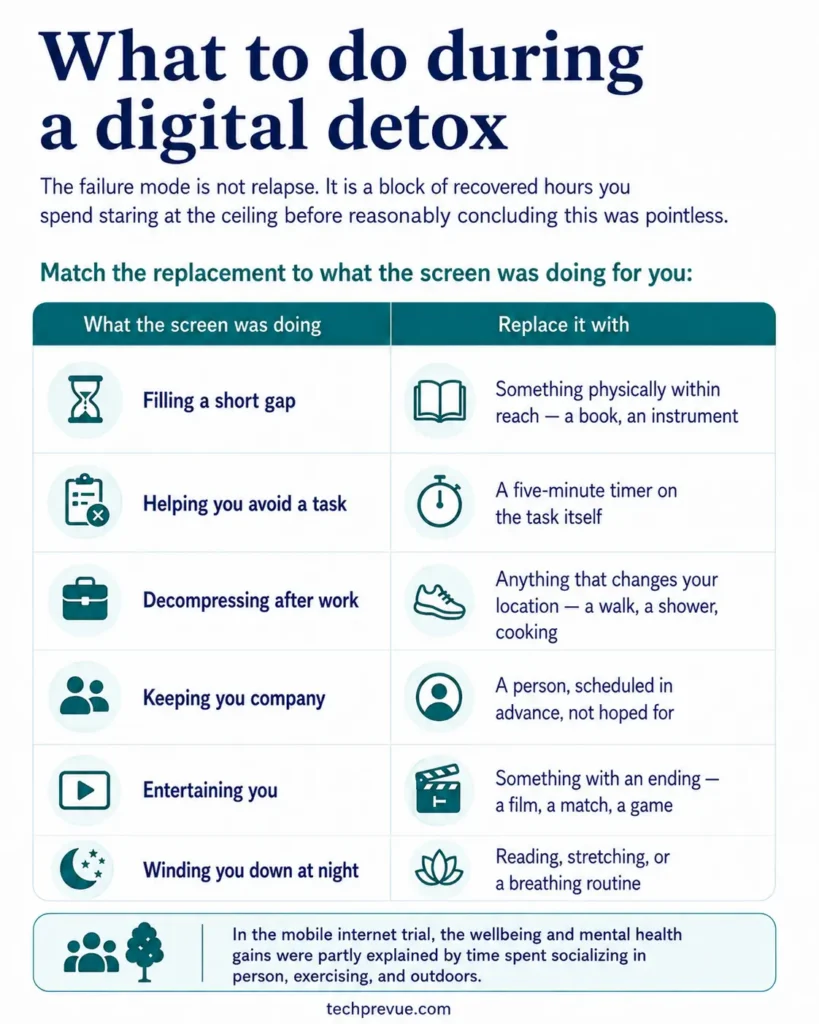
The failure mode is not relapse. It is a block of recovered hours you spend staring at the ceiling before reasonably concluding this was pointless.
Match the replacement to what the screen was doing for you:
| What the screen was doing | Replace it with |
|---|---|
| Filling a short gap | Something physically within reach — a book, an instrument |
| Helping you avoid a task | A five-minute timer on the task itself |
| Decompressing after work | Anything that changes your location — a walk, a shower, cooking |
| Keeping you company | A person, scheduled in advance, not hoped for |
| Entertaining you | Something with an ending — a film, a match, a game |
| Winding you down at night | Reading, stretching, or a breathing routine |
The trial data points the same way: the wellbeing and mental health gains were partly explained by time spent socializing in person, exercising, and outdoors. All three are physical, and none of them happen by accident.
Beyond the phone: the screens nobody plans for
Almost every guide on this subject says “all screens” and then discusses only phones. Here is the rest of it.
Television. Often the largest single block of screen time for many adults, and the least examined. It rarely triggers guilt the way scrolling does, which is precisely why it goes unaudited.
Gaming. Sessions are long rather than fragmented, which makes them different in kind from checking behavior. Absolute abstinence is usually the wrong tool; a session cap works better.
The work laptop. For most knowledge workers this is the largest screen exposure of the week and the least negotiable. Target the edges — no email before 9am, none after 7pm — rather than the middle.
Email and messaging outside work. These feel like obligations rather than consumption, which is why they survive detoxes that remove everything else. Batching them into set windows has decent support in the attention research.
Turning off WhatsApp read receipts removes one of the smaller obligations built into messaging.
Second screens. Phone in hand while the TV runs is two screens delivering one experience badly. Removing the second one is among the easiest wins available.
Smartwatches. A notification on your wrist is harder to ignore than one in your pocket, and easier to forget you enabled. If you wear one, audit what it is allowed to buzz for before you change anything else.
The car and the commute. Podcasts and audiobooks are not screens, but they occupy the same gap that silence used to. Whether that counts is your call — it is worth deciding rather than defaulting.
Phone-free zones by room
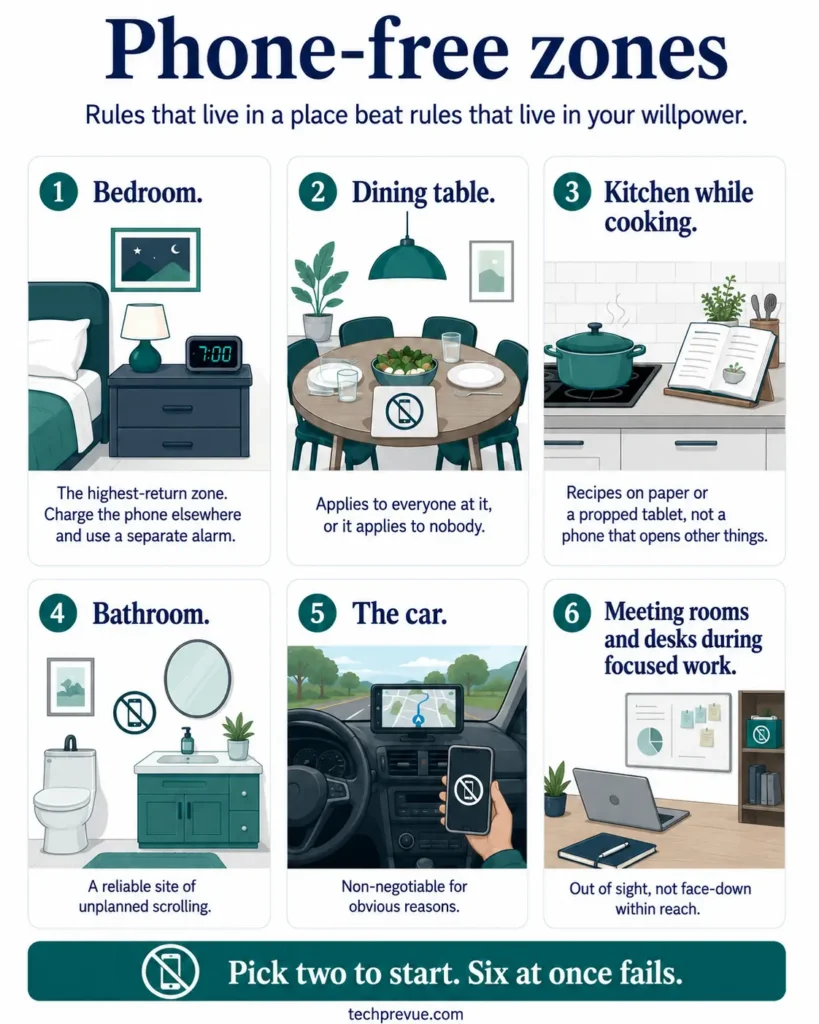
Rules that live in a place beat rules that live in your willpower.
- Bedroom. The highest-return zone. Charge the phone elsewhere and use a separate alarm.
- Dining table. Applies to everyone at it, or it applies to nobody.
- Kitchen while cooking. Recipes on paper or a propped tablet, not a phone that opens other things.
- Bathroom. Unglamorous, and a reliable site of unplanned scrolling.
- The car. Non-negotiable for obvious reasons.
- Meeting rooms and desks during focused work. Out of sight, not face-down within reach.
Pick two to start. Six at once fails.
How to build a digital detox day into your week
A single detox is an event. One recurring day is a practice, and the practice is what holds.
Pick one day — Sunday works for most households — and keep it low-screen. Not zero: calls, maps, and a film in the evening are fine. The target is idle consumption.
Make it the same day every week. The point is removing the decision. You are not choosing to resist each week; the day simply is what it is.
Start the night before. Phones out of the bedroom on Saturday night is what makes Sunday morning work.
Give the day something to be. A walk, a market, a long lunch, a project. An empty screen-free day is just a boring day, and boring days do not repeat.
Run it as a household. A rule that applies to the adults as well as the children survives far longer than one imposed downward.
Fifty-two days a year, achieved without a single dramatic act of willpower.
The best digital detox tools
The most effective tool is usually already on your device and free.
| Tool | Type | Best for | Cost |
|---|---|---|---|
| iOS Screen Time | Built-in | App limits, downtime, per-app blocking | Free |
| Android Digital Wellbeing | Built-in | App timers, focus mode, bedtime mode | Free |
| Focus modes / Do Not Disturb | Built-in | Notification control by context | Free |
| Grayscale mode | Built-in | Reducing pull without blocking anything | Free |
| Freedom | Third-party | Cross-device blocking, phone and desktop together | Paid |
| Cold Turkey | Third-party | Hard-to-bypass desktop blocking | Free tier + paid |
| A physical alarm clock | Analog | Getting the phone out of the bedroom | Low |
| A second, basic phone | Analog | Keeping calls while removing everything else | Varies |
Three things worth knowing before you pick one.
Built-in tools are bypassable. On Android, app timers can be dismissed without a password. On iPhone, set a Screen Time passcode different from your device passcode or you will simply tap through it.
Notification control is worth trying before blocking. Attention research has found benefits from reducing notifications and from receiving them in batches rather than continuously. Nobody has directly compared that against outright blocking, but it is a smaller intervention and easier to sustain.
The most effective tool in the strongest study was total mobile internet blocking — closer to Freedom or a basic phone than to a gentle app timer. If softer tools have failed you repeatedly, that is the evidence-backed escalation.
Digital detox for kids
Children need a different approach, and the honest starting point is that most published guidance here is opinion rather than evidence.
Model it first. This is practitioner judgment rather than a research finding, but it is the most consistent thing I hear from parents: rules imposed by adults who don’t follow them rarely survive. A parent scrolling at dinner while asking a child to put a tablet away is making an argument that has already lost.
Make it a household change, not a punishment. Framing matters more with children than with anyone else. “We are doing this” works; “you are doing this” produces negotiation.
Replace, don’t just remove. The same principle as adults, more so. Removing a device from a bored child creates a problem you will be asked to solve within ten minutes.
Start with zones and timing, not totals. No devices at the table, none in bedrooms overnight, none in the hour before bed. These are easier to enforce and explain than an hours budget, particularly for families already managing the pros and cons of online school.
Keep it age-appropriate. A teenager’s social life genuinely lives on these platforms, and cutting it off entirely has social costs that a younger child’s screen time does not. The wider picture on social media and adolescents is worth reading alongside this.
Expect resistance early on. Adults report the same thing during detox studies, so treat it as part of the process rather than a sign the plan is wrong.
Agree the rules together where age allows. A rule a child helped set tends to be argued with less than one handed down. Again, that is experience rather than evidence, but it costs only a conversation to test.
Watch what the screen was providing. For many children a device is doing social, creative, and entertainment work at once. Removing it removes all three, so the replacement has to cover more than boredom.
If screen use is displacing sleep, school, or friendships over months rather than weeks, that is worth raising with a doctor rather than managing with rules alone.
Are digital detox retreats worth it?
A digital detox retreat is a paid stay — often a few days, often rural — where devices are surrendered on arrival and the schedule is built around offline activity.
The case for one: it removes the two things that sink home attempts, which are access and the absence of anything else to do. For people who have failed repeatedly on their own, the enforced structure is the product.
The case against: I could not find research directly comparing a retreat against an equivalent period of self-directed reduction, so the premium is unproven rather than disproven. There is also a structural problem — you return to the same environment, phone, and habits that produced the issue.
The honest position is that a retreat buys enforcement, and enforcement is genuinely what many people lack. Whether it buys anything beyond that has not been established either way.
If you do go, treat it as a starting point rather than a cure, and decide what changes at home before you leave.
One practical filter. Ask whether the retreat’s value is the absence of devices or the presence of a structured week somewhere pleasant. If it is the second, a holiday with your phone in a drawer costs less and does the same job.
When your job is screens
Generic detox advice assumes screens are optional. For most knowledge workers they are the job.
The workable version separates professional use from idle use so completely that they stop bleeding into each other.
- Separate devices or profiles. Work on one, personal on another. Nothing personal logged in on the work machine.
- Target the edges, not the middle. You cannot remove the workday. You can remove the 7am inbox check and the 11pm one.
- Batch communications. Two or three defined windows rather than continuous monitoring, agreed with your team so nobody is waiting.
- Protect one full day. A day without professional screen access is the closest thing to a detox available in this kind of work.
- Notifications for people, not for systems. Mentions and direct messages only.
- Make the boundary visible. A status message or a stated response window prevents silence being read as unresponsiveness, which is what usually pulls people back in.
The organizational point is worth stating plainly. If a workplace treats availability outside working hours as a virtue, no individual detox will hold against it, and the problem is not one an app can fix.
Common mistakes
- Going total. Complete abstinence has the weakest evidence and the highest failure rate. Partial reduction is the better-supported choice.
- Removing without replacing. The trial data suggests the benefit comes from what fills the time. No replacement, no benefit.
- Assuming compliance is easy. In the strongest study, with an app enforcing the block, many participants still struggled. Plan for that rather than treating it as a character failure.
- No baseline. Nothing to compare against afterwards.
- Only counting the phone. The TV and the work laptop are usually larger.
- Treating it as a one-off cure. Effects measured so far are short-term. Repetition is the mechanism.
- Doing it alone in a household that isn’t. Everyone else’s screens are in your environment too.
Frequently asked questions
What is a digital detox?
A planned, time-limited reduction in screen and device use — covering phones, computers, TV, and gaming — undertaken to improve attention, sleep, mood, or focus. It does not require giving up technology permanently.
What does digital detox mean, exactly?
It means deliberately stepping back from screens for a set period with a defined purpose. The “detox” language is borrowed from medicine and is not literal; nothing is being flushed from your system.
How long should a digital detox last?
Two weeks of partial reduction has the strongest evidence behind it. A weekend is a reasonable first attempt, and an evening is enough to test whether you can.
How long does a digital detox take to work?
Measurable changes appeared within two weeks in the strongest trial. Sleep and attention usually shift before mood does.
Does a digital detox actually work?
For device-level partial reduction the evidence is reasonably good: one randomized trial found 91% of participants improved on at least one of mental health, wellbeing, or attention. Results vary by what is measured — a meta-analysis found reducing social platform use lowers depressive symptoms, while a separate one found no effect on mood or life satisfaction from complete abstinence.
What should I do during a digital detox?
Decide in advance rather than improvising. The trial evidence points to in-person socializing, exercise, and time outdoors as the activities associated with the largest gains.
What are the best digital detox tools?
Start with what’s already on your device — Screen Time on iPhone, Digital Wellbeing on Android, plus focus modes and grayscale. If those have failed repeatedly, harder blocking tools like Freedom or Cold Turkey are the evidence-backed escalation.
Is a digital detox the same as a social media detox?
No. A social media detox targets social platforms only. A digital detox covers all screens, and the research on device-level reduction is currently stronger than the research on social media abstinence.
How do I do a digital detox for kids?
Model it yourself first, frame it as a household change rather than a punishment, and start with zones and timing — no devices at the table or in bedrooms overnight — rather than an hours budget.
Are digital detox retreats worth the money?
They buy enforcement and structure, which is genuinely what many people lack. I could not find research comparing a retreat against an equivalent self-directed break, so the premium is unproven either way — the practical question is whether you can create that structure at home for free.
Can I do a digital detox if my job requires screens?
Yes, in modified form. Target the edges of the day rather than the middle, batch your communications into set windows, and protect one full screen-free day.
When a detox isn’t the answer
A digital detox is a useful experiment. It is not treatment.
If low mood, anxiety, or sleep problems have lasted more than a few weeks, or if being without your devices produces real distress rather than boredom, speak to a doctor or a mental health professional.
India: Tele-MANAS is free and available 24/7 on 14416 or 1-800-891-4416, in English and 20 regional languages.
United States: the 988 Suicide and Crisis Lifeline is available 24/7 by calling or texting 988.
This article is for general information and is not medical advice.
Sources:
- Substance Abuse and Mental Health Services Administration. 988 Suicide and Crisis Lifeline.
- Castelo, N., Kushlev, K., Ward, A. F., Esterman, M., & Reiner, P. B. (2025). Blocking mobile internet on smartphones improves sustained attention, mental health, and subjective well-being. PNAS Nexus, 4(2), pgaf017. (doi.org/10.1093/pnasnexus/pgaf017)
- May, W., Malouff, J. M., & Meynadier, J. (2025). Reducing social media use decreases depression symptoms: a meta-analysis of randomised controlled trials. European Journal of Investigation in Health, Psychology and Education, 15(11), 222. (doi.org/10.3390/ejihpe15110222)
- Lemahieu, L., Vander Zwalmen, Y., Mennes, M., Koster, E. H. W., Vanden Abeele, M. M. P., & Poels, K. (2025). The effects of social media abstinence on affective well-being and life satisfaction: a systematic review and meta-analysis. Scientific Reports, 15, 7581. (doi.org/10.1038/s41598-025-90984-3)
- Pieh, C., Humer, E., Hoenigl, A., Schwab, J., Mayerhofer, D., Dale, R., & Haider, K. (2025). Smartphone screen time reduction improves mental health: a randomized controlled trial. BMC Medicine, 23, 107. (doi.org/10.1186/s12916-025-03944-z)
- Ministry of Health and Family Welfare, Government of India. Tele-MANAS national tele mental health helpline.
