
Quick answer: A social media break is a short, deliberate pause from social platforms — an evening, a weekend, or a week — that you repeat rather than complete. It is lighter than a detox and easier to sustain. Most people who try one fail for social reasons rather than willpower ones: they worry about what people will think, what they’ll miss, and what happens to their account. This guide handles those three problems first, then the practical steps.
What a social media break actually is
A break is a pause you take and come back from. That sounds obvious, but it is the detail that separates it from everything else in this category, and it changes how you should approach it.
The goal is not endurance. Taking a social media break every Sunday for a year does more for you than one heroic month you never repeat.
Because it is short, you do not need to delete accounts, announce anything, or restructure your life around it. Those requirements come from longer protocols and they are the main reason people abandon shorter attempts.
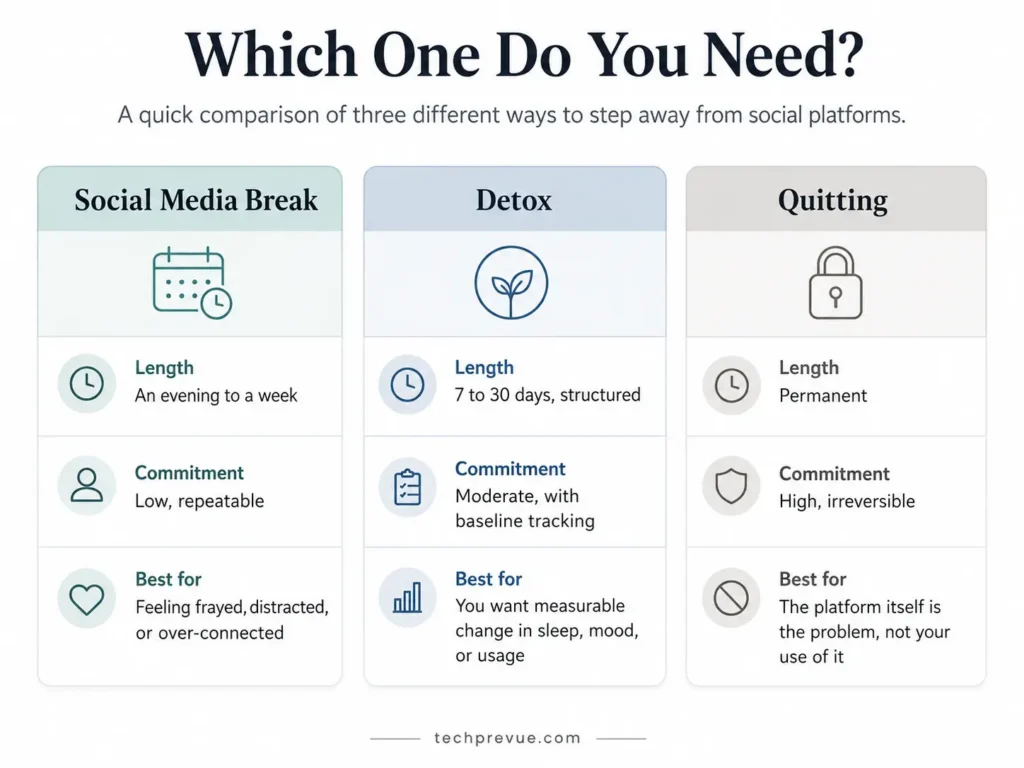
Break, detox, or quitting — which one do you need?
These three get used interchangeably, and picking the wrong one is why attempts fail.
| Length | Commitment | Best for | |
|---|---|---|---|
| Social media break | An evening to a week | Low, repeatable | Feeling frayed, distracted, or over-connected |
| Detox | 7 to 30 days, structured | Moderate, with baseline tracking | You want measurable change in sleep, mood, or usage |
| Quitting | Permanent | High, irreversible | The platform itself is the problem, not your use of it |
If you want the structured version with usage tracking and research behind it, that is a social media detox and it is a different exercise. Start here if you have never stepped away before. Most people should.
Quitting permanently is a separate decision with separate consequences — lost contacts, lost archives, lost professional presence — and it deserves more thought than a break does.
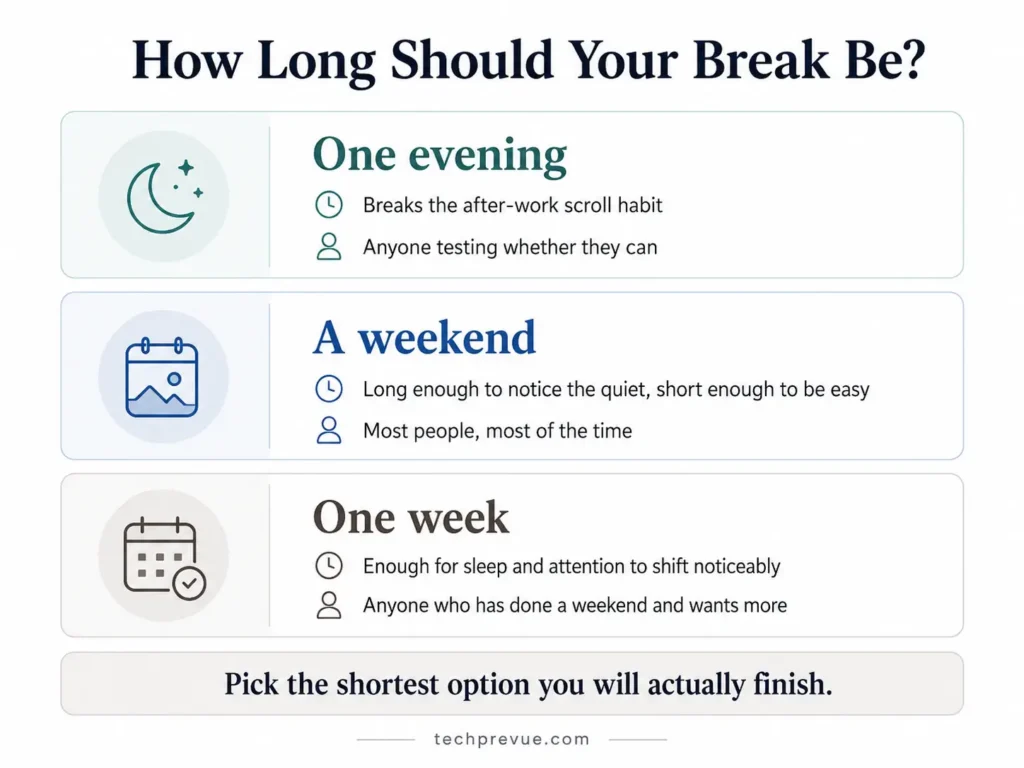
How long should your break be?
Pick the shortest option you will actually finish. Difficulty compounds fast, and an abandoned week teaches you nothing while a completed evening teaches you something.
| Format | What it does | Who it suits |
|---|---|---|
| One evening | Breaks the after-work scroll habit | Anyone testing whether they can |
| A weekend | Long enough to notice the quiet, short enough to be easy | Most people, most of the time |
| One week | Enough for sleep and attention to shift noticeably | Anyone who has done a weekend and wants more |
A weekend is the format I recommend to almost everyone who asks me about taking a social media break. It fits around work, it requires no explanation to anyone, and it can be repeated monthly without becoming a project.
The one-week version is where a break starts overlapping with a detox. If you are going that far, do it properly with a baseline.
Benefits of taking a break from social media
Here is the honest version, because this topic attracts a lot of overclaiming.
What you can reasonably expect
- Better sleep. Usually the first thing people notice, and it starts with getting the phone out of the bedroom rather than with the break itself.
- Less comparison. Fewer highlight reels means fewer involuntary comparisons against people you barely know.
- More usable attention. Reading or working for a stretch stops feeling as difficult once the checking reflex quiets down.
- Time you can see. A weekend off returns several hours you were spending without choosing to.
- Information about your own habits. The most reliable benefit of all — you learn which platforms you actually miss and which you were opening from muscle memory.
That last point is the real return. A weekend tells you what a month would tell you, at a fraction of the cost.
What a short break will not do
- Fix loneliness. Stepping away from a feed does not, by itself, reconnect you with anyone. Schedule real contact if that is the goal.
- Change anything permanently. Measured effects are short-term. Repetition is what holds them, not duration.
- Replace treatment. Persistent low mood or anxiety needs proper support, not a weekend offline.
What the research says
Studies on short reductions in social media use find real but modest average improvements in wellbeing, with results that vary considerably between studies. A 2025 meta-analysis of randomized controlled trials covering 32 articles and over 5,500 participants found a statistically significant but small effect on subjective wellbeing.
Anyone promising a transformation from a weekend is overselling. For the fuller research picture, see the detox guide linked above.
Should you announce it?
This is the question that stops more breaks than any practical obstacle, and almost nobody writes about it.
For a weekend or an evening: say nothing. Announcing a two-day absence creates an obligation to perform the break and an audience for your return. It also turns the break itself into a post, which rather defeats the purpose.
For a week or longer: tell two or three people directly. Not a public post — a message to the people who would otherwise think you were ignoring them. Give them your number and tell them when you’re back.
If you feel you owe an explanation to a wider circle, that feeling is worth examining. It usually signals that the platform has more social weight in your life than you had realized, which is useful to know and is itself a reason to take the break.
For business and creator accounts the calculation is different. A brief note that you’re away, with an alternative contact, prevents the silence being read as unresponsiveness.
What happens to your account while you’re away
Three fears come up constantly here. Two are unfounded and one is real but small.
Will my account be deleted? Not from a short break. X’s published policy asks users to log in at least every 30 days and says accounts may be removed for prolonged inactivity, without defining what prolonged means. A weekend or a week is nowhere near any platform’s threshold. If you plan to be gone for months, log in once and log out.
Will I lose followers? Some drift is normal on any account, break or no break. There is no evidence that a week away causes meaningful follower loss on a personal account.
Will my reach drop? This is the real one, and only for accounts that depend on distribution. Instagram’s head, Adam Mosseri, has said in his Q&A sessions that a long break can slightly reduce reach, that this is not intentional, and that Instagram has been working on it. No platform publishes numbers on this, so treat the size of the effect as unknown.
The practical answer for anyone whose account matters professionally: schedule posts to publish while you’re away, and keep the break to your consumption rather than your publishing. That is not a compromise — the scrolling was the problem, not the posting.
Worth knowing separately: deactivating is not the same as taking a break. Deactivation hides your profile and on some platforms starts a countdown to permanent deletion.
You do not need it. Uninstalling the app achieves the same thing and is reversible in ten seconds.
How to take a break from social media: 7 steps
1. Pick the end point before the start point. Decide when you’re coming back and put it in your calendar. Open-ended breaks fail quietly, because there is never a moment where you have succeeded.
2. Name the platforms. Write down which apps are included and which are not. Messaging usually stays. Deciding this in advance stops you negotiating with yourself on day two.
3. Uninstall, don’t deactivate. Removing the app removes the reflex. Deactivating removes your history and creates a decision you’ll have to unwind later.
4. Log out on desktop. The browser is where a phone-only break quietly collapses. Log out and remove the saved passwords for those sites.
5. Turn notifications off before you go. This is the one change worth keeping permanently after the break ends, so start it now rather than reversing it later.
6. Decide what the time is for. Not a list of worthy activities — one specific thing you’ll do in the gap where scrolling was. A book within reach, a walk at a fixed time, someone you’ll actually call.
7. Move the phone out of the bedroom. Of everything here, this is the change with the most obvious payoff and the least effort. Charge it elsewhere and use a separate alarm.
That is the whole method. If it feels too simple to be worth writing down, notice how many of the seven you currently do.
What to expect when you come back
The return is where most of the value is either kept or lost, and it takes about ten minutes of planning.
Expect the first reopening to be underwhelming. People routinely describe scrolling for a few minutes, finding nothing that justified the anticipation, and closing the app — which is itself the most useful thing a break produces.
Reinstall one platform, not all of them. Wait a few days before adding another. A good number of people discover they only wanted one.
Leave notifications off. Turn them back on later only if something concretely breaks.
Then watch the following week. If your usage is back to where it started within seven days, that is not a willpower failure — it means step six didn’t happen. Fix the substitution, not your self-discipline.
Making one break day permanent
The version of this that changes anything is not a single break. It is one recurring day.
Pick a day — Sunday works for most people — and keep social platforms off it. That is roughly 52 days a year away from feeds, achieved without a single dramatic act of willpower.
It works because it removes the decision. You are not choosing to resist every week; the day simply is what it is, in the same way you don’t renegotiate whether you go to work on Monday.
The one thing worth planning around is the social admin the platform was handling for you. Birthdays are the obvious case, and the fix is better than the thing it replaces: send a card or a message rather than posting on a wall.
People remember a card. Nobody has ever remembered a birthday post.
Households do better with this than individuals. A rule that applies to the adults as well as the teenagers is far more likely to survive than one imposed downward.
Common mistakes
Most failed attempts come down to one of these.
Making it too long. A month attempted and abandoned on day three is worse than a weekend completed, because the abandonment becomes the lesson.
Announcing it publicly. The post about leaving is still a post, and the audience it creates makes returning feel like an event.
Deleting accounts in a burst of enthusiasm. Irreversible, and unnecessary for anything under a month.
Leaving the browser logged in. A break that exists only on the phone tends to collapse here, often without the person noticing they have broken it.
Not deciding what replaces the time. If scrolling was filling boredom or avoidance, removing the app without a plan makes the break considerably harder to hold.
Treating it as a fix. A break is a reset. If the underlying problem is anxiety, low mood, or compulsive use that has lasted months, the break will not resolve it.
Frequently asked questions
What is a social media break?
A short, deliberate pause from social platforms — typically an evening, a weekend, or a week — that you repeat rather than complete. It is lighter and less structured than a detox, and it requires no account deletion.
How long should a social media break be?
A weekend suits most people. It is long enough to notice the change, short enough to finish, and repeatable monthly without becoming a project. Try a single evening first if you have never stepped away.
What are the benefits of taking a break from social media?
Commonly reported gains are better sleep, less comparison, and more available attention. Research on short reductions finds small average improvements in wellbeing that vary between studies, so treat modest and repeatable as the realistic expectation rather than transformation.
Is a social media break the same as a detox?
No. A detox is longer and structured, usually with usage tracking and a defined protocol. A break is shorter, lighter, and designed to be repeated.
How do I quit social media permanently?
That is a different decision from a break and it carries permanent consequences — lost message history, lost contacts, and lost professional presence. Before quitting, run a week-long break first: most people who think they want to quit find that one platform was responsible and the rest were fine.
Will taking a break hurt my Instagram reach?
For a personal account, a short break is unlikely to matter. Instagram’s head has said a long absence can slightly reduce reach unintentionally, though no numbers are published. If your account matters professionally, schedule posts to publish while you are away.
Will my account be deleted if I stop logging in?
Not from a short break. X asks users to log in at least every 30 days and reserves the right to remove accounts for prolonged inactivity, which it does not define. A weekend or a week is well within normal use.
Should I tell people I’m taking a break?
For a weekend, no. For a week or more, message two or three people directly rather than posting publicly, and give them another way to reach you.
Do I need to delete the apps?
Uninstalling is enough and is reversible immediately. Deleting the account is not, and nothing about a short break requires it.
What should I do instead of scrolling?
Decide one specific thing in advance rather than making a list. Match it to what the scrolling was doing — boredom needs something physically within reach, decompression needs a change of location.
When a break isn’t enough
A break is a reset, not treatment.
If low mood, anxiety, or sleep problems have lasted more than a few weeks, or if stepping away from your phone produces distress rather than boredom, that is worth raising with a doctor or a mental health professional rather than managing alone.
India: Tele-MANAS is free and available 24/7 on 14416 or 1-800-891-4416, in English and 20 regional languages.
United States: the 988 Suicide and Crisis Lifeline is available 24/7 by calling or texting 988.
If you are not sure whether your use has reached that point, the signs that you need to step away are worth reading first.
This article is for general information and is not medical advice.
