
Quick Answer: The pros and cons of online school come down to a trade between control and structure. The main pros of online school are schedule flexibility, self-paced learning, access to courses a local school does not offer, and a safer environment for students dealing with bullying or health issues. The main cons are lower graduation rates than brick-and-mortar schools, weaker social development, heavy reliance on a parent acting as learning coach, and wide quality variation between providers.
Key Takeaways
- Online school works, but not for everyone. The National Education Policy Center reports a four-year graduation rate of 65.1% at full-time virtual schools against a national average of 86.5%.
- Who runs the school matters more than the format. District-operated virtual schools consistently outperform virtual charter schools on state ratings and graduation rates.
- The biggest hidden cost is parent time, not tuition. Public virtual schools in the US charge no tuition, but they assume an adult at home is supervising.
- Live classes and self-paced courses are different products. Most pros and cons of online school flip depending on which one you pick.
- AI has already changed the equation for tutoring, cheating, and assessment design, and school policy has not caught up.
Online School at a Glance
| Strongest pros | Strongest cons |
|---|---|
| Set your own schedule and pace | Four-year graduation rates trail traditional schools |
| No commute, no uniform, no travel time | A parent usually has to supervise daily |
| Courses your local school cannot offer | Fewer spontaneous peer interactions |
| Escape from in-person bullying | Larger student-to-teacher ratios |
| Works around medical needs, sport, or work | Requires reliable internet and a proper device |
| Tuition-free public options in most US states | Quality varies enormously between operators |
| Replayable lessons and always-on materials | Special education services are harder to deliver |
| Builds self-management and digital skills | Sports and extracurriculars need outside effort |
- Online School at a Glance
- What Counts as "Online School"?
- Pros of Online School
- Cons of Online School
- AI and the Future of Online School
- Pros and Cons of Online School vs. Public School
- Pros and Cons of Online School by Grade Level
- How Much Does Online School Cost?
- Who Online School Works Best For — and Who Should Avoid It
- 12 Questions to Ask Before You Enroll
- Red Flags: How to Spot a Low-Quality Online School
- Online School in India: Boards, Recognition, and What to Verify
- Common Mistakes Families Make
- Frequently Asked Questions
- The Bottom Line
- Sources
What Counts as “Online School”?
Before weighing the pros and cons of online school, settle what the term means. Online school is a program where instruction, coursework, and assessment happen through digital platforms instead of a physical classroom. That single label covers four very different products, and confusing them is the most common mistake families make.
The four models
| Model | Who runs it | Tuition | Typical trade-off |
|---|---|---|---|
| Public virtual school | State or school district | Free for residents | Large classes, state curriculum rules |
| Virtual charter school | Charter board, often with a private operator | Free for residents | Widest quality variation |
| Private online school | Private institution | Paid | Smaller classes, higher cost |
| Supplemental / hybrid | Local district or third party | Varies | A few courses online, rest in person |
The distinction is not cosmetic. Scale data from the National Education Policy Center’s 2023 report shows district-run virtual schools averaged 498 students per school in 2021-22, while charter virtual schools averaged 1,396. Class size, teacher access, and how quickly someone notices a struggling student all follow from that number.
Synchronous vs. asynchronous: the variable that decides everything
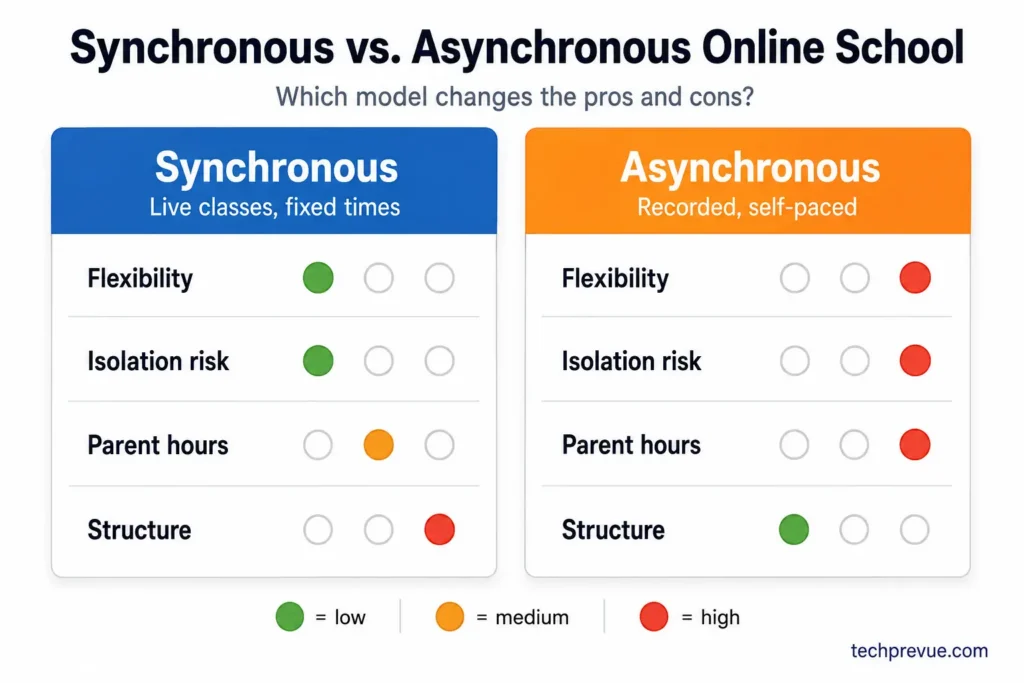
Synchronous means live classes at fixed times with a teacher on camera. Asynchronous means recorded lessons and assignments you complete on your own schedule.
Almost every advantage and disadvantage on this page shifts depending on which one a school uses. “Flexible timing” is only real in an asynchronous program. “Isolation” is a much smaller risk in a synchronous one with daily live sessions.
Ask this question before any other. Many schools advertise flexibility while running a fixed live timetable, and many advertise teacher support while delivering recorded video with an email address attached.
Online school vs. homeschooling vs. hybrid
Homeschooling means the parent designs and delivers the curriculum. Online school means an accredited institution delivers it and issues the credential. Hybrid means the student splits time between a campus and a screen.
Families often use the terms interchangeably, and providers rarely correct them. The legal, accreditation, and record-keeping obligations are different in each case.
Pros of Online School
Most lists of the pros of online school inflate the count by splitting one idea into four. Here are the advantages that hold up under scrutiny, grouped by what they actually deliver.
Flexibility and pace
1. You set the daily schedule. In asynchronous programs, a student can do math at 7 a.m. and English at 8 p.m. This matters most for athletes, performers, students with medical appointments, and teenagers who work.
2. Learning moves at the student’s speed. A student who understands a concept quickly moves on. One who does not can replay a lesson four times without holding up a class or admitting confusion in front of peers.
3. Teenagers can sleep on their own clock. Adolescent sleep cycles run late, and most school start times fight that biology. Removing a 6:30 a.m. alarm is a real health benefit, not a soft one.
4. No commute. An hour of daily travel returns to study, sleep, family, or a job over a 180-day school year. That is roughly 180 hours.
5. Location stops mattering. A family can relocate, travel for work, or live somewhere rural without changing schools mid-year.
Reality check: flexibility is the pro most often oversold. It only exists in genuinely asynchronous programs. Confirm the format in writing before you enroll.
Access and course choice
6. Courses your local school does not offer. Advanced Placement subjects, less common languages, and specialist electives are frequently unavailable in small or rural districts. Online catalogues are not limited by whether one qualified teacher happens to live nearby.
7. Credit recovery without repeating a year. A student who fails one subject can retake it online alongside their normal load instead of losing an entire year.
8. Accessibility for students with disabilities. Online delivery removes physical barriers, allows assistive technology, and lets students control lighting, noise, and pacing. In the US, IDEA and Section 504 obligations still apply to public virtual schools; in India, the Rights of Persons with Disabilities Act, 2016 sets accessibility duties.
9. Adult and returning learners are welcome. Most brick-and-mortar high schools cap enrollment by age. Online programs generally do not, which keeps a diploma reachable for adults who left school early.
Environment, safety, and health
10. Distance from in-person bullying. For a student being targeted at school, removing daily physical proximity is immediate relief. This is one of the most common reasons families switch mid-year.
11. Chronic illness and anxiety are easier to manage. A student undergoing treatment, or one whose anxiety spikes in crowded corridors, can keep progressing academically instead of falling behind while absent.
12. Parents see the actual work. Curriculum, assignments, and grades sit on a dashboard rather than arriving as a report card twice a year.
13. Weather and disruption stop cancelling learning. Snow days, monsoon flooding, heat closures, and strikes do not end instruction when instruction is not tied to a building.
⚠️ Important caveat: online school removes in-person bullying. It does not remove cyberbullying, which can follow a student into discussion boards, group chats, and social platforms. Treat this as a change of venue, not a cure.
Cost and skill development
14. Public virtual school costs nothing in tuition. US public online schools draw the same state and local funding as traditional public schools, so eligible families pay no tuition, curriculum, or instruction fees.
15. Incidental costs drop. No uniforms, no bus fare, no fuel, no cafeteria account. For families running two jobs, this adds up.
16. Self-management and digital fluency get real practice. Students who complete online school without daily supervision have demonstrated time management, written communication, and platform literacy. Those are the same skills remote employers screen for.
Cons of Online School
The cons of online school get softened by most pages ranking for this topic, because most of them sell enrollment. Here is the unfiltered version.
The outcome gap: what graduation data shows
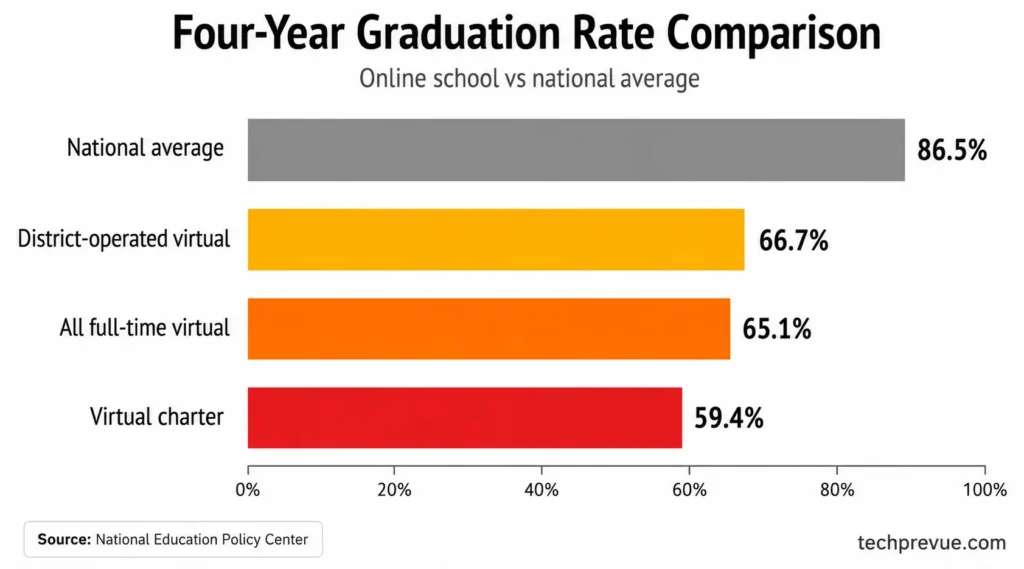
This is the single most important number on the page, and almost nobody publishes it.
The National Education Policy Center surveyed 228 full-time virtual schools and found a four-year graduation rate of 65.1%, against a national average of 86.5%. Within that figure, district-operated virtual schools reached 66.7% while virtual charter schools managed 59.4%.
State performance ratings tell the same story. NEPC found 50.7% of district-operated full-time virtual schools earned acceptable state ratings, compared with 35.2% of charter-operated ones.
What this means in practice: the format is not the whole problem. Who operates the school predicts outcomes better than whether the school is online. Ask who runs it, and check the state report card before you enroll.
Student-to-teacher ratios are worse, not better
NEPC reported virtual schools averaging 24.4 students per teacher against a national public school average of 14.8.
Nearly every online school markets personalized attention. Very few publish the ratio. Ask for it in writing, and ask separately how many students each teacher actually supports across all sections.
The hidden parent cost: someone has to be the learning coach
This is the disadvantage that no enrollment page lists, and the one families underestimate most.
Full-time online school for a child under roughly 14 assumes an adult at home who starts the day, keeps the student on task, troubleshoots the platform, and logs attendance. Researchers at the Center on Reinventing Public Education have made the point directly: virtual school usually requires a parent overseeing education at home, and only a limited number of families can sustain that.
Before enrolling, work out honestly who provides those hours, on which days, and what happens when that person has a deadline or a night shift. If the answer is nobody, the program will likely fail regardless of its quality.
Social development, sports, and extracurriculars
Peer interaction has to be engineered. Corridor conversations, lunch tables, and group projects happen automatically on a campus. Online, every one of them requires a scheduled activity, a club, or a parent driving somewhere.
Sports and arts move off the school’s books. Community leagues, private coaching, and local clubs replace school teams, usually at family expense.
Athletic eligibility needs checking early. In the US, state athletic association rules and NCAA course approval vary by state and by provider. Verify that a specific school’s courses are NCAA-approved before a college-bound athlete enrols, not after.
Younger children struggle most
Age matters more than most marketing admits. Before the pandemic, federal enrollment data showed students in grades K-5 made up only 22% of full-time virtual enrollment.
That changed abruptly. Analysis by the Center on Reinventing Public Education found K-5 virtual enrollment jumped 112% in 2020-21 across the states it examined, while grades 6 and above rose 23%.
The pre-pandemic pattern reflected something real. Early primary students need supervision, physical activity, and social modelling that a screen does not provide well.
Technology, connectivity, and screen time
Reliable internet is not optional, and not universal. A dropped connection during a live assessment is a different problem from a dropped connection during a video call.
Device costs are real. A tablet is rarely enough for coursework involving documents, spreadsheets, and proctored tests. Budget for a laptop, a printer, and a backup connection.
Screen hours climb. Six hours of instruction plus homework plus recreation adds up fast, with knock-on effects on eyes, posture, and sleep.
Self-discipline is the deciding variable
Online school gives a student freedom and then holds them responsible for it. Students who need external structure to start work often stall.
Procrastination compounds quietly in self-paced programs. Without a teacher noticing an empty desk, a student can fall four weeks behind before anyone flags it.
Be honest about the student in front of you rather than the one you hope the program will create.
Special education services are harder to deliver
Speech therapy, occupational therapy, physical therapy, and one-to-one aide support are difficult to replicate over video.
Research summarised by Journalist’s Resource found parents of special-education students were more likely than other parents to choose online school specifically because their child’s needs were not being met in a traditional setting. That makes verification more important, not less.
Ask the specific question: will this school deliver every service on the existing IEP or 504 plan, in what format, and how many minutes per week? Get the answer in writing before withdrawing from the current school.
Accreditation, recognition, and scam risk
An unaccredited diploma is close to worthless. Transcripts get rejected, credits do not transfer, and the money is gone.
Verify in the US: check the state Department of Education’s list of approved schools, and confirm accreditation through Cognia, DEAC, or a regional accreditor. Do not accept a logo on a website as proof.
Verify in India: confirm which board actually registers the student and conducts exams — NIOS, CBSE, BOSSE, or an international board such as Cambridge. A school’s own branding is not a board affiliation.
The consequences of getting this wrong are documented. Hoosier Academy Virtual Charter School in Indiana closed after the 2017-18 school year following persistently low state board ratings, having reported a student-to-teacher ratio above 100.
AI and the Future of Online School
Artificial intelligence has changed the pros and cons of online school faster than school policy has adapted. This section separates what AI actually does now from what is still marketing.
What AI already does well in online classrooms
Instant feedback. A student stuck on a math problem at 9 p.m. no longer waits until the next school day. This closes the single biggest gap in asynchronous learning.
Adaptive pacing. Systems that adjust difficulty based on performance can keep a student in the zone where work is hard but not impossible.
Teacher workload. Evidence reviewed by Stanford’s SCALE initiative found teachers using AI for lesson preparation spent less time planning without a drop in lesson quality. In an online school, where teachers carry larger caseloads, that time goes back to students.
Support for weaker tutors. The same review found that AI systems giving automated feedback and diagnostics to human tutors improved instructional quality, with the largest gains for less experienced tutors.
What the research actually shows about AI tutors
The honest answer is that we do not know much yet, and anyone claiming certainty is selling something.
Stanford’s SCALE initiative reviewed the evidence base in 2026 and found that of more than 800 relevant academic papers, only about 20 produced strong causal evidence. The reviewers identified no high-quality causal studies of AI’s effect on students in US K-12 settings.
A separate systematic review of 28 studies covering 4,597 students found intelligent tutoring systems generally produced positive effects compared with traditional teacher-led instruction. Against non-intelligent tutoring software, the results were mixed, with several studies finding no meaningful difference.
The practical reading: AI tutoring appears to help in well-defined subjects like algebra and vocabulary drilling. It has not been shown to replace a teacher, and effects are strongest when a human stays in the loop.
AI has changed what cheating looks like
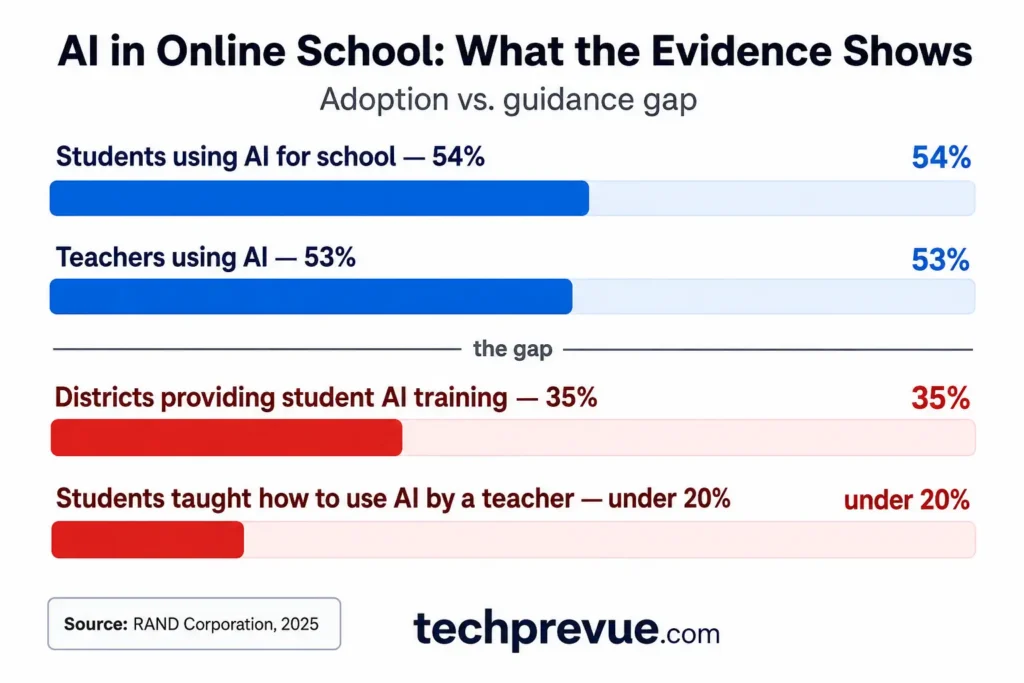
This is where the old advice on this topic became obsolete.
RAND’s nationally representative 2025 survey found 54% of students and 53% of English, math, and science teachers reported using AI for school — an increase of more than 15 percentage points in one to two years.
The supervision gap is the problem. RAND found only 35% of district leaders said their schools provided students with training on AI use, and more than 80% of students said teachers had never explicitly taught them how to use AI for schoolwork.
Students feel the ambiguity too. Half of students told RAND they worry about being falsely accused of using AI to cheat. Detection tools produce false positives, and an online student with no classroom relationship has less benefit of the doubt.
Parents are more worried than administrators. RAND found 61% of parents, 55% of high school students, and 48% of middle school students believed heavier AI use could harm critical thinking — against just 22% of district leaders.
AI proctoring and the privacy trade-off
Online assessment increasingly relies on software that watches a webcam, tracks eye movement, monitors keystrokes, and flags anomalies.
That surveillance buys exam credibility. It costs student privacy, generates false flags, and puts a camera inside a child’s bedroom.
There is no neutral option here. Either the school proctors and accepts the privacy cost, or it does not and accepts weaker assessment integrity. Ask which choice a school has made and why.
India is making AI a school subject
India is running one of the largest structured integrations of AI into school education anywhere.
The Ministry of Education announced in October 2025 that Artificial Intelligence and Computational Thinking would enter the curriculum from Class 3, aligned to NEP 2020 and NCF-SE 2023. Union Education Minister Dharmendra Pradhan launched the Classes 3-8 curriculum on 1 April 2026, with structured modules for Classes 9-12 scheduled from 2027-28.
CBSE formed an expert committee led by a faculty member from IIT Madras to design the framework, with teacher training delivered through NISHTHA on the DIKSHA platform. AI is being integrated into existing subjects rather than added as a standalone exam paper.
For Indian families weighing online school, this matters practically. Ask whether a prospective online school is aligned to the new CT and AI framework or still running a pre-2026 syllabus.
What online school will likely look like by 2030
Three shifts look reasonably safe to predict:
- Assessment moves away from take-home written work. Oral defence, live problem-solving, and in-session drafting will replace essays that AI can produce in seconds.
- The teacher’s role shifts toward diagnosis and relationship. Content delivery and first-pass feedback increasingly automate; noticing a disengaging student does not.
- Quality gaps widen before they narrow. Well-funded programs will deploy AI as an addition to teaching. Underfunded ones will deploy it as a substitute, and outcomes will diverge.
One prediction worth resisting: AI will not fix the graduation gap on its own. That gap is driven by supervision, engagement, and student-teacher ratios — problems that better software does not solve by itself.
Questions to ask an online school about its AI policy
- What is your written policy on student AI use, and when was it last updated?
- Do you use AI detection software, and what happens when it flags a student?
- Is AI tutoring supervised by a teacher, or is it the student’s only support?
- What student data does your AI system collect, who stores it, and for how long?
- Have your teachers received formal training on AI use this year?
Pros and Cons of Online School vs. Public School
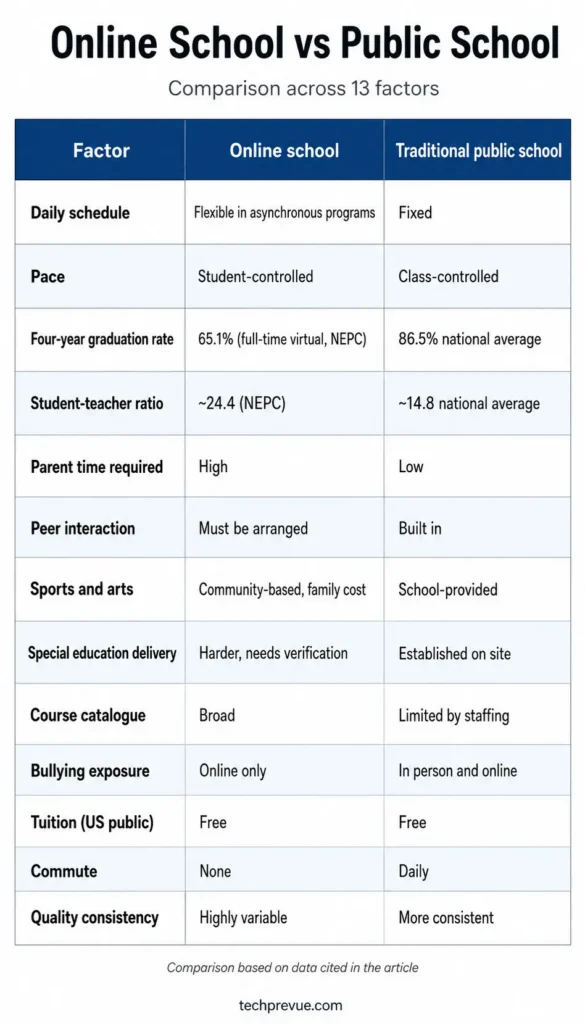
The online school vs public school comparison below uses the outcome data cited above rather than marketing claims from either side.
| Factor | Online school | Traditional public school |
|---|---|---|
| Daily schedule | Flexible in asynchronous programs | Fixed |
| Pace | Student-controlled | Class-controlled |
| Four-year graduation rate | 65.1% (full-time virtual, NEPC) | 86.5% national average |
| Student-teacher ratio | ~24.4 (NEPC) | ~14.8 national average |
| Parent time required | High | Low |
| Peer interaction | Must be arranged | Built in |
| Sports and arts | Community-based, family cost | School-provided |
| Special education delivery | Harder, needs verification | Established on site |
| Course catalogue | Broad | Limited by staffing |
| Bullying exposure | Online only | In person and online |
| Tuition (US public) | Free | Free |
| Commute | None | Daily |
| Quality consistency | Highly variable | More consistent |
Pros and Cons of Online School by Grade Level
Elementary (K-5)
Weakest fit. Young children need physical activity, social modelling, and constant redirection. Expect to supervise for most of the instructional day.
Choose it for medical necessity, severe bullying, or genuine geographic isolation. Avoid it for convenience.
Middle school (6-8)
Mixed. Students gain independence but lose the peer environment at the age when social identity forms most intensely.
Synchronous programs with live class time work considerably better than self-paced ones at this stage.
High school (9-12)
Strongest fit for K-12. Older teenagers can self-manage, and the flexibility pays off for athletes, performers, working students, and those recovering credits.
The trade-offs here are transcript recognition, NCAA eligibility, and a social life that needs deliberate maintenance.
College and adult learners
Best fit overall. Adults have the self-regulation that online formats demand, and the flexibility fits work and family obligations.
The main risks shift to professional networking and to verifying that the institution is properly accredited.
How Much Does Online School Cost?
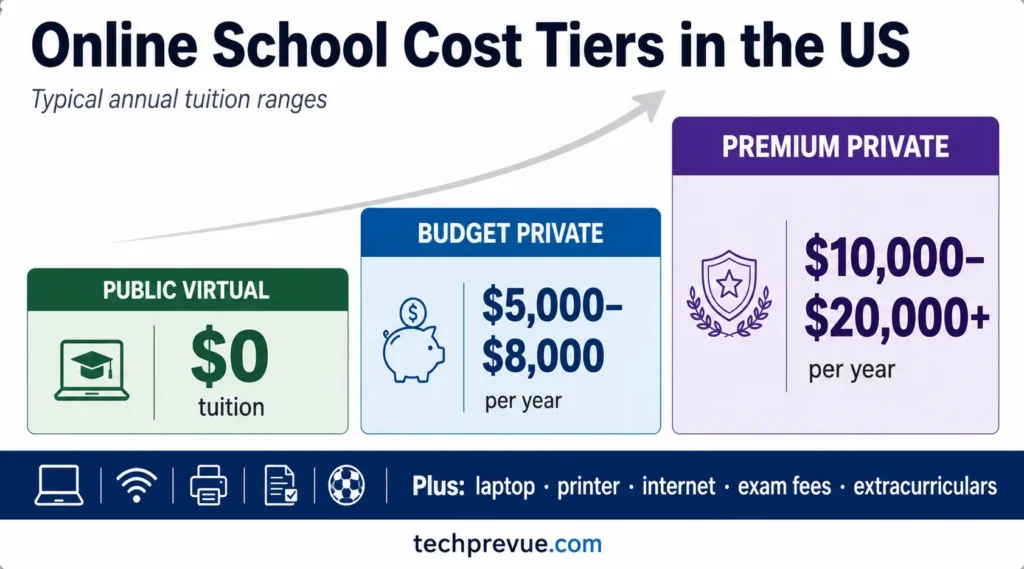
United States
| Option | Annual cost | What you get |
|---|---|---|
| Public virtual school | $0 tuition | State curriculum, certified teachers, large classes |
| Budget private online | ~$5,000-$8,000 | Accredited curriculum, some live teaching |
| Premium private online | ~$10,000-$20,000+ | Small classes, live instruction, individual plans |
Reporting on private online high school places the average private program at roughly $12,000-$16,000 per year. Public options carry no tuition because they receive the same state and local funding as traditional public schools.
Budget for these on top of tuition: a laptop, a printer, home internet at a reliable speed, exam or testing fees, extracurricular fees, and any tutoring the program does not include.
India
Costs vary widely by board and curriculum. NIOS-registered pathways are typically the most affordable, while international curricula such as Cambridge or Pearson Edexcel sit at the top of the range.
Confirm what the quoted fee includes: live class hours, board registration and exam fees, learning materials, practical or lab arrangements, and doubt-clearing sessions. Board exam fees are often billed separately.
Who Online School Works Best For — and Who Should Avoid It
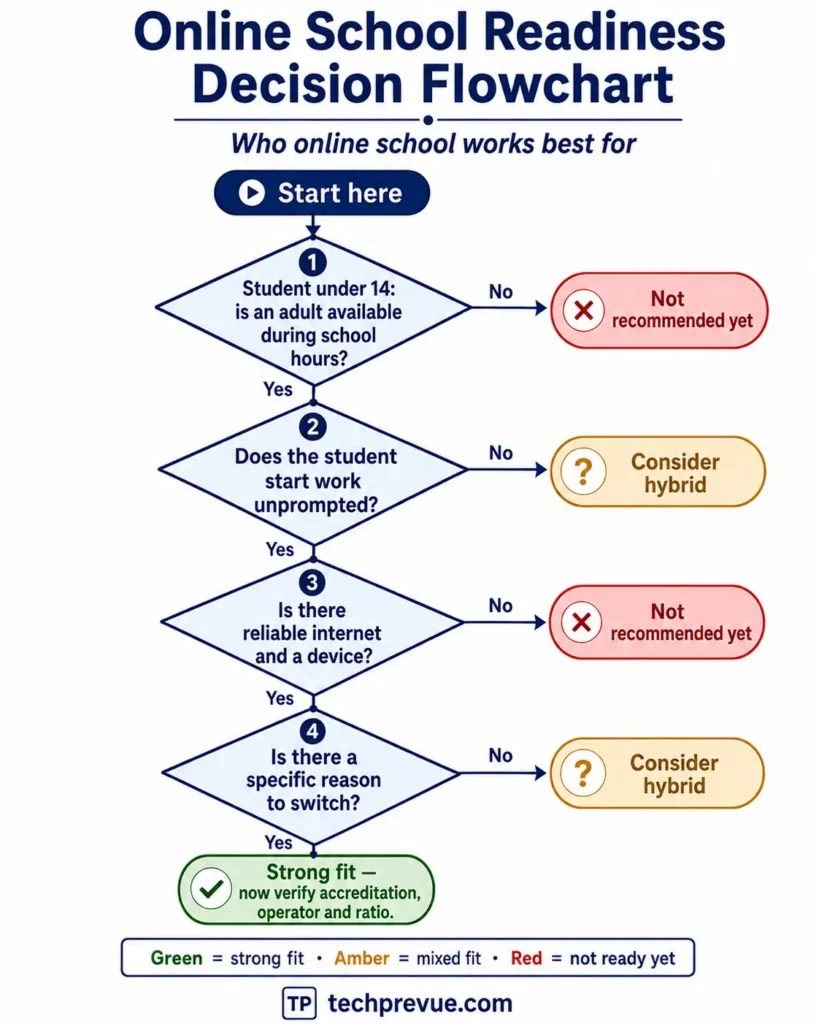
Strong fit signals
- The student starts work without being told
- A parent or guardian is genuinely available during school hours (for under-14s)
- Reliable internet and a proper device already exist at home
- There is a specific reason: medical need, bullying, sport, travel, work, or an unavailable course
- The family has verified accreditation and outcome data for the specific school
Poor fit signals
- The student needs external structure to begin any task
- No adult is available at home during the day
- The student’s main social connections are at school
- The student receives significant special education services on site
- The choice is being made in a hurry, mid-crisis, without checking the school’s record
The 10-question readiness check
Score one point for each “yes.”
- Does the student complete homework without reminders?
- Can the student explain what they are confused about, in writing?
- Is an adult available at home during instructional hours?
- Is home internet reliable enough for daily video?
- Is there a dedicated, quiet workspace?
- Does the student have friendships outside school?
- Is there a plan for physical activity?
- Have you verified accreditation with the state or board directly?
- Have you seen the school’s graduation rate and state rating?
- Is there a specific reason for switching, beyond dissatisfaction?
8-10: Strong candidate. Proceed with verification. 5-7: Possible, but fix the gaps first. Consider hybrid or supplemental courses instead. Below 5: The setup is likely to fail. Address the underlying problem before changing schools.
12 Questions to Ask Before You Enroll
- Who operates this school — a district, a charter board, or a private company?
- What is your four-year graduation rate, and what is your state rating?
- What is the student-to-teacher ratio, across all sections?
- Is instruction synchronous, asynchronous, or mixed? What are the fixed hours?
- How many hours per day should a parent expect to supervise?
- Which accreditor or board issues the credential?
- How do you deliver IEP or 504 services, and how many minutes per week?
- What happens when a student falls two weeks behind? Who calls, and when?
- Are your courses NCAA-approved? (For US college-bound athletes.)
- What is your written AI use policy, and how are violations handled?
- What are the total annual costs, including exams, materials, and technology?
- Can I speak to two current families, not testimonials you have selected?
Red Flags: How to Spot a Low-Quality Online School
🚩 Accreditation described vaguely. “Internationally recognized” and “globally accredited” are not accreditations. A real school names its accreditor or board.
🚩 No graduation rate or state rating published. Schools with good numbers publish them.
🚩 Pressure to enroll immediately. Discounts expiring in 48 hours have nothing to do with education.
🚩 No named, credentialed teachers. If you cannot find who teaches, there may be no one.
🚩 Recorded video sold as “live teaching.” Ask for a class timetable with named instructors.
🚩 Reviews that are uniformly positive. Every real school has complaints. Check independent review sites and state records.
🚩 Refusal to answer the ratio question. A school that will not tell you its student-teacher ratio has already told you the answer.
Online School in India: Boards, Recognition, and What to Verify
The question Indian parents ask is different from the American one. It is not “is it good” but “will it be accepted.”
Which boards actually count
NIOS is an autonomous board under the Ministry of Education, Government of India. Its Class 10 and Class 12 certificates carry recognition comparable to CBSE and CISCE for higher education and employment.
Most online schools in India register students with NIOS as private candidates for board examinations, while delivering their own teaching through the year. Others work with BOSSE, CBSE affiliation, or international boards such as Cambridge and Pearson Edexcel.
Verify the board directly, not the school’s claim about the board. The school teaches; the board certifies. Only the second one appears on the certificate.
Is an online school certificate valid for JEE, NEET, and UPSC?
Yes, provided the Class 12 certificate comes from a recognized board with the required subject combination. JEE and NEET accept candidates from recognized open-schooling and online pathways.
The failure cases are almost never about the online format. They involve wrong subject combinations, missing practical components, or a provider that was never affiliated to a recognized board at all.
Common Mistakes Families Make
Switching mid-crisis without research. The bullying is real and the urgency is real. Take three days to check accreditation and outcomes anyway.
Assuming flexible means less work. Online school generally requires more independent reading time, not less.
Underestimating the parent hours. This is the most common cause of a failed first year.
Believing the marketing on personalization. Ask for the ratio.
Ignoring the social plan. Decide before enrolling where the student will see other children each week.
Choosing self-paced for a student who procrastinates. Self-paced amplifies whatever habits already exist.
Frequently Asked Questions
What are the pros and cons of online school in one sentence?
The pros are flexibility, pace control, course access, and a safer environment; the cons are a lower graduation rate, weaker social development, a heavy parent supervision load, and inconsistent provider quality.
Is online school easier than regular school?
No. Online school usually requires more independent reading and more self-management than a traditional classroom. Students must understand material largely on their own, without a teacher noticing confusion in real time.
Is online school free?
In the US, public virtual schools charge no tuition for eligible residents because they receive the same state and local funding as traditional public schools. Private online schools charge tuition, commonly $5,000-$20,000 a year. In India, costs depend on the board and curriculum.
Do colleges accept online high school diplomas?
Yes, when the school is properly accredited. Colleges care about the accreditor and the transcript, not the delivery format. An unaccredited diploma is the actual risk.
What are the cons of online school that matter most?
Measured by outcomes, the graduation gap. NEPC reports 65.1% for full-time virtual schools against an 86.5% national average. Measured by daily impact on families, it is the parent supervision requirement.
Is online school good for children with ADHD or anxiety?
It can be, but the answer depends on the individual. Reduced social pressure and a controllable environment help anxiety. The lack of external structure often makes ADHD harder to manage without strong support at home.
How many hours a day is online school?
Full-time programs typically involve four to six hours of instruction and independent work, varying by grade. Younger students spend less time on screens and more time on supervised offline tasks.
Can students do sports in online school?
Yes, through community leagues, clubs, and private coaching, usually at family expense. US families with college-bound athletes should verify NCAA course approval and state athletic association eligibility rules before enrolling.
Is AI making online school better or worse?
Both, unevenly. AI improves feedback speed and reduces teacher workload, but Stanford’s 2026 evidence review found no high-quality causal studies of its effect on US K-12 students. Meanwhile RAND found most students have never been taught how to use it appropriately.
The Bottom Line
The pros and cons of online school do not resolve into a verdict that applies to everyone. They resolve into a fit question.
Online school works well for a self-directed high school student with a specific reason to switch, a verified accredited provider, and an adult available when things go wrong. It works poorly for a young child with no supervision at home, in a program chosen quickly from a search result.
The data supports caution without supporting rejection. Graduation rates lag, ratios are worse, and quality varies enormously — but district-operated programs perform measurably better than charter ones, and the families who verify before enrolling have consistently better outcomes than those who do not.
Check the operator. Check the accreditation. Check the ratio. Then decide.
Sources
- National Education Policy Center, Virtual Schools in the U.S. annual report series, University of Colorado Boulder
- National Center for Education Statistics, virtual school enrollment tables (2013-2020)
- Center on Reinventing Public Education, virtual school enrollment analysis
- RAND Corporation, AI Use in Schools Is Quickly Increasing but Guidance Lags Behind (2025)
- Stanford SCALE Initiative, The Evidence Base on AI in K-12: A 2026 Review
- Ministry of Education, Government of India, and CBSE — Computational Thinking and AI curriculum, 2026-27
- National Institute of Open Schooling (NIOS), board recognition documentation
Methodology note: This guide draws on published research from the National Education Policy Center, NCES, RAND Corporation, and Stanford’s SCALE initiative, alongside CBSE and NIOS documentation and published fee schedules from US and Indian online schools. Figures are current as of August 2026 and reviewed as new data is released.