
Quick answer: A social media detox is a planned, time-limited break from social platforms — usually 24 hours, 7 days, or 30 days. In a 2025 study, young adults who substantially reduced their social media use for one week reported depression symptoms down 24.8%, anxiety down 16.1%, and insomnia down 14.5%. Loneliness did not improve. Across the wider research, restricting social media produces small average gains in wellbeing, with results that vary a lot between studies.
Most guides on this topic promise a transformation. This one gives you the numbers, the caveats, three plans you can pick from, and the part almost nobody covers: what to do when you go back.
What is a social media detox?
A social media detox is a deliberate pause from social platforms — Instagram, TikTok, Facebook, X, Snapchat, YouTube, Reddit — for a fixed period you decide in advance.
Two things separate it from simply “using your phone less.” It has an end date, and it targets social platforms specifically rather than all screens.
That specificity matters practically. Cutting yourself off from navigation, banking, and your family group chat adds friction without any evidence of extra benefit, so most people are better served by narrowing the target.
The purpose is not permanent withdrawal. It is diagnostic. A week away tells you which platforms you actually miss, which ones you were opening out of reflex, and what your mood and sleep look like without them.
Socmed detox, social detox, dopamine detox: what each term means
These terms get used interchangeably online, which causes real confusion. They are not the same thing.
| Term | What it means | Scope |
|---|---|---|
| Social media detox | A planned, time-limited break from social platforms | Social apps only |
| Socmed detox | The same thing. “Socmed” is Southeast Asian internet shorthand for social media, common in the Philippines and Indonesia | Social apps only |
| Social detox | Usually short for social media detox. Occasionally used more broadly to include group chats and messaging | Social apps, sometimes messaging |
| Digital detox | A break from all screens — phone, laptop, TV, gaming, email | Everything |
| Dopamine detox | Deliberately avoiding high-stimulation activities to reduce reward sensitivity. A different concept borrowed from behavioral therapy, often misapplied online | Behavioral, not device-specific |
| Social media cleanse | Informal synonym for a detox. Sometimes means curating your feed rather than leaving it | Varies |
Socmed detox meaning, in one line: it is a social media detox. The term is identical; only the slang differs.
The distinction that actually affects your results is scope. If you are trying to sleep better and stop comparing yourself to strangers, a social-platform break is the targeted tool. If you are exhausted by screens generally, that is a broader problem and a broader intervention.
Do you need one? A 12-point self-check
Count how many of these apply to you in a typical week. For a longer diagnostic, see the signs you need to step away from social media.
- You open a social app within five minutes of waking up.
- You check a platform, close it, and reopen it within a minute without noticing.
- You scroll in bed and lose more than 30 minutes of sleep to it.
- You feel worse after a session than you did before it.
- You compare your life to specific accounts and it lands badly.
- You scroll while talking to someone in the same room.
- You’ve picked up your phone mid-task and forgotten why.
- You post something and check the response more than three times in an hour.
- Your screen time report surprises you every week in the same direction.
- You’ve tried to cut back and failed within three days.
- You feel anxious when your phone is in another room.
- You use social platforms to avoid a feeling rather than to find something.
This is an informal reflection checklist, not a validated screening tool, and there is no score that means anything clinically. More checked items simply suggests that experimenting with firmer boundaries is worth your time.
If several of these have been true for months, or they are affecting your work, study, sleep, or relationships, that is worth discussing with a professional rather than self-assessing.
What the 2026 research actually shows
The most-cited recent study was published in JAMA Network Open on 24 November 2025 by a team at Beth Israel Deaconess Medical Center and the University of Bath. It stands out because it did not rely on people estimating their own usage — it tracked phones directly.
Of 417 people enrolled, 373 completed the baseline period, and 295 of them (79.1%) opted into a one-week detox. Average age was 21.
One detail matters before the numbers. This was a reduction, not abstinence: only 6.2% of participants used no social media at all during the detox week, and roughly two-thirds kept using Instagram.
What improved
| Measure | Change after one week |
|---|---|
| Depression symptoms (PHQ-9) | −24.8% |
| Anxiety symptoms (GAD-7) | −16.1% |
| Insomnia severity (ISI) | −14.5% |
| Loneliness | No significant change |
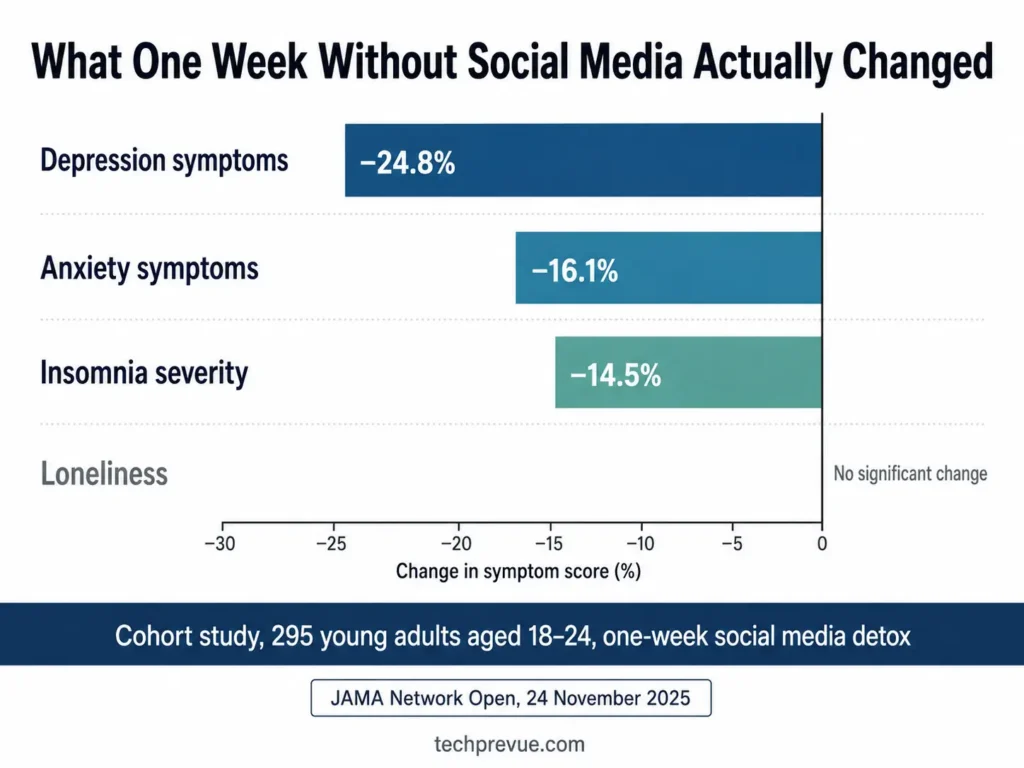
Participants cut their social media use from about 1.9 hours a day to roughly 0.5 hours — around nine hours a week.
The finding nobody quotes
Loneliness didn’t move. Almost every article on this topic promises that stepping back will reconnect you with real people. In this study, over a week, it didn’t. Reduced comparison and better sleep are realistic short-term outcomes; rebuilt friendships are not, unless you actively schedule them.
There is a second, softer signal worth knowing. Cutting nine hours of social media a week did not produce a matching drop in overall phone use — the study’s passive screen-duration measure edged very slightly upward, alongside about 43 more minutes a day spent at home.
The researchers stress both changes were small against considerable variation between individuals, and the study did not track what participants actually did with the freed time. So treat it as a caution rather than a proven effect: removing social apps does not automatically buy you offline time.
Where the effect is strongest
The study found larger improvements among people who started with more severe depressive symptoms. In the moderately severe subgroup the depression effect size reached −0.97, though that subgroup contained only 18 people, so the figure carries wide uncertainty. Participants with no baseline depression still improved on anxiety and insomnia, by less.
The honest caveats
This was not a randomized controlled trial. There was no control group, participants chose to join the detox, the sample skewed female and college-educated, and the intervention lasted one week.
Wider evidence is genuinely mixed, and three separate reviews are worth separating out.
A January 2025 scoping review in Cureus covering 14 studies concluded that outcomes vary considerably by intervention design and by individual circumstances.
A separate systematic review and meta-analysis pooling 10 studies found a significant reduction in depression (SMD −0.29) but non-significant results for stress (SMD −0.31), life satisfaction and overall mental wellbeing — with only two studies contributing to the stress analysis.
A June 2025 meta-analysis restricted to randomized controlled trials — 32 articles, 5,544 participants, 91 effect sizes — found that restricting social media produced a statistically significant but small improvement in subjective wellbeing (g = 0.17, 95% CI 0.08–0.27). Differences by intervention type were not consistent.
So the honest summary: restricting social media use produces small average improvements in wellbeing, results vary substantially across studies, and there is not yet strong evidence that one restriction strategy reliably beats another. Anyone promising a week offline will change your life is overselling. Anyone saying it does nothing is ignoring the data.
How much time you are actually spending
Context helps you set a realistic target. These are DataReportal’s April 2026 figures, all from the same wave.
| Segment | Time on social media per week | Roughly per day |
|---|---|---|
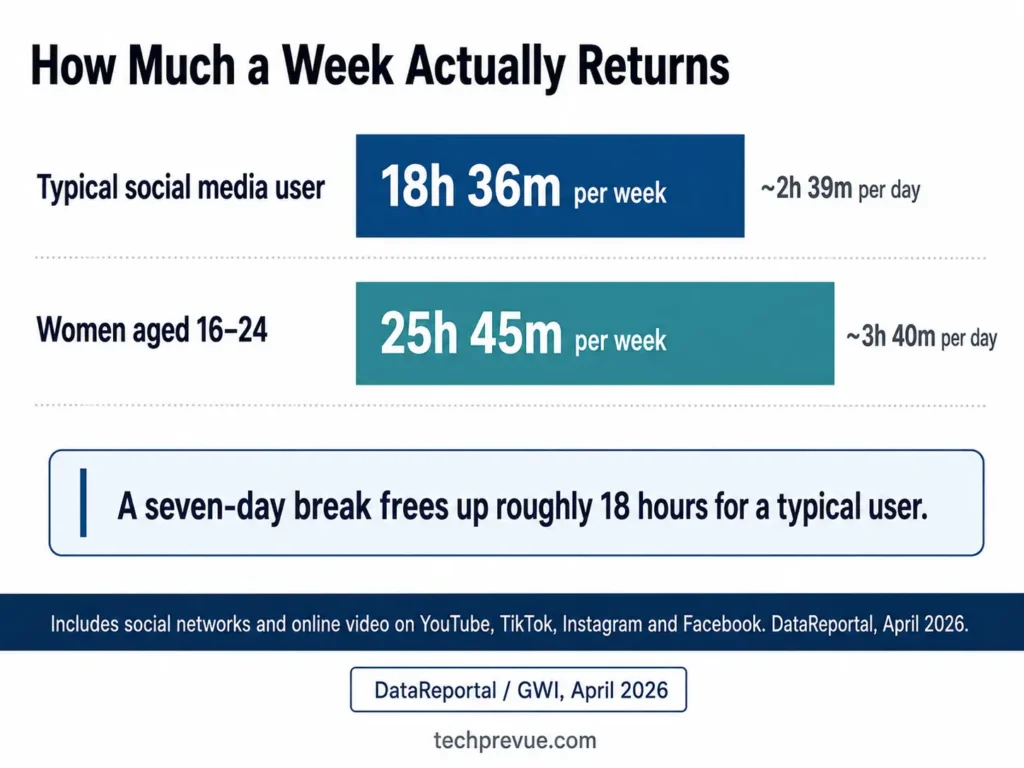
| Typical social media user | 18h 36m | ~2h 39m |
| Women aged 16–24 | 25h 45m | ~3h 40m |
Both figures cover browsing social networks and watching online video on platforms like YouTube, TikTok, Instagram and Facebook. That matters when you decide what your own detox will include — leaving YouTube in changes the number substantially.
There were 5.79 billion social media user identities worldwide as of April 2026, around 69.9% of the global population, though DataReportal notes that identities do not necessarily correspond to unique people. The typical user actively visits or uses about 6.5 different platforms each month.
Country differences are large, and they run in a consistent direction: markets in Africa, Southeast Asia and Latin America — Kenya, the Philippines, Brazil, Nigeria and South Africa among them — sit well above the global figure, while Japan, China and South Korea sit well below. Published daily minutes for individual countries vary widely depending on the survey wave and on whether video is counted, so treat any single country number you see with caution.
The practical point: at the typical user’s rate, a seven-day break frees up somewhere near 18 hours. For a heavy user in a high-usage market it can be closer to 30. That is the actual prize, and it is worth planning for before you start.
How long should your detox be?
Pick based on what you want to find out, not on what sounds impressive.
| Plan | Best for | What it realistically does | Difficulty |
|---|---|---|---|
| 24-hour reset | First-timers, testing the water | Breaks the reflex loop. Shows you how often you reach for the phone | Low |
| 7-day detox | Most people | Measurable change in sleep, mood, and comparison. The length used in the strongest study | Moderate |
| 30-day reset | Heavy users, people who failed shorter attempts | More room for new routines to settle, though the research on longer breaks is thin | High |
If a full week feels like too much right now, a shorter, repeatable social media break is a legitimate starting point.
Recommendation for most readers: seven days. It is long enough to notice a change, short enough that you will actually finish it, and it is the length most of the recent research uses. Do a 24-hour reset first if you have never tried.
In my experience advising clients, a 30-day detox only sticks when a substitution plan is already working. Without one, most people simply return to their old pattern at day 31.
What you might notice in week one
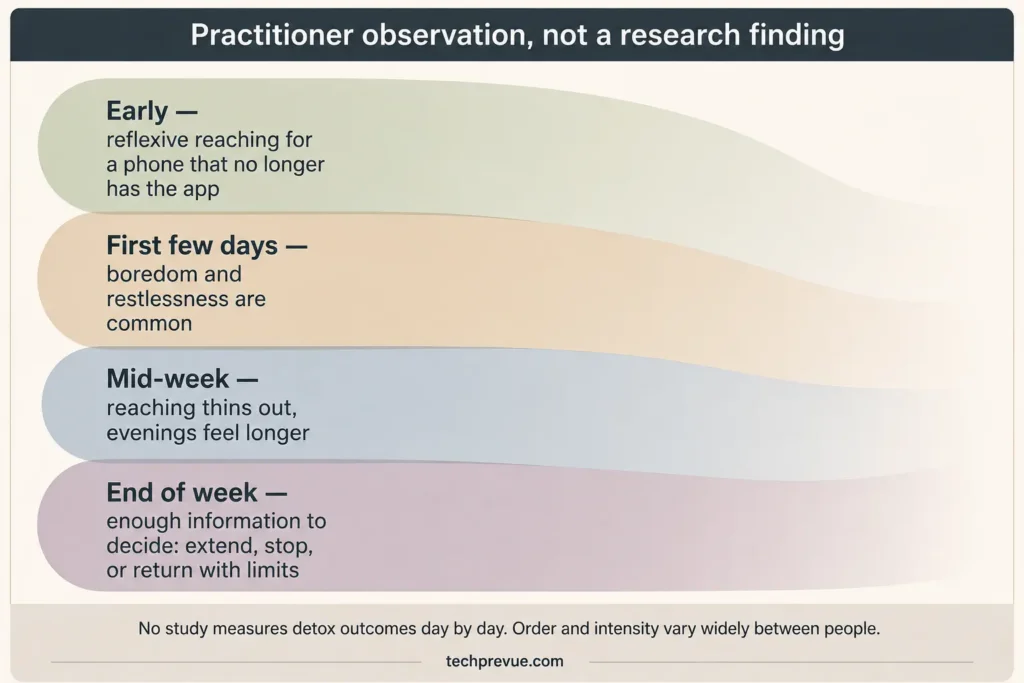
A note on this section. What follows is practitioner observation from running detoxes with our own team and clients, plus what people commonly report anecdotally. It is not a research finding. No study I am aware of measures outcomes day by day across a single week, so treat this as expectation-setting rather than a schedule you should hold yourself to.
Early on, expect reflexive reaching — opening your phone and staring at where the app used to be. This is the most universally reported experience and it is short-lived.
In the first couple of days, boredom and restlessness are common. This is the point at which most attempts I have seen get abandoned, which is the main reason to name it in advance.
Mid-week, the reaching usually thins out and the evenings start to feel longer. Some people notice sleep first; others notice attention or mood first. The order varies more between individuals than most articles admit.
By the end of the week, you will have enough information to decide whether to extend, stop, or return with limits. That decision is the actual output of the exercise.
Your experience may not follow this at all, and that is not a sign it is failing.
How to run a social media detox: 9 steps
1. Record your baseline first. Before you change anything, screenshot your weekly screen time report. Note your average sleep, and rate your mood and anxiety out of 10. Without a baseline you cannot tell whether this worked.
2. Pick your length and your end date. Write the actual date down. An open-ended break has no finish line and fails quietly.
3. Decide what counts. List the specific apps you are stopping. Decide now whether messaging apps, YouTube, and work accounts are in or out. Ambiguity gets negotiated away at day two.
4. Plan the replacement before you start. For each hour you are removing, name what fills it. This is the step that separates a detox from a nine-hour hole in your week.
5. Tell the two or three people who’d notice. Not an announcement post — a direct message to the people who’d otherwise think you were ignoring them. Give them another way to reach you.
6. Remove the apps, don’t delete the accounts. Uninstalling removes the reflex. Deactivating removes your history, your messages, and your reason to come back thoughtfully. Uninstall is enough.
7. Log out on desktop and add friction. Log out of every social account in your browser and remove saved passwords for them. If you need more, blocking tools like Cold Turkey and Freedom will lock sites for a set period.
8. Move your phone out of the bedroom. Sleep is the outcome that improves fastest and the one most easily sabotaged. Charge the phone in another room and use a separate alarm.
9. Write one line a day. Mood, sleep, what you did instead. Five seconds a day, and it is the only thing that will tell you honestly whether this was worth repeating.
How to detox without deleting your accounts
Deleting is not required, and for a lot of people it is not possible. If you run a business page, freelance, or manage client accounts, full removal is the wrong tool.
A partial detox that you finish beats a total one you abandon on day two.
- Keep one platform, cut the rest. Most people have one platform doing the damage. Identify it from your screen time report and remove only that one.
- Consumption-only ban. Post and reply to what you must, never scroll a feed. Go in through direct links and notifications rather than the app icon.
- Time-boxed access. One 15-minute window a day, at a fixed hour, on desktop only. Desktop is slower and less rewarding than mobile, which is the point.
- Feed removal instead of app removal. Unfollow or mute everything that isn’t a person you know. Most of the comparison damage comes from accounts you have never met.
- Notifications off, permanently. This one is worth keeping after the detox ends.
Facebook also has a built-in option for muting a specific person without unfriending them, which is worth understanding before you leave — here is what Take a Break means on Facebook.
App limits and in-app controls
Every major platform now ships its own time controls, and they are free.
Instagram offers a daily time limit and break reminders under its time management settings. Accounts registered to under-18s receive a notification after 60 minutes of daily use and a sleep mode that mutes notifications overnight.
TikTok includes screen time limits and a weekly usage summary. Accounts belonging to under-18s have a 60-minute daily default that requires a passcode to extend.
YouTube has break reminders and bedtime reminders in its settings.
Facebook provides usage tracking and daily reminders in its time-management area.
On the operating system side, per-app limits on social apps are the most useful lever. On iPhone this sits in Screen Time; on Android, in Digital Wellbeing. Set the limit low enough to be a real interruption — 15 minutes is a limit, 90 minutes is a formality.
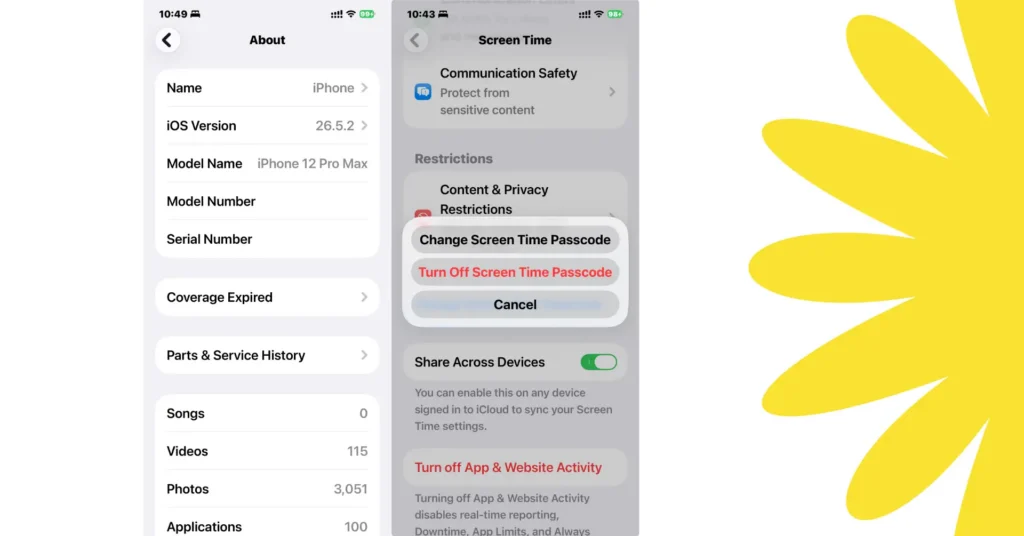
One caution: on Android, built-in app timers can be removed by the user with no password. On iPhone, set a Screen Time passcode different from your device passcode, or you will simply tap “ignore limit.”
What to do instead: the substitution framework
The data says time removed from feeds does not become free time — it moves to other screens. So don’t plan activities. Plan replacements matched to the need the scrolling was serving.
| What you were actually doing | Replace it with |
|---|---|
| Filling a 3-minute gap | A book or a podcast queued and physically nearby |
| Avoiding a task | A five-minute timer on the task itself |
| Decompressing after work | A walk, a shower, cooking — anything that changes your physical location |
| Staying in touch | One scheduled call or coffee per week, booked in advance |
| Keeping up with news | One newsletter or one paper, once a day |
| Wanting to be entertained | Something with an ending — a film, an episode, a game — rather than something infinite |
The last row is the important one. Feeds have no endpoint by design. Anything with a natural stopping point returns the decision to you.
Handling FOMO, boredom, and withdrawal
Fear of missing out is a frequently cited reason for quitting early. It is also the easiest to test. Some of it is simple curiosity about who is watching whom, which is why questions like whether someone can tell you viewed their Instagram get asked so often. Ask yourself at the end of the week what you actually missed. In my experience the honest answer is usually one or two things, and someone had already mentioned both.
Boredom tends to be worst early and to ease. Treat it as a transitional state rather than a permanent one. It is also information: it tells you how much of your day had no plan in it.
Restlessness and irritability are commonly reported during detox studies, particularly early on. If they persist past a week or intensify significantly, that is worth raising with a professional rather than pushing through.
If your job or community genuinely lives on a platform, don’t pretend otherwise. Use the time-boxed approach above instead of a total break. A detox that ignores your actual life is a detox you will abandon.
Detoxing when social media is your job
Running an agency means my team cannot uninstall the apps. Anyone in marketing, sales, journalism, or content creation has the same constraint, and generic detox advice ignores them completely.
What works instead is separating professional use from personal use so completely that they stop bleeding into each other.
- Separate devices or separate profiles. Client work happens on one device or one browser profile. Nothing personal is logged in there.
- Publish through a scheduler. Plan content in advance — including hashtags for Instagram Reels and any Instagram shoutouts you have lined up — so you never open the app just to post. That removes one of the most common routes into an unplanned scrolling session.
- Notifications only for mentions and DMs. Never for feed activity, suggested content, or engagement summaries.
- Fixed check windows. Two or three defined slots a day rather than continuous monitoring. In most agency work, very little on social platforms genuinely needs a reply within the hour — agree what does with your clients up front.
- A real day off. One full day a week with no professional social access. This is the closest thing to a detox available to people in this work, and it is worth protecting.
The professional cost of not doing this is real. Sustained exposure to engagement metrics is a poor mental environment for judgement, and it is difficult to advise clients well from inside it.
My 7-day social media detox: what I noticed
I tested a seven-day social media detox, removing all social media platforms for the full week rather than simply setting daily limits.
Test period: 01 June to 07 June 2026
Length: 7 days
Platforms removed: All social media platforms
Screen time before: ~ 4.5 hours
Screen time after: ~ 1.2 hours
The biggest change I noticed was better focus. Without social apps sitting one tap away, there were fewer reasons to interrupt what I was doing. I could stay with a task longer instead of repeatedly breaking my attention to check a feed or notification.
What surprised me most was not some dramatic feeling of being “detoxed.” It was simply the reduction in small distractions throughout the day. Removing social media created more uninterrupted stretches of attention, and that made concentrating on work noticeably easier.
This was only a seven-day personal test, not a controlled experiment, so I would not treat my experience as evidence that everyone will get the same result. But for me, improved focus was the clearest benefit — and the one that made the experiment worth doing.
Teens, parents, and the 2026 rules
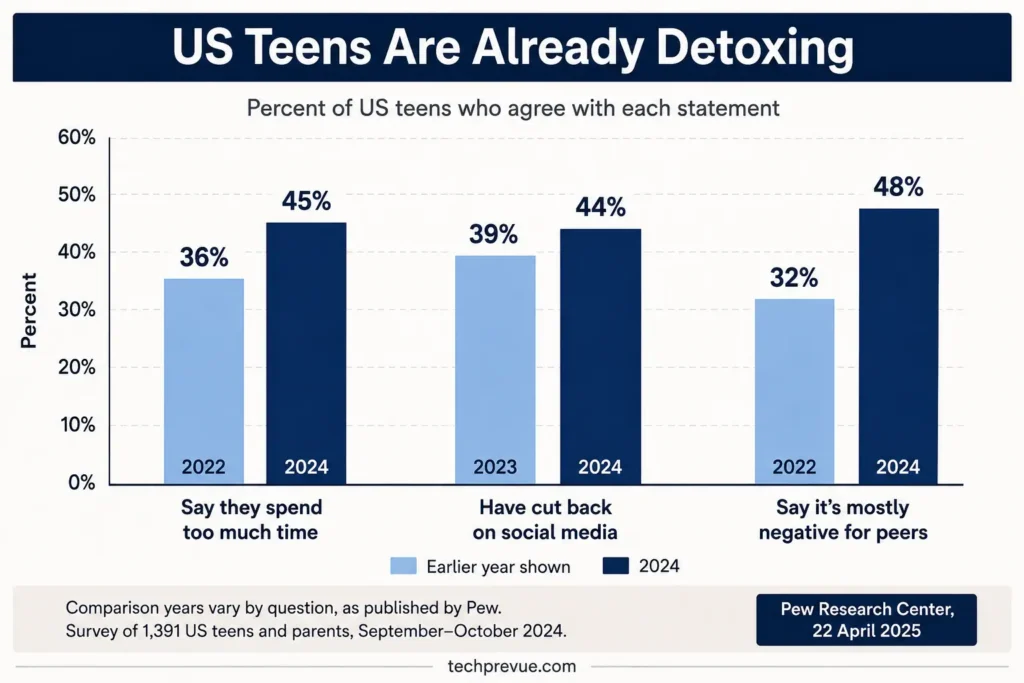
Teenagers are already ahead of the adults on this. In Pew Research Center’s survey of 1,391 US teens and parents, fielded in September and October 2024 and published in April 2025, 45% of teens said they spend too much time on social media, up from 36% in 2022.
Some 44% said they had already cut back, up from 39% the year before. Girls were more likely to try than boys, at roughly 48% against 40%.
The wider picture on social media and adolescents is worth reading alongside these numbers. The attitude shift is sharper still: 48% of teens said social media has a mostly negative effect on people their age, compared with 32% in 2022.
What governments are doing
Australia became the first country to enforce a nationwide under-16 social media ban, in force from 10 December 2025, covering Instagram, Facebook, Threads, TikTok, YouTube, Snapchat, Reddit, X, Kick, and Twitch. Platforms that fail to take reasonable steps face substantial civil penalties, and in mid-2026 the government proposed increasing them further.
The follow-up is the interesting part. Around three months after implementation, regulator-commissioned research found more than eight in ten Australian under-16s were still using social media, with many 10 to 15-year-olds using platforms at rates similar to before the restriction.
Other countries are moving anyway. The United Kingdom has announced plans for a similar restriction from spring 2027.
Denmark has proposed a ban for under-15s. Malaysia has already implemented one: from 1 June 2026, platforms with at least 8 million Malaysian users must block under-16s from registering accounts.
India takes a different route. The Digital Personal Data Protection Rules were notified on 13 November 2025 and are being phased in over roughly 18 months, with the main obligations arriving in May 2027.
The DPDP Act defines a child as anyone under 18 — stricter than GDPR or COPPA — and requires verifiable parental consent before a data fiduciary processes their data, alongside restrictions on tracking, behavioral monitoring and targeted advertising directed at children, subject to statutory exemptions.
India has not adopted an Australia-style blanket minimum age for social media accounts. The DPDP framework regulates how platforms process children’s data rather than prohibiting under-18s from holding an account.
What this means for a family
The Australian result shows how hard this is to enforce from the top down: a national restriction backed by large penalties still left most under-16s online three months in. It does not tell us that household rules work better — nobody has run that comparison — but it does suggest that waiting for regulation to solve this for your family is a poor plan.
Practical version: agree the rules together rather than imposing them, keep phones out of bedrooms overnight for everyone including adults, and run the detox as a household rather than as a punishment applied to one person.
How to re-enter without rebounding
Re-entry is the part that decides whether any of it lasted, and almost nobody writes about it.
Do not reinstall everything on day one. Add one platform back and wait three days before considering the next. Most people discover they only wanted one of them.
Reinstall without notifications on. Turn them on later only if something breaks.
Keep the bedroom rule. Of everything in this guide, it is the change I would keep if I could only keep one, and it costs nothing to maintain.
Set a standing limit before you reopen the app, not after. Fifteen or twenty minutes a day, enforced with a passcode.
Schedule the next one. A detox is a reset, not a permanent fix, and the effects measured in the research are short-term. Treating it as something you repeat is more realistic than treating it as something you complete.
Watch the first week closely. If your usage is back to baseline within seven days, the detox didn’t fail — the substitution plan did. Fix that, not the willpower.
How to measure whether it worked
Compare against the baseline you recorded in step one.
| Metric | How to check | What good looks like |
|---|---|---|
| Daily social media minutes | Phone screen time report | Down and staying down two weeks later |
| Time to fall asleep | Rough estimate or a sleep app | Noticeably shorter |
| Mood, self-rated 1–10 | Your daily one-line log | Higher average across the week |
| Anxiety, self-rated 1–10 | Same log | Lower average |
| Phone pickups per day | Screen time report | Lower — this one is often more revealing than total minutes |
| Total screen time | Screen time report | Flat or down. If this rose, you substituted screens for screens |
That last row is your real test. If social media minutes fell and total screen time held steady or rose, the hours moved sideways.
Common mistakes
- Going cold turkey on every screen at once. Cutting off navigation, banking and messaging adds difficulty without evidence of extra benefit. Target the platforms causing the problem.
- Deleting accounts instead of uninstalling apps. Irreversible, and it removes nothing you actually needed to remove.
- No replacement plan. If scrolling was filling boredom, downtime or stress, removing the apps without deciding what replaces that time makes the break much harder to sustain.
- No baseline. Without one, you will remember the detox as either a miracle or a waste, and neither will be accurate.
- Announcing it publicly. Making a post about leaving is still engagement, and it creates an audience for your return.
- Expecting loneliness to lift. The evidence says it won’t in a week. Schedule actual contact with people if that is the goal.
- Treating it as a cure. A detox is a diagnostic tool and a reset. Persistent depression or anxiety needs proper support, not a week offline.
- Doing it once and stopping. The gains fade. The practice is what holds.
Frequently asked questions
What is a social media detox?
A planned, time-limited break from social platforms, typically 24 hours, 7 days, or 30 days. It targets social apps specifically rather than all screens, and it has a defined end date.
What does socmed detox mean?
Exactly the same as a social media detox. “Socmed” is internet shorthand for social media, used widely in the Philippines and across Southeast Asia. The practice is identical; only the abbreviation differs.
Is a social media detox the same as a digital detox?
No. A digital detox covers all screens, including laptops, TV, gaming, and email. A social media detox targets social platforms only, and the research suggests the narrower version produces more consistent results.
How long should a social media detox last?
Seven days suits most people. It is long enough to produce measurable change in sleep and mood, and it matches the length used in the strongest recent study. Try 24 hours first if you have never done one.
Does a social media detox actually work?
Partly, and the honest answer depends on the outcome. In a 2025 study of 295 young adults who substantially reduced their use for a week, depression symptoms fell 24.8%, anxiety 16.1% and insomnia 14.5%, while loneliness did not change. Across randomized trials the average wellbeing benefit is real but small, and it varies a lot between studies.
What happens in the first week without social media?
Commonly reported experiences include reflexive phone reaching early on, boredom and restlessness in the first days, and the urge to check thinning out through the week. The order and intensity vary widely between people, and no study measures this day by day.
Will I lose followers or reach during a detox?
For a personal account, a week away is unlikely to matter much. Business and creator accounts depend on regular posting, so scheduled publishing or a partial detox is usually the more practical route.
Do I need to delete my accounts?
No. Uninstalling the apps removes the habit loop. Deleting removes your messages, history, and the ability to return on your own terms. Uninstall is enough for almost everyone.
Can I do a social media detox if it’s part of my job?
Yes, in modified form. Separate professional and personal access completely, publish through a scheduler, restrict notifications to mentions and messages, and take one full social-free day a week.
What should I do instead of scrolling?
Match the replacement to what the scrolling was doing for you. Boredom needs something physically nearby; decompression needs a change of location; entertainment needs something with an ending rather than an infinite feed.
Is a dopamine detox the same thing?
No. A dopamine detox refers to avoiding high-stimulation activities generally to reduce reward sensitivity. It is a behavioral concept, frequently misapplied online, and distinct from a time-limited break from social platforms.
How often should I do a social media detox?
There is no researched optimal frequency. The measured effects are short-term, so repeating a short break periodically is a more realistic approach than attempting one long detox — quarterly is the cadence I recommend to clients, not a research finding.
Getting real support
A social media detox is a useful reset. It is not treatment.
If low mood, anxiety, or sleep problems have lasted more than a few weeks, or if they are affecting your work, study, or relationships, speak to a doctor or a mental health professional. The research is clear that people with more severe symptoms benefit most from a break — and equally clear that a break is not sufficient on its own.
India: Tele-MANAS, the Government of India’s national mental health helpline, is free and available 24/7 on 14416 or 1-800-891-4416, in English and 20 regional languages.
United States: the 988 Suicide and Crisis Lifeline is available 24/7 by calling or texting 988.
This article is for general information and is not medical advice.
Sources: JAMA Network Open (Calvert et al., 24 November 2025); Cureus scoping review on digital detox strategies (January 2025); systematic review and meta-analysis of digital social media detox (2024); meta-analysis of randomized trials on social media restriction (June 2025); DataReportal, April 2026; Pew Research Center, Social Media and Teens’ Mental Health, survey fielded 18 September–10 October 2024, published 22 April 2025; eSafety Commissioner, Australia; Malaysian Communications and Multimedia Commission; Ministry of Electronics and Information Technology, DPDP Rules 2025; Ministry of Health and Family Welfare, Tele-MANAS.
