
Bandwidth throttling is when your internet provider deliberately slows your connection, either across the board or for particular apps. The problem is that a throttled connection and a congested one feel identical, and only one of them is something you can act on.
This guide separates bandwidth throttling from the things that imitate it, shows you how to prove which one you have, and explains what the law actually says. That last part matters more in India than most readers expect.
What is bandwidth throttling?
Bandwidth throttling is an intentional speed limit applied by your internet provider rather than a fault in your connection. It can apply to everything you do, or only to traffic the provider has identified as belonging to a specific service.
Providers identify traffic using deep packet inspection, which examines the shape and signature of data rather than its content. Video streaming, torrenting, and large file transfers are the usual targets for bandwidth throttling because they consume the most capacity.
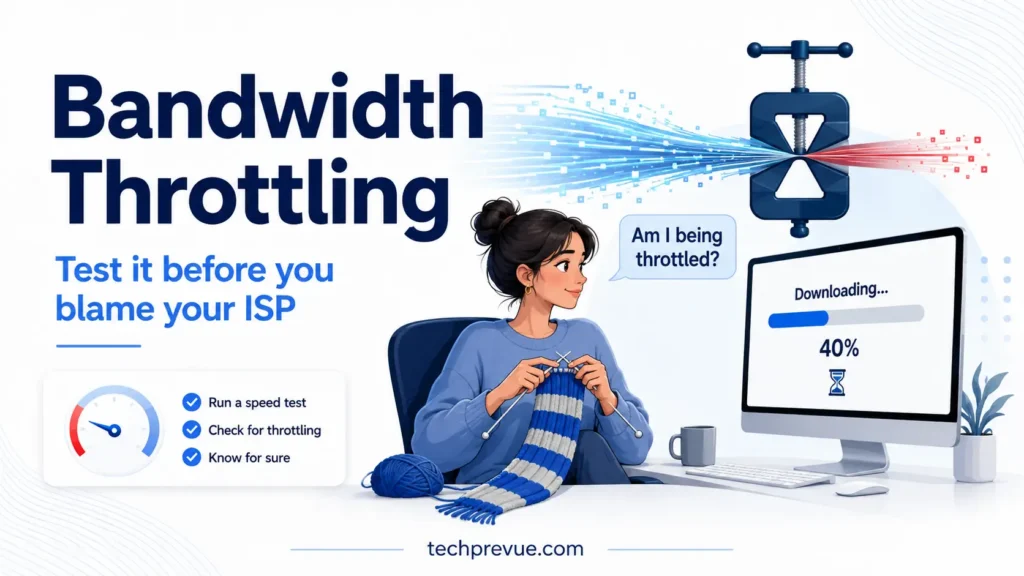
What is internet throttling? is the same question asked with a different word. You will see the practice called internet throttling as often as bandwidth throttling, and providers, regulators, and support staff use the terms interchangeably.
The term gets applied to four different situations, and only one of them is bandwidth throttling in the strict sense.
Throttling, deprioritization, fair usage, and congestion
These four produce the same symptom and have completely different answers. Working out which one you have is the whole job.
| What it is | What triggers it | What it affects | Position in India |
|---|---|---|---|
| Bandwidth throttling | Provider policy | Specific apps or protocols | Prohibited under licence conditions |
| Deprioritization | Live congestion on the cell or node | Heavy users on lower tiers first | Allowed as reasonable traffic management |
| Fair usage limit | Crossing a stated data threshold | Your whole connection | Allowed where the plan discloses it |
| Plain congestion | Too many users at once | Everyone on that segment | Not throttling at all |
The distinction decides your remedy. A fair usage limit is a contract question, congestion is an infrastructure question, and genuine bandwidth throttling is a regulatory one.
If your speeds fall every evening and recover overnight, you are almost certainly looking at the third row or the fourth, not the first. Our guide to why your internet is slow covers how to tell those apart by timing.
Why providers use bandwidth throttling
Four reasons account for nearly all of it, and they are not equally defensible.
Managing congestion. When a node or cell fills up, providers reduce speeds to keep the network usable for everyone. This is the version regulators generally accept.
Enforcing a data threshold. Plans sold as unlimited often reduce speed sharply once you pass a daily or monthly allowance. The speed drops to a fixed number and stays there until the cycle resets.
Targeting specific applications. Some providers slow video streaming or peer-to-peer traffic as policy, regardless of congestion. This is the version that raises legal questions.
Separating plan tiers. Premium plans may receive priority when capacity is short, which leaves lower tiers slower at exactly the busiest moments.
How common is bandwidth throttling?
The largest study of the question found throttling running continuously rather than only when networks are busy. Researchers at Northeastern University and the University of Massachusetts Amherst analyzed more than a million crowdsourced Wehe measurements from over 126,000 users across a year, published in 2019.
Three findings are worth carrying into your own testing.
Video is the target. Streaming was throttled far more than anything else. Among the study’s T-Mobile results, YouTube was throttled in 67% of tests, NBCUniversal in 64%, Netflix in 61%, and Amazon Prime Video in 51%, while Vimeo appeared in 5% and Skype was not throttled at all.
The rate clusters at one number. 1.5 Mbps was the most commonly detected throttling rate, which lines up with plans that advertise standard-definition streaming. AT&T’s Stream Saver caps video at roughly that speed, or about 480p.
It is not congestion management. Northeastern’s summary of the work records the researchers finding the practice running constantly, in every region tested, rather than switching on when networks filled up.
The researchers named a limitation that matters when you read those percentages. Their data could not tell which plan each user was on, so the figures mix throttling imposed on subscribers with throttling those subscribers chose by picking a cheaper video tier.
Two caveats before you apply any of this. The measurements come from one study period and lean heavily on US mobile carriers, so they are evidence that the practice is routine rather than a current rate card for your provider. That is what testing your own connection is for.
How to run a bandwidth throttling test
Am I being throttled? is not a question one speed test can answer. Throttling shows up as a difference between two measurements taken under different conditions, so every useful test is a comparison.
Set up properly before you start. Connect by Ethernet, close background applications, and record every result with a timestamp. Five to seven days of readings taken morning, afternoon, and evening is what turns a suspicion into evidence.
The Wehe test
Wehe is a research tool from Northeastern University and the most rigorous option available to consumers. It works by replaying traffic recorded from real applications, then replaying the same traffic with the contents replaced by randomized bytes.
The logic is what makes it convincing. Your provider can classify the first version as YouTube or Netflix and throttle it, but cannot classify the randomized version at all. A consistent gap between the two is evidence of application-specific treatment rather than a slow connection.
The app is free on iOS and Android, and the methodology is documented publicly if you want to check how the comparison is made.
Compare a service-specific test against a general one
Fast.com is run by Netflix and measures throughput to Netflix servers. A general speed test measures throughput to a nearby test server instead.
Run both within a few minutes of each other. Streaming apps also fail for reasons unrelated to your connection, so rule those out first — Hulu playback errors show how an app fault and a speed fault look identical. If the general test returns a healthy number and Fast.com returns a much lower one, that points at treatment specific to streaming traffic rather than a shortage of bandwidth.
Measurement Lab’s NDT test is worth adding as a third reading. Its results are stored in a public database, which is useful if you later need to show a pattern rather than a single bad day.
The VPN test, and what it does not prove
Run a speed test normally, then again with a VPN connected. If speeds improve noticeably with the VPN on, encryption is preventing your provider from classifying the traffic, which suggests classification-based throttling.
Treat this as suggestive rather than proof of bandwidth throttling. A VPN also changes the route your traffic takes, so an improvement may mean you have bypassed a congested peering point rather than a throttle.
Encryption overhead normally makes a VPN slightly slower than no VPN. When it comes back faster, something on the direct path is worth investigating.
How to stop bandwidth throttling
Identify which of the four situations you have before you change anything. The remedies share nothing.
If you crossed a data threshold, this is a contract matter, and the only fixes are a higher allowance or waiting for the cycle to reset. If the cause is congestion, no remedy on this page applies and the work is in fixing a slow connection instead.
If your testing points at application-specific treatment, you have two paths. One works around the throttle, and one tries to get it removed.
Stopping it and preventing it are different problems. How to stop internet throttling depends on which cause your testing found. How to prevent internet throttling is mostly a matter of matching your plan allowance to your actual usage, so you never cross the threshold that triggers it.
How to bypass ISP throttling
Bypassing works only against throttling that depends on identifying your traffic. Take away the identification and the policy has nothing to match against.
A VPN is the usual method, since it encrypts traffic so your provider sees an undifferentiated stream rather than a video session. Our explainer on what a VPN is and how it works covers the mechanics and the trade-offs.
Encrypted DNS is a lighter option that hides which sites you look up without routing all traffic elsewhere. Both cost some speed, and neither is a remedy so much as a workaround.
When a VPN will not help
A VPN cannot recover speed lost to a data cap, because that limit applies to your whole connection regardless of what the traffic looks like. The same is true of deprioritization and ordinary congestion.
If a VPN makes no difference to your speeds, that is itself a result. It rules out classification-based throttling and points you back at capacity or contract.
Is bandwidth throttling legal?
Whether bandwidth throttling is legal depends entirely on where you are, and the common claim that no rules govern it is wrong in both markets this page covers.
India
India prohibits it, and has since 2018. The Department of Telecommunications amended the licence conditions that internet providers operate under, barring discriminatory treatment of content including blocking, degrading, and slowing down specific services.
That followed two earlier steps. TRAI’s Prohibition of Discriminatory Tariffs for Data Services Regulations came into force in 2016 and ended content-based pricing, and TRAI’s 2017 recommendations extended the same reasoning from pricing to treatment.
Two exceptions matter. Specialised services with genuine latency requirements sit outside the framework, and reasonable traffic management remains permitted where it is proportionate, temporary, and disclosed. Enforcement sits with the Department of Telecommunications rather than TRAI, since the rules live in licence agreements the department administers.
The framework has been tested, with mixed results. TRAI told Airtel and Vodafone Idea to withhold premium priority plans in July 2020 while it examined whether faster speeds for higher-paying postpaid users degraded service for everyone else. The Telecom Disputes Settlement and Appellate Tribunal stayed that order within a week, and the plans continued.
5G network slicing has now reopened the same question. TRAI’s preliminary view on a priority postpaid plan launched in 2026 was that it may not breach the rules, a notably softer position than it took in 2020, and it has asked for technical data while the review continues.
United States
The US position has reversed repeatedly and currently offers no federal protection. Rules adopted in 2015 were repealed in 2017, restored in 2024, and then set aside by the Sixth Circuit in January 2025, which held that the FCC lacked statutory authority to classify broadband under Title II.
As of 2026 the FCC can require providers to disclose their traffic management practices but cannot prohibit them. State law fills part of the gap, with comprehensive bans covering residential users in California, Washington, Oregon, Colorado, and Vermont.
How to complain in India
Your provider is required to run a two-tier grievance process, and it carries deadlines rather than vague promises.
Start at the provider’s complaint center and get a reference number. Faults and service disruption must be addressed within three days and other complaints within seven, with billing complaints resolved in four weeks.
If that fails, appeal to the provider’s Appellate Authority within 30 days of the deadline passing. There is no fee, appeals can be registered on toll-free 198, and the Appellate Authority has 39 days to dispose of the case. TRAI publishes the full grievance timelines and a directory of provider contacts.
Bring evidence rather than an impression. Timestamped wired results across several days, ideally with a Wehe report attached, move a ticket further than a description of buffering.
Frequently asked questions
Is my internet being throttled, or just slow?
Throttled connections slow selectively, while congested ones slow for everything at predictable hours. Compare two measurements rather than reading one: run Wehe to check for application-specific treatment, then compare Fast.com against a general speed test. Repeat both across several days at different hours before concluding anything.
Is bandwidth throttling illegal in India?
Discriminatory treatment of content is prohibited under the licence conditions internet providers operate under, amended in 2018. Reasonable traffic management and specialised services are exempt, so congestion management and disclosed fair usage limits are not covered by that prohibition.
Does a VPN stop bandwidth throttling?
Only the kind that depends on identifying your traffic. A VPN cannot recover speed lost to a data cap, deprioritization, or congestion, because those apply to your whole connection regardless of what it carries.
Why does my internet slow down after a certain amount of usage?
That pattern is a fair usage threshold rather than throttling in the strict sense. Speed falls to a fixed number on a specific date and holds there until your billing cycle resets.
Can I get compensation for throttled internet?
Provider contracts usually describe plan speeds as a maximum rather than a guarantee, which limits refund claims. Faults are different: on wireline broadband in India, a fault unrepaired after three working days entitles postpaid subscribers to a proportional rent rebate and prepaid subscribers to a validity extension.
