
Our grandparents wrote letters and waited weeks for a reply. We send a message and start checking for a response within the minute. What changed was not only speed — it was which limits disappeared, and which new ones took their place.
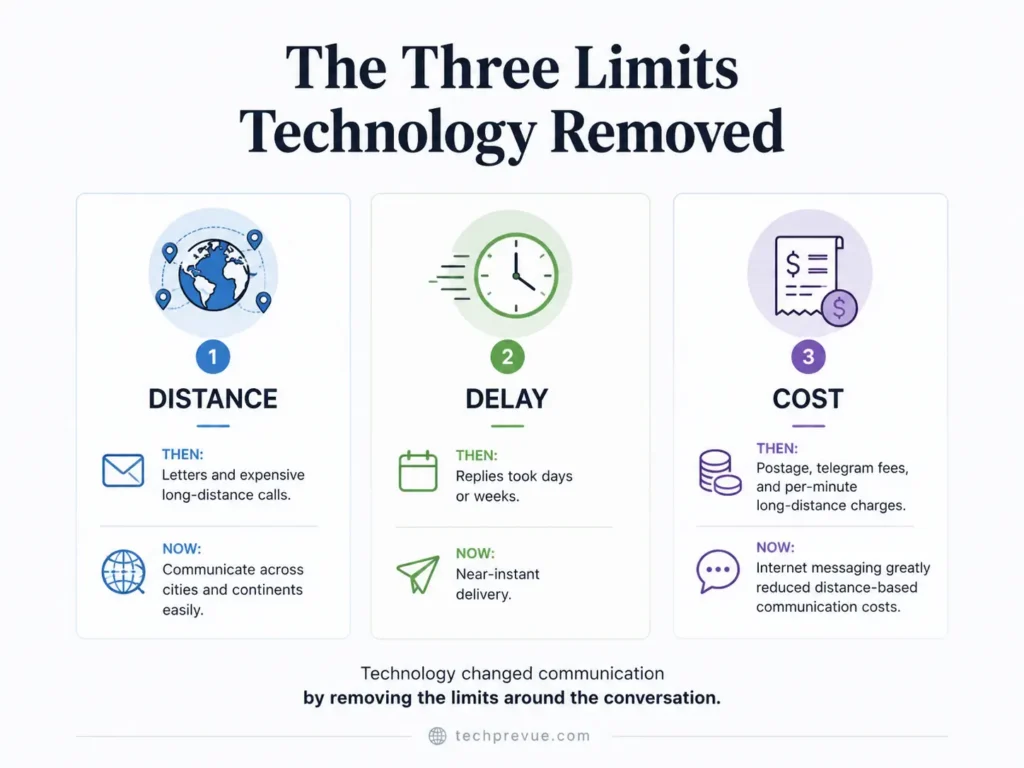
Technology improved communication by removing the three limits that used to govern it: distance, delay, and cost. A message now reaches the next street and another continent at the same price, arrives in milliseconds rather than days, and no longer requires both people to be free at the same moment. Meta has reported WhatsApp carrying more than 100 billion messages a day.
Communication Technology Statistics 2026: Key Numbers
Every figure below is dated and attributed, and each one is used again in context further down.
| Measure | Figure | Source and date |
|---|---|---|
| People online worldwide | 6.0 billion (about 74%) | ITU, 2025 |
| People still offline | 2.2 billion | ITU, 2025 |
| People using WhatsApp | More than 3 billion | Meta, 2026 |
| WhatsApp messages per day | More than 100 billion | Meta, last reported 2021 |
| Social media user identities worldwide | 5.79 billion | DataReportal, April 2026 |
| India voice minutes per subscriber each month | 1,017 | TRAI, Q1 2026 |
| India mobile data per user each month | 26.70 GB | TRAI, Q1 2026 |
| ChatGPT weekly active users | More than 900 million | OpenAI, 2026 |
| Share of work involving AI, where AI is present | 46% | SHRM, survey of 5,875 US workers, March–April 2026 |
| Automated share of all web requests | Roughly 57% | Cloudflare, 2026 |
| US reported fraud losses | $15.9 billion | FTC, 2025 |
| Amount Indians reported in cyber fraud complaints | ₹22,495 crore | Ministry of Home Affairs, 2025 |
| Starlink direct-to-cell satellites launched | More than 650 | Starlink, 2025 progress report |
| RCS users worldwide | Around 1.5 billion (vendor estimate) | Sinch, July 2026 |
| Daily RCS messages in the US | Over 1 billion (vendor estimate) | Sinch, July 2026 |
| Internet shutdowns worldwide | 313 across 52 countries | Access Now, 2025 |
How Did Communication Technology Develop?
Understanding the arc matters, because the change we live through now is the latest step in a long sequence rather than a break from it. Each breakthrough solved the limitation the previous one exposed.
| Era | Breakthrough | What it changed |
|---|---|---|
| Before 1840 | Letters carried by hand, horse, and ship | Weeks or months for a single exchange |
| 1840s–1870s | Telegraph, then Alexander Graham Bell’s telephone | Messages finally outran transport |
| 1900–1970 | Radio, television, long-distance calling | One voice could reach millions |
| 1970–1995 | Fax, mobile phone, email | Messages left the fixed line |
| 1995–2007 | Internet, instant messaging, SMS | Text became instant and nearly free |
| 2007–2020 | Smartphone, messaging apps, video calling | Conversation became continuous |
| 2020–2026 | Remote work tools, live translation, AI, satellite direct-to-cell | Presence, language, and coverage stopped being requirements |
The telegraph made distance survivable, the telephone made it personal, the internet made it free, and AI is now removing the effort of composing the message at all.
How Communication Changed: Before and After
The pattern is easier to see side by side. In almost every case, technology did not invent a new way of talking — it removed a constraint from an old one.
| What we do | Before | Now |
|---|---|---|
| Reaching family abroad | Letters taking weeks, calls billed by the minute | Free video call, any time |
| Sending a document | Post or courier, several days | Shared link, seconds |
| Reaching a colleague in another timezone | Wait for their working hours | Message now, answered later |
| Speaking across a language barrier | Hire an interpreter | Live captions and translation |
| Contacting a business | Phone queue during office hours | Chat any hour, often automated |
| Recording what was said in a meeting | Someone taking notes by hand | Automatic transcript and summary |
| Reaching someone outside cell coverage | Impossible without a satellite phone | Text from an ordinary phone, via satellite |
How Has Technology Improved Personal Communication?
For most of history, reaching someone cost money, took time, and required them to be available. Technology dismantled all three constraints, and the personal effects are the ones we notice first.
1. Speed and Instant Delivery
Delivery time collapsed from days to milliseconds. A message we send crosses undersea cables, satellites, and wireless networks and arrives before we have put the phone down.
That speed changed what we use messages for. We no longer save up news for a weekly letter, nor walk to a post office to send it — we share a photograph of dinner, a delayed train, a test result, as it happens.
It also reached places the post never served well. Villages and remote districts that waited days for mail now sit inside the same network as a city center, provided a signal reaches them.
None of it works without the connection underneath. A weak signal blocks every channel at once, which is why fixing a slow internet connection and improving your Wi-Fi router signal stopped being minor annoyances.
Drawback — instant delivery created an expectation of instant reply. Read receipts removed the last honest excuse, and the pressure to respond now follows us past the end of the day.
2. Cost and Distance
Internet messaging largely removed distance-based charges. Sending across a continent no longer carries the per-minute or per-page premium that post, telegram, and long-distance calling all charged.
For families separated by work, this is the single largest change of the last thirty years. A parent working in Dubai once heard their children on carefully counted minutes; TRAI’s Q1 2026 data now puts average Indian usage at 1,017 voice minutes a month alongside 26.70 GB of data.
The reach is now close to universal among the connected. ITU figures put roughly 6 billion people online, and our guide to the importance of the internet covers what that connection is worth in numbers.
Drawback — free contact is only free for the connected. Around 2.2 billion people remain offline, and for them the old costs never went away.
3. Asynchronous Messaging
The quieter revolution is that we stopped needing to be available at the same moment. Messaging, email, and shared documents let a conversation happen across hours or days without anyone waiting.
This is what makes distributed teams, cross-timezone study, and long-distance family life workable at all. Voice notes extended it further, giving us the warmth of a voice without the demand of a live call — which matters especially for users who type slowly in their own language.
Private messaging is now a major share of time spent online, and DataReportal tracks the platform mix behind it. The shift matters because conversation, not broadcasting, is what most people open these apps to do.
Drawback — asynchronous threads never formally end. A conversation that would have closed with a goodbye now stays open indefinitely, and so does the mental load of owing a reply.
4. Video Calling
Seeing someone changed the emotional weight of a conversation. Grandparents watch grandchildren grow up, patients meet doctors, and interviews happen without a flight.
Video calling also stopped being a business tool. It moved into ordinary family life, medical appointments, and job interviews within a few years, largely because it arrived free inside apps people already had.
Drawback — video demands more than voice. We manage our appearance, our background, and our attention simultaneously, which is why a day of calls exhausts people in a way a day of phone calls never did.
5. Online Communities and Meeting People
Technology changed who we can talk to, not only how. Forums, chat rooms, and interest groups let us find people who share a diagnosis, a profession, or a niche hobby that nobody within traveling distance shares.
For anyone uncomfortable meeting strangers face to face, text removed the hardest part. Typing gives time to think, edit, and step away, which is why online conversation became a genuine route into friendship for socially anxious people rather than a poor substitute for one.
Students gained the same benefit in a different form. Class channels, study groups, and direct access to teachers mean a question asked at 11pm no longer waits for the next lesson, a shift covered further in our guide to how technology changed education.
Drawback — the low barrier applies equally to bad actors. A stranger in a group chat carries none of the social verification that a friend-of-a-friend introduction used to provide.
6. Breaking the Language Barrier
Live translation moved from science fiction to a default setting. Chat apps translate text as it arrives, video tools generate captions in real time, and AI translation now covers dozens of languages well enough for ordinary conversation.
The practical effect is largest where it is least reported. A migrant worker can now handle a hospital appointment, a landlord, or a school meeting without paying for an interpreter.
Drawback — machine translation still misses register, idiom, and politeness. In legal, medical, or contractual conversations, a fluent-sounding mistranslation is more dangerous than an obvious one.
7. Accessibility
Technology quietly rebuilt communication for people it used to exclude. Live captions serve deaf and hard-of-hearing users, screen readers turn text into speech, and dictation lets people who cannot type participate fully.
Predictive text and voice input also brought in users with limited literacy, which is part of why messaging spread through rural India faster than email ever did.
Drawback — accessibility features depend on newer devices and stable connections. The people who need them most are often the ones on the oldest hardware.
8. Reliability and Encryption
Electronic delivery turned out to be far more reliable than paper. A letter could be lost, delayed, damaged, or quietly opened, while a message either arrives with confirmation or visibly fails so we can try again.
Privacy improved alongside it. End-to-end encryption is the default on WhatsApp and iMessage, and since 2026 it covers RCS messages between Apple and Google devices too, which means the carrier moving our message cannot read it.
Reliability still has failure modes worth knowing. Congestion, weather, outages, and human error all interrupt delivery, and Access Now recorded 313 internet shutdowns across 52 countries during 2025.
Drawback — encryption protects the message, not the device. Anyone holding an unlocked phone reads everything, and cloud backups are often stored under weaker rules than the chat itself.
9. Emergency and Urgent Communication
Reaching people quickly in a crisis improved more than almost any other use. Government alert systems now push cyclone, flood, and evacuation warnings to compatible phones in a targeted area, reaching a city faster than sirens ever did.
Businesses gained the same capability for outages, product recalls, and safety notices. What once needed a press release and a news cycle now takes a single push notification.
Satellite messaging extended this to places with no coverage at all. A hiker, a driver, or a fishing crew can now call for help from an ordinary phone where no tower has ever stood.
Drawback — alert systems only work while people still read them. Over-alerting trains people to dismiss notifications, which is exactly the habit that costs lives when a real warning arrives.
How Has Technology Improved Communication in Business?
Business communication changed along the same axis as personal communication, with one addition: it also became measurable. Companies can now see who opened what, when, and what happened next.
10. Workplace Collaboration
Teams stopped needing a shared room. Video calls, shared documents, screen sharing, and project boards carry work that once required everyone in one building at one time.
The practical gains are specific rather than vague:
- Screen sharing replaced describing a problem with showing it
- Shared documents replaced emailed attachments and version confusion
- Cloud storage replaced printing and circulating a file
- Project boards replaced status meetings with owners and dates anyone can see
- Team channels replaced the reply-all thread nobody could follow
- Professional networks like LinkedIn replaced the conference for finding peers and hiring
Drawback — collaboration tools multiplied rather than consolidated. Many teams now run chat, email, a project tool, and a video platform at once, and the effort of checking all four eats the time the tools saved.
11. Customer Communication and Self-Service
Customers stopped waiting for office hours. Knowledge bases, order tracking, chat support, and video walkthroughs let people resolve most questions without speaking to anyone.
The formats multiplied alongside the channels. Video tutorials and walkthroughs replaced written manuals, voice assistants handle reordering and status checks, and augmented reality lets customers see how a product looks before buying without asking anyone.
Messaging became the preferred channel for many, which is why businesses moved onto the platforms customers already use rather than asking them to phone. This shift underpins the growth of conversational commerce across India, Brazil, and Southeast Asia.
Drawback — self-service works until it does not. When a genuine problem falls outside the script, a customer who cannot reach a person experiences the efficiency as a wall.
12. Marketing and Reach
The cost of reaching an audience collapsed. A small business can now run targeted campaigns for a fraction of a television budget, and organic reach on social platforms costs nothing but effort.
Video changed the economics most sharply. A short YouTube or Reels campaign now costs a fraction of a television slot, and an organic channel costs nothing but the work of making it.
Targeting also became precise. Companies can reach a specific city, age group, or interest rather than paying to broadcast at everyone — though rising ad costs and algorithm changes have eroded some of that advantage. Our guide to the advantages and disadvantages of social media marketing covers the trade-offs in detail.
Drawback — the same collapse in cost applied to every competitor at once. Attention became the scarce resource, and audiences learned to ignore most of what reaches them.
13. Public Relations and Reputation
Reputation moved out of the company’s hands. Anyone with a phone can publish a complaint, a screenshot, or a video, and a single clip can go viral and reach a larger audience than any press release.
That forced a genuine improvement in responsiveness. Companies now monitor mentions continuously, respond publicly, and resolve complaints in the open because the alternative is visible silence.
Drawback — speed cuts both ways. A misjudged reply, an old post, or a fabricated screenshot can escalate faster than any team can verify it.
14. Automated and AI-Assisted Communication
Automation let small teams communicate at the scale of large ones. Scheduled emails, onboarding sequences, chatbots that route questions, and auto-replies handle volume that would otherwise need staff.
AI extended this from routing to drafting. Meeting transcripts, summaries, translations, and first-draft replies now arrive generated, and WhatsApp added AI summaries of unread messages. SHRM’s survey of 5,875 US workers found that where AI is present at work, an average of 46% of the work involves AI assistance.
Drawback — automated communication is only as good as its edge cases. A chatbot that cannot recognize an angry customer, a bereavement, or a safety issue converts a solvable problem into a public one.
15. Remote and Hybrid Teams
Location became optional for anything done on a screen. Remote work and the tools behind it existed well before 2020, but that year turned them from an option some companies offered into a default many expected.
What 2020 changed was adoption rather than capability. Video calls, shared documents, and team chat all worked beforehand; the shift was that using them became normal rather than exceptional. Read more on social media in the workplace.
Security became the visible trade-off. Personal devices carrying company data widen the attack surface, and organizations allowing it need device audits and clear access rules rather than trust alone.
Drawback — the commute used to mark the end of the working day, and nothing replaced it. Employers also gained monitoring options an office never offered, from activity tracking to keystroke logs.
How Has AI Changed Communication?
AI moved from a tool we open to a layer inside the conversation. It drafts, translates, summarizes, and screens before we read a word, and most of this arrived in roughly two years.
| AI handles well | AI still fails at |
|---|---|
| Transcribing and summarizing meetings | Recognizing when tone actually matters |
| Translating ordinary conversation | Idiom, register, and politeness |
| Drafting routine replies | Anything requiring genuine judgment |
| Screening spam and scam calls | Knowing when it is confidently wrong |
The useful test is whether a message needed a person. Scheduling, confirmation, and routing gain from automation, while apology, negotiation, bad news, and praise lose something measurable when they are generated.
Drawback — AI made impersonation far harder to detect. Voice cloning turns a short clip into a convincing call from a relative, and the old warning signs of poor grammar and odd phrasing no longer apply.
What New Communication Technology Is Changing 2026?
Three shifts arrived faster than most coverage registered. Two of them remove limits we had stopped questioning, and the third quietly changed what a messaging app even is.
How Does Satellite Direct-to-Cell Messaging Work?
Satellites now connect to ordinary phones with no special hardware, no dish, and no satellite handset. The satellite behaves like a cell tower passing overhead at roughly 550 kilometers, and a standard LTE phone connects to it the same way it would connect to a mast.
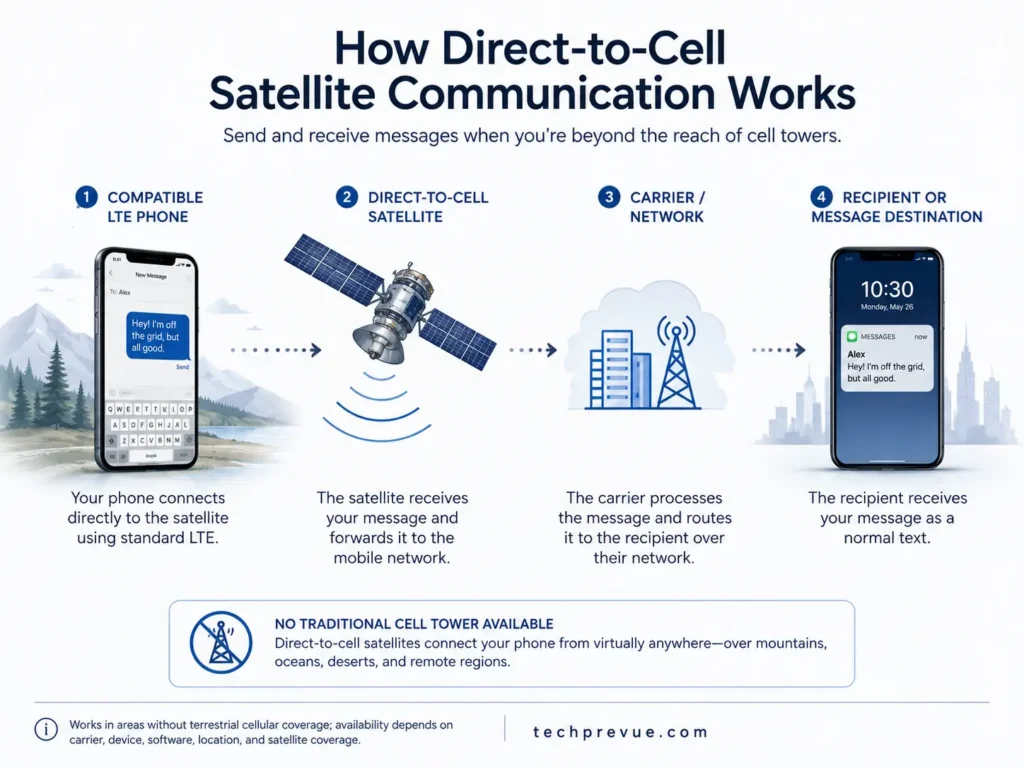
The rollout has been quick. SpaceX sent its first satellite text in January 2024, and Starlink’s 2025 progress report describes more than 650 first-generation direct-to-cell satellites launched, with data service following in late 2025.
Pricing has stayed deliberately low. T-Mobile sells the service as a $10 monthly add-on and includes it free on premium plans, which is what turns it from an expedition tool into something an ordinary hiker or truck driver carries by default.
Competition is arriving rather than settling. AST SpaceMobile made the first space-based voice call using an everyday unmodified smartphone back in April 2023, demonstrated native VoLTE calls over AT&T and Verizon core networks in July 2025, and launched BlueBird 6 from Satish Dhawan Space Centre on an LVM3 rocket in December 2025.
AST is targeting 45 to 60 BlueBird satellites in orbit by the end of 2026, with AT&T, Verizon, and Orange as partners. Amazon’s Project Kuiper and Eutelsat OneWeb are building toward the same goal.
The significance is not speed but coverage. Around 2.2 billion people remain offline and vast areas have never had a tower, so this is the first communication technology in decades that extends the map rather than deepening service where it already exists.
Drawback — satellite text is a lifeline, not a replacement. Bandwidth is thin, availability depends on carrier, device, software, and location, and a service billed as an add-on can be priced out of reach of exactly the communities that most need it.
What Is RCS and Why Does It Matter Now?
RCS, or Rich Communication Services, is the modern successor to SMS, while SMS itself remains an important fallback wherever RCS is unavailable. It keeps the simplicity of texting a phone number while adding read receipts, typing indicators, proper image quality, and group chats that work.
Adoption crossed the threshold when Apple added RCS in iOS 18 during September 2024, ending years in which messages between iPhone and Android fell back to 1990s SMS. Around 1.5 billion people now use it, with over a billion RCS messages sent daily in the US alone.
Encryption began catching up in 2026. Apple’s iOS 26.5 release started rolling out end-to-end encrypted RCS between Apple Messages and Google Messages as a beta, built on the GSMA’s specification.
Drawback — RCS encryption is still rolling out, and coverage depends on the messaging clients, carriers, and participants involved. Check for the encryption indicator rather than assuming every RCS conversation is protected. RCS also needs mobile data where SMS runs over the voice network, which is why SMS survives as the fallback.
How Have Social Media App Features Changed the Way We Talk?
Messaging apps stopped being places we send messages and became places we broadcast, gather, and follow. Features built for feeds moved into the chat app, which means the same icon now serves as inbox, group hub, and news source at once.
| Feature | What it does | What it changed |
|---|---|---|
| Group chats | One message reaches a family or class | Replaced the round-robin phone call |
| Communities | Bundles up to 50 groups under one hub | Schools and housing societies now run on them |
| Channels | One-way broadcast to unlimited followers | Turned messaging apps into news feeds |
| Voice notes | Speak instead of typing | Opened messaging to slower typists |
| Status and Notes | Short updates that expire | Replaced the public post for many under-25s |
| Close friends lists | Share with a chosen few | Made sharing feel private again |
| Disappearing messages | Auto-delete after a set time | Made chat feel less permanent |
| AI summaries | Condense an unread thread | WhatsApp added them for unread messages in 2025 |
The pattern underneath appears to be a retreat from the public feed. Younger users in particular favor group chats, close-friends lists, and expiring updates, where an audience is chosen rather than accumulated.
Drawback — private groups are far harder to moderate than public feeds. Misinformation, scams, and harassment now spread inside encrypted spaces that no platform can see into, and forwarding limits are a blunt tool against it.
What Are the Disadvantages of Communication Technology?
Every gain above created a matching cost, and the honest version of this topic reports both. Five problems are well enough established to take seriously.
1. Information Overload
We receive more messages than we can process, across more channels than we can check. The result is not that we miss information but that we miss the important information inside the noise.
Consolidating channels helps more than managing them. A team that agrees where each type of message belongs recovers more attention than one that simply checks faster.
2. Loss of Non-Verbal Cues
Face-to-face conversation carries tone, expression, posture, and pause. Text strips all four, which is why a neutral message so often reads as cold and a joke lands as an insult.
Voice notes and video recover some of this, and emoji evolved specifically to patch the gap. Neither fully replaces being in the room.
3. Always-On Pressure
Reachability became an expectation rather than a courtesy. Work messages arrive in the evening on the same device we use to relax, and the boundary that a physical office once enforced now has to be enforced by us.
Stepping back helps more than willpower. Our guides to the negative effects of smartphones and taking a social media detox cover what the research actually supports.
4. Scams and Impersonation
The channels that made us reachable made us reachable by anyone. US consumers reported $15.9 billion in fraud losses during 2025, up from $12.5 billion the year before, while India recorded ₹22,495 crore in cybercrime losses.
Four habits cut most of the risk:
- Treat any unexpected message about money as fraudulent until verified on a number you looked up yourself
- Agree a spoken code word with family to defeat voice-cloning calls
- Turn on two-factor authentication for email first, since it is the recovery route for everything else
- Never move money to “protect” it, because no bank or police force will ask you to
The dangers of social media covers the wider risk picture.
5. Digital Exclusion
Improved communication only counts for people who can reach it. Around 2.2 billion people remain offline, and Access Now recorded 313 internet shutdowns across 52 countries in 2025.
When a service assumes everyone is reachable online, being unreachable stops being an inconvenience and becomes exclusion.
Has Technology Actually Improved Communication?
Yes, substantially, and the honest answer holds both columns at once. We communicate more, faster, further, and with more people — and we understand each other slightly less well while doing it.
| What improved | What it cost |
|---|---|
| Messages arrive in milliseconds | Instant reply became expected |
| Distance stopped setting the price | Free contact only for the connected |
| Conversations no longer need both people at once | Threads never formally end |
| We can see the person we are talking to | Video fatigue is real and measurable |
| Language stopped being a hard barrier | Machine translation misses nuance |
| Businesses answer any hour | Reaching a human became harder |
| Small teams communicate at large scale | Attention became the scarce resource |
The clearest improvement is reach. The clearest loss, in our reading, is depth — it is hard to escape the impression that we maintain more relationships than any previous generation while giving each of them less undivided attention. That is an interpretation rather than a measured fact, and it is worth arguing with.
For the wider picture, see how technology has changed our lives across daily life, work, and society, and how technology changed education in particular.
Frequently Asked Questions
How has technology changed communication?
Technology removed distance, delay, and cost from communication. Messages now arrive in milliseconds regardless of location, at the same price whether local or international, and without requiring both people to be available at once. Video, translation, and captions extended this to people previously excluded.
How does technology help communication in business?
It made business communication faster, cheaper, measurable, and continuous. Teams collaborate without sharing an office, customers resolve queries without waiting for office hours, small companies reach targeted audiences affordably, and automation handles volume that once required staff.
What are the disadvantages of communication technology?
Five are well established: information overload across too many channels, loss of tone and body language in text, always-on pressure that outlasts the working day, fraud and AI-driven impersonation costing US consumers $15.9 billion in 2025, and exclusion of the 2.2 billion people still offline.
How has AI changed the way we communicate?
AI now drafts replies, transcribes and summarizes meetings, translates conversation live, and screens spam before we see it. WhatsApp added AI summaries of unread messages in 2025, and SHRM found AI involved in 46% of work where it is present. It handles routine communication well and struggles with tone, nuance, and judgment.
What is satellite direct-to-cell messaging?
It lets an ordinary smartphone send texts through a satellite with no dish or special handset, because the satellite acts as a passing cell tower. Starlink reports more than 650 direct-to-cell satellites launched, with T-Mobile offering the service as a $10 monthly add-on. Availability depends on carrier, device, and location.
Is technology making communication better or worse?
Both, in different directions. Reach, speed, cost, and accessibility improved measurably, while depth of attention, non-verbal understanding, and boundaries between work and rest declined. The outcome depends more on how a person uses these tools than on the tools themselves.
What is the most important communication technology today?
By volume, messaging apps. Meta reports more than 3 billion people on WhatsApp and has reported over 100 billion messages a day, and messaging apps have become the default channel for personal conversation in most markets outside the US, where iMessage and SMS remain strong.
The Bottom Line
Technology improved communication by removing the constraints that defined it for centuries. Distance stopped costing money, delay stopped being unavoidable, and availability stopped being a requirement — and AI has now started removing the effort of composing the message itself.
What technology has not improved is understanding. The tools moved words faster and further than any generation could have imagined, and the harder work of listening carefully, choosing words honestly, and knowing when a message needs a person rather than a template is exactly where it started.
That part is still ours.
