
Two-thirds of the web is invisible. Ahrefs analyzed one billion pages and found that 66.31% of them have zero backlinks. A separate Ahrefs study of 14 billion pages found that 96.55% get no traffic from Google at all.
Here’s the twist most off-page SEO checklists miss: the strongest off-page signal in 2026 isn’t the backlink anymore. When Ahrefs measured 75,000 brands, unlinked brand mentions predicted AI search visibility three times better than backlinks did.
That single finding should reorder your entire off-page SEO checklist. This one does exactly that.
Quick answer: An off-page SEO checklist is a prioritized list of tasks you complete outside your own website — link building, brand mentions, reviews, local citations, and community activity — to build the authority and trust signals that improve rankings in Google and visibility in AI answers.
- What Is an Off-Page SEO Checklist?
- Why Your 2026 off-page SEO Checklist Should Look Different
- The Complete Off-Page SEO Checklist Sheet (Copy This)
- How to Use Off-Page SEO Checklist
- Part 1: Foundation — Audit Before You Build (Tasks 1–5)
- Part 2: Link Building That Still Works (Tasks 6–12)
- Part 3: Brand Signals — The New Core (Tasks 13–18)
- Part 4: Local Off-Page SEO (Tasks 19–22)
- Part 5: Stop Doing These (Tasks 23–25)
- Your Monthly Off-Page SEO Cadence
- Should You Hire Off-Page SEO Services?
- Track What Actually Matters
- FAQs
- Key Takeaways
What Is an Off-Page SEO Checklist?
An off-page SEO checklist covers every action taken away from your site that influences how search engines and AI systems judge it. It typically includes backlink audits, link building tasks, brand mention campaigns, review management, and forum participation, organized so you complete high-impact work first.
Think of it as the reputation half of SEO. On-page SEO controls what your pages say. Off-page SEO controls what the rest of the internet says about you.
The best off-page SEO checklist for 2026 has to serve two systems at once:
- Google’s classic ranking systems, where links still carry weight
- AI answer engines (AI Overviews, AI Mode, ChatGPT, Perplexity, Gemini, Claude), where brand mentions and entity recognition decide who gets cited
Most published off-page SEO checklists only serve the first system. Many still recommend tactics Google classified as link spam years ago. We’ll fix both problems.
Why Your 2026 off-page SEO Checklist Should Look Different
Quick answer: Off-page SEO in 2026 splits into two goals: backlinks for classic Google rankings, and brand mentions for AI visibility. Ahrefs’ study of 75,000 brands found web mentions correlate with AI Overview presence at 0.664, while backlinks correlate at just 0.218 — a 3x gap.
Here is the data that reshaped this off-page SEO checklist. Ahrefs measured which factors correlate with a brand appearing in Google’s AI Overviews, using Spearman correlation across 75,000 brands:
| Off-page signal | Correlation with AI Overview visibility |
|---|---|
| Brand web mentions | 0.664 |
| Branded anchor text | 0.527 |
| Brand search volume | 0.392 |
| Domain Rating | 0.326 |
| Referring domains | 0.295 |
| Total backlinks | 0.218 |
Source: Ahrefs, “An Analysis of AI Overview Brand Visibility Factors” (75,000 brands). Correlation is not causation, but the rank order is consistent enough to plan around.
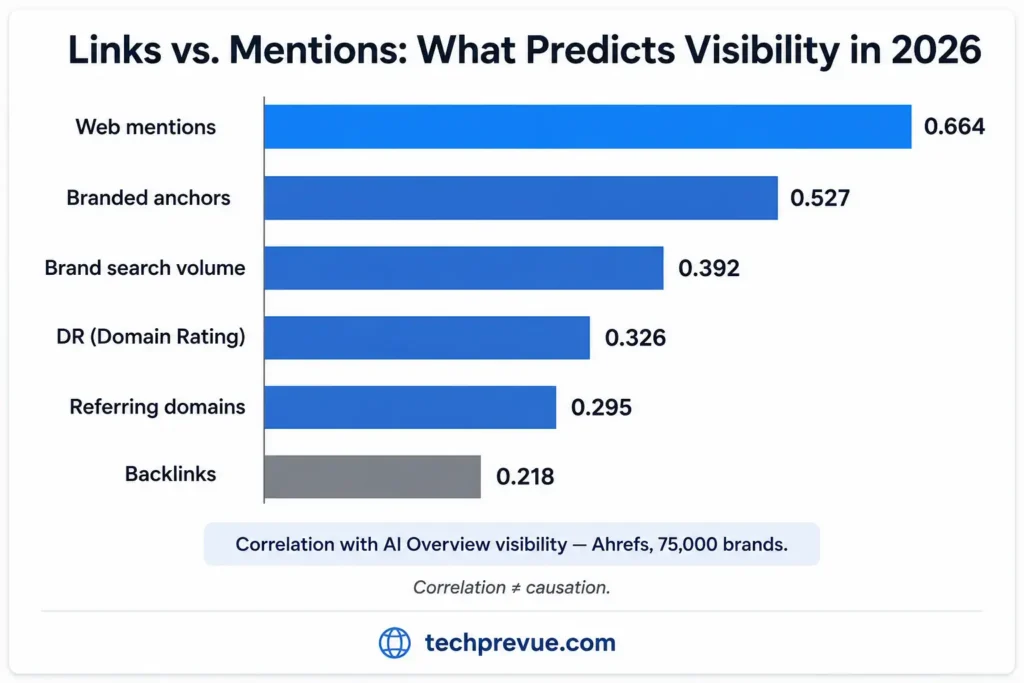
Two more findings from that study deserve your attention:
- Brands in the top 25% for web mentions averaged 169 AI Overview mentions. The next quartile down averaged just 14 — a 10x drop.
- Brands in the bottom half for web mentions were essentially invisible in AI answers, regardless of their backlink profiles.
Now the other side of the ledger. Backlinks are far from dead for traditional rankings:
- 66.31% of pages have zero backlinks, and pages without links rarely earn search traffic. In Ahrefs’ data, only about 1 in 6,671 no-backlink pages attracts over 1,000 monthly visits from Google.
- Link building remains expensive attention. Aira’s survey found SEOs spend 1–2 hours building a single link, which is exactly why this off-page SEO checklist ranks tasks by return on effort.
The practical conclusion: build links for Google, earn mentions for AI, and prioritize tasks that do both. Digital PR, original research, and expert commentary generate links and mentions in one motion. That’s why they sit near the top of this off-page optimization checklist, while directory blasts sit in the “stop doing” section.
The Complete Off-Page SEO Checklist Sheet (Copy This)
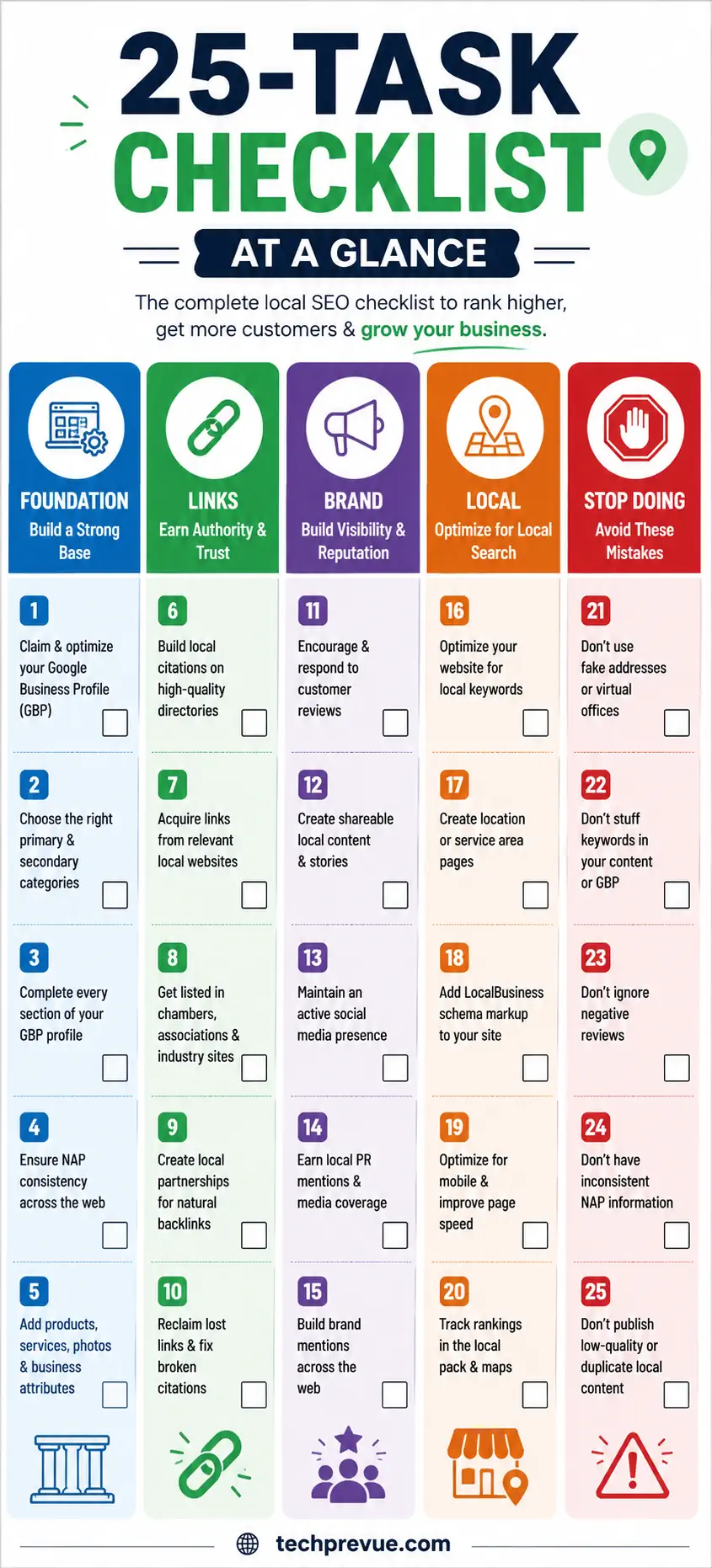
This is the full 25-point sheet, grouped into 5 parts. Copy it into Google Sheets or Notion and it doubles as a reusable off-page checklist template for every campaign you run.
Three columns make this different from the lists you’ve seen elsewhere. Priority tells you what moves visibility fastest — for both Google and AI answers. Frequency tells you how often to revisit it.
Free Tool points to something you can start with today, so you’re not stuck evaluating paid software before you can even begin.
| # | Part | Task | Priority | Frequency | Free Tool |
|---|---|---|---|---|---|
| 1 | Foundation | Audit your existing backlink profile | High | Quarterly | Ahrefs / GSC |
| 2 | Foundation | Check your anchor text distribution | Medium | Quarterly | Ahrefs / Semrush |
| 3 | Foundation | Run a competitor backlink gap analysis | High | Quarterly | Semrush / Ahrefs |
| 4 | Foundation | Set your tracking baseline | Critical | Monthly | GSC + Brand24 |
| 5 | Foundation | Leave the disavow tool alone (usually) | Medium | As needed | Search Console |
| 6 | Link Building | Build one linkable asset per quarter | High | Quarterly | Content + design |
| 7 | Link Building | Run lightweight digital PR | Critical | Quarterly | Outreach tools |
| 8 | Link Building | Reclaim lost and broken links | Medium | Monthly | Ahrefs |
| 9 | Link Building | Convert unlinked brand mentions | High | Monthly | Google Alerts |
| 10 | Link Building | Guest post for relevance, not volume | Medium | Monthly | Manual outreach |
| 11 | Link Building | Answer journalist and creator requests | Medium | Daily | Qwoted / Featured |
| 12 | Link Building | Build relationship links | Medium | One-time | Manual |
| 13 | Brand Signals | Earn editorial mentions, linked or not | Critical | Ongoing | PR + outreach |
| 14 | Brand Signals | Establish a YouTube presence | High | Monthly | YouTube Studio |
| 15 | Brand Signals | Participate genuinely in Reddit, Quora, forums | Medium | Weekly | Manual |
| 16 | Brand Signals | Guest on podcasts | Medium | Monthly | Outreach |
| 17 | Brand Signals | Keep your entity data consistent everywhere | Critical | Quarterly | Schema / Wikidata |
| 18 | Brand Signals | Grow branded search demand | Medium | Ongoing | Search Console |
| 19 | Local SEO | Optimize your Google Business Profile | Critical | Weekly | Google Business Profile |
| 20 | Local SEO | Build consistent local citations | High | One-time | BrightLocal |
| 21 | Local SEO | Earn and answer reviews | High | Weekly | GBP + Manual |
| 22 | Local SEO | Sponsor something local | Medium | Ongoing | Manual |
| 23 | Retire & Rebalance | Audit your checklist against spam policies | Medium | Quarterly | Google Search Central |
| 24 | Retire & Rebalance | Cancel cheap link packages | High | One-time | Manual review |
| 25 | Retire & Rebalance | Rebalance effort toward mentions | Medium | Quarterly | Manual |
Every item is explained below with the goal, the effort, and why it earned its spot. Search intent, met. Now let’s make each row actionable.
How to Use Off-Page SEO Checklist
Work in tiers based on where you are:
- Basic off-page SEO checklist (beginners): Complete Tasks 1–5, then 9, 13, 15, and 19–21. That’s roughly 10 hours of one-time setup. Three of these tasks also carry a recurring weekly load afterward — Task 15’s forum time, Task 19’s maintenance, and Task 21’s review replies add up to about 3–4 hours a week ongoing, not a one-time cost.
- Growth tier (established sites): Add Tasks 6–12, 14–18, and 22. These run on a mix of rhythms — quarterly, monthly, daily, and ongoing — so check each task’s Frequency tag in the sheet above rather than assuming one cadence fits all twelve.
- Advanced tier (competitive niches): Run everything, including the quarterly cleanup in Part 5 (Tasks 23–25) and the tracking stack at the end.
Five tasks are flagged Critical regardless of tier: 4, 7, 13, 17, and 19. The interactive tracker filters by priority, not by these tiers, so if you only use one filter there, use Critical first — it surfaces all five across every part in a single view.
Each task lists the goal, the effort, and the tools. Check items off as you go — the entire point of an off-page checklist is that nothing gets skipped or repeated by accident.
Prefer to check off-page SEO items as you go? Use the free interactive tracker.
Part 1: Foundation — Audit Before You Build (Tasks 1–5)
Quick answer: Start every off-page campaign with an audit: review your backlink profile, check anchor text distribution, map competitor link gaps, and set a tracking baseline. Auditing first prevents you from building links you already have or copying tactics that aren’t working for anyone.
Task 1: Audit your existing backlink profile
Goal: Know what you have before you build. Effort: 1–2 hours.
Pull your profile in Ahrefs, Semrush, or Google Search Console (free, under Links). Record four numbers:
- Total referring domains (unique sites, not total links)
- Followed vs. nofollowed link ratio
- Your 10 most-linked pages
- Links from sites that no longer exist or now host spam
Referring domains matter more than raw backlink counts. Ten links from one site pass far less value than one link each from ten relevant sites.
Task 2: Check your anchor text distribution
Goal: Catch over-optimization before Google does. Effort: 30 minutes.
A natural profile is dominated by branded anchors (“TechPrevue”), URL anchors, and generic anchors (“this guide”). If exact-match keyword anchors make up a large slice of your profile, that’s a pattern Google’s link spam systems are trained to catch.
There’s an upside hiding here too: in the Ahrefs brand study, branded anchor text correlated with AI visibility at 0.527 — stronger than any raw link metric. Ask partners to link with your brand name. It’s safer and more valuable.
Task 3: Run a competitor backlink gap analysis
Goal: Find sites that link to competitors but not you. Effort: 1–2 hours.
Enter your domain plus 3–4 competitors into a backlink gap tool (Semrush Backlink Gap, Ahrefs Link Intersect). Sites linking to two or more competitors are your warmest prospects — they clearly link out in your niche.
Study what earned those links: was it a statistics page, a free tool, a strong opinion piece? You’re not just harvesting a prospect list. You’re reverse-engineering the assets your niche rewards.
Task 4: Set your tracking baseline
Goal: Measure before you act, or you’ll never prove anything worked. Effort: 1 hour.
Record today’s numbers for referring domains, brand mentions (Google Alerts is free; Brand24 and Ahrefs Brand Radar go deeper), branded search volume, and your presence in AI answers. For AI visibility, run 10–15 buyer-style prompts through ChatGPT, Perplexity, and Google’s AI Mode and note whether you appear.
Repeat monthly. Off-page wins arrive slowly, and a baseline is the only way to see them.
Task 5: Leave the disavow tool alone (usually)
Goal: Avoid self-inflicted damage. Effort: 0 minutes for most sites.
Google Search Central’s documentation is direct on this: disavow only if you have a manual action for unnatural links, or expect one because you bought links at scale. Random spam links pointing at your site are ignored automatically. Disavowing links “just to be safe” can remove links that were quietly helping you.
Part 2: Link Building That Still Works (Tasks 6–12)
Quick answer: In 2026, effective link building means creating linkable assets, running digital PR, reclaiming lost links, converting unlinked mentions, and selective guest posting. One strong link from a relevant, trusted site outperforms dozens of low-quality placements — and quality is what both Google and AI systems reward.
Task 6: Build one linkable asset per quarter
Goal: Give people a reason to link without being asked. Effort: High, but it compounds.
Linkable assets are pages that attract links on their own: original surveys, statistics roundups, free calculators, templates, and industry benchmarks. Ahrefs famously ranked #1 for competitive terms by building a statistics page and pitching it to writers who needed data.
A practical India–US example: publish original data comparing SEO salaries, tool pricing, or adoption rates across both markets. Writers covering either market will cite you, because nobody else has the comparison.
Task 7: Run lightweight digital PR
Goal: Earn links and mentions from journalists simultaneously. Effort: 4–6 hours per campaign.
You don’t need an agency. Package something newsworthy — a data finding, a contrarian take backed by evidence, an annual trend report — and pitch it to 20–30 writers who covered similar stories. Personalize the first line of every pitch or don’t bother sending it.
Digital PR is the single best dual-purpose task on this list. Coverage produces the editorial brand mentions AI systems weigh most heavily, and reporters often link too.
Task 8: Reclaim lost and broken links
Goal: Recover value you already earned. Effort: 1–2 hours monthly.
Link rot is enormous: Ahrefs found roughly two-thirds of links created since 2013 are now dead. Some of those were yours. Check your “Lost backlinks” report, then:
- If your page moved, ask the linker to update the URL (or fix your redirect)
- If their page removed you during a refresh, ask politely why
- Find competitors’ broken inbound links and offer your live page as the replacement
Reclamation converts better than cold outreach because the site already chose to link to you once.
Task 9: Convert unlinked brand mentions
Goal: Turn existing mentions into links. Effort: 1 hour monthly.
Search for your brand name in Google (minus your own domain), or use a mention-tracking tool. Every unlinked mention is a warm lead: the author already knows and trusts you. A short, friendly note asking them to link the mention succeeds far more often than any other outreach type.
One caveat from the AI data: an unlinked mention still carries real value for AI visibility. If a major publication mentions you without linking, you’ve already won something. Ask for the link, but don’t burn the relationship over it.
Task 10: Guest post for relevance, not volume
Goal: Reach a real audience on a site Google respects. Effort: 3–5 hours per post.
Guest posting works when the site has genuine traffic and topical overlap with yours. It fails as a scaled link scheme — Google’s spam policies specifically call out large-scale guest posting campaigns with keyword-rich anchors.
Screening test before you pitch: Does the site rank for anything? Would you want their audience even if the link were nofollowed? If either answer is no, skip it.
Task 11: Answer journalist and creator requests
Goal: Become a quoted expert. Effort: 30 minutes daily, optional.
HARO no longer exists — its successor Connectively shut down in December 2024, and several Indian off-page SEO checklists still recommending it are running on autopilot. The active platforms now include Qwoted, Featured, and Peter Shankman’s Source of Sources (SOS).
Answer only questions squarely in your expertise, respond within hours rather than days, and give quotable, specific answers. Each placement typically yields a mention, often a link, and a growing entity footprint.
Task 12: Build relationship links
Goal: Collect the easy links most sites forget. Effort: 2 hours, once.
You likely already qualify for links from suppliers and partners (“stockists” or “partners” pages), industry associations you belong to, tools you use that publish customer showcases, event pages you’ve spoken at, and communities you sponsor. These links are relevant, followed more often than not, and require no creativity — just a list and a few emails.
Part 3: Brand Signals — The New Core (Tasks 13–18)
Quick answer: Brand signals — editorial mentions, YouTube presence, forum participation, podcast appearances, and consistent entity data — are now the strongest predictors of AI search visibility. Build them by being genuinely useful in the places your audience already gathers, not by broadcasting links.
Task 13: Earn editorial mentions, linked or not
Goal: Get discussed by independent, credible sources. Effort: Ongoing.
This is the 0.664 signal. Language models learn which brands to trust from patterns across the web: reviews, comparisons, expert roundups, news coverage, analyst commentary. A mention in a respected industry publication teaches AI systems that your brand belongs in the conversation, even with no link attached.
Practical starting points: contribute expert commentary on breaking industry news, publish research worth citing (Task 6 feeds this), and pitch yourself for “best X tools/agencies” roundups you legitimately belong in.
Task 14: Establish a YouTube presence
Goal: Show up in the platform AI engines cite constantly. Effort: 2–4 hours per video.
Ahrefs’ December 2025 follow-up research found YouTube mentions showing the strongest correlation with AI visibility of any measured signal (~0.737). Gemini and ChatGPT both lean on YouTube content, and video transcripts feed AI training data directly.
You don’t need a production studio. Screen recordings, tutorial walkthroughs, and talking-head explainers work — what matters is that your brand name appears in titles, descriptions, and spoken transcripts around your core topics.
Task 15: Participate genuinely in Reddit, Quora, and niche forums
Goal: Be present where AI engines pull answers. Effort: 2–3 hours weekly.
Reddit consistently ranks among the most-cited domains in AI search results, and forum threads now surface prominently in Google itself for commercial queries. For Indian audiences, Quora carries unusual weight — it has deep penetration in Indian search results in both English and Hindi.
The rules are simple and unforgiving: answer real questions with real substance, disclose your affiliation, and link only when the link is the answer. Accounts that show up purely to drop URLs get banned, and rightly so.
Task 16: Guest on podcasts
Goal: Compound mentions, links, and authority in one appearance. Effort: 2 hours per episode.
Every podcast appearance typically produces show-notes links, a durable brand mention, transcript text that AI systems ingest, and social distribution. Pitch shows one tier below the giants in your niche — they book faster and their audiences are engaged.
Task 17: Keep your entity data consistent everywhere
Goal: Help machines confirm who you are. Effort: 2 hours, then quarterly checks.
This is entity SEO in practice: search engines and LLMs cross-reference your identity across sources rather than trusting any single page. Make the job easy:
- Identical brand name, founder names, and description across LinkedIn, Crunchbase, GitHub, and every social profile
OrganizationorPersonschema on your site withsameAslinks to those profiles- A Wikidata entry if your brand qualifies (never spam Wikipedia — editors will nuke promotional entries, and the reputational cost is real)
Inconsistent entity data doesn’t just dilute authority. It causes AI systems to say wrong things about you.
Task 18: Grow branded search demand
Goal: Make more people search for you by name. Effort: Ongoing, cross-channel.
Brand search volume correlated with AI visibility at 0.392 — stronger than referring domains. Branded search grows as a side effect of everything else in Part 3, plus email newsletters, memorable free tools, and consistent social presence. Track it monthly in Google Search Console; it’s one of the most honest metrics in marketing.
Part 4: Local Off-Page SEO (Tasks 19–22)
Quick answer: Local off-page SEO means optimizing your Google Business Profile, building citations with consistent name-address-phone details, and steadily earning and answering customer reviews. For US businesses the core platforms are Yelp, BBB, and Apple Maps; for Indian businesses, Justdial, Sulekha, and IndiaMART.
Task 19: Optimize your Google Business Profile
Goal: Win the map pack. Effort: 2 hours, then 30 minutes weekly.
Complete every field, choose precise categories, upload real photos monthly, and post updates. An active, complete profile outperforms a claimed-and-abandoned one for local queries, and it feeds accurate business data to AI assistants answering “near me” questions.
Task 20: Build consistent local citations
Goal: Confirm your business details everywhere they’re checked. Effort: 3–4 hours, once.
Citations are mentions of your name, address, and phone number (NAP) on business listings. Consistency is the entire game — mismatched details erode trust with both Google and customers.
| Market | Core citation sources |
|---|---|
| United States | Yelp, Better Business Bureau, Apple Business Connect, Bing Places, industry-specific directories |
| India | Justdial, Sulekha, IndiaMART, TradeIndia, Google Business Profile |
Note the framing: these are local trust citations, not a link building tactic. Listing a Delhi restaurant on Justdial is smart local SEO. Submitting a SaaS blog to 200 generic directories for backlinks is the spam pattern covered in Part 5.
NAP consistency across every listing is what actually earns the local trust signal — not the number of directories you’re on.
Task 21: Earn and answer reviews
Goal: Build the trust signal customers and machines both read. Effort: 30 minutes weekly.
Ask every happy customer for a review, make it one-click easy, and respond to everything — especially criticism. Review content is mined by AI assistants when they recommend businesses, and your responses are public proof that a real, accountable team exists. Never buy reviews; both Google and India’s Central Consumer Protection Authority have moved against fake review operations.
Task 22: Sponsor something local
Goal: Earn hyper-relevant local links and mentions. Effort: Varies.
Local sports teams, college events, meetups, and charity drives usually publish sponsor pages. These links are geographically relevant, editorially given, and nearly impossible for competitors to replicate. This works identically in Austin and Ahmedabad.
Part 5: Stop Doing These (Tasks 23–25)
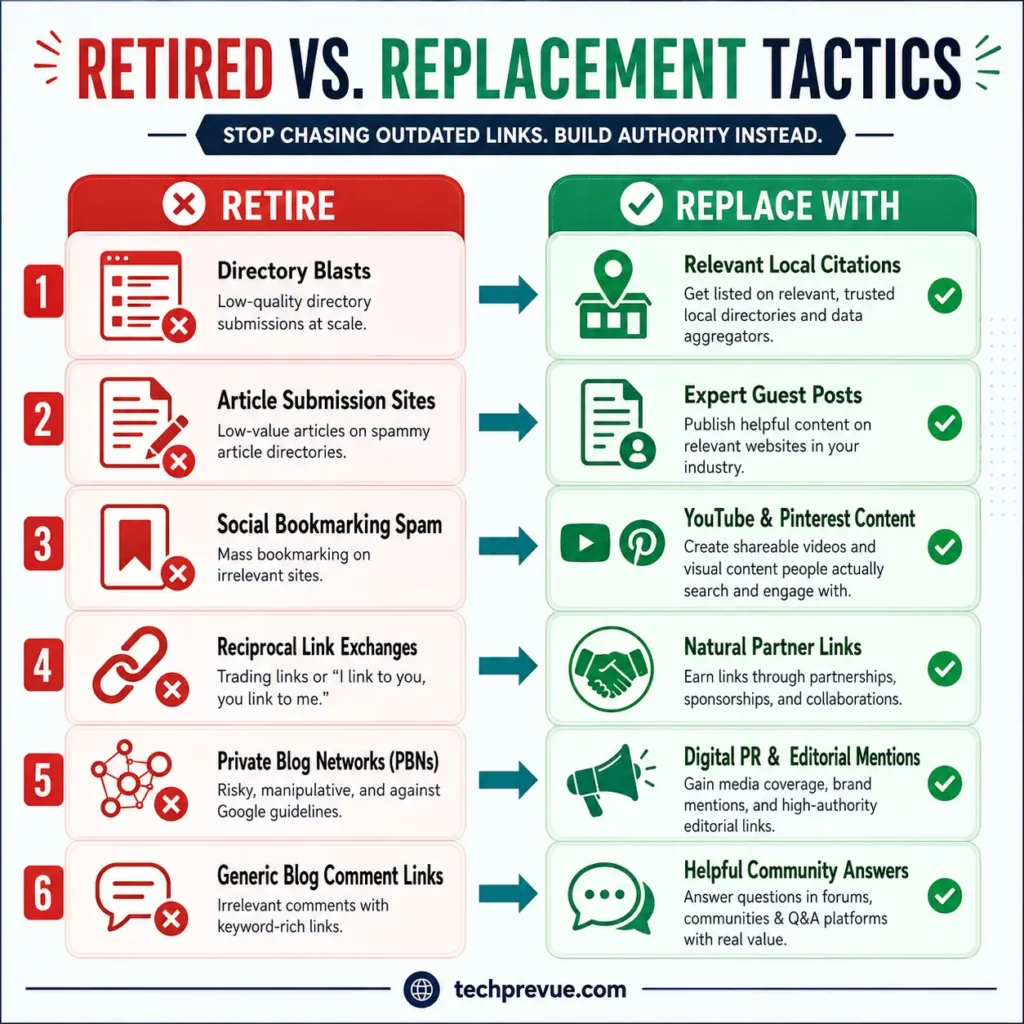
Quick answer: Retire these off-page tactics: bulk directory submissions, article and image submission sites, social bookmarking, reciprocal link exchanges, PBNs, and comment spam. Google’s link spam policies target all of them, and Ahrefs’ AI-era data shows they don’t build the brand signals that now drive visibility either.
Off-page SEO activities lists — especially those circulating in India — still recommend tactics from 2012. This table is your permission slip to delete them.
| Outdated off-page SEO tactic | Why it fails in 2026 | Do instead |
|---|---|---|
| Bulk directory submissions | Google’s spam policies flag low-quality directory links; zero brand value | Local citations only (Task 20) |
| Article submission sites | Duplicate content on zero-audience domains | Guest posts on real sites (Task 10) |
| Image submission / social bookmarking sites | Dead platforms, nofollowed links, no readers | Share visuals on Pinterest or YouTube where audiences exist |
| Reciprocal link exchange schemes | “Excessive link exchanges” are named in Google’s link spam policy | Natural partner links (Task 12) |
| PBNs and bought link packages | SpamBrain devalues them; manual action risk | Linkable assets and digital PR (Tasks 6–7) |
| Blog comment and forum signature links | Nofollowed, ignored, and reputation-damaging | Genuine community participation (Task 15) |
| Keyword-anchor press release links | Wire services nofollow links; Google discounts them | PR for coverage and mentions, not links (Task 7) |
Task 23: Audit your own off-page SEO checklist against Google’s spam policies
Read Google’s link spam policies once a quarter. If a tactic you’re running is described there, stop — before a core update or manual action makes the decision for you.
Task 24: Cancel cheap link packages
“500 backlinks for $50” purchases only ever buy risk. Ahrefs’ data shows top-ranking pages gain followed links from new domains at a steady 5–14.5% monthly pace — natural profiles grow gradually, and sudden spikes of low-quality links look exactly like what they are.
Task 25: Rebalance your effort toward mentions
If your monthly off-page hours are 90% link outreach and 10% brand building, the 2026 data says you’re inverted. A 50/50 split between link-focused work (Part 2) and brand-signal work (Part 3) matches where visibility actually comes from now.
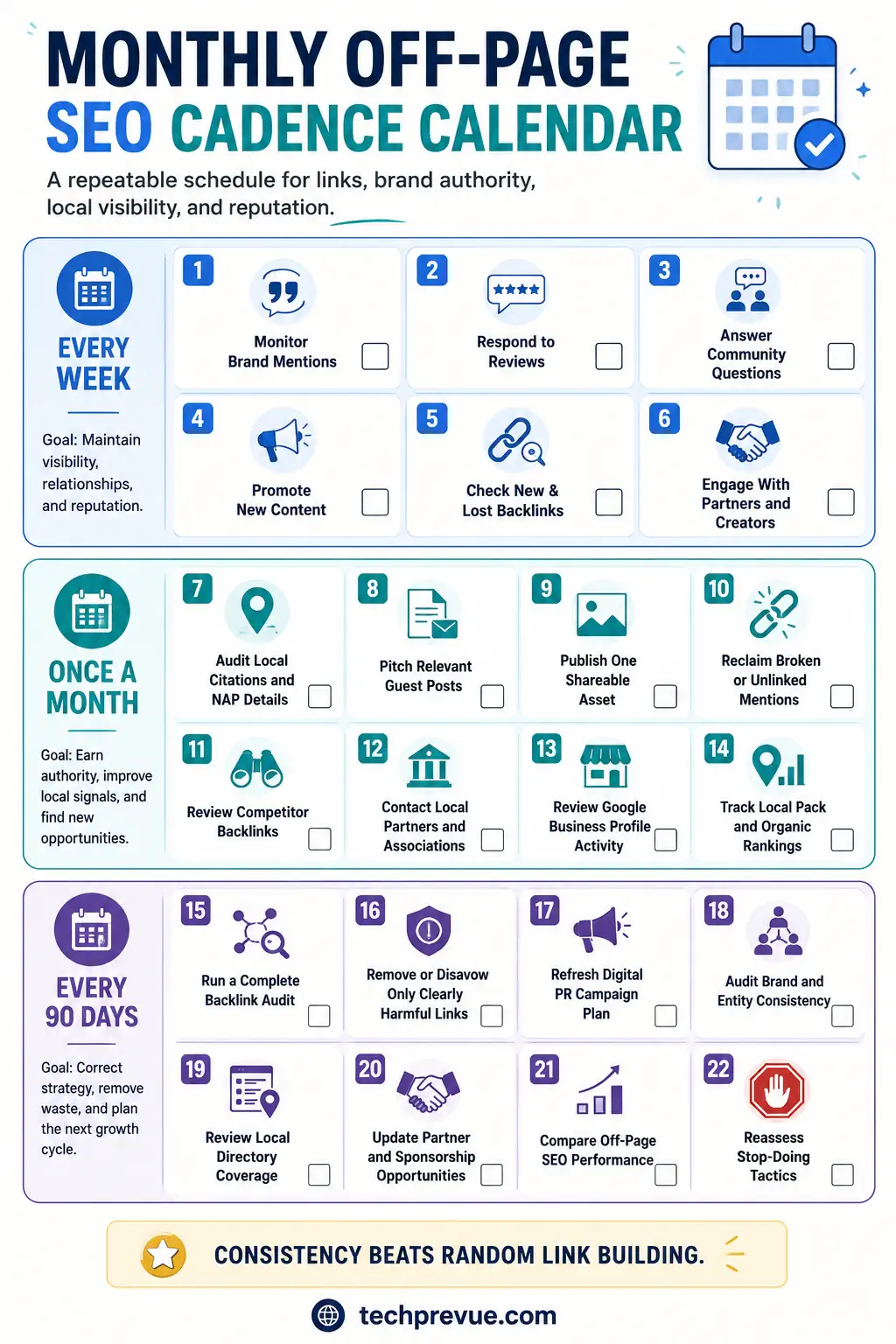
Your Monthly Off-Page SEO Cadence
| Frequency | Tasks |
|---|---|
| Weekly | Forum participation (15), review responses (21), journalist requests (11) |
| Monthly | Link reclamation (8), unlinked mentions (9), tracking update (4), 1–2 guest posts or podcasts (10, 16) |
| Quarterly | New linkable asset (6), digital PR push (7), entity consistency check (17), spam policy self-audit (23) |
Consistency beats intensity. Four focused hours weekly outperforms a heroic 40-hour sprint twice a year, because links and mentions compound while campaigns spike and fade.
Should You Hire Off-Page SEO Services?
Quick answer: Hire off-page SEO services when you lack time for consistent outreach, but only after auditing what they deliver. Good providers earn editorial links and coverage through content and PR. Red flags include guaranteed rankings, fixed link quantities, secret “publisher networks,” and prices too low to cover real outreach.
Questions that separate real providers from link sellers:
- “Can I see the actual sites you’ve earned links from?” Real coverage is showable. Networks get hidden.
- “How do you earn links?” The answer should describe content, data, and outreach — not inventory.
- “What happens to brand mentions and AI visibility?” Providers still selling pure link volume haven’t read the 2026 data.
- “What’s your anchor text policy?” Anyone promising exact-match keyword anchors at scale is building you a penalty.
A reasonable benchmark: quality link building runs $200–$500+ per earned link in competitive niches, because real outreach takes hours per placement. Prices dramatically below that are recycling PBN inventory.
Track What Actually Matters
Measure these monthly against your Task 4 baseline:
- Referring domains (growth trend, not raw totals)
- Brand mentions (volume and source quality)
- Branded search impressions (Google Search Console)
- AI answer presence (your recurring prompt set across ChatGPT, Perplexity, AI Overviews)
- Referral traffic from earned links and mentions
- Review velocity and rating (local businesses)
Rankings lag these signals by weeks or months. If referring domains and mentions trend up, rankings and AI citations follow.
FAQs
What is an off-page SEO checklist?
An off-page SEO checklist is a structured task list covering all SEO work done outside your website: backlink audits, link building, brand mentions, reviews, local citations, and community engagement. It exists so off-page work happens in priority order instead of at random.
What does a basic off-page SEO checklist include?
A basic off-page SEO checklist for beginners includes five things: audit your current backlinks, fix your Google Business Profile and citations, convert unlinked brand mentions, participate in one relevant community, and earn reviews. That foundation takes about 10–12 hours and covers most early-stage impact.
Which off-page SEO activities matter most in 2026?
Digital PR, original research, editorial brand mentions, YouTube presence, and genuine community participation deliver the most in 2026 because they build links and brand signals simultaneously. Ahrefs’ 75,000-brand study found brand mentions predict AI visibility three times better than backlinks.
Do backlinks still matter for SEO?
Yes. Pages without backlinks rarely rank for competitive keywords — 66.31% of pages have zero backlinks and almost none of them earn meaningful Google traffic. What’s changed is that backlinks now share the stage with brand mentions, which matter more for AI-generated answers.
How many backlinks do I need to rank?
There’s no universal number; you need a stronger, more relevant link profile than the pages currently ranking for your target keyword. Check the referring domains of the top 10 results and treat the median as your working benchmark. Ten relevant links routinely beat a hundred generic ones.
How long does off-page SEO take to show results?
Expect 3–6 months for measurable movement and 6–12 months for competitive keywords. Referring domains, brand mentions, and branded search volume improve first; rankings and AI citations follow. Anyone promising off-page results in weeks is describing tactics that trigger penalties.
Are directory submissions still worth doing?
Only as local citations. Listing a local business accurately on Justdial, Sulekha, Yelp, or the BBB helps local visibility. Submitting any website to bulk web directories for backlinks stopped working years ago and now matches patterns described in Google’s link spam policies.
What’s the difference between on-page and off-page SEO?
On-page SEO is everything you control on your website: content, titles, internal links, and structure. Off-page SEO is everything that happens elsewhere: backlinks, mentions, reviews, and community presence. On-page makes your pages worth ranking; off-page convinces search engines and AI systems that others agree.
Key Takeaways
- Backlinks still drive classic Google rankings; brand mentions now drive AI visibility. Your off-page SEO checklist must feed both.
- The highest-ROI tasks — digital PR, original data, expert commentary — earn links and mentions in the same motion.
- Two-thirds of the web has zero backlinks. Even modest, consistent link earning puts you ahead of most competitors.
- Retire directory blasts, article submissions, bookmarking sites, and link exchanges. They’re named in Google’s spam policies and build no brand signal.
- Track referring domains, mentions, and branded search monthly. They move before rankings do.
Work the off-page SEO checklist top to bottom, keep the cadence, and let the compounding do what it does.
