
Quick Answer: Off-page SEO is the practice of improving your website’s search rankings through actions taken outside your website. It includes link building, digital PR, brand mentions, reviews, local citations, directory submission, and community visibility. Search engines and AI answer engines use these external signals to judge whether your site is trusted, authoritative, and worth recommending.
Here is the uncomfortable truth about ranking in 2026. You can publish the best article in your niche, optimize every heading, and still sit on page three.
Why? Because Google does not just evaluate what you say about yourself. It evaluates what the rest of the web says about you.
That is off-page SEO. And it now decides more than your Google rankings. It decides whether ChatGPT, Gemini, Perplexity, and Google AI Overviews mention your brand at all.
This off-page SEO guide covers everything: the meaning, how it works, 15 techniques that still deliver results, backlink quality evaluation, link compliance, local citations for US and Indian businesses, AI visibility, measurement, and a 30/60/90-day action plan you can start this week.
Let’s begin with the fundamentals.
- What Is Off-Page SEO?
- Why Is Off-Page SEO Important in 2026?
- Off-Page SEO vs On-Page SEO vs Technical SEO
- How Does Off-Page SEO Work?
- Prepare Your Website Before Starting Off-Page SEO
- How to Create an Off-Page SEO Strategy (7 Steps)
- 15 Off-Page SEO Techniques That Work in 2026
- Off-Page SEO Activities List: Quick Reference Table
- How to Evaluate Backlink Quality (Scorecard)
- Link Attributes Explained: Follow, Nofollow, Sponsored, and UGC
- Digital PR, Link Building, and Link Earning: What's the Difference?
- Reviews and Online Reputation Management
- Local Off-Page SEO for US and Indian Businesses
- Off-Page SEO for AI Search: AEO, GEO, and AIO
- How to Measure Off-Page SEO Results
- Useful Off-Page SEO Tools by Task
- Off-Page SEO Mistakes and Risky Practices to Avoid
- Do Old Off-Page SEO Tactics Still Work in 2026?
- What Should You Do About Spammy or Toxic Backlinks?
- How Long Does Off-Page SEO Take to Show Results?
- 30/60/90-Day Off-Page SEO Action Plan
- Off-Page SEO Examples for Different Businesses
- Off-Page SEO Checklist
- Frequently Asked Questions About Off-Page SEO
- Build a Reputation, Not Just Backlinks
What Is Off-Page SEO?
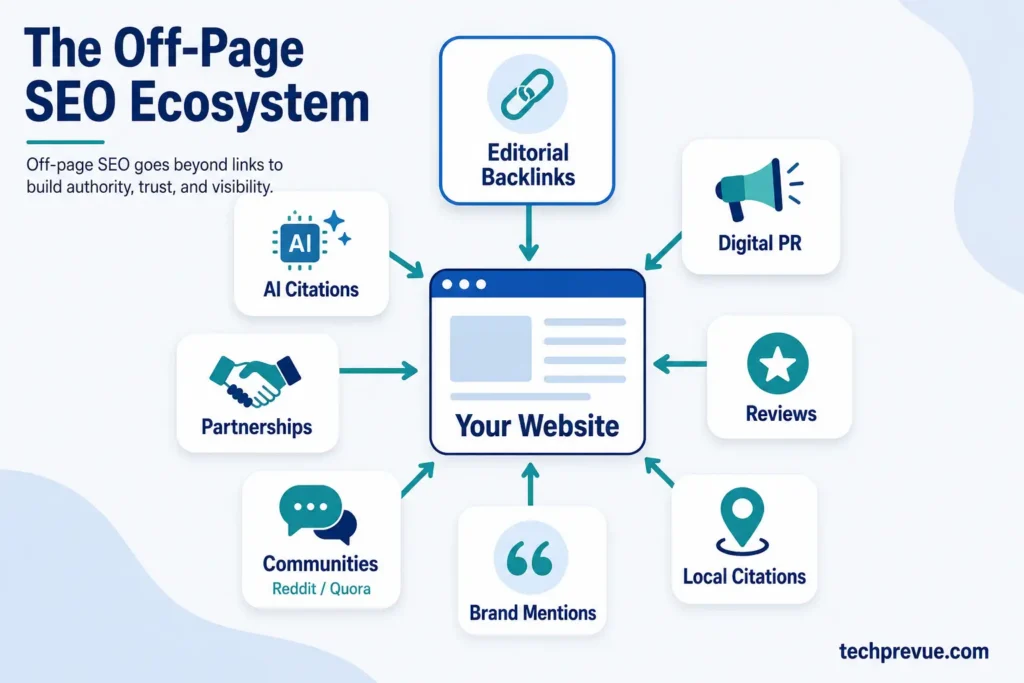
Off-page SEO refers to all optimization activities performed outside your own website to improve its visibility, authority, and trustworthiness in search engines and AI-driven answer engines.
If on-page SEO is what you build, off-page SEO is what you earn.
Think of it like a job interview. Your resume is on-page SEO — you control every word. Your references are your off-page reputation — other people vouching for you. Employers trust references more than resumes. Search engines work the same way.
Off-Page SEO Meaning in Simple Words
In simple words, off-page SEO means making your website look trustworthy through signals that come from other places on the internet.
Those signals include:
- Backlinks from other websites pointing to your pages
- Brand mentions in articles, forums, and social media (linked or unlinked)
- Reviews on Google, Yelp, Justdial, and industry platforms
- Local citations listing your business name, address, and phone number
- Directory submission to relevant, moderated directories
- Social and community visibility on Reddit, Quora, LinkedIn, and niche forums
- Digital PR coverage in news publications and industry media
Every one of these tells search engines the same thing: real people and real websites recognize this brand.
Is Off-Page SEO the Same as Off-Site SEO?
Yes. Off-page SEO and off-site SEO are two names for the same discipline. Some tools and guides also call it off-page optimization or off-site optimization.
Use whichever term you prefer. Google’s documentation does not use either label formally — it simply describes external signals like links, mentions, and reputation.
What Counts as an Off-Page SEO Activity?
An activity counts as off-page optimization when it happens outside your website and influences how search engines or AI systems perceive your site.
Clear examples of qualifying activities:
- Earning an editorial backlink from an industry publication
- Getting quoted as an expert in a news story
- Building citations on Google Business Profile and Bing Places
- Collecting genuine customer reviews
- Answering questions on Reddit or Quora with your brand attached
- Appearing as a podcast guest
- Reclaiming an unlinked brand mention
What Does Not Count as Off-Page Optimization?
This is where most guides blur the line. These activities support your off-page efforts but belong to other disciplines:
- Schema markup, headings, content structure — that’s on-page SEO
- Site speed, crawlability, Core Web Vitals — that’s technical SEO
- Paid search ads — that’s PPC, and it has no direct effect on organic rankings
- Internal linking — happens on your site, so it’s on-page
Keep the boundary clean: if the signal lives on a domain you don’t control, it’s off-page SEO.
Why Is Off-Page SEO Important in 2026?
Off-page SEO is important because search engines treat external signals as independent evidence of quality — evidence you cannot manufacture on your own site. Without it, even excellent content struggles in competitive niches.
Here are the five reasons that matter most right now.
Off-Page Signals Help Search Engines Rank Pages
Links remain part of how Google discovers, evaluates, and ranks content. Google’s own guide to its ranking systems confirms that link analysis, including PageRank, still operates inside its core ranking systems.
The scale of the problem is sobering. Ahrefs studied over a billion pages and found that roughly 96% of them get no search traffic from Google — and the majority of those pages have zero backlinks. Content without external validation rarely ranks for anything competitive.
Off-Page SEO Builds Brand Authority and E-E-A-T
Google’s Search Quality Rater Guidelines instruct human raters to research a site’s reputation on other websites — reviews, news coverage, expert opinions — rather than trusting what a site says about itself.
That reputation research is off-page territory. Independent coverage, expert mentions, and honest reviews are exactly the evidence raters (and ranking systems trained on their judgments) look for.
Off-Site Signals Drive Referral Traffic and Conversions
A backlink from a relevant site is not just a ranking signal. It is a doorway.
A single mention in the right industry newsletter or Reddit thread can send more qualified visitors than weeks of rankings for a minor keyword. Referral traffic converts well because it arrives pre-trusted — someone the reader already follows recommended you.
Off-Page Activity Grows Branded Search Demand
When people see your brand on podcasts, in news coverage, and across communities, they start searching for you by name.
Branded searches are a powerful signal. Google has even filed patents describing how branded search behavior can associate a company with topics, similar to how links do. More people searching “your brand + topic” tells Google your brand belongs to that topic.
Off-Page SEO Decides Your AI Search Visibility
This is the newest reason, and arguably the biggest.
AI answer engines — ChatGPT, Perplexity, Gemini, and Google AI Overviews — build answers from sources they consider trustworthy. Research on generative engine optimization (the GEO study presented at KDD 2024) found that content citing credible sources, quotations, and statistics gained significantly more visibility in AI answers, while keyword stuffing performed about 10% worse than doing nothing.
What earns AI citations? Third-party corroboration. Brands that are mentioned, reviewed, and discussed across the web get cited. Brands that only talk about themselves get ignored. We cover this in depth in the AI search section and in our guide on how to rank in AI Overviews.
Off-Page SEO vs On-Page SEO vs Technical SEO
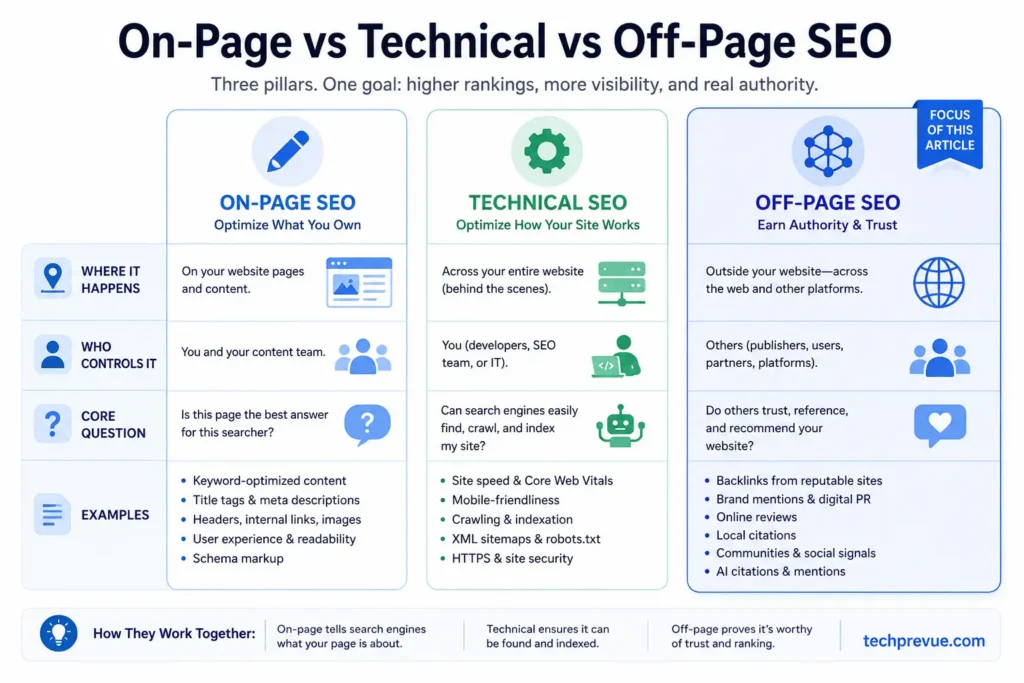
The fastest way to understand the discipline is to see it next to its siblings. All three work together, but they answer different questions.
| Factor | On-Page SEO | Technical SEO | Off-Page SEO |
|---|---|---|---|
| Where it happens | On your pages | On your server and code | On other websites and platforms |
| Who controls it | You, fully | You, fully | Others — you can only influence it |
| Core question answered | What is this page about? | Can search engines access it? | Can this site be trusted? |
| Examples | Content, titles, headings, internal links | Crawling, indexing, Core Web Vitals, HTTPS | Backlinks, mentions, reviews, citations, digital PR |
| Speed of results | Days to weeks | Days to weeks | Months |
| Main risk | Thin or over-optimized content | Blocked or broken pages | Link spam penalties |
On-Page SEO Examples
On-page SEO covers everything you optimize inside the page: keyword-focused content, title tags, meta descriptions, heading structure, image alt text, and internal linking. If you’re new to the discipline, start with the fundamentals in our guide to what SEO is and how it works.
Technical SEO Examples
Technical SEO makes your site crawlable and fast: XML sitemaps, robots.txt, canonical tags, structured data implementation, mobile performance, and Core Web Vitals. It is the plumbing that lets your on-page and off-page work actually count.
Off-Page SEO Examples
Off-page SEO covers the reputation layer: a marketing blog linking to your research, a customer leaving a Google review, a journalist quoting your founder, a Reddit thread recommending your tool, or a local newspaper covering your business.
Which Type of SEO Should You Do First?
Do them in this order: technical first, on-page second, off-page third.
There is no point promoting pages Google cannot crawl, and no point earning links to content that disappoints visitors. Fix the foundation, publish something worth referencing, then begin off-page promotion. Skipping ahead wastes outreach effort on pages that cannot convert attention into rankings.
How Does Off-Page SEO Work?
Off-page SEO works by feeding search engines and AI systems independent evidence about your website. Four mechanisms do most of the heavy lifting.
Links and PageRank
Backlinks are the original off-page signal. Google’s founders built PageRank on a simple idea borrowed from academic citations: pages referenced by many trusted pages are probably trustworthy themselves.
The system has evolved enormously — Google now evaluates the relevance, context, and trustworthiness of each link, not raw counts — but link analysis remains a confirmed part of Google’s core ranking systems. Not all links are equal, though. A single editorial link from a respected industry site can outweigh hundreds of low-quality links.
Link Relevance, Context, and Editorial Trust
Modern link evaluation asks three questions about every backlink:
- Is the linking site topically relevant to yours? A link from a cooking blog to a plumbing service carries little weight.
- Was the link given editorially? Links someone chose to add because your content deserved it count. Links you placed yourself count far less — or against you.
- Does the surrounding text support the link? A link embedded in a genuine recommendation beats a link dropped in a footer.
This is why 50 relevant, editorial links beat 5,000 directory spam links every single time.
Brand Mentions and Entity Associations
Google increasingly understands the web through entities — distinct people, brands, organizations, and concepts — rather than just keywords and links.
Every time your brand appears next to your topic, even without a link, it strengthens the entity association. Unlinked mentions in news articles, podcast transcripts, and forum discussions all teach search engines and AI models what your brand is known for. This is also why consistent brand information across the web matters so much for AI visibility.
Reviews, Citations, and Third-Party Reputation
For local and commercial queries, reviews and citations act as trust infrastructure.
Google cross-references your business name, address, and phone number (NAP) across directories to confirm you are a real, stable business. Review volume, recency, and sentiment influence local rankings and — just as importantly — whether humans click through at all.
Direct Ranking Signals vs Indirect SEO Benefits
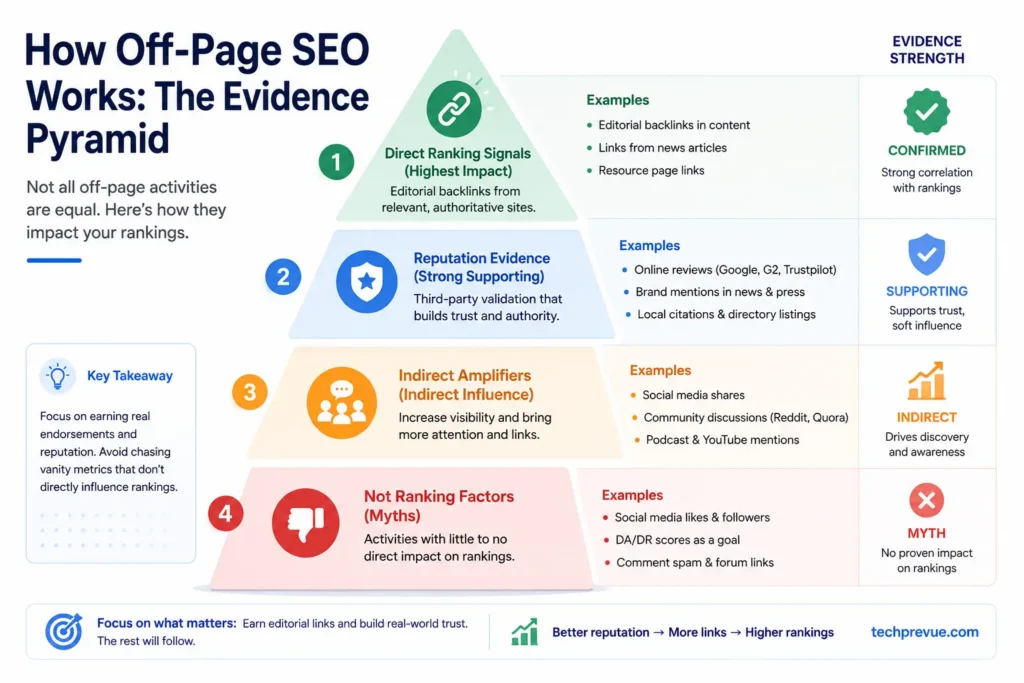
Here is the evidence-based classification most guides skip. Not everything labeled “off-page SEO” influences rankings the same way.
| Category | Examples | Honest Status in 2026 |
|---|---|---|
| Direct ranking signals | Crawlable editorial backlinks, PageRank | Confirmed part of Google’s ranking systems |
| Strong reputation evidence | Reviews, credible press coverage, local citations, GBP signals | Confirmed for local rankings; feeds E-E-A-T evaluation |
| Indirect amplifiers | Social shares, Reddit threads, YouTube, podcasts, bookmarking communities | Not direct ranking factors — but they generate the mentions, links, traffic, and AI citations that are |
| Unproven or misrepresented | Follower counts, like totals, Domain Authority as a “Google score” | Do not treat as ranking factors; DA/DR are third-party comparison metrics |
Keep this table in mind for every technique in this guide. It is the difference between strategy and superstition.
Common Off-Page SEO Myths
Myth 1: Off-page SEO is only link building. Links are the biggest piece, but reviews, citations, mentions, and community reputation all contribute — and AI engines lean heavily on the non-link signals.
Myth 2: Social media likes boost rankings directly. Google has repeatedly said raw social metrics are not ranking factors. Social works indirectly: distribution creates mentions and links.
Myth 3: More backlinks always means higher rankings. Quality, relevance, and editorial independence beat volume. Spam volume can trigger penalties.
Myth 4: Domain Authority is a Google metric. DA (Moz) and DR (Ahrefs) are proprietary estimates. Useful for comparison, meaningless as targets.
Myth 5: HARO is still the best free PR tactic. HARO no longer exists — it was rebranded to Connectively and shut down in December 2024. Guides still recommending it haven’t been updated. Use current journalist-request platforms instead (covered in the digital PR section).
Prepare Your Website Before Starting Off-Page SEO
Off-page SEO amplifies what already exists. Promote a weak site and you amplify weakness. Complete these five preparation steps first — they take days and save months.
Choose the Pages Worth Building Links To
Do not build links to every page. Pick 3–5 strategic pages: your money pages, your best guides, and one or two linkable assets. Every campaign in this guide should point somewhere deliberate.
Fix Content, Technical SEO, and Conversion Problems First
Run a quick audit before outreach:
- Does the target page fully satisfy its search intent?
- Does it load fast and work on mobile?
- Does it have a clear next step for visitors?
A journalist who clicks through to a broken or thin page will not link. Fix first, promote second.
Create Linkable and Citeable Assets
People link to resources, not sales pages. The assets that earn links and AI citations in 2026:
- Original research and surveys — unique data journalists must cite
- Free tools, calculators, and templates — evergreen link magnets
- Definitive guides — the resource everyone references
- Original statistics pages — “X statistics 2026” content that ranks and gets cited
- Strong visuals and frameworks — diagrams other blogs embed with attribution
One genuinely useful asset outperforms fifty outreach emails for mediocre content.
Set Up Analytics, Referral, and Conversion Tracking
Before the first campaign, configure:
- Google Search Console (impressions, links, manual action alerts)
- GA4 with referral traffic and conversion events
- A baseline export of current referring domains
You cannot prove your campaigns work — or catch problems — without a baseline.
How to Create an Off-Page SEO Strategy (7 Steps)
An off-page SEO strategy connects business goals to specific external signals. Without one, you end up doing random acts of link building. Follow these seven steps.
Step 1: Set a Clear SEO Business Goal
Start with the outcome, not the tactic. Examples of real goals:
- Rank the pricing page for a commercial keyword within 9 months
- Double qualified referral traffic from industry sites
- Get cited in AI answers for your core category question
“Get more backlinks” is not a goal. It is a means.
Step 2: Identify Your Audience and Its Trusted Link Sources
List where your audience actually spends attention: which publications, newsletters, YouTube channels, subreddits, and podcasts they trust. Those sources are your outreach map. A link or mention there moves both rankings and revenue.
Step 3: Analyze Competitor Backlinks, Mentions, and Coverage
Run your top 3–5 competitors through a backlink tool and answer:
- Which sites link to them but not to you?
- Which content earns them the most referring domains?
- Where are they mentioned without links?
- Which communities discuss them?
Their backlink profile is a pre-qualified prospect list. Every site linking to a competitor has already proven it links to content like yours.
Step 4: Find Authority and Reputation Gaps
Search your brand name and your category the way a customer would. Check what AI tools say when asked about your category. Gaps to note: missing reviews, outdated information on third-party sites, zero presence in community discussions, no coverage in publications your competitors appear in.
Step 5: Select Linkable Assets and Channels That Match Your Strengths
Match tactics to your resources:
- Have data? Lead with original research and digital PR.
- Have expertise? Lead with guest articles, podcasts, and expert commentary.
- Have a local business? Lead with citations, reviews, and local press.
- Have budget but no time? Focus on fewer, higher-quality placements.
Step 6: Plan Link Outreach, Distribution, and Relationships
Build a simple pipeline: prospect list → personalized pitch → follow-up → relationship. The highest-ROI off-page work is repeat coverage from people who already know you. Treat every placement as the start of a relationship, not a transaction.
Step 7: Measure Off-Page Results and Improve the Campaign
Review monthly: new referring domains, referral traffic, branded search growth, rankings for target pages, and AI mentions. Kill what isn’t working. Double down on what is. Full metrics are covered in the measurement section.
15 Off-Page SEO Techniques That Work in 2026
These off-page SEO techniques are ordered roughly by impact for most websites. Each entry explains what it is, why it still works, and how to execute it without crossing Google’s spam policies.
1. Earn Backlinks With Original Research and Data
Nothing earns links like being the source. Publish original surveys, data studies, or industry benchmarks and you become the citation everyone else needs.
How to execute:
- Survey your customers or community (even 100–200 responses produce quotable findings)
- Analyze your own platform data for industry patterns
- Update the study annually so links compound year after year
This is also the single strongest tactic for AI citations. Answer engines actively prefer content with statistics and citable sources — the GEO research found source-backed content gained substantially more visibility in generated answers.
2. Use Digital PR and Journalist Outreach
Digital PR means earning coverage in news and industry publications through genuinely newsworthy stories: data, expert commentary, or timely reactions.
What works in 2026:
- Data-led campaigns — pitch your original research with a clear headline finding
- Reactive commentary — respond fast when news breaks in your industry
- Journalist-request platforms — HARO is gone (shut down December 2024), so use its successors: Qwoted, Featured, SourceBottle (popular in Asia-Pacific), and Help a B2B Writer
One placement in a real publication typically outweighs dozens of low-tier guest posts — in authority, in referral traffic, and in AI training data.
3. Contribute Expert Guest Posts (Selectively)
Guest posting still works when you treat it as expert contribution, not link manufacturing.
The 2026 rules:
- Write only for sites with a real audience in your niche
- Prioritize referral traffic and reputation over the link itself
- Use natural, branded anchor text — never exact-match keyword anchors
- Expect editorial standards; mass guest posting on “write for us” farms is a link scheme Google explicitly targets
If you’re building a personal brand from scratch, understanding what blogging is and how it works helps you evaluate which blogs deserve your contribution.
4. Reclaim Unlinked Brand Mentions and Lost Links
Some of the easiest backlinks are ones you almost have.
- Unlinked mentions: Set up alerts for your brand name. When a site mentions you without linking, send a short, polite request. Conversion rates are high because the author already knows you.
- Lost links: Backlink tools show links that disappeared. Many vanish through site redesigns, not decisions — a friendly note often restores them.
- Broken link building: Find dead pages competitors’ backlinks point to, build something better, and suggest your resource as the replacement. Use it selectively; success rates are modest but the links are editorial.
5. Do Directory Submission the Right Way
Directory submission is one of the oldest off-page SEO activities — and one of the most misunderstood in 2026. Most US guides tell you to skip it entirely. That advice is half right and half lazy.
Here is the honest picture. Google’s spam policies explicitly list “low-quality directory or bookmark site links” as link spam. Mass-submitting your site to 500 generic directories is not SEO; it is a spam footprint.
But quality directory submission is alive and essential, because the directories that matter have evolved into citation and discovery platforms:
- Core business directories: Google Business Profile, Bing Places, Apple Business Connect
- US platforms: Yelp, BBB, Chamber of Commerce listings, industry associations
- Indian platforms: Justdial, Sulekha, IndiaMART, TradeIndia, and state or city business associations
- Niche directories: industry-specific, moderated directories your customers actually browse (software marketplaces, legal directories, medical directories)
How to judge any directory in 10 seconds: Does it have editorial standards? Does it get real visitors? Would you list here even if links didn’t exist? Three yes answers — submit. Any no — skip.
Done this way, directory submission builds NAP citations, local rankings, referral traffic, and the entity consistency AI engines rely on.
6. Use Social Bookmarking and Content Communities Strategically
Social bookmarking is the second technique modern guides love to dismiss — and again, the dismissal misses what the tactic became.
The old model is genuinely dead. Delicious and StumbleUpon are gone, Pocket shut down in mid-2025, and mass bookmark links are named in Google’s link spam examples. Nobody should be blasting URLs to bookmarking-site lists in 2026.
The evolved model is thriving. Bookmarking grew into content communities and discovery platforms:
- Reddit — now one of the most frequently cited domains in AI-generated answers and prominently surfaced in Google results
- Flipboard and Mix — curation platforms that still drive real referral traffic in some niches
- Pinterest — a visual discovery engine that functions as bookmarking for DIY, food, design, and ecommerce
- Hacker News, Product Hunt, and niche communities — launch visibility that produces genuine editorial links
The strategy: share where you participate. A submission from an active, credible community member earns discussion, traffic, mentions, and downstream links. A drive-by link drop earns removal. Bookmarking links themselves are typically nofollow — the value is discovery, not PageRank.
7. Build Local Citations and Optimize Google Business Profile
For any business serving a geographic area, citations are non-negotiable off-page work.
The essentials:
- Claim and fully complete your Google Business Profile — categories, services, photos, posts, Q&A
- Keep NAP (name, address, phone) identical everywhere, down to the spelling
- Build citations on the platforms your country actually uses (see the local off-page SEO section for US and India lists)
- Fix inconsistent old listings — conflicting data erodes trust
Citations are also entity signals. Consistent business information across trusted platforms is exactly what AI systems check before recommending a business.
8. Participate in Forums and Q&A Communities
Forum posting earned a bad reputation because of signature-link spam. The modern version is reputation building where your customers ask questions.
Where it works: Reddit, Quora, Stack Exchange, industry Slack and Discord groups, and vertical forums (Team-BHP for Indian automotive, for example).
The rules that keep it valuable:
- Answer genuinely; link only when the link answers the question
- Build profile history before ever mentioning your brand
- Expect nofollow links — the payoff is visibility, referral traffic, and mentions in threads AI engines read and cite
One authoritative answer that ranks inside a popular thread can deliver customers for years.
9. Distribute Content Through Social Media
Social media marketing supports your off-page profile indirectly — and the word “indirectly” is doing honest work here. Likes and follower counts are not ranking factors. Distribution is the value.
What social distribution actually produces:
- Content in front of people who can link, cite, and mention you
- Branded search demand from repeated exposure
- Social profiles that rank for your brand name and feed AI systems consistent entity information
Focus on one or two platforms where your audience lives. For most B2B brands that means LinkedIn and X. For consumer brands, Instagram and YouTube. If video is part of your mix, our guide to trending YouTube hashtags covers discovery tactics that compound with brand search.
10. Run Influencer and Creator Collaborations
Influencer marketing contributes to your off-page profile through reach, trust, and the mentions and links that follow genuine collaborations.
Compliance matters more than ever:
- Sponsored links must use
rel="sponsored"— paid dofollow links violate Google’s link spam policies - Disclose paid relationships (FTC rules in the US; ASCI guidelines in India)
- Prefer creators whose audience matches your customer, not whose follower count flatters your report
The best collaborations produce content assets — reviews, tutorials, comparisons — that keep generating branded searches long after the campaign.
11. Appear on Podcasts, Webinars, and Interviews
Every podcast appearance produces a bundle of off-page value: a backlink from show notes, a brand mention in the audio and transcript, entity association with your topic, and an audience hearing your expertise.
Pitch shows one tier below the giants — they say yes faster and their audiences are engaged. Repurpose each appearance into clips and quotes for further distribution.
12. Syndicate Content Without Creating Confusion
Content syndication means republishing your content on larger platforms (Medium, LinkedIn Articles, industry hubs) to reach new audiences.
Do it safely:
- Ask syndication partners to use a canonical tag pointing to your original, or at minimum a clear attribution link
- Wait until Google indexes your original before syndicating
- Syndicate selectively — audience expansion is the goal, not duplicate copies everywhere
13. Form Partnerships and Co-Marketing Campaigns
Partner with complementary brands on webinars, joint research, bundled offers, or shared tools. Each partner promotes to their audience, and both sides earn mentions, links, and borrowed trust. A joint original-research report is the highest-leverage version: two distribution networks promoting one linkable asset.
14. Host and Join Events for Off-Page Visibility
Events — virtual or physical — generate a predictable trail of off-page signals: listing-site links, speaker-page links, press coverage, social mentions, and photos and recaps published by attendees.
You don’t need a conference. A focused workshop, a meetup, or a sponsored community event produces local press and citation opportunities most competitors never pursue.
15. Build Thought Leadership on External Platforms
Consistent expert publishing on platforms you don’t own — LinkedIn, industry publications, YouTube, conference stages — compounds into the reputation layer everything else in this guide depends on.
For individual experts, also claim your entity presence directly: a Google People Card (available in India), complete author profiles, and consistent bios everywhere you publish. When search engines and AI systems can verify who you are, everything you create carries more weight.
Off-Page SEO Activities List: Quick Reference Table
Use this table to triage any off-page activity — including ones a vendor proposes — in seconds. “Link value” reflects typical ranking credit; “total value” includes traffic, mentions, entity signals, and AI visibility.
| Off-Page SEO Activity | Link Value | Total Value 2026 | Risk Level |
|---|---|---|---|
| Original research / data assets | High | Very high | None |
| Digital PR and journalist outreach | High | Very high | None |
| Editorial guest posts (selective) | High | High | Low |
| Unlinked mention reclamation | High | High | None |
| Broken link building | Medium | Medium | None |
| Quality directory submission | Low–medium | High (citations, local) | Low if selective |
| Mass directory submission | None | None | High — link spam |
| Content communities (Reddit, Flipboard, Pinterest) | Low (nofollow) | High (discovery, AI citations) | Low if genuine |
| Bookmarking-site link blasts | None | None | High — link spam |
| Google Business Profile + citations | Low | Very high (local) | None |
| Forum and Q&A participation | Low | High | Low if genuine |
| Social media distribution | None direct | Medium–high | None |
| Influencer collaborations (disclosed) | Medium | High | Low with rel=”sponsored” |
| Podcasts and interviews | Medium | High | None |
| Content syndication (canonical) | Low | Medium | Low |
| Press releases (newsworthy) | Low | Medium | Low |
| Press releases (for links only) | None | None | Medium |
| Paid dofollow links / niche edits | Negative | Negative | High — policy violation |
| PBN links | Negative | Negative | Very high |
| Profile / comment / signature spam | None | None | High |
Print it, save it, send it to the next agency that emails you a “300 backlinks package.”
How to Evaluate Backlink Quality (Scorecard)
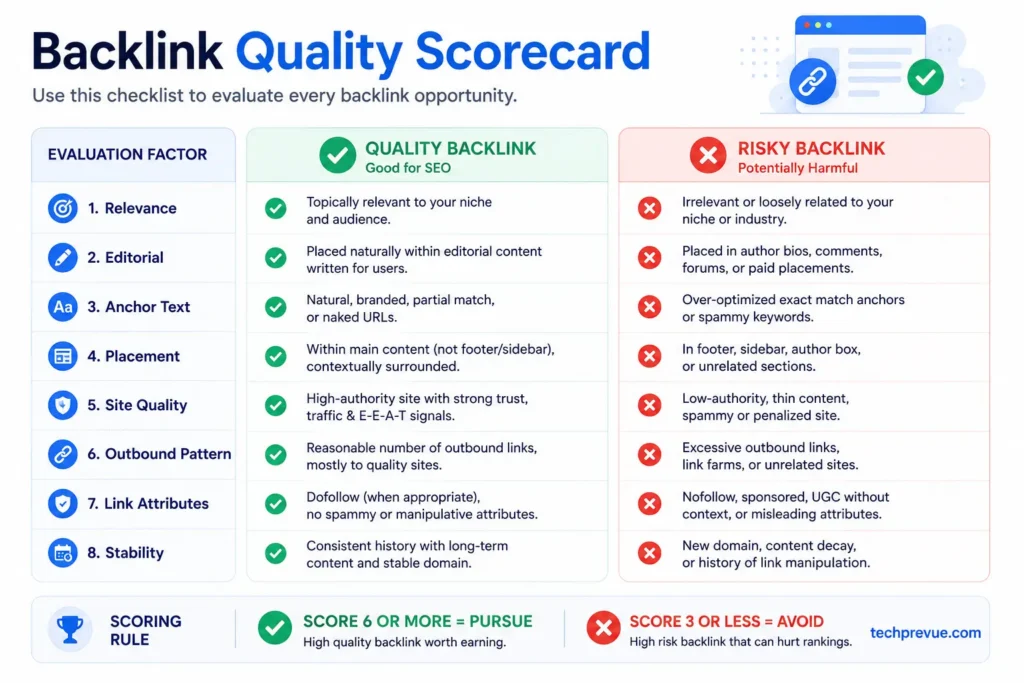
Every technique above eventually produces link opportunities. This is how you separate links worth pursuing from links that waste effort or create risk. Score each prospect on eight factors.
Topical Relevance of the Linking Site
Is the linking site about your topic, or at least your industry? Relevance is the first filter — an irrelevant link from a “strong” domain is worth less than a relevant link from a modest one.
Editorial Independence of the Backlink
Would this site link to you if you didn’t ask, pay, or trade? The more editorial the decision, the more the link is worth. Self-placed links (profiles, comments, mass directories) sit at the bottom of the scale.
Source and Page Reputation
Check the linking site like a customer would: real content, real authors, real updates? Then check the specific page — a link from a maintained resource page beats a link from a forgotten 2019 roundup.
Real Audience and Referral Potential
Does the site have actual visitors who might click? A link that sends customers is valuable even if it were nofollow. A link no human will ever see is valuable only if everything else checks out.
Link Placement and Surrounding Context
In-content links inside relevant paragraphs carry the most weight. Footer, sidebar, and author-bio links carry less.
Natural Anchor Text
Healthy backlink profiles are dominated by branded and natural anchors (“TechPrevue”, “this study”, “according to this guide”). A profile stuffed with exact-match keyword anchors is a classic penalty pattern.
Indexability and Link Attributes
Is the linking page indexed by Google? Is the link followed, or marked nofollow/sponsored/UGC? Followed links from indexed pages pass ranking credit; the rest still carry discovery and reputation value.
Long-Term Link Stability and Spam Footprint
Will this link exist in two years? Does the site link out to casinos and essay mills next to you? A quality link lives in a clean neighborhood and stays put.
A Practical Backlink Evaluation Table
| Signal | Quality Backlink | Risky Backlink |
|---|---|---|
| Relevance | Same industry or topic | Random niche, link farms |
| Editorial | Author chose to link | Paid, traded, or self-placed |
| Anchor text | Branded or natural phrase | Exact-match money keyword |
| Placement | Within main content | Footer, sidebar, signature |
| Site quality | Real audience, real standards | Thin content, sells links openly |
| Outbound pattern | Links to reputable sites | Links to gambling, pills, essays |
| Attributes | Followed, indexed page | Hidden, mass nofollow schemes |
| Stability | Evergreen resource | Expiring paid placement |
Score 6+ quality signals: pursue it. Score 3 or fewer: skip it, whatever its DA.
Link Attributes Explained: Follow, Nofollow, Sponsored, and UGC
Link attributes tell search engines how to treat a link. Getting them right keeps your link building compliant; getting them wrong on paid links is a direct policy violation. Google documents these in its guidance on qualifying outbound links.
When a Regular (Followed) Link Is Appropriate
A standard link with no attribute passes full ranking credit. It is appropriate when the link is editorial — someone genuinely recommending or citing a resource. This is the link every technique in this guide is ultimately trying to earn.
When to Use rel=”sponsored”
Any link that exists because money, products, or services changed hands: paid placements, sponsorships, affiliate links, and paid influencer content. Since Google’s link spam policies treat undisclosed paid dofollow links as spam, rel="sponsored" is your compliance layer on both sides of any deal.
When to Use rel=”ugc”
User-generated content: comments, forum posts, community submissions. It tells Google the site owner didn’t editorially vouch for the link.
When rel=”nofollow” Is Appropriate
The general-purpose attribute for any link you don’t want to vouch for and that isn’t clearly sponsored or UGC — including links to competitors or unverified sources.
Can Nofollow Links Still Be Valuable?
Yes — and this matters for realistic expectations. Since 2020, Google treats nofollow (and sponsored/UGC) as hints rather than absolute directives, meaning it may consider them for crawling and ranking in some cases.
More practically: nofollow links from Reddit, Quora, news sites, and directories deliver referral traffic, brand mentions, entity signals, and AI-answer visibility. A backlink profile with zero nofollow links would actually look unnatural. Judge every link by total value, not attribute alone.
Digital PR, Link Building, and Link Earning: What’s the Difference?
These three terms get used interchangeably, but they describe different postures — and knowing the difference changes how you allocate effort.
- Link building is proactive acquisition: you identify targets and ask. Guest posts, broken link building, and reclamation live here.
- Link earning is passive attraction: you publish something so useful that links arrive without asking. Research, tools, and definitive guides live here.
- Digital PR is the bridge: you create newsworthy material and actively place it with journalists and publishers.
Mature programs run all three. Beginners should start with building (predictable), invest in earning (compounding), and graduate to PR (highest ceiling).
What Makes a Story Newsworthy for Digital PR?
Journalists don’t cover products. They cover stories. Before pitching, test your idea against the classic news values:
- New data: “67% of X now do Y” — findings nobody else has
- Timeliness: connects to something happening this week
- Conflict or surprise: challenges what people assume
- Local relevance: a national trend with a city-level angle
- Human stakes: affects readers’ money, health, time, or work
If your pitch has none of these, it is an ad, and it will be treated like one.
Anatomy of a Data-Led Digital PR Campaign
The repeatable campaign structure that earns links in any niche:
- Find a question your industry argues about but nobody has measured
- Collect the data — survey your audience, analyze your platform data, or compile public records into something new
- Extract 3–5 headline findings and lead with the most surprising one
- Build the asset — a clean landing page with charts, methodology, and quotable statistics
- Pitch in tiers — exclusives to one or two dream publications first, then broad outreach, then journalist-request platforms
- Recycle for a year — localized angles, updated cuts, reactive commentary whenever the topic trends
A single well-built study can feed twelve months of coverage. That efficiency is why digital PR has displaced volume guest posting at the serious end of the industry.
A Link Outreach Personalization Framework That Gets Replies
Mass templates get deleted. Full personalization doesn’t scale. Use the 80/20 structure — a consistent skeleton with three personalized slots:
Subject: New data: [headline finding relevant to their beat]
Hi [Name], your piece on [specific recent article — slot 1] covered [specific point — slot 2].
We just published research on [topic] with a finding your readers would care about: [one-sentence stat].
Happy to share the full data, methodology, or a quote from [expert]. Relevant for [their beat — slot 3]?
[Name, role, one-line credential]
Three genuine personalization slots, under 100 words, one clear offer. Send fewer, better pitches — ten researched emails outperform two hundred blasts, and they don’t burn your domain’s sender reputation.
Measuring Digital PR Beyond Backlinks
PR produces value links alone don’t capture. Track all four layers: links earned (and to which pages), unlinked mentions (future reclamation targets plus entity signals), referral traffic and conversions from coverage, and branded search lift in the weeks after each campaign. A campaign that earns six links, forty mentions, and a visible branded-search bump succeeded — even if a links-only report calls it modest.
Reviews and Online Reputation Management
Reviews are off-page SEO for the trust economy. They influence local rankings, click-through rates, purchase decisions, and — increasingly — what AI assistants say when someone asks “is [your brand] good?”
Why Reviews Matter for Rankings and AI Answers
Google confirms that review signals contribute to local ranking. Beyond local packs, Google’s quality raters are explicitly told to check independent reviews when assessing a site’s trustworthiness.
AI engines go further. Ask any assistant to compare products in your category and watch it synthesize review sentiment from across the web. Your review footprint is being read, summarized, and repeated.
How to Request Honest Reviews
- Ask at the moment of success — after delivery, resolution, or a milestone
- Make it one click: direct links to your Google or platform review form
- Ask everyone, not just happy customers (selective solicitation violates most platform rules)
- Never pay for or incentivize reviews — fake review schemes risk platform removal and legal action in both the US (FTC) and India (CCPA guidelines)
How to Respond to Positive and Negative Reviews
Respond to everything. Thank positive reviewers briefly and specifically. For negative reviews: acknowledge, take it offline, and resolve — future customers read your responses more carefully than the complaints. A thoughtful response to a bad review is trust-building content you didn’t have to create.
Monitor Brand Sentiment and Correct Wrong Information
Set a monthly reputation check:
- Search your brand name and scan page one
- Check review platforms for new patterns
- Ask ChatGPT, Gemini, and Perplexity what they know about your brand
- Correct outdated facts at the source — wrong founding dates, old addresses, discontinued services
That last step is genuine off-page work in 2026: AI systems repeat what third-party sources say, so fixing the sources fixes the answers.
Local Off-Page SEO for US and Indian Businesses
Local off-page SEO runs on the same principles everywhere — citations, reviews, local links — but the platforms and tactics differ sharply between markets. This section gives both playbooks.
The Universal Local SEO Foundation
Regardless of country:
- Complete Google Business Profile with accurate categories, hours, photos, and regular posts
- Identical NAP details everywhere
- Steady review velocity with owner responses
- Links and mentions from genuinely local sources
Local Citations and Directories in the US
Priority platforms: Google Business Profile, Bing Places, Apple Business Connect, Yelp, BBB, Nextdoor, and your city’s Chamber of Commerce. Then go vertical: Avvo or Justia for lawyers, Healthgrades or Zocdoc for doctors, Houzz for home services, TripAdvisor and OpenTable for hospitality.
High-value local link sources: local newspapers (many accept expert commentary), community sponsorships, local business associations, and university or city resource pages.
Local Citations and Directories in India
India’s citation landscape is its own ecosystem, and most US-written guides ignore it entirely:
- Justdial — still the discovery giant for local services
- Sulekha — strong for home services and education
- IndiaMART and TradeIndia — essential for B2B, manufacturing, and wholesale
- Zomato and Swiggy — the review layer for food businesses
- Practo — the vertical standard for doctors and clinics
Additional India-specific moves: get listed with your industry association and local trade bodies, pursue coverage in regional-language publications (a Hindi or Tamil news mention is an authority signal English-only competitors never earn), and keep spellings of your business name consistent across English and regional-language listings.
Local Digital PR and Community Coverage
The fastest local authority builder in either market: become the local expert journalists call. Introduce yourself to the two or three reporters covering your beat, offer data or commentary, sponsor something visible, and host events worth covering. One story in a real local outlet outranks a hundred generic citations.
Off-Page SEO for AI Search: AEO, GEO, and AIO
Search behavior split in the mid-2020s. People still use Google — and they increasingly ask AI assistants. Off-page SEO now has a second job: making your brand visible, accurate, and citeable inside AI-generated answers.
What AEO, GEO, and AIO Mean
- AEO (Answer Engine Optimization): Optimizing to be the direct answer — in featured snippets, voice results, and AI answers
- GEO (Generative Engine Optimization): Optimizing for citation inside generative AI responses (ChatGPT, Perplexity, AI Overviews)
- AIO (AI Optimization): The umbrella term for making content and brands legible to AI systems
The three overlap heavily. What matters is the shared mechanism: AI engines assemble answers from sources they trust, and trust is built off-page.
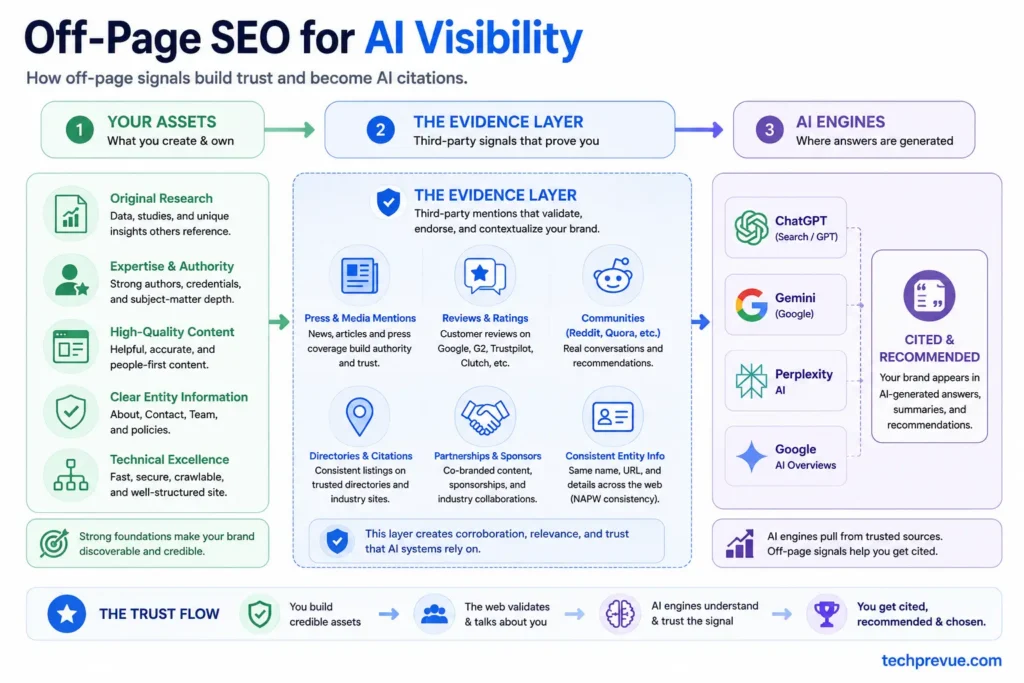
Why Off-Page Signals Drive AI Citations
AI systems learn about your brand from the entire web — training data, retrieved pages, review platforms, community discussions. Your own website is one voice among thousands.
The evidence base:
- The GEO research study (KDD 2024) tested optimization strategies across thousands of queries: adding citations, quotations, and statistics boosted visibility in generative answers by 30–40% on key metrics, while keyword stuffing reduced visibility by about 10%
- Multiple 2025 citation studies found Reddit, Wikipedia, and major review platforms among the most-cited domains in AI answers — third-party surfaces, not brand sites
- Interestingly, 2025 research from Ahrefs found that adding schema markup showed no measurable effect on AI citation rates — technical markup helps machines parse pages, but reputation earns the citation
Translation: the off-page work in this guide — research assets, PR coverage, reviews, community presence, entity consistency — is the AI visibility playbook.
Build Third-Party Corroboration Around Your Brand
AI systems corroborate before they recommend. Strengthen the evidence trail:
- Get your key facts (founding, services, locations, expertise) stated consistently on authoritative third-party pages
- Earn mentions in “best of” and comparison content written by others
- Publish original data other sites cite — every citation is a corroboration vote
Strengthen Entity Consistency Across Trusted Sources
Audit everywhere your brand is described — GBP, LinkedIn, directories, Wikipedia/Wikidata if eligible, industry profiles — and standardize names, descriptions, founders, dates, and locations. Conflicting information makes AI systems hedge or skip your brand entirely.
Participate in Communities Where Real Questions Are Asked
AI engines heavily weight community content because it captures authentic experience. Genuine, expert participation in Reddit threads, Quora answers, and niche forums puts your brand inside the exact conversations AI models retrieve and summarize.
Monitor AI Citations, Context, and Sentiment
Add AI answer tracking to your monthly reporting: ask the major assistants your category’s key questions, record whether you’re mentioned, how accurately, and with what sentiment, and track the trend. Then work backward — when a wrong or missing answer traces to a stale third-party page, fix the source.
Why No Technique Can Guarantee an AI Citation
Be skeptical of anyone selling guaranteed AI citations. Models change, retrieval changes, and answers vary by phrasing and user. Off-page work raises the probability of citation by improving the evidence AI systems find. That is the honest ceiling — and it is worth a lot.
How to Use AI in Off-Page Campaigns Without Creating Spam
AI tools belong in your workflow on the research side, not the publishing side:
Good uses: analyzing competitor backlink exports, grouping prospects, researching journalists and communities, drafting personalization you then edit and verify.
Spam uses that will burn your domain: mass-produced AI guest posts, automated bulk outreach, fake expert personas, and auto-generated link networks. Google’s spam policies target scaled content abuse regardless of how it was produced — and human editors blacklist senders faster than Google does.
Rule of thumb: AI for the spreadsheet work, humans for the relationships.
How to Measure Off-Page SEO Results
Off-page SEO measurement fails when it stops at link counts. Measure outcomes first, signals second, vanity never. Here is the hierarchy.
Business and Conversion Metrics First in Off-Page Reporting
The metrics that justify the budget:
- Leads or revenue attributed to referral and organic growth
- Qualified referral traffic — visitors from earned placements, and what they do next
- Assisted conversions — off-page touchpoints that appear earlier in converting journeys
Search Visibility Metrics
- Rankings for target pages — the 3–5 strategic pages your campaigns support
- Branded search demand — impressions and clicks for your brand terms in Search Console; the cleanest proxy for growing brand authority
- New relevant referring domains — count only topically relevant domains; a hundred spam domains is noise, not progress
- Links to strategic pages — deep links to money pages matter more than another homepage link
Reputation and AI Visibility Metrics
- Brand mentions and share of voice versus competitors in your category’s coverage
- Review volume, recency, and sentiment across your priority platforms
- Local profile actions — calls, direction requests, and website clicks from GBP
- AI citation visibility — your monthly AI answer audit: mentioned or not, accurate or not, positive or not
Why DA and DR Should Not Be Your Primary SEO KPIs
Domain Authority (Moz) and Domain Rating (Ahrefs) are third-party estimates of link strength. Useful for quickly comparing prospects; misleading as goals. They are not Google metrics, they can be inflated by spam, and they pay no bills. Report them as context, never as results.
Useful Off-Page SEO Tools by Task
Choose tools by job, not by brand loyalty. One paid backlink suite plus free Google tools covers most teams.
- Backlink analysis and competitor research: Ahrefs, Semrush, Majestic, or Moz Pro — any one of them; plus Google Search Console’s free links report
- Brand-mention monitoring: Google Alerts (free), Brand24, or Mention for social and forum coverage
- Digital PR and outreach: Qwoted or Featured for journalist requests; Hunter for contact finding; BuzzStream or Pitchbox for relationship pipelines
- Reviews and local listings: Google Business Profile manager, Bing Places, and a listings tool if you manage many locations
- Measurement: GA4 for referral and conversion tracking, Search Console for branded demand and manual action alerts
- AI visibility monitoring: the assistants themselves (free monthly audits), plus emerging trackers like Profound or Semrush’s AI toolkit for scale
Tools report. They do not build reputation. Budget accordingly.
Off-Page SEO Mistakes and Risky Practices to Avoid
Every mistake below either wastes money or invites a link spam penalty. Several are still sold as “SEO packages” in both the US and India — treat this as your vendor-screening list.
Buying Links and Paid Link Insertions
Paid dofollow links — including “niche edits” inserted into old posts — violate Google’s link spam policies. Sponsored placements are fine only with rel="sponsored". If a vendor promises “high DA dofollow links, $30 each,” you are buying a spam footprint attached to your domain forever.
Private Blog Networks (PBN Links)
Networks of sites that exist to link to customers. Google’s spam systems and manual reviewers dismantle them routinely, and links from a deindexed network are worse than no links.
Mass Directory Submission and Bookmarking Blasts
The spam version of techniques 5 and 6: submitting to hundreds of low-quality directories or bookmarking sites in bulk. Explicitly named in Google’s spam examples. Quality and relevance or nothing.
Exact-Match Anchor Text Campaigns
Engineering your backlink anchors around money keywords is one of the oldest penalty patterns in SEO. Keep anchors branded and natural, and never use your focus keyword as the anchor when you can influence it.
Mass Guest Posting and Scaled AI Content
Publishing hundreds of thin guest posts — human or AI-written — across low-quality blogs is a link scheme plus scaled content abuse in one package.
Excessive Link Exchanges
Occasional reciprocal links between genuinely related sites are natural. Systematic “you link me, I link you” programs are named link spam.
Fake Reviews and Undisclosed Influencer Deals
Fake reviews risk platform bans and regulatory action; undisclosed paid promotion violates FTC and ASCI rules. Both destroy the trust your off-page efforts exist to build.
Judging Backlinks Only by DA or DR
Chasing third-party scores leads to buying irrelevant “high DA” links — expensive, risky, and useless. Score prospects with the backlink evaluation table above instead.
Do Old Off-Page SEO Tactics Still Work in 2026?
Every SEO course, especially in the Indian training market, still teaches a list of legacy off-page activities. Here is the honest, tactic-by-tactic status check — what evolved, what died, and what will hurt you.
Press Release Submission and Distribution
Status: reframed. Press releases distributed purely for backlinks are worthless — wire-service links are nofollow or ignored, and Google has treated press-release anchors as unnatural for over a decade. But a genuinely newsworthy release still earns real journalist pickups, which produce editorial coverage and links. Write releases for news value, distribute to relevant journalists, and treat any link as a bonus.
The Skyscraper Technique for Link Building
Status: diminished but usable. The classic Backlinko-popularized method — find linked-to content, make something bigger, pitch everyone linking to the original — still works occasionally. Its weakness in 2026: everyone runs the same play, and “longer” no longer reads as “better” to editors drowning in AI-written pitches. It succeeds only when your version adds genuinely new information: fresh data, original testing, or expert input. Length alone converts nobody.
Web 2.0 Submission and Profile Creation
Status: dead as a link tactic. Creating networks of free Blogger, WordPress.com, and Tumblr properties to link back to your site is a self-made link scheme — thin satellite content with manufactured links. The only modern version worth doing: one or two well-maintained brand profiles on platforms where you actually publish (a LinkedIn newsletter, a Medium presence with canonicals), managed as real channels rather than link sources.
Blog Commenting for Backlinks
Status: dead for links, alive for relationships. Comment links are nofollow everywhere that matters, and mass commenting is textbook UGC spam. Thoughtful comments on industry blogs still have one real use: getting noticed by authors you later pitch. Comment to start conversations, never to place URLs.
Image, PDF, PPT, and Video Submission Sites
Status: mostly dead — with two exceptions. Uploading infographics, documents, and videos to submission directories for backlinks produces nothing; those platforms have no audience and their links carry no weight. The exceptions have real audiences: SlideShare-style platforms in niches where professionals genuinely browse decks, and YouTube — which is not a “video submission site” but the world’s second-largest search engine. Publish where humans watch; skip the directories where only bots visit.
The Pattern Behind Every Legacy SEO Tactic
Notice the rule that separates survivors from casualties: tactics tied to real audiences evolved and survived (directories became citations, bookmarking became communities, press releases became digital PR). Tactics tied only to link placement died. Before adopting any technique — old or new — ask one question: would this still be worth doing if the link didn’t exist? If yes, it probably works. If no, it probably never will again.
What Should You Do About Spammy or Toxic Backlinks?
Every established site accumulates spammy backlinks. Scrapers, bots, and junk directories link to everyone. The right response is usually calmer than the “toxic link audit” industry suggests.
When Bad Links Require No Action
Google has stated for years that it ignores most spam links automatically, and that random low-quality links generally don’t need cleanup. A few dozen junk domains in your profile is normal internet weather.
When to Investigate Suspicious Backlinks Seriously
Act when you see: a manual action notice in Search Console, a sudden flood of thousands of spam links (possible negative SEO), or clear evidence of past paid-link building on your own domain.
The Backlink Cleanup Sequence
- Check Search Console → Security & Manual Actions
- Remove links you control (old profiles, past vendors’ placements)
- Request removal from webmasters where practical
- Consider Google’s disavow tool only for a manual action or a clearly unnatural link history — Google itself says most sites should never need it
Avoid Fear-Based Toxic Link Audits
Recurring “toxicity scores” sold as monthly emergencies mostly monetize anxiety. Monitor quarterly, act on real triggers, and spend the saved budget earning good links instead.
How Long Does Off-Page SEO Take to Show Results?
Expect meaningful movement from sustained off-page SEO in three to six months, with compounding gains from month six onward. Competitive niches and new domains sit at the slower end.
Factors That Affect the Off-Page Timeline
- Starting authority: established sites convert new links into rankings faster
- Competition: outranking entrenched pages requires closing a real authority gap
- Link velocity and quality: a steady stream of relevant editorial links beats sporadic bursts
- On-page readiness: links to content that satisfies intent convert to rankings; links to weak pages stall
Early SEO Indicators vs Long-Term Outcomes
Watch these before rankings move: new referring domains trending up, referral traffic arriving, branded impressions climbing in Search Console, and faster indexing of new content. These leading indicators typically precede ranking gains by weeks.
Set Realistic Link Building Expectations
Anyone promising page-one rankings in 30 days through link building is describing either a non-competitive keyword or a scheme. Plan quarters, not weeks — and remember the compounding: every earned link and mention keeps working while you build the next one.
30/60/90-Day Off-Page SEO Action Plan
Strategy without a schedule is a wish. This plan turns the entire guide into ninety days of concrete work for a small team — or one focused person.
Days 1–30: Off-Page Audit and Foundation
| Task | Output | Success Metric |
|---|---|---|
| Baseline audit: export referring domains, rankings, referral traffic | Baseline report | Complete by day 7 |
| Competitor backlink and mention analysis (top 3–5) | Prospect list of 100+ relevant sites | List scored with the quality table |
| Fix target pages (content, speed, conversion) | 3–5 promotion-ready pages | Pages pass intent and UX review |
| Claim and complete GBP, Bing Places, core citations | Consistent NAP everywhere | Zero conflicting listings |
| Set up alerts: brand mentions, competitor mentions | Monitoring live | Alerts arriving |
| Run first AI answer audit | AI visibility scorecard | Documented baseline |
Days 31–60: Launch Off-Page Assets and Outreach
| Task | Output | Success Metric |
|---|---|---|
| Publish one linkable asset (research, tool, or definitive guide) | Live asset | Indexed and promoted |
| Start digital PR: journalist-request platforms + 2 data pitches | Active pitching rhythm | 10+ quality pitches sent |
| Reclaim unlinked mentions and lost links | Outreach batch one | 20+ reclamation requests |
| Begin community participation (2 platforms) | Established profiles | Daily/weekly genuine activity |
| Launch review request workflow | Review velocity | New reviews every week |
| Pitch 2–3 podcast or guest appearances | Bookings | 1+ confirmed |
Days 61–90: Expand Off-Page Relationships and Measure
| Task | Output | Success Metric |
|---|---|---|
| Follow up all open outreach; nurture responders | Relationship pipeline | Response rate tracked |
| Secure first partnerships or co-marketing project | Joint project scoped | 1 collaboration live |
| Publish second asset or major asset update | Fresh citation target | New links referencing it |
| Expand citations to niche/vertical directories | Vertical presence | All relevant platforms covered |
| Month-3 measurement review against baseline | Growth report | Referring domains, referral traffic, branded search all up |
| Re-run AI answer audit; fix wrong third-party facts | Corrected sources | Accuracy improved vs baseline |
Ongoing Monthly Off-Page Maintenance
After day 90, settle into rhythm: one campaign or asset per month, continuous community presence, weekly review responses, monthly metric review, quarterly backlink hygiene check, and a quarterly AI visibility audit.
Off-Page SEO Examples for Different Businesses
The same principles express differently by business model. Three quick blueprints.
Off-Page SEO Example: Blog or Publisher
A tech blog competing for informational keywords should lead with: an annual original survey of its readers (linkable data), digital PR around the findings, podcast guesting for the founder, active Reddit and forum presence in its niche, and unlinked mention reclamation. Success looks like rising referring domains from industry sites, growing branded searches, and citations in AI answers to category questions.
Local Business Example: Citations and Reviews First
A dental clinic in Austin or Lucknow should lead with: a complete Google Business Profile, weekly review requests with owner responses, citations on national and vertical platforms (Healthgrades or Practo), coverage in local publications, and community sponsorships. Success looks like map-pack rankings, direction requests, calls, and AI assistants recommending the clinic with accurate details.
SaaS Example: Data Assets and Marketplace Reviews
A project management SaaS should lead with: original industry benchmark data, a free tool or template library, listings and review velocity on software marketplaces, founder-led commentary in trade media, and genuine participation where buyers compare tools. Success looks like links to product pages, presence in third-party comparison content, and mention in AI answers to “best [category] software.”
What Off-Page SEO Success Looks Like Beyond Backlinks
In all three cases, the finish line is the same: strangers recommending you in places you don’t control. Links are the receipt, not the achievement.
Off-Page SEO Checklist
Run this checklist quarterly:
- [ ] 3–5 strategic pages selected and promotion-ready
- [ ] At least one current linkable asset (data, tool, or definitive guide)
- [ ] Competitor link and mention gaps reviewed this quarter
- [ ] Every new link prospect scored for quality before pursuit
- [ ] Zero paid dofollow links; all sponsored links correctly attributed
- [ ] Anchor text profile branded and natural
- [ ] GBP and all citations complete and consistent (NAP identical)
- [ ] Directory presence limited to relevant, moderated platforms
- [ ] Review requests running; all reviews answered
- [ ] Active, genuine presence in 1–2 communities
- [ ] Digital PR pitching rhythm active
- [ ] Unlinked mentions and lost links reclaimed monthly
- [ ] Brand information consistent across all major third-party profiles
- [ ] Monthly metrics reviewed: referring domains, referral traffic, branded search
- [ ] Quarterly AI answer audit completed and source corrections made
Frequently Asked Questions About Off-Page SEO
What is off-page SEO in simple words?
Off-page SEO means improving your search rankings through activities outside your website — earning backlinks, reviews, mentions, and citations that prove to search engines and AI systems that your site is trusted.
What is an example of off-page SEO?
A news site linking to your original research is a classic example. Others include a customer’s Google review, a Reddit thread recommending your product, a podcast interview, and a Justdial or Yelp listing.
Is off-page SEO only link building?
No. Link building is the largest component, but off-page SEO also includes reviews, local citations, brand mentions, digital PR, community participation, and reputation management — signals that matter increasingly for AI-generated answers.
What is the most important off-page SEO technique?
Earning editorial backlinks from relevant, trusted websites remains the single most impactful technique, because links are a confirmed part of Google’s ranking systems. Original research and digital PR are the most reliable ways to earn them.
Is directory submission still useful for off-page SEO?
Yes — selectively. Quality directories (Google Business Profile, Bing Places, Justdial, Sulekha, and moderated niche directories) build citations, local rankings, and entity consistency. Mass submission to low-quality directories is classified as link spam by Google and should be avoided.
Does social bookmarking still work for SEO?
The old tactic of blasting links to bookmarking sites is dead and flagged as spam. Its modern successor works well: sharing genuinely useful content in communities like Reddit, Flipboard, and Pinterest drives discovery, referral traffic, and mentions that AI engines frequently cite.
Do nofollow links help off-page SEO?
Yes. Google treats nofollow as a hint rather than a strict directive, and nofollow links deliver referral traffic, brand visibility, and entity signals. A natural backlink profile always contains a healthy share of nofollow links.
How many backlinks does a page need to rank?
There is no universal number. You need enough relevant, quality links to close the gap with the pages currently ranking — analyze the top results’ referring domains for a realistic benchmark. Ten strong links can beat a thousand weak ones.
Can a website rank without off-page SEO?
For low-competition, long-tail keywords, yes — excellent content alone can rank. For competitive keywords, effectively no. Studies consistently show top-ranking pages hold far more referring domains than the pages below them.
Is social media part of off-page SEO?
Yes, as an indirect channel. Social metrics are not direct ranking factors, but social distribution creates the visibility that leads to links, mentions, branded searches, and AI citations.
Does off-page SEO matter for AI search like ChatGPT and AI Overviews?
Enormously. AI engines decide what to say about brands based on third-party evidence: coverage, reviews, community discussions, and consistent entity information. Off-page SEO is the primary lever for AI visibility.
How is off-page SEO different in India vs the US?
The principles are identical; the platforms differ. India runs on Justdial, Sulekha, IndiaMART, Practo, and regional-language media, while the US runs on Yelp, BBB, and vertical directories like Healthgrades. Businesses serving both markets need consistent entity information across both ecosystems.
Should I remove every spammy backlink pointing to my site?
No. Google ignores most spam links automatically. Investigate only for manual actions, sudden spam floods, or a history of paid links — and use the disavow tool only when genuinely justified.
Build a Reputation, Not Just Backlinks
Strip away the tactics and off-page SEO is one discipline: becoming a brand the web vouches for.
Referenced by publishers. Recommended in communities. Reviewed by customers. Represented accurately everywhere — including inside AI answers.
Backlinks follow reputation far more reliably than reputation follows backlinks. Build something worth citing, put it in front of the people who cite things, keep your facts consistent across the web, and measure what actually moves your business.
Start with the day-1-to-30 plan above. Ninety days from now, your site won’t just be arguing its own case — the rest of the internet will be arguing it for you.
