
Wondering how to rank in AI Overviews now that Google answers most questions before anyone clicks? You’re not alone. AI Overviews reach over 1.5 billion users every month, and the sites cited inside them are winning visibility that blue links alone can’t deliver anymore.
This guide breaks down exactly how to get your content cited, using published data instead of guesswork.
Quick Answer: To rank in AI Overviews, first rank in Google’s top 10 for your target query, then place a direct 40–60 word answer near the top of your page. Support it with question-based subheadings, schema markup, strong E-E-A-T signals, and topic clusters that cover related “fan-out” queries. Refresh the page regularly to keep the citation.
What Are Google AI Overviews?
Google AI Overviews are AI-generated summaries that appear at the top of search results, above every organic listing. Google’s Gemini model reads multiple sources, synthesizes an answer, and links to the pages it used as citations.
They started as Google SGE (Search Generative Experience) in 2023. So if you’ve searched for “how to rank in AI Overviews Google SGE,” you’re looking at the same feature under its old name. SGE became AI Overviews at Google I/O in May 2024, and the citation mechanics carried over.
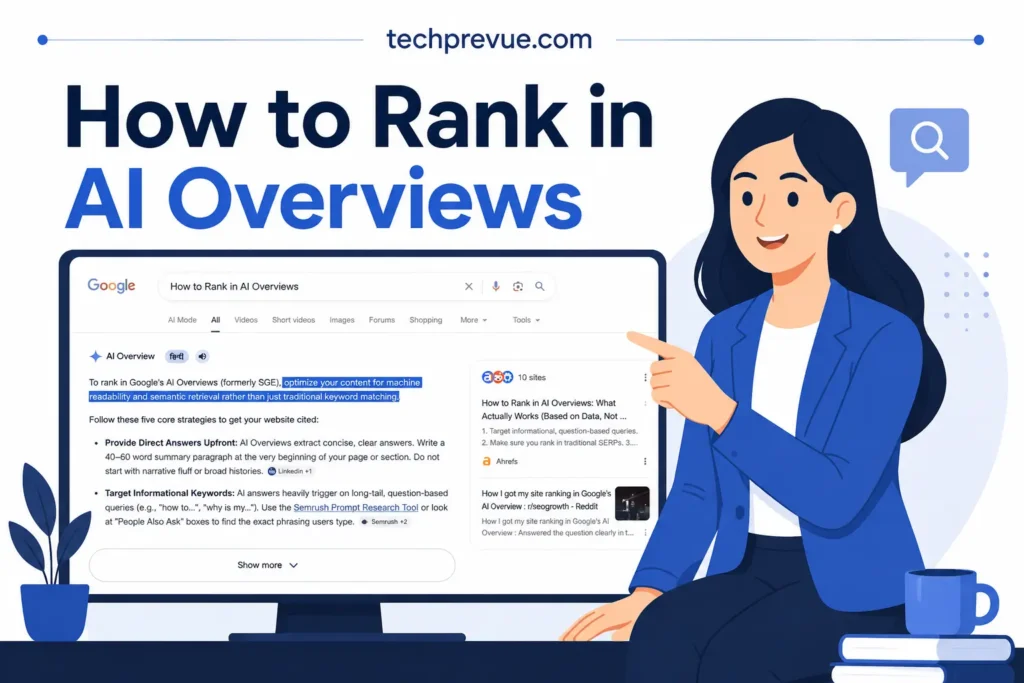
When your page appears as one of those cited sources, you’re effectively “ranking” in the AI Overview. The top citation is visible without any interaction. The rest appear when users tap “Show more.”
Why Ranking in AI Overviews Matters in 2026
The click economy has changed. Here’s what independent studies show:
| Finding | Data | Source |
|---|---|---|
| Keywords that trigger AI Overviews | 21% of all queries; 57.9% of question queries | Ahrefs study of 146M SERPs |
| Intent behind AIO keywords | 99.9% informational | Ahrefs |
| CTR drop when an AI Overview appears | 34.5% average, up to 61% | Ahrefs; Seer Interactive |
| Users clicking a result when an AI summary is present | 8% (vs. 15% without one) | Pew Research Center |
| Long-term clicks for cited brands | 35% more organic clicks over time | Seer Interactive |
Read those last two rows together. Clicks are down overall, but brands that get cited pull further ahead of brands that don’t. Visibility inside the answer is the new position #1. If you don’t appear there, users may never scroll far enough to find you.
How Google Picks Sources for AI Overviews
Understanding the machine makes AI optimization much easier. The process works in four stages:
- Query interpretation. Google parses intent and identifies entities in the search.
- Query fan-out. The system silently expands your search into multiple related sub-queries and retrieves results for each one.
- Synthesis. Gemini uses retrieval-augmented generation (RAG) to write a summary from the retrieved pages.
- Citation. Pages that supplied specific passages get linked, often through text fragment URLs that jump to the exact paragraph used.
Two details matter most for you. First, fan-out means Google isn’t just checking who ranks for the main keyword. Ahrefs found that pages ranking for those hidden fan-out queries were 161% more likely to be cited in the final overview. Second, passage-level linking means individual paragraphs compete, not just whole pages.
How to Rank in Google AI Overviews: 10 Proven Strategies
These best practices for how to rank in Google AI Overviews come from published citation studies and documented experiments, not theory. Work through them in order.
1. Rank in the top 10 first
There’s no shortcut past traditional SEO. Ahrefs analyzed 1.9 million AI Overview citations and found 76% of cited URLs also ranked in the top 10, with a median organic position of 2. Semrush’s study puts the overlap at roughly 67%, and SE Ranking found that 92% of AI Overviews link to at least one top-10 domain.
So your foundation is unchanged: solid keyword research, quality content, healthy backlinks, clean technical SEO. AI Overviews sit on top of organic rankings; they don’t replace them.
2. Put the answer first
Google’s AI extracts passages that answer questions completely and immediately. Bury your answer under three paragraphs of backstory and the AI will cite someone else.
For every question your page targets, write a 40–60 word standalone answer directly under the heading. Definition first, details after. Exposure Ninja documented a case where adding one summary paragraph to the top of a post earned an AI Overview citation within 12 hours of reindexing.
3. Optimize for query fan-out
This is the biggest gap between pages that get cited and pages that don’t. If you want to rank for AI Overviews in Google consistently, cover the sub-questions Google generates around your topic, not just the head term.
How to find them:
- Pull every People Also Ask question for your keyword.
- Check autocomplete and related searches.
- Look at what subtopics the current AI Overview actually covers.
- Answer each one under its own H2 or H3, phrased as the question.
One page that answers eight related questions beats eight thin pages answering one each — as long as every section stands alone.
4. Build topical authority with topic clusters
AI systems evaluate whether your whole site understands a subject, not just one URL. Create a pillar page for your main topic, then supporting articles for each subtopic, and interlink them with descriptive anchor text.
This structure feeds the Knowledge Graph, strengthens internal linking, and multiplies your surface area across fan-out queries. It’s slow work. It’s also the most durable form of artificial intelligence optimization there is, because authority compounds while individual citations rotate.
5. Add schema markup
Structured data makes your content machine-readable. It won’t force a citation, but it removes ambiguity about what your page contains.
| Schema type | Use it on | Why it helps |
|---|---|---|
| Article | Every editorial page | Confirms author, date, publisher |
| FAQPage | FAQ sections | Maps questions to extractable answers |
| HowTo | Step-by-step guides | Marks each step as a discrete unit |
| Product | E-commerce pages | Feeds specs into the Shopping Graph |
| Organization | Sitewide | Anchors your brand as an entity |
Validate everything in Google’s Rich Results Test. Broken schema is worse than none. Google’s own documentation on AI features in Search confirms that standard SEO and structured data best practices apply to AI surfaces too.
6. Strengthen E-E-A-T signals
Google’s AI leans on trust signals when choosing sources. Cover the basics on every important page:
- Author bio with real, verifiable credentials
- A visible “last updated” date and review statement
- Citations to primary sources for every claim and statistic
- First-hand proof: screenshots, test results, original data
One original study or survey per topic cluster does more for authoritativeness than a dozen aggregated listicles.
7. Refresh content on a schedule
Freshness isn’t optional anymore. AirOps found that pages left untouched for a quarter were 3x more likely to lose their AI citations than recently updated ones. Put your money pages on a refresh calendar: update statistics, replace stale examples, revise the quick-answer blocks, and resubmit through Search Console.
8. Earn brand mentions beyond your site
Ahrefs’ December 2025 research across 75,000 brands found that branded web mentions and YouTube presence were among the strongest correlations with AI visibility. Google’s AI checks whether the wider web treats you as an authority.
Practical moves: digital PR, original data that journalists cite, podcast and YouTube appearances, and genuine participation in Reddit and Quora threads where your audience asks questions.
9. Make every passage extractable
Because AI Overviews link to specific text fragments, each section of your page should work as a self-contained answer. Keep paragraphs short. Give each section unique vocabulary — if three sections repeat the same phrasing, passage-linking gets ambiguous and Google may skip you. Use tables and numbered lists where the format fits the answer.
10. Track your AI Overview visibility
You can’t improve what you don’t measure. Manually check your target keywords weekly, or use a tracker (SE Ranking, Semrush, Ahrefs, and AirOps all offer AIO monitoring). Watch three numbers: keywords triggering overviews, your citation share, and CTR shifts on affected pages in Search Console.
How to Rank in AI Overviews Without Citations or Top Rankings
Here’s the part most guides skip. What if you’re not in the top 10 yet — can you still get in?
Sometimes, yes. Search Engine Land’s analysis confirms that some AI Overview sources come from beyond page one, and occasionally from pages that don’t rank for the main query at all. It happens through fan-out: your page might be the single best answer to one narrow sub-question inside the overview, even if a bigger site owns the head term.
So the playbook for ranking in AI Overviews without citations to your domain yet:
- Target long-tail, question-form queries of 7+ words where competition is thin.
- Answer one specific sub-question better than anyone — with data or first-hand testing.
- Get brand mentions on pages that already rank; the AI reads those too.
- Win a featured snippet for the sub-question. Snippet holders frequently graduate into overviews.
Think of it as a side door. Slower than ranking outright, but real.
How to Rank in AI Overviews for Product Descriptions
E-commerce gets ignored in most AIO guides, yet commercial queries trigger overviews more often every quarter. For product pages:
- Rewrite thin manufacturer descriptions into original, spec-complete copy. Duplicated text almost never gets cited.
- Answer buyer questions on the page itself: sizing, compatibility, materials, care, returns.
- Add Product and Review schema so the Shopping Graph can read your specs.
- Publish comparison content (“X vs Y”) — AI answers love structured comparisons.
- Keep prices and availability accurate; stale data kills trust signals.
A product page that reads like a helpful answer, not a label, is the one that gets pulled into the summary.
How Long Does It Take to Rank in AI Overviews?
Honest answer: it depends on where you’re starting from. Based on documented cases and citation studies:
| Your starting point | Typical timeframe |
|---|---|
| Already ranking top 3 for the query | Hours to 2 weeks after adding answer-first blocks |
| Ranking top 10 | 2–8 weeks with on-page optimization and reindexing |
| Ranking page 2+ | 3–6 months (you must climb organically first) |
| New site or new topic cluster | 6–12 months of authority building |
The fastest documented win is the 12-hour Exposure Ninja case — but that page already ranked #1. For everyone else, treat this as a compounding project, not a hack.
How to Stay in AI Overviews Once You Rank
Getting cited once isn’t the finish line. AI Overviews are non-deterministic — they regenerate, and their sources rotate. AirOps found only 30% of brands stay visible from one AI answer to the next.
The retention routine:
- Refresh cited pages quarterly, minimum.
- Re-check the overview monthly; if your citation dropped, compare your passage against the new sources and close the gap.
- Keep earning fresh brand mentions. Authority decay is real.
The same research found 40% of pages that lost citations won them back after targeted optimization. Losses are recoverable if you’re watching.
Common Mistakes That Keep You Out of AI Overviews
- Burying answers under long intros
- Publishing one mega-page instead of a cluster, or a cluster of thin pages with no depth
- Skipping schema, or shipping schema with validation errors
- Chasing exact-match keywords while ignoring fan-out questions
- Letting winning pages go stale for six months
- Blocking Google-Extended or AI crawlers by accident in robots.txt
FAQs – How to Rank in AI Overviews
How do I rank in AI Overviews?
Rank in the top 10 organically, answer the query in the first 40–60 words of the relevant section, use question-based headings, add valid schema markup, and build topical authority through interlinked content clusters. Then keep the page fresh.
How do I optimize my SEO for Google’s AI Overviews?
Start with an audit: check which of your keywords already trigger overviews and whether you’re cited. Then optimize page structure (answer-first blocks, question headings), technical signals (schema, speed, crawlability), and authority signals (E-E-A-T, brand mentions). It’s standard SEO with an extraction layer on top.
Is ranking in AI Overviews the same as ranking in Google SGE?
Yes. SGE was the beta name for what became AI Overviews in May 2024. Advice for how to rank in Google AI Overviews SGE-era still applies — answer clearly, rank organically, prove trust — though citation behavior has matured since the experiment days.
Does my location affect AI Overviews?
Yes. If your location is USA, you see the widest AI Overview rollout, so competition for citations is heaviest there — but local intent still matters, and local pages with strong Business Profiles win geo-modified overviews. Availability and triggering rates vary by country and language.
Can AI optimization replace traditional SEO?
No. AI optimization — sometimes called GEO or AEO — is a layer on top of SEO, not a substitute. Since the overwhelming majority of citations go to pages already ranking in the top 20, traditional rankings remain the entry ticket.
How do I rank in AI search overviews on mobile?
The same principles apply, but mobile makes speed and Core Web Vitals more important, since most overview triggers happen on phones. Keep answers high on the page; mobile users see even less below the AI box.
Final Thoughts
Learning how to rank in AI Overviews isn’t about tricking a new algorithm. It’s about being the clearest, most trustworthy answer on a topic you genuinely own — and structuring that answer so a machine can lift it cleanly. Rank first. Answer fast. Cover the fan-out. Prove your expertise. Then defend the citation with freshness.
The sites doing this in 2026 aren’t just surviving the zero-click era. They’re the ones the AI keeps recommending.
Sources & Data References
Studies referenced in this article: Ahrefs’ analysis of 1.9 million AI Overview citations and 146 million SERPs (2025–2026), Ahrefs’ 75,000-brand visibility study (Dec 2025), Semrush’s AI Overview study, SE Ranking’s AIO research, Pew Research Center’s 2025 study of 68,879 real searches, Seer Interactive’s CTR research, AirOps citation-volatility research, and Exposure Ninja’s documented ranking experiments.
Followed link kept in article (non-competing authority): Google Search Central — AI features and your website
