
In a 2019 analysis of 912 million blog posts, Backlinko and BuzzSumo found that 94% earned no external links at all. Not a few. Almost all of them.
The study is dated, but nothing since has moved the underlying picture.
That number is usually quoted as a warning. It is better read as a description of the bar. Most published content gives no one a reason to reference it, which means the reason is the thing to design — not the word count, not the format, not the outreach list.
The best content marketing strategies to get backlinks start from a question most content plans never ask: what would another writer need to say that makes citing this page useful?
Quick answer: To earn backlinks with content marketing, publish something a writer cannot easily reproduce — original research, proprietary data, a working tool, a maintained reference, or first-hand evidence. The format matters far less than whether it gives someone a specific reason to cite you.
Google still uses links to discover pages and judge relevance, as described in its link best practices documentation. But links are one signal among many, not one of three universal ranking factors — a claim that circulated for years after Google stopped supporting it.
If you are starting from scratch, read what backlinks are and how they work first. This guide handles a narrower problem: what should you create if you want other sites to reference you without being asked?
How Content Marketing Earns Backlinks
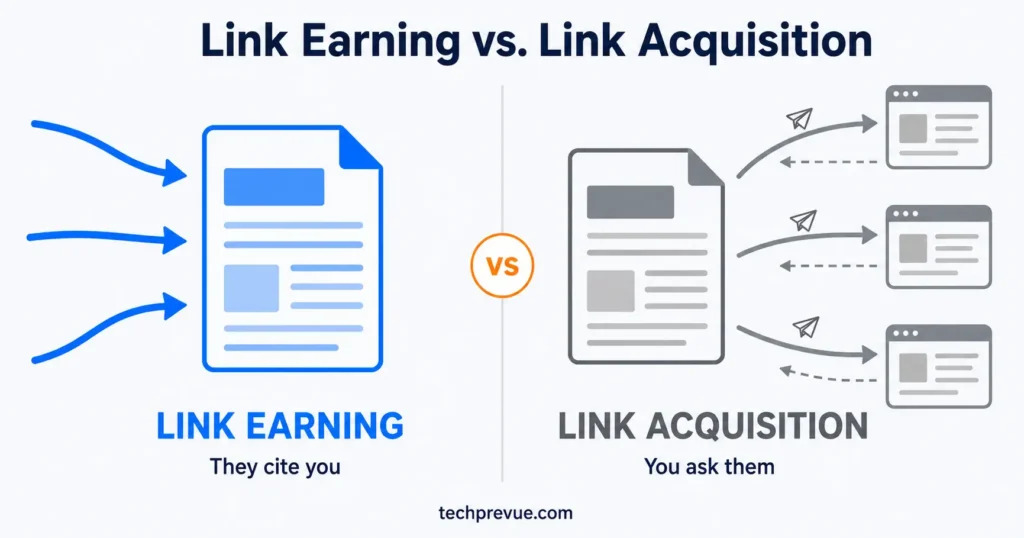
Two different jobs hide inside most conversations about backlinks, and confusing them wastes budget.
Link earning happens when a publisher decides your content is worth referencing. Link acquisition is the work of finding opportunities and actively pursuing links — outreach, broken-link replacement, journalist requests, guest contributions, resource pages.
This article is about the first job only.
For acquisition methods, use our guide to getting backlinks. For the full discipline — earning, acquiring, evaluating quality, managing risk, and measuring results — see the link building pillar.
The distinction matters because outreach cannot repair an asset that gives publishers no reason to cite it. A perfect pitch for a forgettable page still fails. A genuinely useful resource can survive mediocre promotion. That is why content marketing strategies to get backlinks work differently from outreach tactics: the leverage sits in what you build, not in how many people you ask.
Consider two pages on the same topic. 10 Email Marketing Tips may help a reader and still offer another writer nothing exclusive — every tip is available in fifty other places. A study showing how 2,000 email campaigns performed by send hour gives that writer a specific finding they cannot get elsewhere.
That is the gap between useful content and citation-worthy content.
What Google Actually Says About This
In May 2026, Google published its official guide to optimizing for generative AI features. Buried in it is the clearest statement Google has made about what makes content worth surfacing.
Google divides content into two categories:
Commodity content is built on common knowledge that could originate from anyone. Google’s own example is an article titled 7 Tips for First-Time Homebuyers. It adds little unique insight, because anyone could write it.
Non-commodity content provides expert or first-hand takes that go beyond the ordinary. Google’s example: Why We Waived the Inspection & Saved Money: A Look Inside the Sewer Line.
Key takeaways
- Google names commodity content as the failure mode, and its example is a generic listicle.
- The distinction is about knowledge, not length — Google states there is no ideal page length.
- A first-hand perspective is the differentiator Google explicitly calls out.
- Google says the same foundational SEO practices apply, because its generative AI features are rooted in its core Search ranking and quality systems.
That distinction is not a link-building framework, but it maps onto one exactly. Commodity content has no citation reason; non-commodity content does.
Google is describing, from the ranking side, the same quality that makes a publisher choose to reference you.
Two other lines from that guide belong in any content plan. Google says there is no ideal page length, and it warns that creating separate pages for every query variation, primarily to manipulate rankings or AI responses, violates its scaled content abuse policy.
The intent qualifier matters. Covering a topic thoroughly across several genuine pages is not the problem; publishing thin variants to farm queries is.
What Makes Content Worth Linking To?
Before funding a survey, a calculator, an infographic, or a 5,000-word guide, put the idea through the TechPrevue Citation-Readiness Framework.
Ask one question:
What could another writer say that would make citing this page useful?
If there is no convincing answer, a more expensive version of the same idea will not fix it.
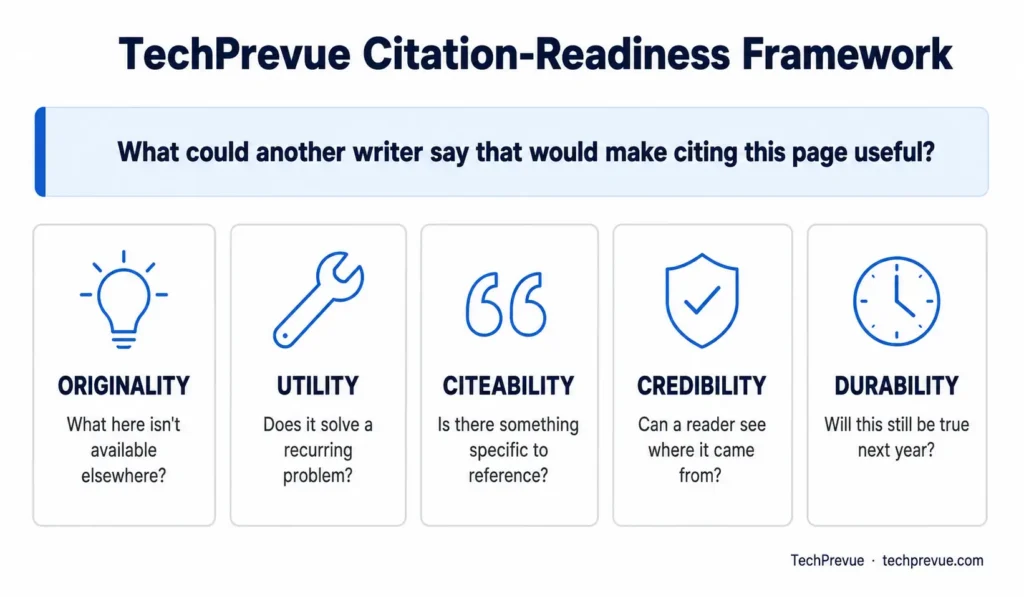
The five-part test
| Test | Question to ask | Failure signal |
|---|---|---|
| Originality | What here isn’t available elsewhere? | Every fact traces to another site |
| Utility | Does it solve a recurring problem or save real work? | Reader enjoys it, then never returns |
| Citeability | Is there a specific result, figure, tool, definition, or visual to reference? | No sentence a writer could quote |
| Credibility | Can a reader see where the information came from and why to trust it? | No method, no date, no sample |
| Durability | Will this stay useful, or can you maintain it as it changes? | Accurate today, wrong in ten months |
You do not need to score ideas numerically. The framework exists to kill weak concepts before production money is spent.
Take two statistics pages. The first collects figures from twenty other sites — anyone citing those figures should link to the originals, not your roundup.
The second analyzes your own anonymized dataset, publishes the sample size, method, and date, and reports findings available nowhere else. Only the second has an independent reason to be cited.
Apply the test to this article as a check on the framework itself. The Backlinko sample size, the Google commodity/non-commodity language, and the correlation figures later in this piece are all specific enough to reference. The framework is our own. If we had written seven tips for getting more backlinks, none of that would be true.
Which Content Types Earn Backlinks?
There is no universally best format. Choose according to the information or utility you can genuinely supply.
Featured answer: The content types that most reliably earn backlinks are original research, proprietary data, maintained statistics pages, free tools and calculators, original data visualizations, documented case studies, and definitive reference guides. Each earns links for a different reason.
| Content asset | Why someone links | Effort | Shelf life | Best fit |
|---|---|---|---|---|
| Original research | You are the source of the finding | High | 12–24 months | Data-rich businesses |
| Proprietary data | Primary-source statistics | Medium | 12–24 months | SaaS, platforms, marketplaces |
| Statistics / reference page | Fast, reliable sourcing | Medium | High, if maintained | Publishers and researchers |
| Free tool or calculator | Repeated practical utility | High | Multi-year | Business and technical niches |
| Original visualization | Makes hard information reusable | Medium | Tracks its data | Data-heavy subjects |
| Case study or expert resource | First-hand evidence | Low–medium | 12–36 months | Specialist industries |
| Definitive reference | Saves explanation and research time | Medium | High, if maintained | Complex evergreen topics |
Treat this as a decision aid, not a promise. A mediocre calculator does not become linkable because it is interactive, and an original study does not deserve citations if its methodology cannot survive basic scrutiny.
1. Publish original research and proprietary data
Original research gives publishers the simplest possible reason to cite you: you are the source.
You do not need a research department. Depending on your business you can analyze anonymized customer data, survey a relevant audience, manually audit a defined sample, run a controlled experiment, compare public datasets in a new way, or publish benchmarks from a process you already operate.
The strength comes from the evidence, not from calling a blog post a “study.”
A research page that writers will actually cite states:
- what was measured
- when the analysis was run
- how the sample was selected
- the sample size
- the method used
- the limitations affecting interpretation
- the findings, stated plainly
Publishing the method also makes the asset updatable rather than disposable. When the numbers age, you re-run the same method instead of starting over.
If you have no research budget
Three approaches cost time rather than money:
The manual audit. Define a narrow, defensible sample and check one specific thing across all of it by hand. Small samples are fine when the boundary is stated: “We manually checked the 50 highest-ranking Indian D2C checkout flows in July 2026” is a citable sentence. “We looked at a lot of sites” is not.
The small survey. A hundred honest responses from a clearly described audience beats a thousand from an undefined one. State who you asked, how you reached them, and the response rate. Publish the questionnaire.
The recombination. Two public datasets nobody has joined can produce a genuinely new finding. The originality lives in the join and the interpretation. Cite both sources fully — you are adding to them, not replacing them.
2. Build statistics and reference pages people can actually cite
A statistics page can earn links, but collecting numbers from other publishers creates weak citation value.
A stronger reference combines trustworthy primary sources with real organizational work: definitions, comparison, context, and ideally some data you own. Make it trivial for a writer to determine exactly what a figure measures, what period it covers, and where it originated.
The best reference resources remove research friction. A page comparing social media usage by country is far more useful when each figure carries its year, its sample or population definition, its primary source, and a note on methodological differences between countries. A page mixing numbers from different years without flagging it looks comprehensive and creates work for anyone trying to cite it accurately.
That friction is the whole opportunity. Most statistics roundups are unciteable precisely because a careful writer cannot tell what they are looking at.
3. Create free tools and calculators
Tools attract a different kind of reference. A publisher links to a calculator because rebuilding the functionality would be pointless.
ROI calculators, cost estimators, generators, assessment tools, converters, and benchmark calculators can become destinations other sites recommend by default.
The test is simple:
Would someone solving this problem rather send a reader to your tool than explain the manual process?
If yes, the utility is real. If the tool exists because “calculators get backlinks,” the result is usually a thin page wrapped around a function nobody needed.
Tools also have the longest shelf life of any asset in the table. A calculator that stays accurate keeps earning references for years without further investment, which is why the high build cost often works out cheaper per link than repeated campaigns.
4. Turn original information into visual assets
Infographics were once treated as a link-building tactic in themselves. That framing put the value in the wrong place.
A decorative graphic assembled from statistics copied off other websites contains no exclusive information. The design is yours; the substance belongs to someone else, and a careful writer will cite them.
A visualization earns its own citation when it clarifies something genuinely hard to explain in prose — a proprietary dataset, a multi-variable comparison, a timeline, a geographic pattern, a decision tree, a benchmark, or a relationship between variables.
Data first, visualization second.
An original chart showing a finding from your own research gives publishers both evidence and an explanation in one object. A poster of generic SEO tips gives them neither.
5. Document case studies and create expert resources
First-hand experience produces source material that does not exist anywhere else — which is precisely the non-commodity quality Google describes.
An interview becomes valuable when it captures expert knowledge a writer could quote. A case study becomes valuable when it documents what was attempted, what changed, what failed, and the boundaries of the result.
Avoid turning one successful campaign into a universal law. A strong case study gives readers enough about the starting conditions to judge whether the result transfers to them. That transparency is what makes the evidence usable — a dramatic percentage with no baseline is not evidence, it is a claim.
6. Build definitive reference content when the topic needs one
A reference guide can earn links without proprietary research if it explains a difficult subject more clearly than the alternatives.
The goal is not maximum length. Google states plainly in its AI optimization guide that there is no ideal page length and that pages should be built for the audience.
Reference content earns depth by answering the problem completely — a detailed technical or regulatory explanation, a maintained glossary, an industry process, an annotated comparison, or a framework people repeatedly need to explain to their own audiences.
How to Create a Linkable Content Asset
Choosing a format is the easy part. The asset has to be planned around the people who could realistically reference it.
1. Find the citation need
Read the articles, reports, newsletters, forums, academic work, and news coverage in your field, and watch for the moments where a writer clearly needed evidence and settled for something weak.
Look for old statistics still being quoted years past their date, calculations people keep doing by hand, definitions that stay muddled, and subjects where everyone cites the same one or two aging sources.
Those gaps are usually better starting points than keyword volume. A phrase with 200 searches a month that thirty journalists need evidence for is worth more than a 10,000-volume term nobody ever cites.
2. Identify who would actually reference it
Your customer and your linker are often different people.
A mortgage calculator serves homebuyers but attracts links from financial writers and property publications. A cybersecurity benchmark serves security teams while being cited by journalists, analysts, and researchers.
Design for both without confusing either. Usually this means the asset serves the customer and the methodology page serves the linker.
3. Pick the format after finding the problem
Do not start with “we need an infographic.”
Start with the information need.
If the problem needs computation, build a calculator. If writers need new evidence, run research. If the information is hard to interpret, visualize it — and if people repeatedly need a reliable explanation, build a reference.
4. Create something you can defend
Originality without credibility is not enough.
Document methodology, assumptions, dates, definitions, and limitations wherever they matter. If a result rests on a small sample or an unusual audience, say so in the same breath as the finding.
This matters most for research and statistics pages, where a striking percentage travels much further than the context that qualifies it. Publishing the caveat protects you when the number gets quoted back at you eighteen months later.
5. Connect it to the rest of your site
A linkable asset should never sit as an orphan.
Link it into your main topical resources. Content-led link earning belongs inside a broader content marketing strategy and supports the wider authority work covered in our off-page SEO guide. Internal links also give readers somewhere to go once the immediate question is answered.
6. Set the maintenance cadence before you publish
An evergreen concept does not make every number evergreen.
| Asset type | Realistic review cycle | What breaks first |
|---|---|---|
| Original research | Annually | The finding’s date context |
| Statistics page | Quarterly | Individual source figures |
| Calculator | On rule change | Tax rates, formulas, thresholds |
| Reference guide | Twice yearly | Regulatory and platform changes |
| Case study | Rarely | Nothing, if dated properly |
Decide before publication whether you can hold that cadence. A smaller resource that stays accurate is more defensible than a large one full of numbers nobody rechecks. Assets that decay quietly do more reputational damage than assets that never existed, because the links pointing at them are now pointing at something wrong.
How to Make an Asset Technically Easy to Cite
This is where most linkable-asset projects lose links they had already earned. A writer decides to reference you, spends ninety seconds hunting for the exact figure and its source, gives up, and cites someone else. Remove that friction deliberately.
Put the headline finding in one quotable sentence. Near the top, in its own paragraph, containing the number, the sample, and the period. Not buried in paragraph fourteen. A writer should be able to copy one sentence and have a complete, accurate citation.
Publish a methodology block. Sample size, selection method, collection window, tools used, known limitations. Give it its own heading so it can be linked directly.
Burn the source into every chart. Any image will eventually appear somewhere without the surrounding page. Put your brand, the sample size, and the date inside the graphic itself.
Use stable, descriptive heading anchors. A writer citing one specific finding should be able to link straight to it. Avoid auto-generated anchors that change when you edit a heading.
Offer the underlying data. A downloadable CSV or a clean table converts a passing reference into a page other researchers build on. It also makes your figures verifiable, which raises the odds that a careful publication uses them at all.
Write a “cite this” line. Publication name, author, title, date, URL, pre-formatted. It costs one paragraph and it standardizes how you get referenced.
Date the page visibly and keep it accurate. Google supports byline dates, and writers routinely reject sources they cannot date. An undated statistic is an unusable statistic.
Write real alt text on data visuals. Alt text describing the finding — not “chart” — helps accessibility, image search, and AI systems that parse the page. Google’s AI optimization guide explicitly identifies high-quality images and video as opportunities for additional visibility.
Using Customer Data Without Creating a Legal Problem
“Analyze your anonymized customer data” appears in every linkable-asset guide. Almost none mention that the data belongs to your customers and is regulated in most markets you publish into.
This is a prerequisite, not a footnote — but it is also not a blocker. Research and statistical use is one of the recognized categories in most modern frameworks.
In India, the Digital Personal Data Protection Rules were notified by MeitY on 14 November 2025, operationalizing the DPDP Act, 2023. Processing can rest on consent or on certain legitimate uses, and the Act carries an exemption for research, archiving, and statistical purposes where the prescribed conditions are met. In the EU and UK, GDPR requires a lawful basis and purpose limitation. In the US, state-level laws increasingly apply.
Before publishing findings drawn from customer or user data, check four things: your lawful basis, whether your privacy notice covers this purpose, whether a research or statistical exemption applies, and whether aggregation or anonymization takes the output outside scope. Sensitive datasets and anything involving children warrant legal review rather than a checklist.
Three practices keep a research asset publishable regardless of jurisdiction:
- Aggregate before you analyze. Working from an aggregated extract is safer than pulling raw records and stripping identifiers afterward.
- Suppress small cells. Any segment with a handful of members can be re-identified from context. Set a minimum cell size and hold to it.
- Say what you did. A line stating the data was aggregated and anonymized, with the threshold used, strengthens the research and answers the obvious objection before a journalist raises it.
Handled properly this becomes a credibility asset. A methodology section that addresses privacy directly is more citable than one that hopes nobody asks.
How to Promote Linkable Content Without Turning This Into an Outreach Guide
“Publish and wait” is not a distribution strategy.
Even a strong asset needs a first audience — the channels you control, communities where your participation is genuine, your newsletter, industry relationships, and editorial opportunities where the finding fits the publication’s beat.
Promotion and link earning are related jobs, not the same job. This page is about making content worth referencing. For prospecting, outreach, broken-link building, journalist request platforms, guest contributions, and competitor backlink analysis, continue to How to Get Backlinks.
One boundary worth stating plainly: do not manufacture links to make an asset look successful. Google’s spam policies prohibit link schemes, and a strong asset with a purchased link profile is harder to defend than a weak asset with none.
How to Measure Whether the Content Earned Links
Pageviews cannot tell you whether a linkable asset worked. Track the outcome the asset was built to produce.
Featured answer: Measure a linkable asset on referring domains rather than raw backlinks, the editorial context of each link, referral traffic from relevant sites, Search Console performance including the Generative AI report, and unlinked brand mentions. Raw backlink counts are the least informative number available.
1. Referring domains, not backlinks
Count distinct websites, not links. One publication can generate dozens of sitewide or repeated links and tell you almost nothing. Ten relevant editorial domains say far more about adoption than a hundred links from a single site.
2. Link relevance
Read the page that links to you.
Was your research cited as evidence, your tool recommended, your chart embedded? Or were you added to an unrelated list?
Context tells you whether the asset earned genuine editorial usefulness or just accumulated a number.
3. Referral traffic
A backlink can be valuable even when its ranking effect is impossible to isolate. Relevant links introduce readers, subscribers, journalists, and prospects to your brand. Check whether the meaningful referring sites actually send people — some of the highest-authority links send almost no traffic, and some modest ones send a great deal.
4. Search Console, including the AI report
Monitor queries, impressions, clicks, and landing page performance in the standard report.
Where available, Search Console’s Generative AI performance report shows visibility inside AI Overviews, AI Mode, and Discover. Two limits matter before you build a dashboard around it.
Google is rolling it out to a subset of site owners, starting in the UK, so not every property has access. And it reports impressions, pages, countries, devices, and dates only — no clicks, no CTR, no query data — with history beginning 18 May 2026.
That makes it a visibility signal, not proof an asset earned anything. It is still first-party data, which beats third-party estimates; Google warns explicitly against tools claiming access to its internal ranking metrics.
Do not assume every improvement came from links. Search performance depends on many systems, and correlation between link growth and rankings does not establish cause.
Brand mentions — with the caveat nobody includes
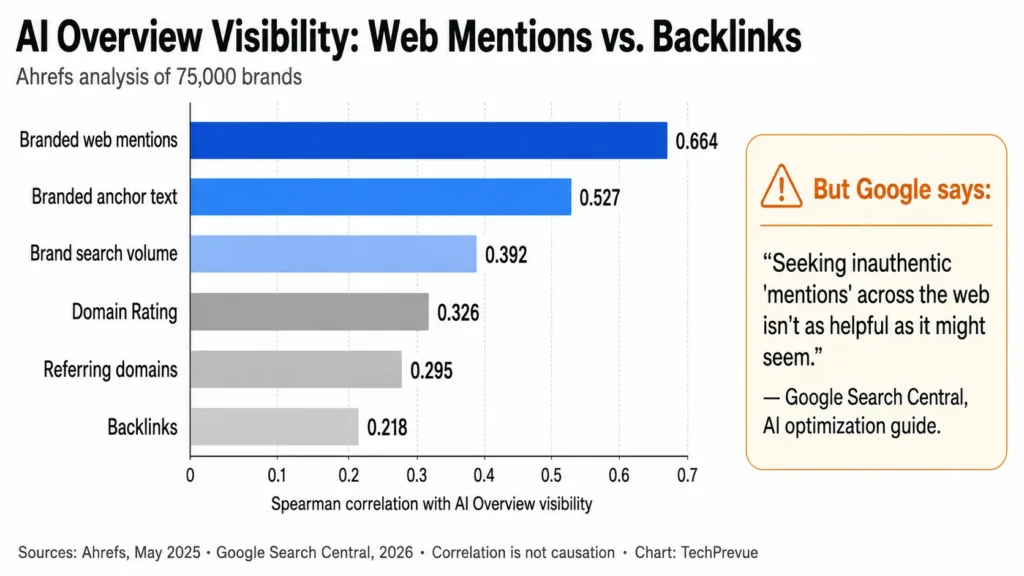
Links are no longer the only third-party signal worth watching, and the data on this is striking. Ahrefs analyzed 75,000 brands in May 2025 and found that branded web mentions correlate with AI Overview visibility at 0.664. The top three factors were all off-site: web mentions, brand anchors at 0.527, and brand search volume at 0.392.
The link metrics sat lower — Domain Rating at 0.326, referring domains at 0.295, and raw backlink count at 0.218. Those three are worth separating rather than collapsing into “backlinks,” because they are not the same measurement and they do not score the same.
Two caveats belong beside those numbers, and most articles quoting them omit both.
Ahrefs’ own caveat: correlation is not causation, and the study notes all measured factors showed moderate to very weak correlations on the Spearman scale. Large brands naturally have more mentions and more AI visibility, so brand strength could be driving both.
Google’s caveat, which is sharper: its AI optimization guide lists “seeking inauthentic mentions” among the things you can safely ignore, stating directly that pursuing mentions across the web is not as helpful as it seems.
Those two positions are not actually in conflict, and the resolution is the point of this entire article. Mentions correlate with visibility because they are a symptom of being worth mentioning. Chasing the symptom produces inauthentic mentions, which Google has told you it discounts. Producing something genuinely worth citing produces authentic ones, along with the links.
So track unlinked mentions as a diagnostic — evidence that the underlying work is landing. Do not run a campaign to manufacture them.
Content Marketing Tactics That No Longer Deserve the Hype
Some backlink advice survived long after the evidence behind it went stale.
1. Writing longer to earn more links
Long content can hold more research, examples, and reference value — but the word count is not the asset. The Backlinko finding that long-form content earns more links is a correlation from 2019 measuring referring domains, and it has been repeated ever since as if it were an instruction.
Google’s position is unambiguous: there is no ideal page length. A 700-word calculator page can out-earn a 7,000-word article that restates existing advice. Write the shortest page that fully supports the asset.
2. Calling everything “epic content”
“Epic” is not a measurable standard. Ask instead what the page contains that a credible publisher cannot obtain as easily somewhere else. If the answer is nothing, adding screenshots, another thousand words, or a bigger introduction does not fix the citation problem — it just makes the commodity content longer.
3. Publishing decorative infographics
Infographics still work when the visual makes original or genuinely complex information easier to understand. The weak version takes widely available facts, arranges them attractively, and assumes design alone earns the citation. It does not, because the facts still belong to someone else.
4. Recruiting guest authors mainly for backlinks
Guest contributors add legitimate expertise, perspective, and audience. They should not be recruited because you expect them to link to their own article. That reasoning starts the editorial decision in the wrong place, and it produces a publication that serves contributors rather than readers.
5. Publishing without distribution
Linkable content does not advertise itself. Decide before production which publications, communities, customers, or partners could genuinely care about the result. If you cannot name them, that is useful information about the idea — arriving early, while it is still cheap to change course.
Frequently Asked Questions
What type of content gets the most backlinks?
No single format always wins. Content becomes linkable when it offers original evidence, repeated utility, a reliable reference, or information another publisher cannot easily reproduce. Original research, proprietary data, calculators, maintained statistics pages, original visualizations, and definitive reference guides are the recurring examples — but the reason for the link matters more than the format carrying it.
Do infographics still work for backlinks?
Yes, when the infographic carries real informational value. A visualization built from original data, a genuinely complex comparison, or a process nobody has mapped clearly gives publishers something worth embedding. A decorative infographic assembled from other publishers’ facts has a much weaker claim to the citation, because the underlying information belongs to whoever produced it.
Can a small business create original research?
Yes, and small samples are not the obstacle people assume. A business can survey its own customers, analyze anonymized internal data, manually audit a tightly defined sample, document an experiment, or combine public datasets in a new way. State the sample, the method, and the date clearly, and a study of 100 responses is more citable than a vague claim about thousands.
How long before a linkable asset earns links?
Longer than most plans assume, and the shape differs by asset. Assets that depend on outreach or news relevance earn most of their links in the first few weeks, while assets that depend on ranking — statistics pages, calculators, reference guides — often earn nothing for months and then accumulate steadily for years. Judge research campaigns on a quarterly horizon and evergreen tools on an annual one.
Are backlinks still important in 2026?
Google still uses links to discover pages and as a relevance signal, but it evaluates many other systems alongside them, and it has said publicly that links have not been a top-three ranking factor for some time. Treat backlinks as independent third-party evidence rather than a ranking formula.
The Question Worth Asking Instead
Most content plans start with “what should we publish this month?” That question produces commodity content by default, because the fastest thing to publish is always the thing everyone else has already published.
The better question is the one the Citation-Readiness Framework is built around:
What can we publish that credible people would have a specific reason to reference?
It is a slower question. It kills more ideas than it approves. It is also what separates content marketing strategies to get backlinks from content marketing that simply fills a calendar — and the only version that reliably earns links — and, going by Google’s own commodity and non-commodity framing, the only version with a durable future in search at all.
