
Pew Research Center analyzed 68,879 Google searches made by 900 US adults in March 2025, then re-ran those queries in April to identify which had produced an AI summary.
Among the searches classified as producing one, users clicked a traditional result on 8% of visits, against 15% for searches without one. They clicked a source cited inside the summary on 1% of visits.
That number changes what a good blog niche looks like. Picking a topic because it gets searches is no longer enough, because a search that ends inside Google pays nobody.
The blog niche ideas that still work in 2026 share one property: a machine cannot finish the reader’s job. Something else has to happen — a purchase, a booking, a test result, a conversation, a document, a decision the reader needs help executing.
This guide gives you 45 directions, including 15 overlooked blog niches that most “best niche” lists skip entirely. More importantly, it gives you a test to run before you commit a year of your life to one.
Key takeaways
- Your revenue model shapes the traffic you need more than your topic does. Display advertising usually needs far more visitors than services, leads, or high-value affiliate offers before the revenue becomes meaningful.
- Strong results are the minority outcome. In Orbit Media’s August 2025 survey of 808 content marketers, 21% reported strong results and 60% reported some results. Self-reported, and describing those respondents rather than all blogs.
- Almost nobody blogs for ad money. Asked to define success in the same survey, 77% named traffic and visibility and 69% business leads — only 7% named ad revenue.
- AI answers absorb the easy queries first. Choose subjects where the reader still has to buy, book, file, install, or hire after reading.
- Your product category caps affiliate income before traffic does. A supplement pays 1.00% once; a $50 monthly subscription at 25% recurring pays every month it renews.
- Two gates are hard stops. Fail on evidence or on operating risk and the idea is rejected, whatever the other five say.
- How to Choose a Blog Niche?
- What Makes a Good Blog Niche?
- What Changed in 2026: Pick a Niche AI Can't Finish
- Use Seven Gates Before You Commit
- 30 Blog Niche Ideas by Audience and Business Model
- The 30 Mainstream Niches at a Glance
- 15 Overlooked Blog Niches Worth Validating
- The 15 Overlooked Niches at a Glance
- How to Narrow a Broad Idea Without Making It Too Small
- How to Validate Demand Before You Start
- Validate the United States and India Separately
- Six Revenue Models, and Which Niches Fit Each
- Approach High-Risk Niches Carefully
- Choose One Idea, Then Run a Small Test
- Frequently Asked Questions
How to Choose a Blog Niche?
A blog niche is a focused subject for a defined group of readers.
Choose one by combining subject + audience + recurring problem + context, then test it against seven gates: audience clarity, your evidence, content runway, demand, answerability, business fit, and operating risk. Reject any idea that fails the expertise or safety gate.
Two summary tables list all 45 niches by audience, risk level, and how each one can earn.
What Makes a Good Blog Niche?
“Fashion” is a market. “Office style for women working in hot, humid cities” is a niche — it names an audience, a setting, and a set of decisions you can cover for years.
The context can be a country, profession, life stage, budget, climate, skill level, or product type. One good constraint usually does more work than three vague ones.
Narrow does not automatically mean low competition or profitable. The niche still needs unresolved questions, sources you can reach, and room for you to publish something better than a summary of what already ranks.
Google’s guidance on people-first content asks whether a site has an intended audience, a primary focus, and first-hand expertise.
It flags entering a topic only for search traffic, without real expertise, as a warning sign.
What Changed in 2026: Pick a Niche AI Can’t Finish
Most blog niche ideas lists still assume the 2019 model — rank for an informational query, collect the click, monetize the pageview. The click side of that model has been repriced.
The click math
Ahrefs re-ran its study using December 2025 data across 300,000 keywords and found that the presence of an AI Overview correlates with a 58% lower click-through rate for the top-ranking page.
Ahrefs notes similar findings from Seer Interactive, Kevin Indig, and Authoritas.
Pew found the same behavior from the user side. It also found people were more likely to end their browsing session entirely after a search with an AI summary — 26% of the time, against 16% without one.
Google disputes this picture. In an August 2025 post, its head of Search wrote that total organic click volume to websites has been relatively stable year-over-year, and dismissed third-party reports as resting on flawed methods or isolated examples.
Google published no supporting data.
So read it this way: multiple independent studies point in the same direction, while the magnitude and the aggregate effect remain disputed. Both of these are observational findings, not proof of cause.
What this means for niche selection
AI Overviews appear frequently on informational and question-style searches, which raises the chance a reader gets an answer without visiting any result.
Pew’s data shows where that lands: just 8% of one- or two-word searches produced an AI summary, rising to 53% for searches of 10 words or more, and 60% for queries beginning with question words such as who, what, when, or why.
That is the shape of a standard informational blog post. Queries that can be answered completely on the results page carry the greater click risk; queries where the reader still has to buy, book, file, install, or decide do not.
So add one question to your shortlist: after reading the AI answer, does my reader still need my page?
- High risk: definitions, general explainers, simple how-tos, list-of-facts content, anything a model can answer from public sources.
- Lower risk: first-hand product testing with original photos, local and regional specifics, licensed or regulated procedure, community and lived experience, tools and calculators, service work that ends in a phone call.
This is also why several blog niche ideas below sit in industrial, regulated, and procedural territory. Those readers need a document, a quote, or a qualified human — not a paragraph. That has a direct commercial consequence, covered later: when the reader needs a person, the person can be you.
Use Seven Gates Before You Commit
Mark each gate green, amber, or red. Do not average them. A red expertise or safety gate is a rejection no matter how good the rest looks.
| Gate | Green signal | Red signal |
|---|---|---|
| Audience | You can name one reader and one recurring problem | The audience is “everyone” |
| Evidence | You have experience, original testing, reachable sources, or qualified review | You would be rewriting other pages |
| Content runway | You can map at least 30 genuinely different articles | Most ideas resolve to the same answer |
| Demand | Search, communities, customers, or client questions show sustained interest | Interest rests on one short-lived trend |
| Answerability | The reader still needs to act after reading a summary | A four-sentence AI answer ends the job |
| Business fit | A relevant product, service, subscription, sponsor, or lead path exists | Revenue depends on unrelated promotions |
| Operating risk | You can maintain accuracy, testing, rights, and compliance | The subject exceeds your credentials or update capacity |
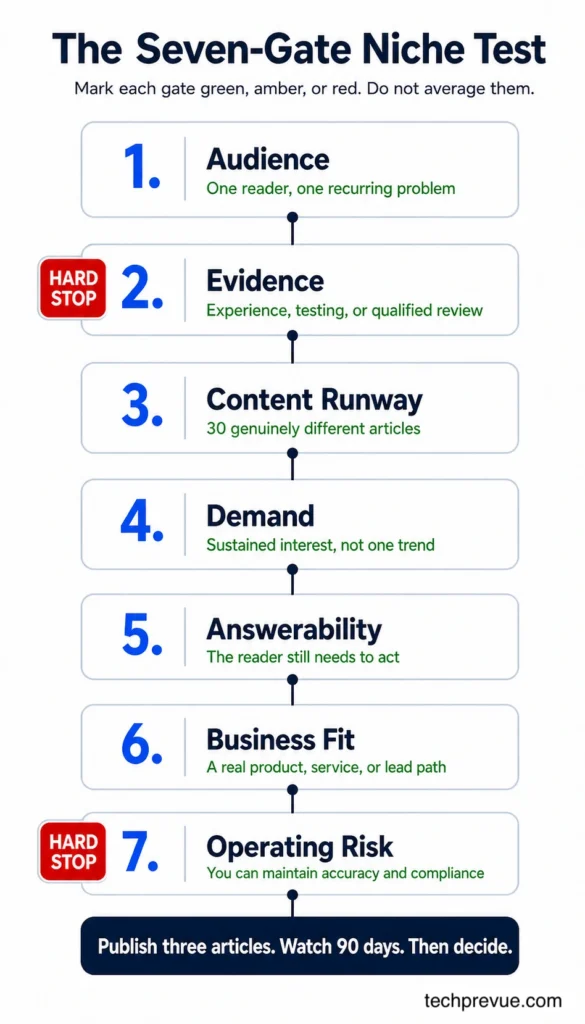
Amber means “go collect evidence,” not “assume it works out.” Four greens and two researched ambers may be testable. A red safety gate needs a qualified partner or a safer angle on the same audience.
30 Blog Niche Ideas by Audience and Business Model
These blog niche ideas are starting directions, not guaranteed winners. Each becomes useful only after you attach an audience and a problem.
One standard applies to all of them, so it is stated once here rather than repeated 30 times: publish what you can support. That means dated testing, named sources, visible corrections, and qualified review wherever the advice can cost the reader money, health, or legal standing.
Each block of entries is followed by a summary table, one row per niche, so you can compare all of them without scrolling back. Here is how to read the columns.
Best for names the kind of person who can credibly run it — the background that makes your version worth reading rather than a rewrite of what already ranks.
Risk rates what a mistake costs your reader, not how hard the niche is:
- Low — errors cost you credibility and little else. No credentials needed.
- Medium — readers spend money or make business decisions on your advice. Needs accuracy, dates, and disclosure.
- High — health, money, legal standing, safety, or children are at stake. This is Your Money or Your Life territory. Needs credentials or qualified review, or you pick a safer angle.
Ways to earn lists the models that realistically fit, most viable first. These are models, not earnings promises — what any of them pays depends on your market, your skill, and your capacity to deliver.
The six models are explained in detail further down.
Across all 45 entries: 10 are Low risk, 18 Medium, and 17 High. If you have no relevant credentials, start in the Low and Medium bands.
Technology and Business
1. AI workflows for one profession. Pick accountants, teachers, designers, recruiters, or shop owners — a group whose daily tasks you actually know. Software affiliates and training fit well. The work is hands-on testing and constant re-testing, since tools change monthly.
2. Software tutorials for one industry. A general software blog fights official documentation and large publishers. Project-management tools for architects, or inventory software for independent retailers, has readers you can name and vendors who want them.
3. Cybersecurity and privacy for small organizations. Dental offices, nonprofits, freelance teams, local retailers. Bad security advice causes real damage, so this one needs genuine expertise and a clear line between education and professional assessment.
4. Web design or development for one sector. Restaurants, clinics, schools, musicians, professional services. Articles that show real decisions about accessibility, performance, and maintenance turn into audits and build leads.
5. Local SEO or digital marketing for one market. Home services, independent consultants, regional retailers. The commercial path is short. Never present one tactic as a guaranteed ranking or a guaranteed sale.
6. Small-business operations and automation. Appointment systems, invoicing, inventory, support workflows, reporting — for one type of business. Templates and software partnerships fit, provided you understand what a bad recommendation costs an operator.
Jobs, Education, Science, and History
7. Job-search guidance for one candidate type. New graduates, career returners, tradespeople, international applicants, and mid-career switchers face different obstacles. Live vacancies require employer verification, dates, and prominent scam warnings.
8. Recruitment and workplace practice for one employer type. Early-stage startups, manufacturers, schools, remote agencies. Interviewing, onboarding, retention, and hiring operations all have depth. Employment rules need qualified review.
9. Professional certifications and continuing education. Pick one profession or exam family. Separate official requirements from study advice, and date every fee, format, and renewal rule.
10. Student learning for one stage or curriculum. Science study skills for secondary students, writing support for university entrants, project-based learning for homeschool families. Original exercises beat copied answer keys, which AI now supplies free.
11. Science explainers for a defined reader. Link claims to primary papers or institutions. Separate consensus from preliminary findings and correct errors where readers can see them.
12. Space and astronomy for observers. Beginner observation, astrophotography under city light pollution, mission explainers, school astronomy clubs. Event dates and visibility need location-aware updates.
13. History or archaeology for one period or trade. Archives, museums, and books support work no summary tool can reproduce. Separate documented fact, oral history, and disputed interpretation.
14. Local heritage for one city. Buildings, industries, migrations, and collections in a single place. Site visits and photographs are the moat, and the audience is unusually loyal.
15. Language learning for a purpose. Travelers, healthcare workers, customer-service teams, exam candidates, families preserving a heritage language. Courses and tutoring fit naturally, and the strongest version teaches a vocabulary the reader uses at work rather than a general syllabus.
Health, Healthcare, Beauty, and Fashion
16. Healthcare navigation for one population. Preparing for appointments, finding official services, decoding administrative terms, supporting a caregiver. Not diagnosis. Location-specific processes need authoritative review.
17. Evidence-based health education by qualified contributors. Clinicians or researchers covering one condition, life stage, or public-health problem. Review, primary sources, conflict disclosure, and update dates are the product, not extras.
18. Fitness and movement for a defined audience. Strength training for older beginners, mobility for desk workers, sport prep for amateur players. Prerequisites, modifications, and clear stopping points matter more than programming.
19. Beauty and skincare decisions. Narrow by skin concern, climate, budget, or routine complexity. Original product use and consistent photography are what a model cannot generate.
20. Haircare for one hair type or setting. Textured hair, hard-water routines, humid climates, protective styling, gray hair. Document test conditions. Hair-loss and scalp-disease claims need medical expertise.
21. Fashion and personal style for a defined life. Workwear for a profession, modest fashion, adaptive clothing, petite or tall sizing, fixed-budget style. First-hand fit notes and original images beat trend roundups.
22. Sustainable fashion and clothing care. Repair, fabric care, wardrobe longevity, secondhand buying, supply-chain literacy. Sustainability claims need evidence, and the affiliate layer should not contradict the message.
Money and Consumer Decisions
23. Personal finance education for one life stage. Students, new parents, freelancers, immigrants, retirees. Qualified review, current country-specific sources, and a firm boundary against personalized recommendations.
24. Financial operations for one type of small business. Cash-flow routines, bookkeeping systems, invoice processes, questions to ask an accountant. Tax and legal conclusions must match jurisdiction and date.
25. Buying guides for one user or activity. Home bakers, field researchers, new photographers, small workshops. First-hand testing with a published method is the entire moat here.
Home, Food, Travel, Family, and Interests
26. Food and cooking under one constraint. Regional cuisine, small kitchens, batch cooking, allergy-aware meals, cooking for one. Recipes tested by you, images shot by you.
27. Travel and local guides from first-hand visits. Accessible travelers, families on public transit, weekend trips from one city. Prices and opening conditions change, so budget for maintenance.
28. Home maintenance for one housing type. Rented apartments, older houses, hot climates, monsoon conditions, small commercial spaces. Separate cosmetic work from anything needing a licensed professional.
29. Parenting and family systems for one stage. Routines for dual-working households, reading activities for early learners, travel with toddlers. Child health and safety claims raise the evidence bar sharply.
30. Pet ownership for one species or life stage. First-time cat owners, senior-dog caregivers, aquarium beginners, urban bird keepers. Symptoms, nutrition, medication, and emergencies belong with veterinary sources.
The 30 Mainstream Niches at a Glance
One row per niche. Risk rates what a mistake costs your reader, not how hard the niche is.
| # | Niche | Best for | Risk | Ways to earn |
|---|---|---|---|---|
| 1 | AI workflows for one profession | Practitioners in that profession | Low | Consulting, training, software affiliates |
| 2 | Software tutorials for one industry | Implementers and consultants | Low | Implementation projects, vendor commission |
| 3 | Cybersecurity for small organizations | Qualified security practitioners | High | Assessments, training products, tooling affiliates |
| 4 | Web design or development for one sector | Working designers and developers | Low | Audits, build projects, care retainers |
| 5 | Local SEO or digital marketing | Practitioners with client results | Medium | Retainers, audits, tool affiliates |
| 6 | Small-business operations and automation | Operators and process consultants | Medium | Implementation, templates, software partnerships |
| 7 | Job-search guidance | Recruiters and career coaches | Medium | Coaching, resume services, courses |
| 8 | Recruitment and workplace practice | HR practitioners and founders | Medium | HR consulting, vendor partnerships, templates |
| 9 | Professional certifications | Certified professionals and trainers | Medium | Tutoring, cohort prep, course affiliates |
| 10 | Student learning | Qualified teachers and tutors | Medium | Tutoring, workbooks, institutional licensing |
| 11 | Science explainers | Researchers and science communicators | Medium | Speaking, memberships, writing contracts |
| 12 | Space and astronomy | Active observers | Low | Equipment affiliates, courses, guided sessions |
| 13 | History and archaeology | Researchers and serious amateurs | Low | Books, talks, commissioned research |
| 14 | Local heritage | Residents with archive access | Low | Tours, talks, image licensing, local sponsors |
| 15 | Language learning for a purpose | Fluent speakers and trained teachers | Low | Tutoring, cohort courses, corporate training |
| 16 | Healthcare navigation | Caregivers and patient advocates | High | Advocacy services, guides, courses |
| 17 | Evidence-based health education | Credentialed clinicians only | High | Practice referrals, memberships, publisher work |
| 18 | Fitness and movement | Certified coaches | High | Online coaching, training plans, equipment affiliates |
| 19 | Beauty and skincare | Testers who document results | Medium | Product affiliates, brand deals, consultations |
| 20 | Haircare | Stylists, or people with that hair type | Medium | Product affiliates, consultations, salon services |
| 21 | Fashion and personal style | Stylists and those living the constraint | Low | Affiliates, styling services, direct sales |
| 22 | Sustainable fashion and clothing care | Repairers and makers | Low | Repair services, workshops, courses |
| 23 | Personal finance education | Licensed advisers or reviewed writers | High | Courses, memberships, licensed advisory |
| 24 | Financial operations for small business | Accountants and bookkeepers | High | Bookkeeping, templates, software partnerships |
| 25 | Buying guides | Owners who use the equipment | Medium | Category-rate affiliates, brand deals, own products |
| 26 | Food and cooking | Cooks who test and photograph | Medium | Display ads, cookbooks, classes, brand work |
| 27 | Travel and local guides | People who actually visit | Medium | Itinerary planning, tours, booking affiliates |
| 28 | Home maintenance | Tradespeople and hands-on owners | High | Tool affiliates, consultations, licensed trade work |
| 29 | Parenting and family systems | Parents, with review for health claims | High | Display ads, product affiliates, courses |
| 30 | Pet ownership | Experienced owners; vets for medical | High | Product affiliates, courses, display ads |
15 Overlooked Blog Niches Worth Validating
Every large blog niche ideas list runs the same categories: AI tools, personal finance, fitness, travel, pets, parenting. The fifteen below rarely appear on them.
Read them as hypotheses, not verdicts. This article has just spent several sections arguing that unsourced profitability claims are worthless, so it would be dishonest to end with fifteen of them.
What follows is a shortlist of directions selected on three checkable properties — an identifiable buyer, a plausible transaction, and a reader task an AI answer does not finish. What is not established is the demand volume, the competition level, or the earnings for any of them.
Run each one you like through the seven gates and the SERP check above before you commit. The reason to start here is that these are less picked-over than the mainstream 30, not that anyone has proven they pay.
One structural note. Most of these monetize through your own services rather than through ads, which changes the maths entirely. Many may never need to reach an ad network’s traffic threshold, because services, leads, referrals, or specialized products can be the better primary model.
Industrial, Trade, and B2B
31. Commercial and industrial equipment ownership economics. CNC machines, commercial HVAC, forklifts, laboratory instruments, restaurant equipment. Buyers hold budgets and vendors run partner programs.
Independent coverage of total cost of ownership, service intervals, and resale looks thin, though you should check that against your own SERP sample. The barrier is access — you need shop-floor experience or working relationships with operators.
32. Trades business operations. Estimating, job costing, licensing by state, crew scheduling, and quoting software for plumbing, electrical, HVAC, or roofing firms.
Field-service software vendors run partner programs, and the vocabulary keeps most general bloggers out. Verify commission terms directly with two or three vendors before assuming the model works.
33. Freight, customs, and export documentation. HS codes, incoterms, LCL versus FCL, packing lists, certificates of origin.
Paperwork errors cost small exporters real money, and much of the available content is vendor marketing. India angle: IEC registration, GST on exports, and port-specific procedure are worth testing for volume, since English-language coverage of them is limited.
34. Franchise and small-business acquisition research. Franchise disclosure document analysis, unit economics, seller financing, and the questions to ask before signing.
Buyers are making decisions worth six figures. Broker and lender referral arrangements exist in this space, but terms vary widely and need checking case by case. Requires financial literacy and scrupulous independence.
Regulated and Procedural
35. Compliance for one type of small business. HIPAA for solo clinics, PCI-DSS for small merchants, FSSAI licensing for cloud kitchens, DPDP readiness for Indian SMEs.
Regulations and platform requirements change periodically, creating an ongoing content opportunity — and an obligation to monitor and update, since a stale page here is worse than no page.
36. Procedural self-help, not legal advice. Small claims filing, consumer forum complaints, RTI applications, traffic-ticket procedure, benefits appeals.
Large publishers tend to avoid this because the liability is uncomfortable, which is the opening. Scope strictly to documented procedure, link the official forms, and never cross into advising on a specific case.
37. Grant writing and nonprofit funding. Proposal structure, budget narratives, funder research, reporting requirements. The audience holds organizational budgets, and courses and services are a natural fit. Competition looks light, but confirm that on your own target queries.
38. Insurance claim navigation for one product. Denied health claims in India, pet insurance in the US, small-business liability, home claims after weather damage.
Readers arrive motivated and frustrated, and much of what ranks is insurer marketing. India angle: IRDAI grievance procedure and claim-rejection reasons are worth checking for independent coverage before you commit.
Demographic Tailwinds
39. Aging in place and caregiver logistics. Home modification, mobility equipment, fall prevention, coordinating care across family members.
High-ticket products and an audience with demographic tailwinds behind it. Independent testing appears scarce; confirm that yourself. The medical boundary must be explicit.
40. Adaptive and disability equipment. Wheelchairs and cushions, adaptive kitchen tools, hearing and vision accessibility, adaptive clothing.
Expensive products and a readership poorly served by mainstream review sites. Lived experience or close collaboration with disabled users is close to mandatory here, not optional.
41. Digital estate and legacy planning. Password inheritance, account closure after a death, digital asset transfer, memorial pages, platform-by-platform procedure.
A young category with few established publishers. Demand direction is the thing to test first, since a new category can also mean a thin one.
Specialist Commerce and Craft
42. Hearing, vision, and sleep hardware. The FDA’s over-the-counter hearing aid rule took effect on October 17, 2022, creating a direct-to-consumer category for adults with perceived mild to moderate hearing loss.
The FDA notes close to 30 million US adults have some degree of hearing loss and only about one in five who could benefit seeks help. High-ticket products and a retail channel that opened recently. Whether independent review supply has caught up is worth checking before you commit.
43. Restoration and preservation trades. Watch servicing, antique clock repair, bookbinding, leatherwork, furniture restoration.
Small audiences with high intent, and demonstration content an AI answer cannot substitute for. Tools and courses are the obvious revenue path; the open question is audience size.
44. Controlled-environment and specialty agriculture. Commercial hydroponics, mushroom cultivation, beekeeping, polyhouse production.
Readers spend real capital on equipment and inputs. India angle: horticulture subsidies and polyhouse schemes differ by state and change often, which is the kind of gap a focused publisher can fill.
45. Residential solar and home energy economics for one market. Payback math, system sizing, installer evaluation, net metering rules. India angle: PM Surya Ghar: Muft Bijli Yojana, launched in February 2024, targets one crore households by FY 2026–27.
The Union Budget’s Expenditure Profile for 2026–27 lists ₹22,000 crore for the scheme, up from ₹17,000 crore revised for 2025–26. Public money at that scale implies household decisions being made; subsidy slabs, DISCOM approval, and application rejections are the queries to test.
The 15 Overlooked Niches at a Glance
Note how few of these monetize through advertising. Most depend on selling your own services.
| # | Niche | Best for | Risk | Ways to earn |
|---|---|---|---|---|
| 31 | Commercial and industrial equipment | Operators and procurement staff | Medium | Procurement advisory, vendor referral, spec reviews |
| 32 | Trades business operations | Trade owners and their consultants | Medium | Software commission, setup consulting, templates |
| 33 | Freight, customs, export documentation | Brokers, forwarders, exporters | High | Documentation services, training, retainers |
| 34 | Franchise and acquisition research | Brokers, accountants, past buyers | High | Advisory, broker referral, disclosure reviews |
| 35 | Compliance for one business type | Compliance professionals and auditors | High | Readiness audits, remediation, staff training |
| 36 | Procedural self-help | Paralegals and former court staff | High | Document prep, workshops, form packs |
| 37 | Grant writing and nonprofit funding | Working grant writers | Medium | Proposal writing, review services, cohort training |
| 38 | Insurance claim navigation | Ex-adjusters and claim advocates | High | Claim assistance, courses, appeal templates |
| 39 | Aging in place | OTs, contractors, family caregivers | High | Home assessments, contractor referral, equipment affiliates |
| 40 | Adaptive and disability equipment | Disabled users and OTs | Medium | High-ticket affiliates, consultations, paid reviews |
| 41 | Digital estate and legacy planning | Estate pros and security technologists | High | Templates, guided setup, legal partnerships |
| 42 | Hearing, vision, and sleep hardware | Audiologists, opticians, long-term users | High | Device affiliates, fitting fees, comparison reviews |
| 43 | Restoration and preservation trades | Practising restorers | Low | Repair income, courses, tool affiliates |
| 44 | Controlled-environment agriculture | Working growers | Medium | Setup consulting, supplier partnerships, training |
| 45 | Residential solar and home energy | Installers and energy consultants | Medium | Referral fees, system-sizing reviews, courses |
How to Narrow a Broad Idea Without Making It Too Small
Add one constraint at a time. Stop when the audience and the problem are clear enough to guide your content calendar — not when the audience becomes tiny.
Going all the way down to a single sub-topic is a legitimate strategy in its own right, as our list of gaming niche ideas shows.
| Broad subject | Focused niche | Why it is clearer |
|---|---|---|
| Fashion | Practical office style for women in hot, humid Indian cities | Defines audience, setting, and recurring wardrobe decisions |
| Jobs | Remote SaaS job-search guidance for Indian graduates | Defines candidate, industry, work model, and geography |
| Beauty | Simple haircare for curly hair in humid climates | Defines hair type, climate, and desired routine |
| Science | Research explainers for secondary-school science clubs | Defines knowledge level and use case |
| History | Source-based guides to one city’s built heritage | Defines location, evidence, and reader interest |
| Healthcare | Administrative guidance for family caregivers | Defines the role while avoiding diagnosis |
Test the focused version against a 30-article runway. If your titles cover distinct questions across learning, comparison, action, mistakes, tools, and change over time, there is room. If every title restates the same answer, widen one constraint.
How to Validate Demand Before You Start
Validation reduces uncertainty. It does not predict success, and no list of blog niche ideas can do it for you. Use several signals, because a keyword tool, a Facebook group, or an affiliate program can each mislead you on its own.
1. Separate search demand from business demand
Use Google Keyword Planner or another documented source to find recurring queries. Set the country and language, group close variants, and read the problems behind the numbers.
Keyword Planner’s competition column reflects advertiser participation, not organic difficulty. A high bid shows commercial interest. It does not prove a new blog can rank or convert.
Demand also shows up in customer interviews, support tickets, sales calls, professional communities, course enrollments, and product reviews. Some of the best blog niche ideas support a small service business without ever producing mass traffic.
2. Check direction and seasonality
Google Trends compares relative interest over time and across locations. Its 0-to-100 values are normalized, not search counts, so use it for direction and seasonality rather than audience size.
Pull a five-year view to separate recurring demand from a spike. Exams, travel, fashion, sports, and tax topics have legitimate cycles.
3. Read the SERP, not just the volume
Run your core questions the way a reader would, and record four things.
- Who owns page one. Independent sites ranking means the door is open. Ten pages of Forbes, Healthline, and NerdWallet means it is not.
- Whether an AI Overview appears. If it does on most of your core queries, assume the click rate is materially lower before you have written a word.
- Whether forums outrank publishers. Reddit and Quora sitting above commercial pages is a supply gap — real experience exists, good content does not.
- Whether affiliate programs exist at all. Search the product category plus “affiliate program” or “partner program.” If nothing comes back, your revenue model has to be services or products.
Weak results are not automatically an opportunity. Sometimes the query has no demand, and sometimes it needs authority you do not have.
4. Build the content runway
Map 30 useful articles before you buy a domain. Organize them by reader problem rather than keyword modifier, and delete titles that produce the same answer.
Then outline the first three. If you cannot name the evidence, the examples, and the reader’s next step for those three, the niche is not ready — however good the tool numbers look.
Validate the United States and India Separately
Do not test blog niche ideas by combining both countries in a keyword tool and calling the result universal demand. Run separate location settings, inspect the local results, and repeat for the relevant languages.
India is not one audience, and neither is the United States. State rules, city conditions, language, climate, income, curriculum, product availability, and payment habits all change the reader’s problem.
Regional relevance has to change the substance, not just the currency symbol. A useful India section addresses an exam system, a climate condition, a regulation, a platform gap, or a buying constraint that changes the decision itself.
The monetization gap most niche guides skip
Here is the part almost no “profitable blog niches” article says out loud: the same article earns very differently depending on where your readers live.
Premium ad networks state this in their own eligibility rules.
Raptive requires that 50% of traffic come from the United States, United Kingdom, Canada, New Zealand, or Australia for sites between 25,000 and 99,999 monthly pageviews, dropping to 40% at 100,000 pageviews and above, on a 25,000 pageview minimum.
Mediavine takes a revenue-based route instead. Its stated requirement is at least $5,000 in annual ad revenue to apply, with Journey by Mediavine opening at 1,000 sessions as the on-ramp.
Read the Raptive tiers carefully, because the detail matters. Below 100,000 pageviews, a site needs half its traffic from those five countries, so a mostly-Indian audience will not qualify.
At 100,000 pageviews and above the bar drops to 40%, which means a site with majority-Indian traffic can still meet it.
Mediavine sets no geographic rule at all. Its gate is revenue, and how quickly any site reaches $5,000 depends on factors neither network publishes.
That does not make India a bad market. It makes display advertising a bad primary plan for India-focused blog niche ideas. Services, lead generation, digital products, cohort courses, and local sponsorships convert on relevance rather than geography.
If ads are part of the mix, our roundup of Google AdSense alternatives covers networks that accept smaller and non-US audiences.
Six Revenue Models, and Which Niches Fit Each
Profit comes from a transaction, not a category name. But the more useful point is the one almost every niche list skips:
Your revenue model is one of the biggest determinants of how much traffic you need.
Display advertising usually requires substantially more traffic than services, lead generation, or high-value affiliate offers before the revenue becomes meaningful. A specialist compliance blog may be viable with far fewer visitors if a small number become high-value clients.
Niche economics, search intent, conversion rate, and customer value all matter too. But pick the model first, and the traffic target becomes a much easier question.
1. Your own services, sold through the blog
The most under-rated model on this list, and the one that makes small audiences viable. You publish work that demonstrates competence, and readers who cannot do the job themselves get in touch.
This is not “monetization” bolted on afterwards. The article is the sales process — a piece showing how you scoped a migration, ran an audit, or fixed a filing error does the qualifying work before anyone calls.
Nobody publishes credible benchmarks for what these engagements pay, because it depends entirely on the work. What is structurally true is that a single project can exceed a year of display revenue from the same page, which is why service-led niches do not need to clear any ad network’s threshold.
Fits: web design and development for a sector, local SEO, small-business operations, AI workflows for a profession, compliance, grant writing, freight documentation, trades operations, industrial procurement, restoration trades, tutoring and certification prep.
What it demands: delivery capacity, a way to say no when you are full, and content that shows judgment rather than summarizing what a tool already outputs.
2. Display advertising
Real, but the most demanding model in traffic terms and the least controllable. Networks publish their splits, which is the only hard data available anywhere in blog monetization.
Google AdSense pays publishers 80% of revenue after the advertiser platform takes its fee — roughly 68% overall when Google Ads is the buyer. Notably, Google states these percentages are the same regardless of where the publisher is located.
Mediavine’s published revenue share for sites launched after 1 January 2026 rises with earnings: 75% below $100,000 a year, 80% from $100,000, 85% from $250,000, and 90% from $500,000.
Read the tiers carefully. They show how the publisher revenue share increases with annual advertising revenue. They do not disclose how many publishers sit in each tier, so treat the $100,000 first rung as a threshold, not as evidence of what a typical publisher earns.
Set expectations against Orbit Media’s 12th annual blogger survey, which asked 808 content marketers in August 2025 how their blogging was going. Just 21% reported strong results.
Fits: high-volume consumer subjects — food, parenting, pets, travel, home, hobbies. Fails: anything B2B, industrial, or specialist, where the audience is small and valuable rather than large and cheap.
3. Affiliate revenue on physical products
Straightforward, and capped by someone else’s rate card. As the Amazon table below shows, the classification of the product sets your ceiling before traffic enters the calculation.
Fits: beauty, equipment, hobbies, adaptive gear, home, pets. What it demands: first-hand testing and a published method, or you are competing with every other page recycling the same specifications.
4. Affiliate revenue on software and subscriptions
The same reader is worth far more here, and this is the single most useful monetization fact in the article.
Physical goods pay a one-time percentage.
Many software programs pay a recurring one instead, though not all do. Rewardful, which runs affiliate tracking for SaaS companies, reports from its own vendor-side program data that most sit between 20% and 30% of revenue, with some reaching 40% for top partners.
Individual programs publish their own terms — LiveChat’s Text partner program currently offers 20% for the customer’s lifetime, rising to 22% after five referrals, on a 120-day cookie. These are that program’s published terms, not typical industry earnings, and programs change them.
Compare the two. A supplement recommendation earns 1.00% once. A $50-per-month tool at 25% recurring earns $12.50 every month the customer stays. That gap is a choice about which niche you enter, not a reward for better traffic.
Fits: software for one industry, trades operations, small-business systems, marketing, productivity, creator tools.
5. Digital products and memberships
Courses, templates, cohort training, paid research, communities. No credible published benchmarks exist for what these earn, so treat any figure you find with suspicion.
Fits: education, professional skills, operations, specialist research, anything where readers need to do the thing rather than know about it. What it demands: a product that solves a problem the free content deliberately leaves open — not a repackaged archive.
6. Sponsorship, directories, and placements
Brand partnerships, paid listings, job placements, local sponsors. Rate benchmarks circulate widely and none of them survive checking, so this article does not publish any.
What is documented is the legal exposure, and in India it is heavier than most bloggers realize.
An Indian blogger may be treated as an endorser when making an endorsement involving a material connection to an advertiser. That connection has to be disclosed clearly.
Under Section 21 of the Consumer Protection Act, 2019, for a false or misleading advertisement the Central Consumer Protection Authority may:
- Impose a penalty of up to ₹10 lakh for a first contravention, and up to ₹50 lakh for subsequent ones.
- Prohibit an endorser from making endorsements for up to one year, or three years for a repeat contravention.
The Act recognizes a defence where the endorser exercised due diligence to verify the claims. The CCPA’s advertising guidelines set out the requirements in full, and the Advertising Standards Council of India publishes accepted disclosure formats.
In the United States, the Federal Trade Commission’s endorsement rules impose comparable obligations.
Fits: established audiences with repeat reach, local and regional publishing, specialist job and event markets. What it demands: disclosure discipline and a willingness to turn down money when the claim will not stand up.
Match the model to the niche before you commit
| Niche group | Primary model | Secondary | What kills it |
|---|---|---|---|
| Industrial, trades, B2B | Services and leads | Vendor partnerships | Chasing pageviews instead of clients |
| Compliance and procedural | Services and leads | Training products | Letting a page go stale after a rule change |
| Marketing, design, software | Services and leads | Recurring software affiliate | Advice too generic to prove competence |
| Education and certification | Digital products | Tutoring services | Copying official syllabi instead of teaching |
| Health and finance | Qualified services | Memberships | Publishing without credentials or review |
| Beauty, fashion, hobbies | Physical-product affiliate | Sponsorship | No original testing |
| Food, travel, parenting, pets | Display advertising | Products and affiliate | Reaching ad thresholds takes years |
| Specialist and craft | Own services or products | Courses | Audience too small for any ad model |
Your category sets your ceiling before your traffic does
Two blogs with identical traffic can earn very differently, because affiliate rates are set by product category. Amazon publishes its US rates openly in the Associates Program Standard Commission Income Statement:
| Category | US fixed commission rate |
|---|---|
| Luxury Beauty, Luxury Stores Beauty | 10.00% |
| Physical Books, Kitchen, Automotive | 4.50% |
| All Other Categories | 4.00% |
| Home, Tools, Pets, Sports, Outdoors, Business & Industrial Supplies | 3.00% |
| PC and PC Components | 2.50% |
| Televisions | 2.00% |
| Grocery, Health & Personal Care | 1.00% |
| Gift cards, wireless service plans, vehicles | 0.00% |
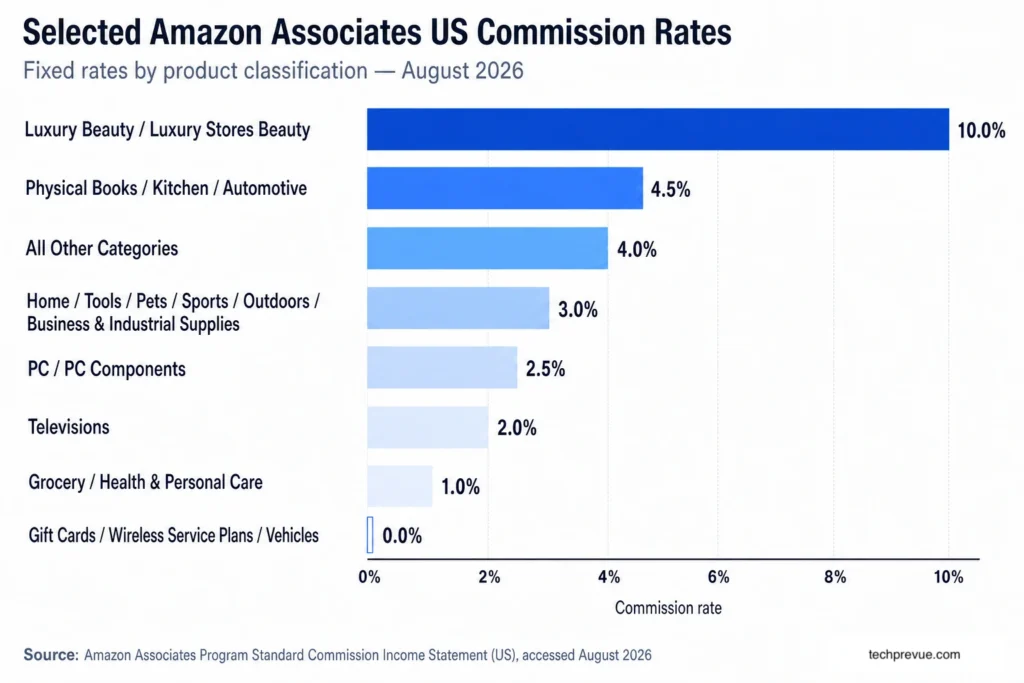
Rates checked August 2026. Amazon revises this statement periodically and rates differ by country — check the current version for your market.
One detail decides everything here: Amazon pays on how it classifies the product, not on what your blog is about. A beauty blog is not automatically a 10% blog.
Ordinary Beauty sits at 3.00%, and only items Amazon files under Luxury Beauty earn 10.00%. Health & Personal Care, which covers most supplements, pays 1.00%.
So the same 1,000 readers can be worth ten times more or ten times less depending on which specific products they buy. If you are new to the model, start with the basics of affiliate marketing before building a plan around any rate card.
Check the classification of the products you actually plan to recommend before you build a plan around a category average. Amazon also pays flat bounties on some sign-ups, such as $15.00 for a qualifying Amazon Business registration.
Rates change and vary by country, so check the current statement for your market before you model anything.
Amazon retired Native Shopping Ads, banners, and mobile pop-overs in 2023, so any guide still describing those units is out of date.
Text links remain, and the former Product Advertising API has been replaced by the Creators API — which requires a minimum of 10 qualifying sales in a rolling 30-day window, so a new blog will not have programmatic product data on day one.
Advertising alone is a weak reason to choose a subject. A small expert audience can support services and products. A broad informational audience can produce almost nothing if readers have no purchase to make.
Approach High-Risk Niches Carefully
Google treats topics affecting health, financial stability, safety, or social welfare as Your Money or Your Life subjects, where trust signals carry greater weight. E-E-A-T is not a score or a ranking lever, but it is a useful editorial warning.
Health and healthcare: use qualified authors or reviewers, primary sources, update dates, and clear limits. Without those resources, move from treatment advice to a safer angle — navigating official services, or preparing questions for a professional.
Finance: no predictions, no guaranteed outcomes, no personalized recommendations from unqualified contributors.
India’s Securities and Exchange Board publishes an official investment-scam checklist that flags guaranteed returns, unregistered entities, and pressure to act quickly.
Employment: never republish vacancies without checking the employer and the original listing.
The US Federal Trade Commission’s job-scam guidance warns that fake recruiters seek money or personal information, so a jobs site needs verification and reporting procedures.
Beauty: separate appearance advice from medical claims. The FDA explains that a cosmetic promoted to treat disease or affect body structure or function may be regulated as a drug, and its cosmetics claims guidance requires claims to be truthful and not misleading.
In India, the Central Drugs Standard Control Organization publishes the national Cosmetics Rules.
Science and history: show readers what evidence supports each claim. Separate peer-reviewed findings from preprints, and documented history from oral accounts.
Fast-changing products and platforms: record the version, date, region, test conditions, and limitations. If you cannot maintain the page after a major release, pick a more durable topic.
Choose One Idea, Then Run a Small Test
Put your strongest three blog niche ideas through the seven gates. Drop anything with a red expertise or safety result, then go collect evidence on the ambers.
For each finalist, write one sentence: “This blog helps [audience] solve [recurring problem] in [context] using [evidence or experience].” If that sentence needs several unrelated audiences, the niche is still too broad.
Then build the 30-article map, outline three evidence-backed pieces, and name the single reader action you want. Publish those three, watch what happens for 90 days, and let the results guide the decision.
Ninety days is an initial evidence checkpoint, not a deadline for ranking. If impressions, indexing, engagement, or qualified enquiries are improving but the sample is still too small to judge, keep running the test.
Choose the niche where you can sustain the work and add something real today — not the one attached to the most impressive unsourced income screenshot.
Once the audience and the first three reader problems are documented, our guide to how to start a blog covers the setup that follows.
Frequently Asked Questions
Which blog niche is the most profitable?
There is no single most profitable blog niche, because the revenue model matters more than the topic. A small blog whose readers hire a service can out-earn a much larger one running display ads, since one project can be worth a year of ad revenue from the same page.
Decide how you intend to get paid first; the traffic you need follows from that choice, not the other way round.
Can I start a blog in a niche where I have no experience?
You can, but you need a credible substitute for experience — original testing, qualified contributors, primary research, or documented interviews.
Google’s helpful content guidance treats entering a topic purely for traffic, without expertise, as a warning sign. In health, finance, and safety niches, that substitute is not optional.
How narrow is too narrow for a blog niche?
A niche is too narrow when you cannot map 30 genuinely different articles or name a repeat reader action. Narrow it until the audience and problem are specific enough to guide your calendar, then stop.
If your titles start repeating the same answer, widen exactly one constraint — usually the audience or the geography.
Do I still need a niche now that AI answers most searches?
More than before. AI Overviews absorb the general, easily summarized queries first, which is precisely what an unfocused blog publishes.
A defined niche lets you build first-hand evidence, regional specifics, and reader relationships that a summary cannot replace — and gives you a direct audience that does not depend on a click from Google.
