
Quick answer: How to write a guest post, in order: request the publication’s guidelines, agree the terms in writing, pitch two or three specific ideas, then draft to their format rather than your own. The writing is the easy part. Almost everything that decides whether you get published happens before it and after it.
Most advice on writing a guest post jumps straight to the draft.
That’s backwards, and it explains why so many carefully written articles never find a home anywhere.
What follows is the execution: pitching, outlining, drafting, links, bio, submission, and what to do once an editor replies. If you’re still working out whether any of this is worth your time, or where to place a piece, the strategy side lives here.
- What to Do Before You Write a Word
- How to Pitch a Guest Post
- How to Outline a Guest Post
- How to Write a Guest Post: the Draft
- How to Add Links Without Getting Flagged
- How to write an Author Bio That Earns the Click
- What to Include in Your Submission Asset Pack
- What Happens After Your Submission
- What to Do After Your Post Publishes
- What Separates a Revision Request From a Rejection
- Guest Post Writing Mistakes That Cost Placements
- Frequently Asked Questions
What to Do Before You Write a Word
Learning how to write a guest post properly starts with three steps that cost roughly an hour between them.
Skip them and a promising placement turns into twelve wasted hours of writing.
1. Never Write the Article First
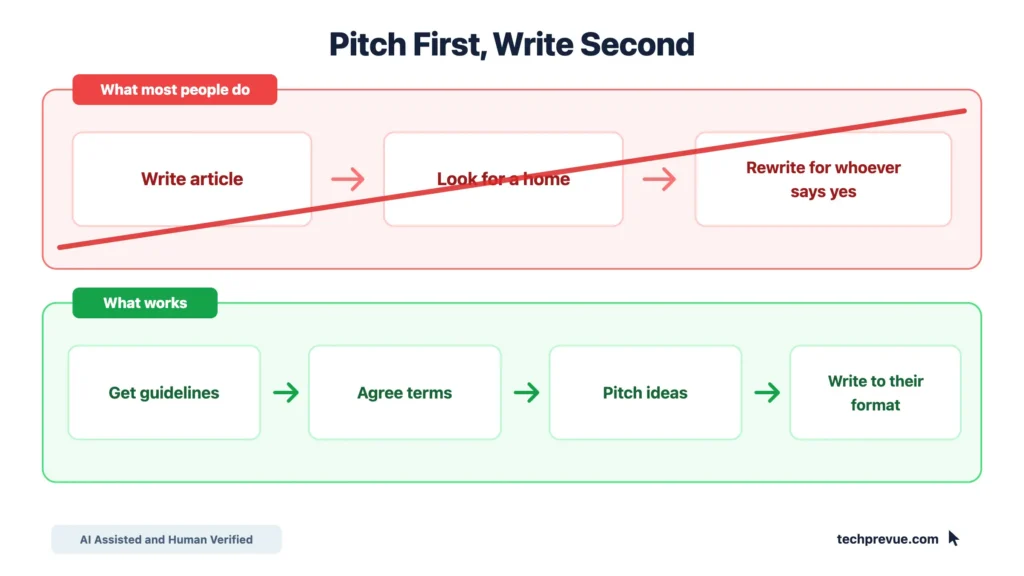
Here’s the mistake that costs beginners the most.
They write something they’re proud of, then go hunting for a home for it. It rarely works, because every publication has its own length requirements, formatting conventions, and subject boundaries, which means a draft written in a vacuum needs rebuilding for whichever site eventually says yes. Mailchimp’s guidance makes the same point, and it’s the most useful line in their guide.
Pitch first. Write second. That order matters more than anything else on this page.
2. Get the Guidelines, Then Read Them Properly
Most sites accepting contributors publish their standards somewhere, usually on a page called “write for us” or “contribute.” Find it before you pitch, because half of what you need is sitting there already.
Serious publications maintain substantial style guides. Surfer’s team, who have had several hundred articles accepted between them, suggest budgeting a full hour to study one rather than skimming it over coffee.
Here’s what you’re mining it for:
| Look for | Why it decides your draft |
|---|---|
| Word count range | Writing 2,500 words for a 900-word slot means cutting 60% of your work |
| Subject boundaries | Some sites ban competitor mentions, affiliate content, or whole topics |
| Link policy | How many, where they can sit, what attribute gets applied |
| Voice and formatting | Contractions, heading depth, person, image specs |
| Exclusivity terms | Many require the piece never appears elsewhere, in whole or in part |
| Disclosure rules | Commercial relationships usually have to be declared in the piece |
No published guidelines? Follow the pattern of their recent posts and send one clarifying question by email. Smaller publishers often haven’t written theirs down yet, and asking reads as professional rather than needy.
3. Agree Expectations Before You Start
Almost nobody does this, and it prevents most of the disappointment that follows.
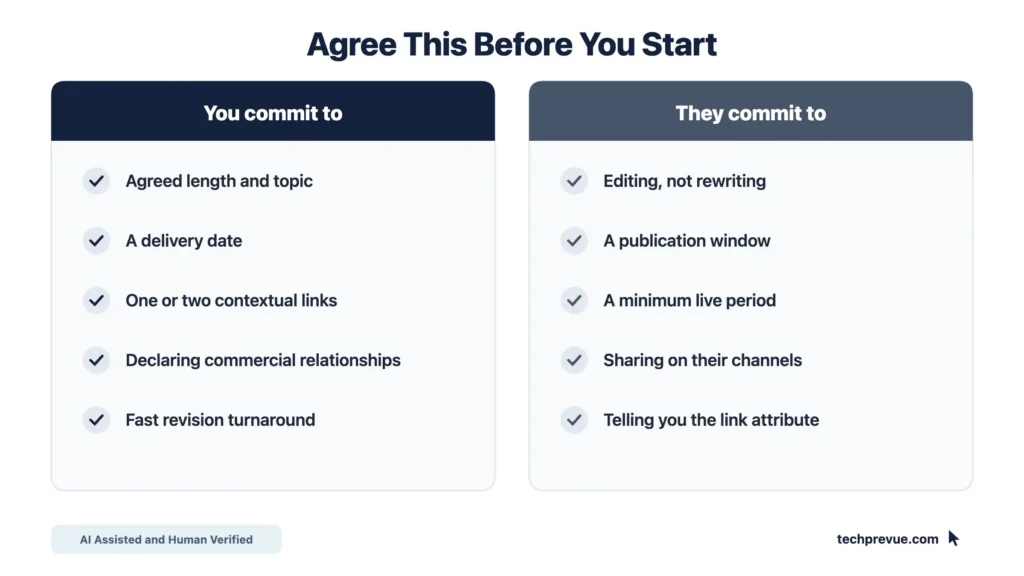
Send a short email confirming what each side is committing to. I have advocated for and used this specific checklist approach in my professional practice since 2015, and it’s the most practical idea circulating on this subject right now.
| You commit to | They commit to |
|---|---|
| A draft of agreed length on an agreed topic | Editing for clarity and house style, not rewriting your argument |
| A delivery date | A publication window, or a heads-up if it slips |
| One or two contextual links, disclosed upfront | Keeping the piece live for a stated minimum period |
| Declaring any commercial relationship | Sharing it on their usual channels within a set window |
| Responding to revisions inside a few working days | Telling you which link attribute they apply |
Insist on that last row. Ask whether contributor links carry nofollow, sponsored, or nothing at all, and get it in writing before you start. An editor running a clean operation answers in one line.
One caution about the left column. You’ll find templates online committing the publisher to a minimum number of followed links, usually five. Treat that as a warning rather than a win, for reasons I’ll come to.
How to Pitch a Guest Post
Your pitch is a business proposal, not a favor request. Editors commission subjects; they aren’t doing anyone a kindness.
1. What Goes in the Email
Four elements, in this order.
Proof you read the site. Name a specific piece and what you took from it. Specific evidence that you read it, not flattery that could apply to any site.
If you already follow the editor or read their newsletter, say so and mean it. Manufacturing a touchpoint two weeks ahead of a pitch is just flattery with a longer runway, and experienced editors can tell.
Why you specifically can write this. Your role, your data, the years you’ve spent doing the thing. Skip the credentials nobody asked about and the ones that don’t bear on this subject.
Two or three ideas, each in two or three sentences, each visibly filling a hole in their coverage.
One low-friction ask. Would any of these be useful, or would they rather have something else?
Keep the whole thing under 200 words. An editor deciding in 15 seconds can’t decide in favor of an email they never finished reading. Anything past roughly 250 words gets skimmed for the ask and closed.
Attach nothing.
Link one or two published samples instead, and let them choose whether to click.
2. Subject Lines That Don’t Read as Spam
“Guest Post Opportunity” and “Collaboration Request” are indistinguishable from the forty other pitches that landed that morning. Neither gets opened.
Name the site or the angle instead.
Idea for your onboarding series works because it proves familiarity before the email is even open.
Test it this way: could this subject line have gone to 200 sites unchanged? Then rewrite it.
3. How Many Ideas to Pitch, and How to Format Them
Two or three. One forces a binary yes or no, while five reads like a content farm working through a list. Three is the number that gives an editor a real choice without making the email feel like a catalog.
Give each idea its own short block, working title in bold, two lines underneath. Long unbroken paragraphs don’t get read on a phone, and most editors triage on a phone between other things.
Add one sentence explaining what makes the idea different from whatever already ranks. That sentence does more work than any amount of introduction.
4. Pitch Data They Can’t Generate
Every editor’s inbox is full of synthesized overviews anyone could assemble in ten minutes.
What nobody can synthesize is your primary data.
If you have internal platform numbers, a teardown of fifty client accounts, or the documented results of a strategy that failed, pitch the dataset before you pitch the article. It changes what you’re asking for. You stop asking an editor to trust your opinions and start offering an exclusive their competitors will end up citing.
Lead with the finding, not the methodology. Say you’d audited 140 outbound campaigns and traced most of the inbox failures to a single misconfigured DNS record — that finding is the pitch, and the four-step fix is the article.
The difference in framing does the work:
- Weak: I’d love to write about email deliverability based on a small study we ran.
- Strong: We audited 140 campaigns last quarter and most inbox failures came down to one missing DNS record. Here’s the teardown and the fix.
Publications live on organic citations. Original research is one of the few things that reliably converts a cold pitch into a commission, because it earns them links without spending marketing budget.
5. Offer to Rewrite Something They Already Have
Here’s a pitch almost nobody sends.
Find an article of theirs that’s slipping — outdated statistics, a subject that’s moved on, a piece that stopped ranking — and offer to bring it up to date. Editors rarely have capacity for maintenance work, and an offer to improve a page they already own is much harder to refuse than a proposal for something new.
It also puts you in a different queue. You’re no longer competing against forty pitches for a new slot; you’re solving a problem that was already on their list.
6. Following Up Without Becoming a Nuisance
Once, five to seven working days later, on the same thread. Add something rather than repeating yourself: a fresh angle, a new statistic, a relevant example.
If that gets no reply, stop. A second follow-up converts almost nobody and costs you a relationship with someone who might say yes to a better idea six months from now.
Silence is usually a symptom of workload rather than a verdict on your idea. Editors run behind, and a pitch arriving in a quieter month often lands with the same person who ignored the last one.
7. Four Checks Before You Hit Send
A minute each, and they catch the unforced errors that trigger instant deletions.
| Check | What to do | Green light |
|---|---|---|
| Archive search | Run site:theirdomain.com "your angle" in Google | Nothing on their site covers this angle from the past year |
| Recipient | Confirm the content lead or managing editor on LinkedIn or their about page | The email names a real person, not “Editorial Team” |
| Subject line | Read it out loud | It names a topic or a gap, with “collaboration” and “guest post” stripped out |
| Samples | Open your sample links in a private window | Both load instantly, with no paywall, login, or broken redirect |
The last one catches more people than you’d expect. A sample link that hits a login wall tells an editor nothing except that you didn’t check.
How to Outline a Guest Post
You have a yes.
The job now is producing something that fits their site rather than yours, which is the point where how to write a guest post becomes a research problem more than a writing one.
1. Write for the Overlap, Not Their Whole Audience
Standard advice says write for the publisher’s audience. That’s incomplete, and following it literally wastes the placement.
Aime Cox of Studio Cotton makes the sharper argument: write for the slice of their audience that also belongs to yours. Her example is a maker of outdoor furniture producing a genuinely excellent piece about kitchen coffee bars for an interior design blog. It performs well, readers click through, and they arrive at a site selling nothing they came for.
Aim at the overlap.
Find the one subject where their readers’ interests and your own expertise genuinely intersect, then write that.
Quick test. If a reader finishes your piece, clicks your bio link and lands on your site, does what they find make sense as a next step? If not, change the topic before you write a word.
2. Check the Angle Has Search Demand
Before you commit to an idea, spend five minutes confirming people search for it.
You don’t need a paid tool. Type the angle into Google, look at what already ranks, and check the autocomplete and related searches underneath. If nothing surfaces and nobody’s written about it, that’s usually a signal about demand rather than a gap you’ve spotted.
This does something useful for the pitch too. An editor evaluating your idea wants to know it will bring traffic, and “this gets searched and you have nothing covering it” is a far stronger case than “I’d love to write about this.”
3. Working Out Their Format From Their Archive
Guidelines give you the rules a publication was willing to write down. The archive gives you everything else, including the conventions nobody thought to document.
Open their five most recent posts and note the pattern:
- Roughly how many words, and how many H2 sections
- First person, second person, or neither
- Whether paragraphs run long or sit at two or three sentences
- Tables, pull quotes, numbered lists, screenshots
- How introductions work, straight into the answer or a scene-setter first
- Whether they link out, and to what kind of source
Then match it.
Nobody’s asking you to imitate a staff writer’s voice, but a piece that structurally resembles nothing else on the site creates work for the editor and reads as an outsider’s.
4. How Long Should a Guest Post Be?
Follow the stated range where one exists. Where it doesn’t, count the words on three recent posts covering similar ground and aim for the middle.
| Publication type | Usual range |
|---|---|
| Small practitioner blog | 800–1,200 words |
| Established niche publication | 1,200–2,000 words |
| Large industry site with an editorial team | 1,500–3,000 words |
Running long is not a favor to anyone. An editor holding a 1,000-word slot and a 2,600-word draft either cuts it themselves or sends it back, and one of those outcomes is a rejection with extra steps.
How to Write a Guest Post: the Draft
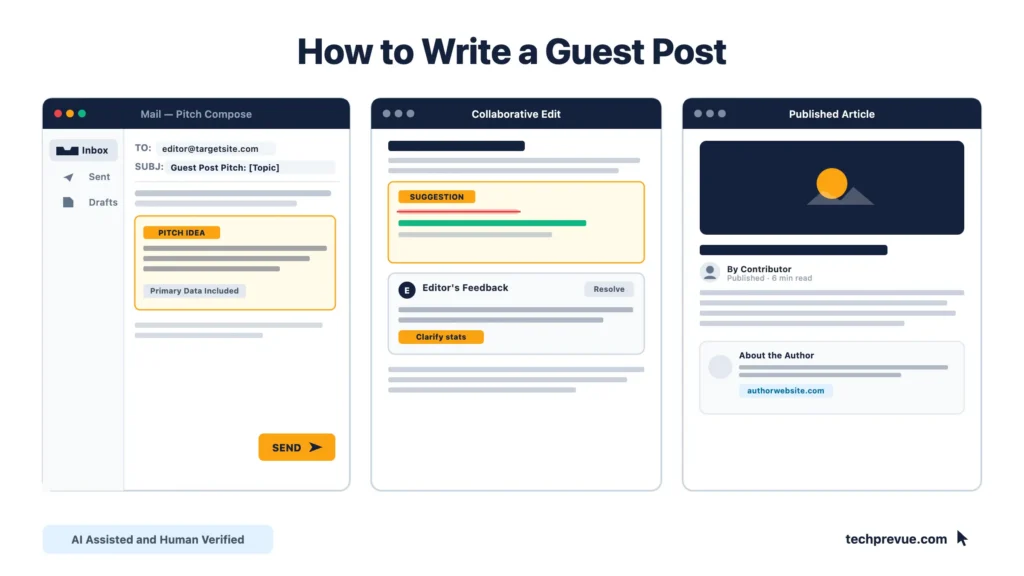
It’s writing the draft stage. You already know the subject and the format, so the remaining work is making the piece feel like it belongs where it’s going.
The six sections below are the ones editors comment on most.
1. Matching Their Voice Without Losing Yours
Fit the register, keep the perspective.
Their site conversational and yours formal? Loosen up. Theirs technical and precise? Tighten.
What doesn’t change is the substance only you can supply. They said yes because you know something their staff writers don’t, so the opinions, the examples and the judgment calls stay yours.
Introduce yourself in a single clause early on — after eight years running campaigns for D2C brands — and readers know who’s talking without you spending a paragraph on it.
2. Pitching the Explanation at the Right Level
How much does this audience already know? Miss in either direction and you lose them.
The best rule I’ve seen on this comes from Studio Cotton: write the shortest possible explanation for the person who knows the least. Name the hardwoods rather than assuming everyone remembers which woods qualify, but do it in four words instead of a paragraph.
Experts skim a short clarification without irritation.
Beginners hit an unexplained term and close the tab.
3. Deliver What the Headline Promised
You’d be surprised how many articles quietly fail to be about the thing their title said they’d be about.
A headline promising five ways to do something, where one of the five is an argument that the thing doesn’t matter much, hasn’t delivered five ways. Readers notice. So do editors, and it produces an awkward conversation neither of you wanted.
Before you submit, read your title, then read your headings. If a section doesn’t serve the promise, it’s padding — cut it or change the title.
4. Making It Actionable, Not Theoretical
Overview content is what an editor can already commission from a competent freelancer for a modest fee. What they can’t buy is the specific thing you learned by doing the work.
So give the number, the tool, the sequence, the thing that went wrong at 4pm on a Friday. A reader who finishes should be able to do something differently that same afternoon.
This is also what earns the click on your bio. Nobody follows up on a tidy summary of what they already knew.
5. Never Turn It Into a Sales Pitch
Readers arrived because they wanted to learn something specific. If they wanted to buy, they’d have gone looking for a product page.
Mentioning your product is fine when it illustrates a point you’re already making. Steering the reader toward buying it is not, and it costs you credibility the moment they sense the article exists to extract money.
Not in the conclusion either.
That’s where most people crack, and it happens to be the most visible place on the page to do it.
6. Using AI Without Getting Rejected
This is the live issue in 2026, and most guides say nothing about it. Editors are rejecting more submissions than ever, because the volume of machine-written pitches has made them suspicious by default.
Two rules keep you on the right side.
Disclose it if you used it. Policies range from outright bans to complete indifference. Ask during the expectations stage rather than after the fact, because being found out later ends the relationship permanently.
Never submit a draft you didn’t substantially write. The tells are obvious to anyone reading submissions daily: uniform paragraph lengths, hedged claims with no source, examples that would fit any industry, and a total absence of anything that happened to an actual person.
Research help, outlining and a grammar pass are broadly accepted. A generated draft with your name on it is the fastest route to a permanent no.
How to Add Links Without Getting Flagged
Nothing in writing a guest post causes more avoidable damage than link placement.
This is where writers create problems for themselves, usually by following advice from people who never read Google’s documentation.
1. How Many Links to Your Own Site Is Defensible
One or two, placed where they genuinely help the reader. That’s the whole answer. A 1,500-word article carrying 6 links back to your own commercial pages reads as an advertisement to any editor who has been doing the job more than a month.
You’ll find guidance recommending you include as many as will fit — six, eight, whatever the draft tolerates. The reasoning is that every link is another route back to your site, which is true and beside the point.
Google’s spam policies specifically name links with optimized anchor text placed in guest posts as link spam. A piece stuffed with self-referential links is the pattern that policy describes, and the risk lands on the publisher as well as you.
2. Link Generously to Their Content
Different story entirely.
Linking out to their existing articles is the cheapest goodwill you will ever buy from an editor.
It strengthens their internal linking, keeps readers on their site, and signals that you actually read the archive rather than skimming the homepage. Three or four is normal and nobody has ever objected to it.
External links to genuine sources work the same way. Cite the study, the documentation, the primary data, and your piece gets more credible while costing you nothing.
3. Body Links vs Author Bio
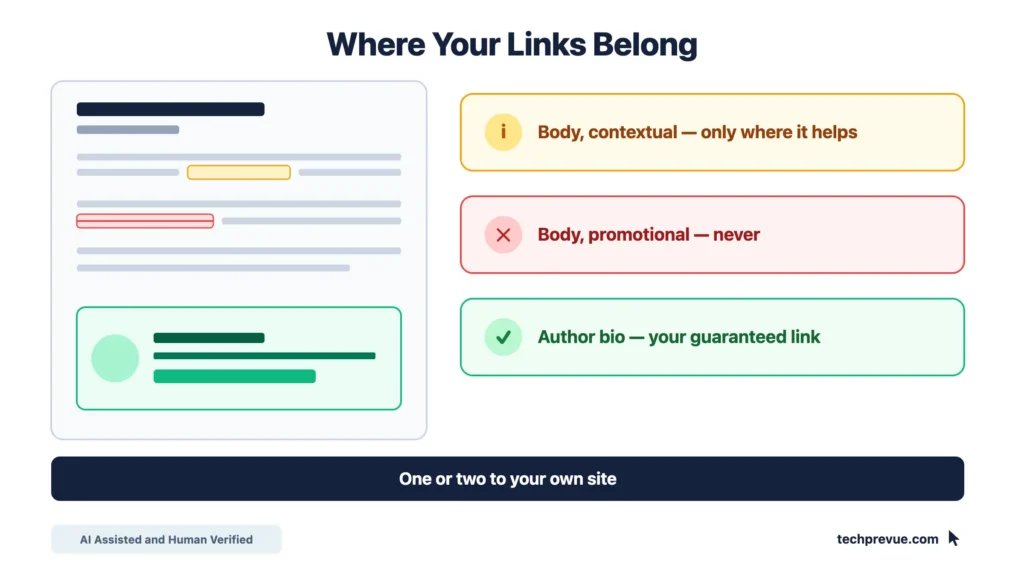
| Placement | What it’s for | Watch for |
|---|---|---|
| Author bio | Your primary link. Expected, uncontroversial. | Wasting it on your homepage |
| Body, contextual | Supporting a specific claim you made | Only where a reader genuinely needs it |
| Body, promotional | Nothing. Don’t. | This is what gets drafts rejected |
The bio link is the one you’re guaranteed. Treat body links as a bonus you might not get, and build the piece so it works without them.
4. Anchor Text That Won’t Create Problems
Use your brand name, the article title, or a plain descriptive phrase. Our teardown of onboarding flows is fine. Your target commercial keyword is not.
Simple test: strip the link out, and does the sentence still read naturally? Anchor text engineered around a keyword usually fails that, and it’s as visible to an editor as it is to an algorithm.
Never reuse the same anchor across placements. Repetition across multiple sites is exactly the footprint Google’s guidance describes.
5. When a Publisher Promises You Five Followed Links
Treat it as a red flag, not a bargain.
A publisher guaranteeing a number of followed links is telling you they apply no editorial judgment to outbound links. That usually means they sell placements, which makes the attribute question urgent, because paid links have to carry sponsored or nofollow under Google’s policies.
It also means their outbound profile is already crowded with everyone else’s commercial anchors. One contextual link from a site that guards its standards is worth more than five from a site that doesn’t.
When a site’s pitch to you leads with link counts instead of audience, you’re not being offered a guest post.
How to write an Author Bio That Earns the Click
Thirty words and one link. Most people waste both.
Two components, nothing more: the single most relevant thing about you for this audience, and where to go next.
Relevant beats impressive.
A room full of early-stage founders doesn’t care about your postgraduate degree; they care that you’ve done the thing three times and can say what broke.
Where to Send Them
Not your homepage.
A homepage asks a warm reader to work out their own next step, and roughly 9 in 10 simply won’t bother.
Send them somewhere that continues what they were reading — the related guide, the tool, the newsletter that promises more of the same. Studio Cotton’s version of this suggests offering several routes in the closing paragraph so readers pick the channel they prefer.
Then check the link actually works and points where you meant. Fixing a broken bio link after publication means emailing an editor about your own mistake.
What to Include in Your Submission Asset Pack
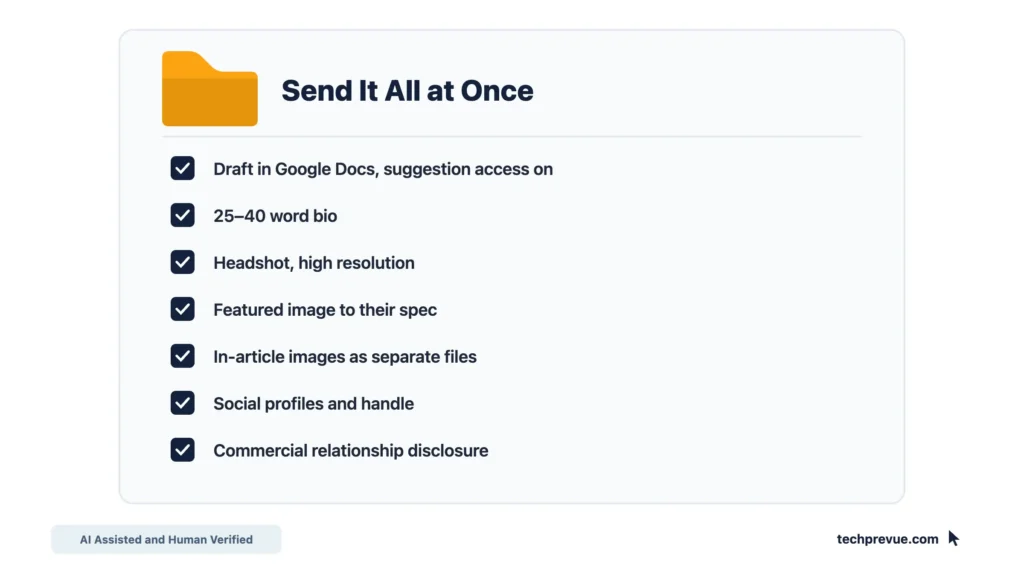
Send everything in one go.
Every item an editor has to chase delays publication by days and spends goodwill you would rather keep for the revision round.
- The draft in Google Docs, suggestion access enabled
- A 25–40 word bio, written to match their existing bio format
- A headshot at decent resolution, not cropped out of a group photo
- A featured image sized to their spec
- In-article images as separate files, never embedded in the document
- Your social profiles and preferred handle for tagging
- Disclosure of any commercial relationship mentioned in the piece
- Clean formatting, with no font overrides or color spans — those break most CMS stylers on paste
- Images compressed and cropped to their aspect ratio before you send them
Google Docs matters more than it sounds. It lets an editor suggest rather than rewrite, keeps revision history visible, and avoids the version confusion that email attachments guarantee.
Name image files descriptively. guest-post-onboarding-flow.jpg helps their SEO, while IMG_4471.jpg creates work for someone else.
Read the draft once more before it goes. Once it’s live you can’t quietly fix a typo — you either email the editor about it or live with it needling you every time you look.
What Happens After Your Submission
The Revision Round
Expect edits. A publication that changes nothing isn’t reading carefully, which tells you something about what the placement is worth.
Turn revisions around inside 2 to 3 working days. Editors have calendars to fill, and the contributor who replies fast is the one who gets asked back next quarter. Take 2 weeks and your piece slides to whenever there’s a gap.
Push back on substance, concede on style. If they’ve altered your argument or introduced an inaccuracy, say so plainly and explain why. If they’ve cut your favorite sentence or reordered a section, let it go.
Your links are the one exception to that rule. If an agreed link vanishes during editing, ask about it once, politely, referring to what you agreed at the start. That’s what the written expectations were for.
When an Editor Goes Quiet After You Submit
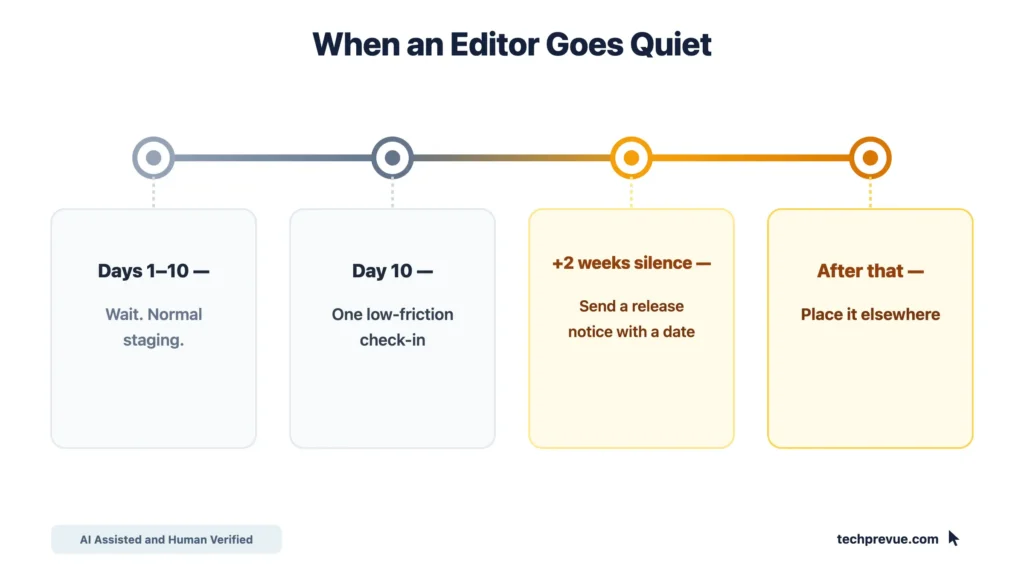
You pitched, got a yes, delivered the asset pack on time, and then heard nothing for three weeks.
Don’t panic, and don’t read it as rejection. Editorial desks stage content two to four weeks ahead, so a draft sitting untouched usually means the editor is clearing this month’s calendar rather than reconsidering yours.
Wait ten business days before checking in. Then send one low-friction note on the existing thread:
Hi [Name], checking in to see whether you need any adjustments on the [title] draft, or whether it’s set for the queue.
If another two weeks pass in silence, you have a practical problem rather than an emotional one. You can’t place the piece anywhere else while there’s a chance it goes live on Tuesday.
Break the deadlock with a release notice that names a date:
Hi [Name], since I haven’t heard back I’m assuming priorities have shifted. If I don’t hear from you by [date roughly a week out], I’ll withdraw the draft and place it elsewhere. Thanks for considering it either way.
That gives them a clear window to claim the piece if it was simply buried, and releases you cleanly if it wasn’t. Knowing how to write a guest post includes knowing when to walk one back.
If You’re Rejected
Ask one question: was it the topic or the execution?
Most editors will tell you, and the answer is worth more than the placement was. Topic rejections mean your research missed. Execution rejections mean your draft did.
Then ask whether a different angle would work. A rejected pitch from someone who handled it well is a far warmer prospect than a cold email, and editors remember who took a no gracefully.
Don’t send the same piece elsewhere unrewritten. It was built for one site’s format, and the next editor spots that immediately.
What to Do After Your Post Publishes
Share it everywhere you’re active, and tag the publisher so amplifying it costs them one tap.
Reply to comments for the first two weeks. Readers who engage with a contributor are the ones most likely to click through, and editors notice contributors who bring engagement instead of just filing copy.
Send the editor a short note a month later with what it did — traffic you sent, engagement you generated. That email is why you get invited back, and a standing invitation is worth more than any single placement.
What Separates a Revision Request From a Rejection
We publish contributed articles here, so we see this exchange from the other side.
<!– PUBLISHER DATA — Vinay to supply. Do not publish with invented figures. NOTE: this is a DIFFERENT cut from the /guest-posting/ page, which covers PITCH rejection. This section covers what happens to DRAFTS after a pitch was accepted. Needed: (1) rough share of accepted pitches that get revisions vs outright rejection (2) three most common reasons a draft gets revisions rather than a no (3) the thing that most often turns a borderline draft into a yes If you’d rather not publish figures, delete this block and the section runs qualitatively. –>
[INSERT: revision-vs-rejection split and the period measured]
The pattern holds regardless. Drafts get revisions when the thinking is sound and the execution is fixable. They get rejected when the thinking was never there.
Fixable: wrong length, wrong structure, missing sources, too many self-links, a buried lead, a tone that doesn’t match the site. All of it is an afternoon’s work for a writer who answers email.
Not fixable: no first-hand knowledge, an argument built to justify a link, or a draft that reads as machine-written. Editing can’t add expertise that wasn’t in the room.
The dividing line is always whether the writer actually knows something worth publishing. Everything else is formatting.
Guest Post Writing Mistakes That Cost Placements
Most failures in how to write a guest post come down to nine repeatable errors.
- Writing the full article before anyone agreed to publish it
- Pitching a topic the site already covered in the past year
- Missing a stated word count by more than about 20%
- Loading the draft with links back to your own commercial pages
- Using your target keyword as anchor text
- Treating the author bio as ad copy instead of a credential
- Sending images embedded in a document rather than as files
- Going quiet when the first round of edits lands
- Publishing, then never telling the editor how it performed
Frequently Asked Questions
How long should a guest post be?
Follow the publication’s stated range. Where none exists, match the average length of their recent posts on similar topics — usually 800 to 1,200 words on small blogs, and 1,500 to 3,000 on larger industry sites.
Should I write the guest post before pitching it?
No. Pitch two or three ideas first and write only once one is accepted, because every publication has different length, format and subject requirements that a pre-written draft won’t match.
How many links can I include in a guest post?
One or two to your own site, placed where they help the reader, plus as many genuine internal and external links as the piece needs. Guidance suggesting five or more self-links describes the pattern Google’s spam policies flag.
What should go in a guest post author bio?
One credential relevant to that specific audience, and one link to a page that continues what the reader was just reading. Around 25 to 40 words is standard.
Can I use AI to write a guest post?
Ask the publisher first, since policies range from outright bans to no restrictions. Research and outlining help is widely accepted, while submitting a generated draft under your own name is among the most common reasons submissions get rejected in 2026.
What do I do if my guest post is rejected?
Ask whether the topic or the execution was the problem, then ask whether a different angle would work. Most editors answer, and a writer who handles rejection well is a warmer prospect than a stranger.
How soon should I follow up on a pitch?
Once, five to seven working days later, on the same thread, adding something new rather than repeating the original. If that draws no reply, move on.
