
Tumblr was four things at once: a blog you controlled, a chronological feed, a reblog culture that spread posts with commentary attached, and a fandom space with tags and pseudonymity.
No single Tumblr replacement in 2026 rebuilds all four. That is the honest starting point, and it is why most lists of sites like Tumblr leave people unsatisfied.
This guide sorts 20 Tumblr alternatives by what you are actually trying to replace.
Quick answer: Pillowfort is the best Tumblr replacement for most people, matching Tumblr’s blogging and fandom experience with reblogs, user-created communities, and NSFW labeling. For blog ownership choose WordPress or Ghost, for art choose Cara or DeviantArt, for chronological microblogging choose Mastodon or Bluesky, and for long-form fandom writing choose Dreamwidth.
- What you are actually replacing
- Comparison table: 20 Sites like Tumblr at a glance
- How these were evaluated
- Best Tumblr alternatives for fandom and community
- Best Tumblr alternatives for artists
- Best Tumblr alternatives for independent blogging
- Best decentralized Tumblr alternatives
- Content policy compared
- Commonly suggested, but not real alternatives
- alternatives that have shut down
- How to export and move your Tumblr blog
- Notes for readers in India
- How to choose
- Frequently asked questions
- The short version
What you are actually replacing
Before comparing sites like Tumblr, decide which parts of Tumblr you need:
- Ownership — a blog at your own domain, with a working export
- Chronological feed — posts in order, not algorithmically ranked
- Resharing with commentary — reblog chains, not silent reposts
- Fandom features — tag discovery, pseudonymity, mature-content labeling
Most people need two of the four. Pick those two, then use the comparison table below.
Comparison table: 20 Sites like Tumblr at a glance
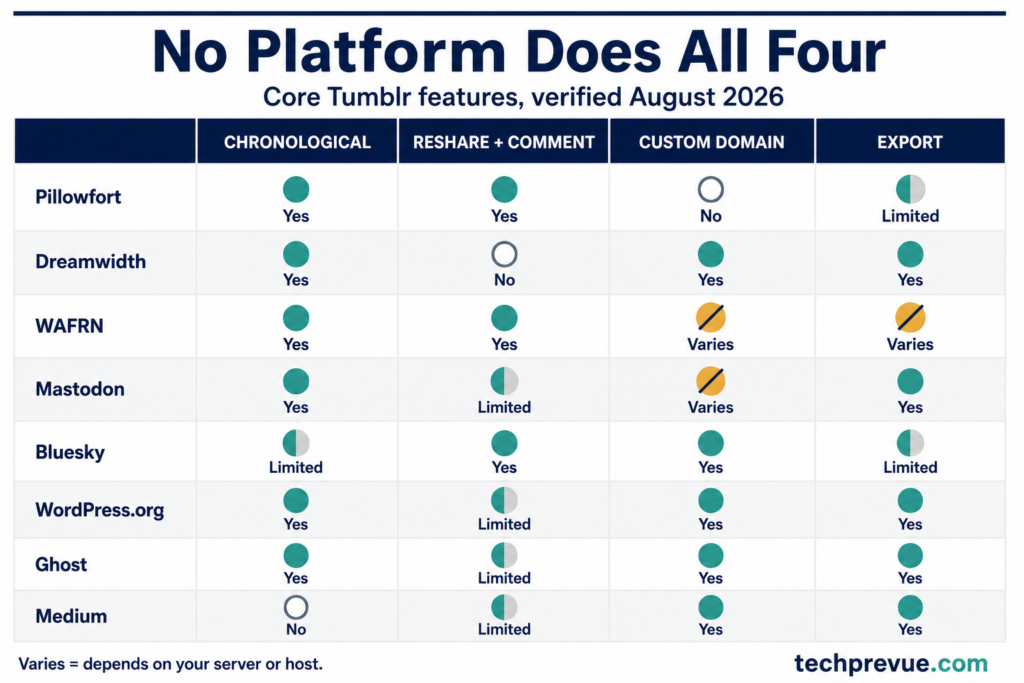
Fields are stated as Yes, No, Limited, or Varies rather than scored, so you can check each one against the platform’s own documentation.
| Platform | Chronological feed | Reshare with commentary | Custom domain | Export | Hosting model | Starting price |
|---|---|---|---|---|---|---|
| Pillowfort | Yes | Yes | No | Limited | Hosted | Free (waitlist) or $5 once |
| Dreamwidth | Yes | No | Yes (paid) | Yes | Hosted | Free |
| WAFRN | Yes | Yes | Varies | Varies | Federated | Free |
| Mastodon | Yes | Limited | Varies | Yes | Federated | Free |
| Bluesky | Limited | Yes | Yes (handle) | Limited | Hosted protocol | Free |
| Pixelfed | Yes | Limited | Varies | Varies | Federated | Free |
| WordPress.org | Yes | Limited (plugin) | Yes | Yes | Self-hosted | Hosting cost |
| WordPress.com | Yes | Limited | Yes (paid) | Yes | Hosted | Free |
| Ghost | Yes | Limited (beta) | Yes | Yes | Hosted or self-hosted | $18/mo or self-host |
| Micro.blog | Yes | Limited | Yes | Yes | Hosted | ~$5/mo |
| Neocities | Limited | No | Yes (paid) | Yes | Static hosting | Free |
| SpaceHey | Yes | No | No | Limited | Hosted | Free |
| DeviantArt | Limited | Limited | No | Limited | Hosted | Free |
| Cara | Limited | Yes | No | Limited | Hosted | Free |
| Substack | Limited | Yes (Notes) | Yes | Yes | Hosted | Free |
| Blogger | Yes | No | Yes | Yes | Hosted | Free |
| No | Limited | No | Limited | Hosted | Free | |
| Newgrounds | Limited | No | No | Limited | Hosted | Free |
| Medium | No | Limited | Yes (paid) | Yes | Hosted | Free |
| No | Yes (repin) | No | Limited | Hosted | Free |
Varies means the answer depends on which server or host you choose, not on the software.
How these were evaluated
Every one of these alternatives was checked against its own published documentation in August 2026. Where a platform’s own pages contradicted the common wisdom in other articles, the platform’s pages won.
Three criteria decided which Tumblr alternatives made the list: the service is still running, it replaces something specific about Tumblr, and its terms are published and current.
Nothing in this guide is based on hands-on testing of all 20 services. Where a claim comes from documentation, that is what it is.
Best Tumblr alternatives for fandom and community
1. Pillowfort
Of all the Tumblr alternatives here, Pillowfort is the closest structural match. It has reblogs, threaded comments, user-created communities, and per-post visibility settings that let you publish publicly, to followers only, or privately.
Registration is open, which several older guides still get wrong. You can pay a one-time $5 registration fee for instant access, or join a free rolling waitlist. There is also a mobile app installable from the site.
Users can mark posts NSFW so others can filter them. Pillowfort also prohibits AI-generated text and images.
Strengths
- Reblogs, threaded comments, and communities in one place
- Public, followers-only, or private visibility per post
- Bans AI-generated text and images
- Independently funded, with no venture capital
Limitations
- No custom domain
- Small user base; discovery depends on tags
Skip it if: you need your posts to rank in search engines.
2. Dreamwidth
Dreamwidth is one of the longest-running sites similar to Tumblr: an open-source fork of LiveJournal, fan-owned and ad-free. Entries run to 300,000 characters and threaded comments are excellent, so it suits long meta posts and discussion.
Its adult-content system is unusually granular. You can flag individual entries or a whole journal as 18+ and write your own explanation of why, and readers control their own filtering.
Dreamwidth has no mobile app by choice. Listing in the Apple or Google stores would require content guidelines it does not want to impose.
Strengths
- Entries up to 300,000 characters with strong threaded comments
- Per-entry or per-journal 18+ flagging with custom explanations
- Fan-owned, ad-free, free tier available
- Imports journals and comments from LiveJournal and compatible sites
Limitations
- No mobile app, and none planned
- No reblog chains; sharing happens through links and comments
Skip it if: you post primarily from a phone.
3. Reddit
Among sites similar to Tumblr, Reddit is where topic communities went. For finding people who care about the same narrow thing, nothing else here competes.
As a Tumblr replacement it is partial. You get no personal space, no theme, and no ownership, and posts get buried by the feed within days.
Strengths
- Strongest niche community discovery of anything here
- Free, with no posting limits
Limitations
- No personal blog, theme, or profile customization
- Every subreddit adds rules on top of sitewide policy
- Posts have a short visible lifespan
Skip it if: you want a space that is recognizably yours.
4. SpaceHey
SpaceHey is an unusual Tumblr alternative here, rebuilding the mid-2000s social profile with custom CSS, blogs, bulletins, and a friends list. It appeals to the same instinct that made Tumblr themes worth fiddling with.
Two constraints matter. SpaceHey moved to invite-only registration in March 2026, so you need a code from an existing user, and it became inaccessible in Brazil under that country’s ECA Digital age-verification rules.
Strengths
- Custom CSS profiles, blogs, and bulletins
- Free and ad-free, funded by donations
Limitations
- Invite-only since March 2026
- Unavailable in Brazil under ECA Digital rules
- Small team, with users reporting a bug backlog
Skip it if: you cannot get an invite code.
Best Tumblr alternatives for artists
5. Cara
Cara is the strongest of the Tumblr alternatives aimed at artists, built as a portfolio and social platform by artists themselves. Your profile has a Timeline for everything you post and a Portfolio tab you curate.
It applies “NoAI” tags to uploaded images by default and does not permit AI-generated images as portfolio work. The team is candid that these tags cannot stop determined scrapers.
Two current facts most guides miss: Cara does not permit NSFW content at all, citing a lack of legal and moderation resources, and Cara Glaze is disabled following an abuse incident, so artists must run Glaze from the University of Chicago directly.
Strengths
- NoAI tags applied to uploads by default
- Separate Timeline and curated Portfolio views
- Open to Work filter searchable by art directors
Limitations
- No NSFW content permitted
- Cara Glaze integration currently disabled
- Portfolio accounts require a vouch from an existing member
Skip it if: you post mature work, or you want a blog rather than a portfolio.
6. DeviantArt
DeviantArt has hosted artists since 2000 and retains one of the largest built-in audiences for visual art of any Tumblr alternative here, along with groups, commissions, and critique tools.
Its mature policy is detailed and worth reading before you upload. Mature content is permitted with proper tagging, but there are specific boundaries around sexual, erotic, and fetish themes, and avatars and preview images cannot contain mature content.
Strengths
- Large established audience for visual art
- Mature-content tagging system
- Groups, commissions, and critique tools
Limitations
- Detailed restrictions on sexual, erotic, and fetish themes
- A violation in one image can affect a whole multi-image submission
Skip it if: you post writing rather than visual art.
7. Pixelfed
Pixelfed handles the photo side. Image sharing here is federated, chronological, ad-free, free of engagement ranking, and connected to Mastodon through ActivityPub.
Content rules and stability depend on the instance you join, not on Pixelfed as a company. Read your server’s about page first.
Strengths
- Chronological photo feed with no engagement ranking
- Federates with Mastodon and the wider fediverse
- Free and open source
Limitations
- Images only; poorly suited to text posts
- Rules and reliability vary by instance
Skip it if: your posts are mostly writing.
8. Newgrounds
Newgrounds is the oldest of these Tumblr alternatives, hosting independent creative work since 1995 across Games, Movies, Art, and Audio. For animators and game developers it remains one of the few places with a genuine audience.
It has rules and enforces them, so older guides claiming otherwise are wrong. Adult material sits behind filters requiring an account and an age setting.
Strengths
- Real audience for animation, games, and audio
- Free, with community rating and feedback
Limitations
- Narrow fit outside those formats
- Dated interface and limited blogging tools
Skip it if: you post static art or written work.
9. Pinterest
Repinning is a genuine re-share mechanic and boards work well for aesthetic curation, which covers one real Tumblr habit.
It replaces nothing else. There is no blog, no commentary chain, no chronological feed, and a commercial algorithm controls your reach. Some guides call Pinterest the closest functional match among available alternatives. It is not.
Strengths
- Repinning as a working re-share mechanic
- Boards plus a very large discovery audience
Limitations
- No blog, commentary chains, or chronological feed
- Algorithmic reach
- No sexual content or visible intimate body parts permitted
Skip it if: you write posts rather than collect images.
Best Tumblr alternatives for independent blogging
10. WordPress.com
WordPress.com offers a dedicated Tumblr importer, which makes it the lowest-friction migration path of the alternatives here.
One fact worth knowing before you move: WordPress.com and Tumblr are both Automattic properties, and their mature-content rules are close to identical. Both permit labeled mature content including nudity, and both prohibit visual depictions of sexually explicit acts.
Moving from Tumblr to WordPress.com does not change what you are allowed to post.
WordPress.com does apply no interstitials or age gates to mature-marked sites, and does not suspend sites solely for mature content. Those sites are excluded from Top Blogs, recent posts, and related-posts listings.
Strengths
- Dedicated Tumblr importer
- No age gates on mature-marked sites
- Custom domains, themes, and plugins on paid plans
Limitations
- Content rules close to Tumblr’s own
- Mature-marked sites excluded from discovery listings
Skip it if: you are leaving Tumblr over its content policy.
11. WordPress.org
Self-hosted WordPress gives you the most control of any Tumblr alternative here. You install the software on hosting you choose and no single platform decides your terms.
That is control, not immunity. Your host, your domain registrar, your payment processor, and the law where you operate can all still restrict what you publish. Choose a host whose terms cover your content, and read them before you migrate.
Adding the ActivityPub plugin lets Mastodon users follow your blog and reply as comments.
Strengths
- No single platform controls your site or your archive
- ActivityPub plugin federates your blog to Mastodon
- Unlimited customization through themes and plugins
Limitations
- Hosting, updates, backups, security, and spam are yours
- Your host’s terms and local law still apply
- Requires more technical effort than anything else here
Skip it if: you do not want to maintain a website.
12. Ghost
Ghost is the Tumblr alternative for people who want a publication rather than a profile. Its social web feature gives your publication an ActivityPub endpoint, so fediverse users can follow your site directly and every post reaches them. It also publishes short-form Notes to the same network.
Ghost documents this feature as beta with named rough edges: no mute or report tools yet, no video attachments on notes, and search requires a full handle. Notes you publish do not appear on your own website. It also requires a custom domain.
Ghost’s own compatibility notes point out that Ghost-to-Tumblr federation does not work, because Tumblr never completed its move onto the social web.
Ghost(Pro) starts at $18 per month billed yearly. The software itself is open source and free to self-host.
Strengths
- ActivityPub endpoint plus short-form Notes
- Newsletters, memberships, and subscriptions built in
- Free and open source if you self-host
Limitations
- Social web features are in beta with documented gaps
- Ghost(Pro) starts at $18/mo; no free hosted tier
- Requires a custom domain for social features
Skip it if: you want to publish in five minutes at no cost.
13. Micro.blog
Micro.blog is the quietest of these Tumblr alternatives. It hosts a blog at your own domain with ActivityPub enabled by default, and cross-posts automatically to Mastodon, Threads, and Bluesky. It handles both short posts and full-length articles.
Strengths
- Your own domain with ActivityPub on by default
- Automatic cross-posting to several networks
- Short and long posts in one place
Limitations
- Paid only, at roughly $5 per month
- Small, quiet community with limited discovery
Skip it if: you want a large audience already in place.
14. Neocities
Neocities is the Tumblr replacement for people who miss custom themes. It gives you free static hosting for a site you build yourself, with $5 per month adding a custom domain and more storage. It hosted more than 1.6 million sites as of May 2026.
The appeal is the customization Tumblr themes used to allow, without limits. An Activity feed lets you follow other sites, so it is less isolating than it sounds.
Strengths
- Complete design control with no theme limits
- Free tier; $5/mo adds a custom domain
- Activity feed for following other sites
Limitations
- You write the HTML and CSS; there is no post editor
- Static pages only, no server-side scripting
Skip it if: you do not want to learn any code.
15. Substack
Substack pairs newsletters with Notes, a short-form feed that works like a microblog, making it one of the stronger alternatives for writers. You own your mailing list and can export it.
Strengths
- You own and can export your mailing list
- Notes adds a short-form social feed
- Free to start, payments built in
Limitations
- Explicit content may be removed from discovery
- Strict no-nudity rule on profile images
Skip it if: you want a visual blog rather than a newsletter.
16. Blogger
Blogger or Blogspot is the plainest of these Tumblr alternatives and the least likely to disappear: free, stable, backed by Google, with AdSense integration.
Strengths
- Free permanently, no storage or bandwidth charges
- AdSense integration built in
- Running since 1999
Limitations
- No reblogs, community, or discovery feed
- Adult-marked blogs cannot be monetized
Skip it if: the social side of Tumblr was what you valued.
17. Medium
Among sites like Tumblr aimed at writers, Medium is the fastest way to publish and reach readers without configuring anything. Custom domains are available on a paid membership, and the Partner Program pays writers in roughly 110 countries including India.
Medium’s recommendation system can surface your work, but it does not guarantee readers without promotion.
Strengths
- Custom domain on a paid membership
- Partner Program covers India and ~110 countries
- Distribution through Medium’s recommendation system
Limitations
- No Google Analytics, custom scripts, or AMP support
- No reblog chains and no chronological feed
Skip it if: owning your platform matters more than reach.
Best decentralized Tumblr alternatives
18. Mastodon
Mastodon is the most established open-source Tumblr alternative, built as a network of independently operated servers running shared software. Feeds are chronological, there are no ads, and boosts reshare posts without adding commentary.
Content rules are set by each server, so choosing where to join is a real decision rather than a formality.
Strengths
- Chronological feed, no ads, no engagement ranking
- Open source, with the option to run your own server
- Connects to Pixelfed, Ghost, WordPress and more
Limitations
- Rules and moderation vary by server
- Boosts carry no added commentary
Skip it if: you want to sign up without choosing a server.
19. WAFRN
WAFRN is the Tumblr alternative built closest to Tumblr’s own shape: open-source federated software, named in reference to Tumblr’s 2018 adult-content policy. It was built around long posts, large media, files kept in the format you upload, and a reverse-chronological feed.
It bridges both the fediverse and Bluesky’s network. Its documentation is candid about tradeoffs: reshares work differently from Tumblr’s because strict replication would break compatibility with other platforms, and you cannot repeat an interaction without undoing it first.
Servers are run as hobby projects, registration may need manual approval, and search is limited.
Strengths
- Long posts, large media, reverse-chronological feed
- Bridges the fediverse and Bluesky
- Open source under AGPLv3
Limitations
- Hobby-run servers; registration may need approval
- Limited search
- Reshares behave differently from Tumblr reblogs
Skip it if: you need reliability guarantees or scale.
20. Bluesky
Bluesky is where a large share of Tumblr and X users landed, and it is among the fastest-growing alternatives. Quote posts approximate reblogs with commentary, and custom feeds let you build a timeline instead of accepting one.
Availability now depends on where you live. Bluesky stopped serving Mississippi rather than comply with that state’s law, and requires age assurance in the UK and several US states.
Strengths
- Custom feeds instead of a single algorithm
- Quote posts work like reblogs with commentary
- Large active user base
Limitations
- Unavailable in Mississippi; age assurance required in several regions
- No long-form blog posts
Skip it if: you write long-form, or live in an affected region.
Content policy compared
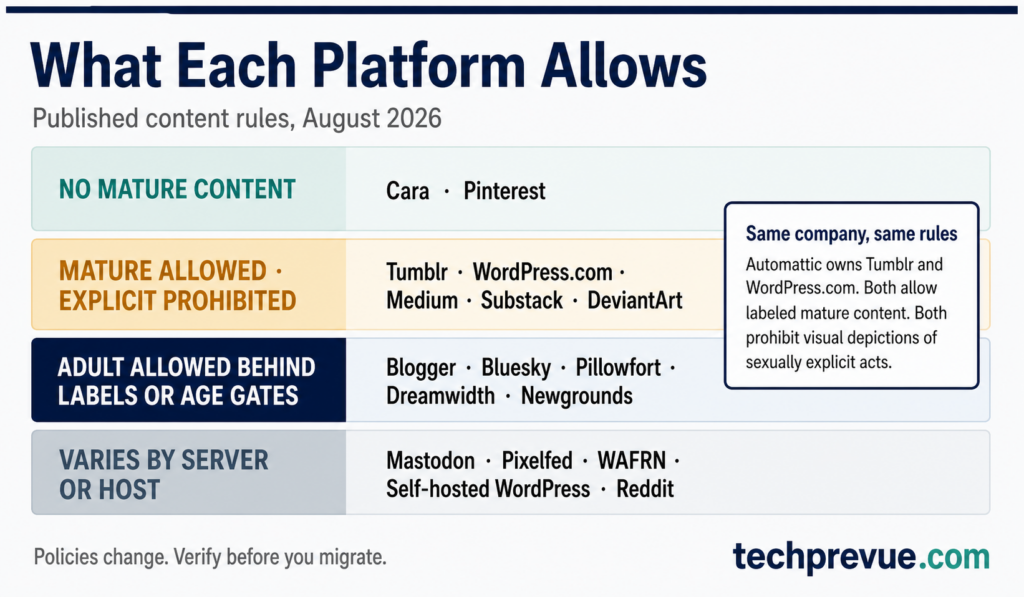
Content rules are the most common reason people leave Tumblr, and the most commonly misreported detail in other guides. Each line below reflects the platform’s own published policy as of August 2026.
| Platform | Mature content rule |
|---|---|
| Tumblr | Labeled mature content allowed; visual depictions of sexually explicit acts prohibited |
| Cara | No NSFW content permitted |
| No sexual content or visible intimate body parts | |
| Medium | Erotic writing and non-graphic erotic images allowed; pornographic images and video prohibited |
| WordPress.com | Mature content allowed when marked Mature; sexually explicit acts prohibited |
| Substack | Artistic nudity and erotic literature allowed; porn prohibited |
| DeviantArt | Mature content allowed with tagging; specific limits on sexual and fetish themes |
| Blogger | Adult content allowed behind an adult warning; monetizing it prohibited |
| Bluesky | Labeled adult content allowed, subject to age assurance and regional law |
| Pillowfort | NSFW posts allowed when marked |
| Dreamwidth | 18+ flagging per entry or journal; under-18s cannot view flagged content |
| Newgrounds | Adult material behind account and age filters |
| Mastodon / Pixelfed / WAFRN | Varies by server |
| WordPress.org / self-hosted Ghost | Set by your hosting provider’s terms |
| Sitewide policy plus per-subreddit rules; communities can be marked mature |
Age-verification requirements are changing quickly across the UK, EU, Australia, Brazil, and several US states. Check a platform’s current status for your region rather than assuming.
Commonly suggested, but not real alternatives
| Platform | Why it disappoints Tumblr users |
|---|---|
| Professional networking; no reblogs, no fandom, no personal blog | |
| Algorithmic, no commentary resharing in feed, no blog | |
| X | Quote posts work, but no blog format or ownership |
| Threads | Algorithmic feed, no long-form blog |
| Real-name culture, the opposite of Tumblr pseudonymity | |
| Wix / Site123 | Website builders with no community or feed |
alternatives that have shut down
Two alternatives still recommended elsewhere no longer exist:
- Typepad — closed September 30, 2025, with accounts and content deleted
- Cohost — the reblog-focused Tumblr alternative went read-only in October 2024 and shut down January 12, 2025
Platform stability is a selection criterion, not an afterthought.
How to export and move your Tumblr blog
Whichever of these Tumblr alternatives you pick, the export comes first. Tumblr provides a ZIP export containing posts, media, comments, and messages.
Check Tumblr’s Known Issues before you rely on it. Tumblr’s own staff changelog has listed failing blog exports as a known issue on its April and May 2026 updates, and the notice remains posted on Tumblr’s support blog: the company says it is aware some exports are failing and is working on a fix.
That does not mean exports never work. It means you should verify yours rather than assume.
- Request your export early, before you have chosen a destination.
- Open the ZIP and check it. Confirm your posts and images are inside and readable.
- Save a second copy outside Tumblr.
- Then import. WordPress.com has a dedicated Tumblr importer; Dreamwidth and others have their own paths.
- Keep your Tumblr blog online until the new site is verified.
Reblog chains rarely survive migration intact on any platform. If specific threads matter, archive them separately.
Notes for readers in India
A few practical differences apply when choosing sites like Tumblr from India.
Monetization: Medium’s Partner Program supports India directly. Blogger connects to AdSense. Ghost and self-hosted WordPress let you run subscriptions or ads on your own terms.
Payment friction: Pillowfort’s one-time $5 fee needs a card that handles international transactions. Its free waitlist avoids this.
Data control: self-hosting lets you choose your provider and server location, which gives you more control over where reader data sits. It does not by itself establish compliance with India’s data protection framework — that depends on how you configure consent, storage, and disclosure.
How to choose
| If you are leaving because… | Best sites like Tumblr to start with |
|---|---|
| You want fandom and reblog culture back | Pillowfort, then Dreamwidth |
| You want to own your blog permanently | WordPress.org, then Ghost |
| You are an artist protecting your work | Cara, then DeviantArt |
| You want a chronological, ad-free feed | Mastodon, then Bluesky |
| You mostly collected images | |
| You want maximum design control | Neocities |
| You want to write and be read quickly | Medium, then Substack |
| Content policy pushed you out | Read the policy table above first |
Most people end up using two Tumblr alternatives: one place to publish and own, one place to be social. That reflects Tumblr doing two jobs at once.
Frequently asked questions
What is the best Tumblr alternative in 2026?
Pillowfort is the best Tumblr alternative for most people leaving over fandom reasons. It combines reblogs, user-created communities, threaded comments, and NSFW labeling in one place. If you want to own your blog rather than join a community, WordPress or Ghost are stronger picks.
Which sites similar to Tumblr allow mature content?
The answer depends on where each platform draws its line.
Cara and Pinterest permit no mature content. Medium, WordPress.com, Substack, and DeviantArt allow nudity or erotic material with limits but prohibit explicit sexual imagery.
Blogger, Bluesky, Pillowfort, Dreamwidth, and Newgrounds permit adult content behind labels or age gates. On Mastodon,
Pixelfed, and WAFRN the rule varies by server, and on self-hosted software it comes down to your host’s terms.
Check the platform’s own policy page before migrating.
Are there free Tumblr alternatives?
Yes. Plenty of free sites like Tumblr exist. Blogger, Mastodon, Bluesky, Pixelfed, Dreamwidth, Neocities, WordPress.com, Reddit, Substack, and Newgrounds all have free tiers, and Pillowfort offers free access through its waitlist. Free tiers usually limit custom domains or storage.
Can I move my Tumblr posts to another platform?
Yes. Tumblr provides a ZIP export and WordPress.com offers a dedicated Tumblr importer. Request your export early and confirm the file opens correctly, since Tumblr has listed failing exports among its known issues in 2026. Keep your original blog online until the new site works.
The short version
The best alternatives are not the biggest ones. They are the ones whose feed behavior, resharing model, and content rules match what you actually need.
Of the 20 Tumblr alternatives here: Pillowfort for fandom, WordPress or Ghost for ownership, Cara or DeviantArt for art, Mastodon or Bluesky for chronological posting.
Whichever you pick, export your Tumblr blog and check the file before you need it.
