
The best gaming niche ideas share four parts: a defined slice of gaming, a specific audience, a problem that keeps coming back, and a format you can still produce in month nine. Miss any one of them and you have a topic, not a niche.
“Gaming” fails that test. “Performance guides for competitive shooters on entry-level Windows laptops” passes it — you know exactly who is reading and what they need fixed.
The second decision matters just as much: blog or YouTube?
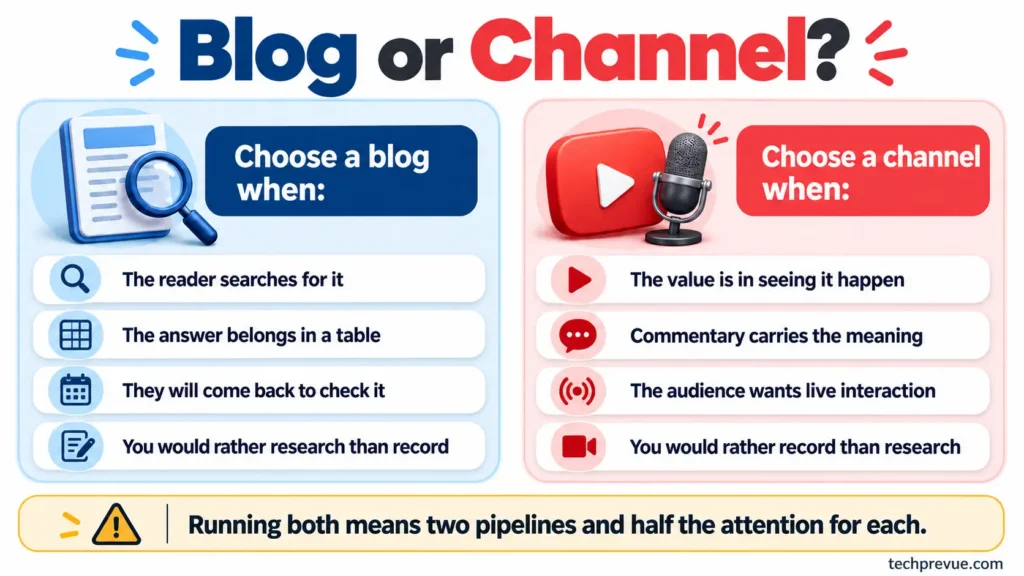
They are not interchangeable. Written content wins when the reader needs to search, scan, compare, and return to a settings table. Video wins when the value depends on seeing the frame drop, hearing the commentary, or joining a live chat.
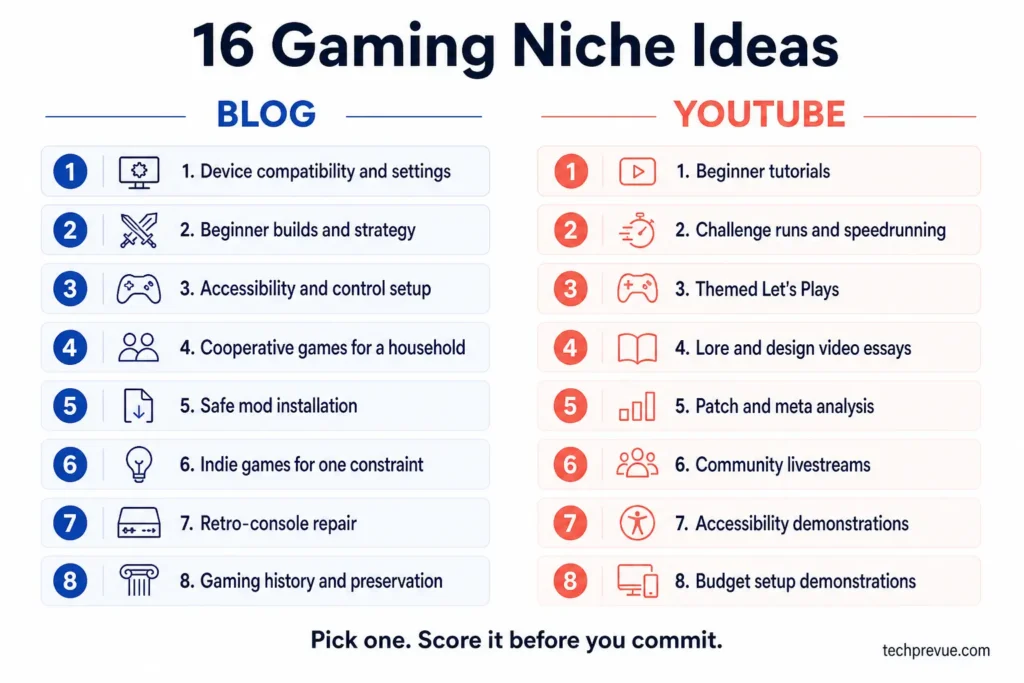
Below are eight gaming niche ideas that suit a blog, eight that suit a channel, and a scoring method for choosing between them. Each is a starting point assessed from a content-strategy perspective, not a personally tested ranking of guaranteed winners.
- Gaming Niche vs. Sub-Niche vs. Micro-Niche vs. Format
- Gaming Blog vs. YouTube Gaming Channel
- How to Narrow Gaming Niche Ideas
- Gaming Niche Ideas for Blogs
- Gaming Niche Ideas for YouTube
- Which Gaming Niche Ideas Work for a Blog, YouTube, or Both?
- Score Your Shortlist in Five Minutes
- How to Validate a Gaming Niche Before Committing
- Revenue Models and What They Actually Depend On
- Common Gaming-Niche Mistakes
- Frequently Asked Questions
Gaming Niche vs. Sub-Niche vs. Micro-Niche vs. Format
Most people skip this distinction and pay for it six months later.
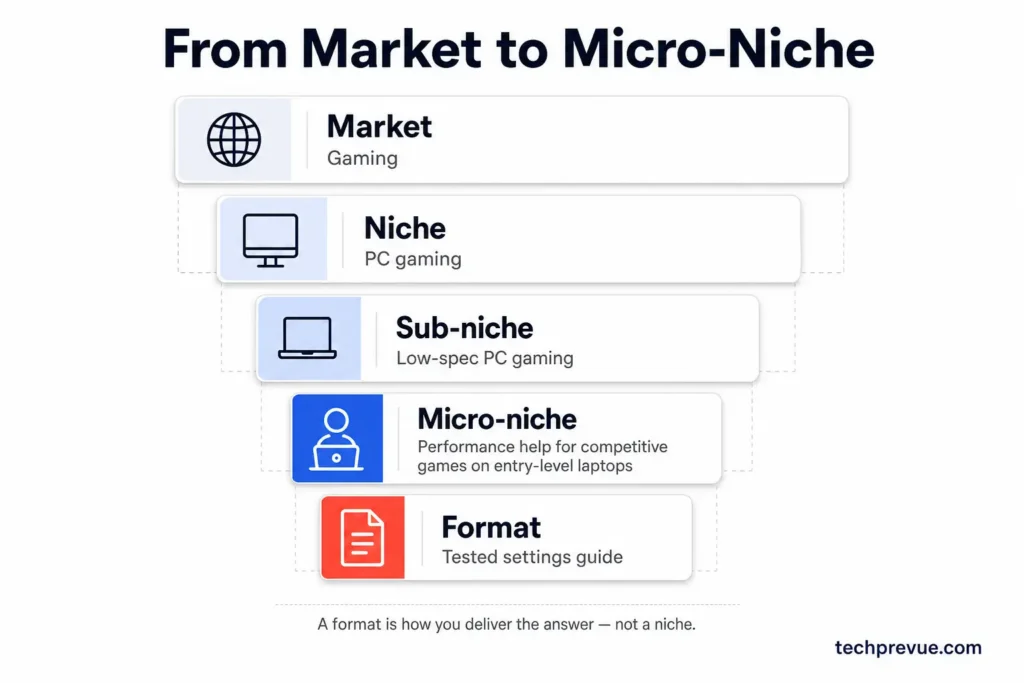
A gaming niche is a focused area within the wider gaming market. A sub-niche narrows that area. A micro-niche names a particular audience and the recurring need you solve for them.
Format is separate. Reviews, tutorials, livestreams, walkthroughs, montages, and video essays describe delivery, not audience.
| Level | Example | What it defines |
|---|---|---|
| Market | Gaming | The overall subject |
| Niche | PC gaming | A platform or part of the market |
| Sub-niche | Low-spec PC gaming | A narrower context |
| Micro-niche | Performance help for competitive games on entry-level laptops | A reader and recurring problem |
| Format | Tested settings guide | How the answer is delivered |
One warning about micro-niches. A single keyword, an exact-match domain, or a five-page site does not make you focused — it makes you small.
Real focus makes editorial decisions easier while still leaving room for dozens of genuinely different questions.
Gaming Blog vs. YouTube Gaming Channel
Pick the medium that fits the audience’s need and your production strengths, not the one that sounds easier.
And stop calling every gaming video a vlog. Tutorials, livestreams, recorded walkthroughs, montages, and essays are different formats with different workloads.
| Decision | Gaming blog | YouTube gaming channel |
|---|---|---|
| Strongest use | Searchable instructions, comparisons, reference, troubleshooting | Demonstrations, entertainment, personality, live interaction |
| Evidence that works | Clear sourcing, tested steps, dated screenshots and results | Original footage, commentary, editing, on-screen proof |
| Main workload | Research, writing, editing, site maintenance, updates | Recording, scripting, editing, thumbnails, publishing cadence |
| Common failure | Generic text with no experience or evidence behind it | Long raw gameplay with no reason to watch |
| Useful measure | Relevant search visits, returning readers, onward actions | Retention, returning viewers, comments, repeat viewing |
Running both can work when one piece of research deserves two treatments. A performance test becomes a written settings table and a video demonstration. Each version has to stand alone, though — never make a reader sit through nine minutes of video for a number that belongs in a table.
Choosing written publishing? This guide to starting a blog covers the setup process separately. Anyone who still needs the vocabulary can start with the basics of the medium.
How to Narrow Gaming Niche Ideas
Use one formula: gaming subject + audience + recurring problem + context + sustainable format.
Watch it work. “Mobile game reviews” is broad enough to describe ten thousand sites, while “written reviews of offline Android games for commuters with 20-minute sessions” names the device, the reader, the constraint, and the format without betting everything on one title.
The same fix applies to video. “Gameplay videos” tells a viewer nothing; “commentated challenge runs in turn-based strategy games for intermediate players” gives them a reason to pick you over thousands of unedited playthroughs.
Then answer the harder question: does your evidence match your promise?
A content strategist can explain how to evaluate a gaming publication. A build guide, repair tutorial, benchmark, or review needs direct experience, documented testing, or review by someone who has it.
Google’s people-first content guidance asks whether you have an intended audience and first-hand expertise. It also names one specific warning sign: entering a subject mainly for search traffic, without genuine knowledge.
Gaming Niche Ideas for Blogs
These eight gaming niche ideas sit deliberately below “gaming news” and “game reviews.” Each solves a recurring problem — you still have to test demand, competition, evidence, and workload before committing.
One reminder before the list. A written gaming product does not have to be a stream of articles; compatibility tables, searchable fix libraries, release calendars, and community reports often serve the reader better.
1. Device Compatibility, Performance, and Settings
Someone is about to spend money, and they want one answer: will this run on my machine? That question never stops being asked. Narrow it to a single hardware class — Steam Deck, Linux, integrated-graphics laptops, budget Android phones, cloud gaming on weak hardware — and you own a reader who checks back before every purchase.
The work is in the proof: test conditions, exact specifications, game build number. Skip those and you are guessing in public like everyone else.
2. Beginner Builds and Strategy for One Game or Mode
Build guides help a defined skill level make better in-game decisions. Narrow by one title, one role, one mode, or the first ten hours. Skip that step and you produce a shallow pile of unrelated tips, which is exactly what the larger esports-adjacent sites already publish at scale.
Maintenance is the catch. A balance patch can invalidate an article overnight, so you need a dated update process and an explanation of why a build works rather than a copied tier list.
3. Accessibility and Control Setup
Accessibility coverage explains subtitles, remapping, difficulty options, colorblind modes, audio cues, and controller alternatives. The strongest version serves one type of need or one platform. Avoid medical claims entirely.
Document the exact settings and separate built-in features from third-party tools. Better still, consult affected players or an accessibility reviewer instead of guessing what people need.
4. Cooperative Games for a Defined Household
Recommendations get useful the moment they serve a real group. Couples with mismatched skill, parents playing with a seven-year-old, remote friends on different platforms, two people sharing one screen — each has different criteria. Session length, difficulty scaling, voice requirements, cross-play support, and whether progress saves mid-level all change the answer.
This is not a rewrite-the-store-page niche. Say who played, for how long, on what hardware, and what made co-op comfortable or miserable.
5. Safe Mod Installation and Troubleshooting
Pick one game ecosystem and help readers install, update, remove, and diagnose mods.
Narrow beats broad here, because compatibility depends on the game version, the mod loader, the operating system, and how files collide with each other.
Every guide needs source checks, backups, recovery steps, and a plain warning about unofficial downloads and account bans. Never distribute copyrighted files or call an unverified download safe.
6. Indie Games for One Constraint
Indie discovery works when the selection rule is sharper than “hidden gems.”
Try short narrative games under three hours, cozy games with no fail state, horror games that run on integrated graphics, or two-player co-op that needs no voice chat.
Publish the rule and stick to it. First-hand play notes, stated exclusions, and honest limitations beat a longer list assembled from press releases.
7. Retro-Console Repair and Maintenance
Cover one hardware family: common faults, cleaning, storage, controller drift, display connections, replacement parts.
This one suits someone with hands-on electronics experience, not a writer summarizing forum threads.
Respect the safety boundary. Power supplies, batteries, soldered joints, and brittle 30-year-old plastic separate routine maintenance from work that needs a technician — and preservation is not a synonym for distributing game files.
8. Gaming History, Preservation, and Lost-Game Research
Investigate one platform, franchise, studio, region, or era.
Canceled projects, regional release differences, forgotten hardware, development decisions, physical-media preservation, and the people behind influential games all reward archival work.
Strong pieces rest on archived manuals, contemporary press, original interviews, and preservation organizations rather than recycled trivia. Label recollections, disputed accounts, and fan theories for exactly what they are.
Who Can Run These Blogs, and How the Money Works
Revenue follows the reader’s problem.
A repair publication and a lore-analysis publication do not create the same commercial opportunities, and program availability varies by country. Disclose every commercial relationship.
| Gaming blog direction | Who can run it credibly | Realistic revenue paths | Non-negotiable requirement |
|---|---|---|---|
| Device compatibility and settings | A hardware tester, technician, or publisher with repeatable device access | Advertising; disclosed hardware affiliates; setup services | Document devices, settings, versions, and repeatable results |
| Beginner builds and strategy | An experienced player, analyst, or coach — or a contributor reviewed by one | Advertising; memberships; coaching; original paid guides | Maintain advice after balance and rule changes |
| Accessibility and control setup | An accessibility specialist, affected player, or reviewer working with users | Advertising; adaptive-equipment affiliates; consulting | Involve affected users; make no medical claims |
| Cooperative-game recommendations | Couples, families, or reviewers who play the games together | Advertising; disclosed game and equipment affiliates; newsletter sponsorships | State who played, platform, session length, and criteria |
| Safe mod installation | An experienced mod user, developer, or community maintainer | Advertising; memberships; support services; tool affiliates | Check sources, versions, backups, rights, and security risk |
| Indie games for one constraint | A critic, curator, or enthusiast who plays the selected games | Advertising; disclosed store affiliates; newsletters; memberships | Apply one consistent selection method with play notes |
| Retro-console repair | A repair technician, electronics professional, or hardware hobbyist | Parts and tool affiliates; repair services; workshops | Separate routine maintenance from hazardous repair |
| Gaming history and preservation | A historian, archivist, journalist, or researcher using traceable sources | Advertising; memberships; newsletters; original research products | Separate documented history from recollection and theory |
Gaming Niche Ideas for YouTube
Video-first gaming niche ideas need one thing a blog does not: a reason to watch instead of simply playing the game yourself.
That reason comes from instruction, skill, analysis, editing, personality, or community. Decide which one you are selling before you record anything.
1. Beginner Tutorials for One Game or Mode
Tutorial channels solve one visible problem per video.
Teach movement to new competitive players, explain a strategy game’s economy, or demonstrate controller settings on a specific platform. Show the exact action on screen while the commentary explains the decision. Chapters, on-screen labels, and updated descriptions rescue the video when a later patch changes the method.
2. Challenge Runs and Speedrunning
A rule creates tension that raw gameplay never will.
Speedrunning adds measurable performance and community-defined categories; challenge runs add unusual equipment, resource limits, or a self-imposed goal. You need enough skill or storytelling ability to make repeated attempts watchable. Publish the rule set and stay honest about resets, edits, and assistance — the community notices either way.
3. Themed Let’s Plays With a Clear Promise
Why would anyone watch episode one from a creator they have never heard of? They would not, unless the series promises something specific. Humor with friends, first-time reactions to horror, completionist runs, role-play, or a documented learning journey all give viewers a reason to click.
Personality carries part of the value, but the theme has to stay consistent. Cut dead time hard and keep the decisions, reactions, and story people came for.
4. Lore, Design, and Investigative Video Essays
Video essays reward research and scripting more than mechanical skill, which makes this the most viable faceless gaming format.
Examine a franchise’s narrative, a genre’s design choices, a studio’s history, a canceled project, or the culture around one mechanic. Footage and artwork still carry rights and attribution duties. Build an original argument, use only the clips that support it, and never let borrowed footage become the entire product.
5. Patch, Meta, and Update Analysis
Reading patch notes aloud is not analysis.
Explain how the update changes play, then narrow to one game, one role, one competitive tier, or one type of change. Production has to be fast but careful. Mark speculation clearly, link the official announcement in the description, and revisit evergreen videos when a later patch flips the conclusion.
6. Community Livestreams Around One Game
Livestreaming works when viewers know what participation buys them.
Coaching sessions, subscriber matches, community challenges, tournament watch-alongs where rights allow, or a fixed weekly learning stream all qualify. A Discord server usually does more for retention than the stream itself.
Live also creates moderation and scheduling work that recorded video does not. Many creators simulcast to Twitch and YouTube, so read each platform’s exclusivity terms before committing to either.
Set chat rules, build repeatable segments, and make the format useful on the night only four people show up.
7. Accessibility Demonstrations and Adaptive Gaming
Video shows what an options menu cannot.
Demonstrate how subtitles, remapping, visual aids, audio cues, difficulty settings, adaptive controllers, and alternative inputs actually behave during play. This work belongs to disabled players, accessibility specialists, adaptive-gaming users, or creators working directly with them. State the platform, game version, and equipment, and never claim one setup works for everyone.
8. Budget Setup and Performance Demonstrations
Some things have to be seen: frame pacing, loading times, thermal throttling, control lag.
Show how a game behaves on a defined phone, laptop class, controller, or network connection — including entry-level VR headsets, where frame rate matters far more than resolution. Use original footage and disclose settings, recording overhead, device condition, and sponsorships. One good test does not prove that every device wearing the same label behaves identically.
Which Gaming Niche Ideas Work for a Blog, YouTube, or Both?
Plenty of gaming niche ideas support both media. The audience still has to get a complete answer in each one.
| Direction | Stronger as a blog | Stronger as video | Worth doing as both |
|---|---|---|---|
| Compatibility, performance, and settings | Searchable tables and diagnostic steps | Visible performance comparison | Yes |
| Builds and strategy | Reference values and decision trees | Demonstrated execution | Yes |
| Accessibility setup | Scannable option lists | Control and interface demonstration | Yes |
| History and archival research | Citations, timelines, source comparison | Narrative documentary | Yes |
| Mod installation | Versioned steps and recovery notes | Installation demonstration | Yes |
| Challenge runs | Limited written value | Skill, tension, and story | Usually video only |
| Lore and design analysis | Sources and detailed argument | Visual essay and narration | Yes |
| Livestream community | Supporting schedules and recaps | Real-time participation | Usually video only |
Short on time? Pick one primary medium and ignore the other for six months. Repurposing earns its keep only when the second version delivers something the first could not.
Score Your Shortlist in Five Minutes
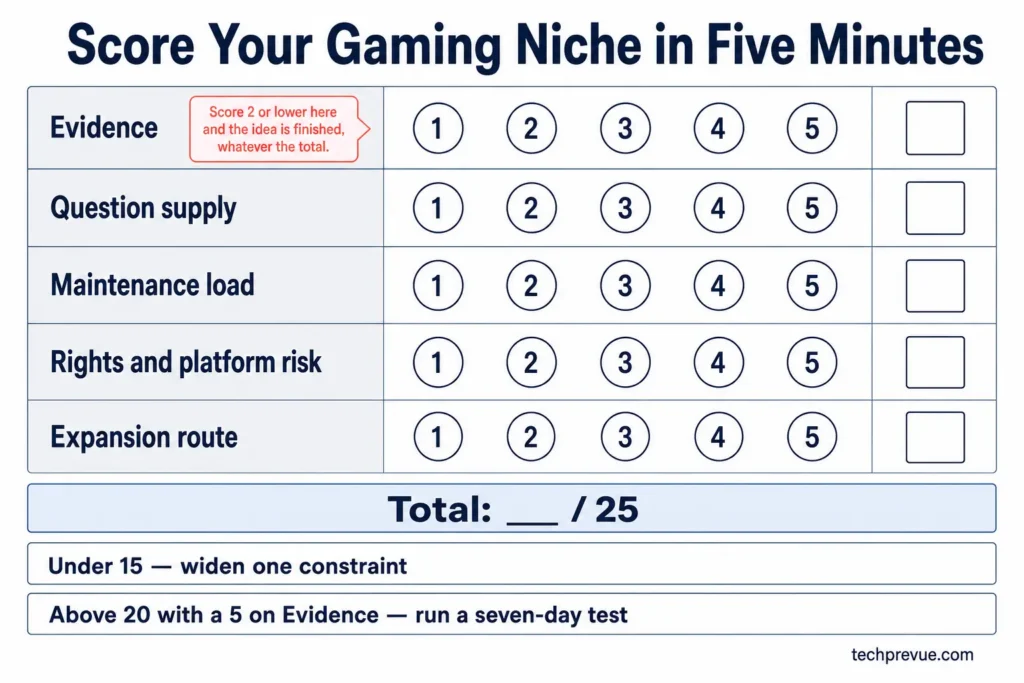
Narrow the list to three gaming niche ideas, then score each one from 1 to 5 on the factors below.
| Factor | Score 1 | Score 3 | Score 5 |
|---|---|---|---|
| Evidence | Desk research only | Extensive play or an adjacent skill | Direct experience, testing, or a qualified reviewer |
| Question supply | Runs dry after 10 pieces | 20–30 distinct problems | 50+ across learning, comparison, fixes, decisions |
| Maintenance load | Patch-dependent, weekly churn | Quarterly refresh | Largely evergreen |
| Rights and platform risk | Publisher restricts commercial use | Standard policy with some ambiguity | Clear permission, stable ecosystem |
| Expansion route | Dead end if the game fades | Related titles only | Natural path to a genre, device, or reader problem |
Anything scoring 2 or lower on Evidence is finished regardless of its total. You cannot out-research first-hand experience.
Add the remaining scores. Under 15 means widening one constraint or finding a different angle; above 20 with a 5 on Evidence earns a seven-day test.
How to Validate a Gaming Niche Before Committing
Validation lowers the risk on any of these gaming niche ideas. It does not guarantee traffic, subscribers, or income. Kill an idea that fails the evidence or workload check even when a keyword tool reports beautiful numbers.
1. Pass the Evidence and Capability Gate
Write down, in one sentence, what qualifies you to cover this.
Extensive play, repair experience, original benchmarks, research skill, access to a qualified reviewer, community moderation, or production expertise all count. “Other sites already cover it” does not. Choose a safer adjacent angle or recruit a contributor who can review the gaming-specific claims.
2. Map the Content Runway and Exit Route
List 20 distinct reader or viewer problems across learning, comparison, troubleshooting, updates, and decisions.
If most of those titles resolve to the same answer, widen one constraint. If the list demands unrelated games and audiences, narrow the promise instead.
Then name the exit. A site about one game can grow into its franchise, genre, engine, device class, or player problem — but the path has to feel natural to the audience you already have.
3. Inspect Current Results and Communities
Search your proposed questions on Google and YouTube, then check publisher forums, Steam discussions, subreddits, and the Discord servers where your audience actually talks.
You are hunting three things: repeated unanswered problems, outdated top results, and format mismatches — video-only results where a reference table would help, or written results where a demonstration would be clearer.
Google Trends compares relative interest by time and location, but its values are normalized rather than absolute search counts. YouTube Studio’s research tools show demand among viewers who already watch content like yours, which is a different signal again.
Use both to explore direction and seasonality. Neither declares a niche profitable.
4. Check Lifecycle, Rights, and Platform Risk
How often could a patch invalidate your work? What happens when the game stops receiving support?
Live-service and news coverage demand faster maintenance than retro repair, history, or tightly scoped recommendations.
Platform risk is specific and occasionally brutal. India removed PUBG Mobile in September 2020; its replacement, Battlegrounds Mobile India, was delisted in July 2022 and restored in May 2023 — a publisher built entirely on those titles lost its subject twice in three years.
For video, read the publisher’s current commercial-use policy alongside YouTube’s video game content guidance. YouTube states that monetization may depend on rights granted by the publisher, and that extended gameplay without appropriate added value may not be accepted.
5. Validate the United States and India Separately
One English query does not represent both markets.
Repeat the research with the target country, language, device context, game availability, payment options, and local results. The differences are often large enough to change the decision entirely.
An India angle needs a real constraint. Android-first testing on 4 GB devices, Hindi or Tamil commentary, mobile data limits, UPI and gift-card payment routes, regional tournament coverage, and delayed or absent console releases all qualify.
A US angle varies too — by platform, state, price tier, service availability, and community. Neither country is one audience.
6. Run a Seven-Day Sample-Content Test
Build one complete article brief or video script. Not a title list. Name the audience problem, the evidence, the source material, the production time, the update risk, and the useful next step.
Then show it to a few people who match the intended audience and ask what is still unanswered. Continue only if you can improve the sample with evidence or sharper decisions rather than more words.
If the written test wins, review these SEO fundamentals before mapping search-led topics. If video wins, current hashtag research helps with packaging alongside titles and thumbnails — but packaging cannot rescue a niche with no audience.
Revenue Models and What They Actually Depend On
Different gaming niche ideas monetize in completely different ways. Advertising, disclosed affiliate links, sponsorships, digital products, memberships, and services all work for a gaming blog.
Which one works for you depends on where money already changes hands inside your reader’s problem. Repair and hardware readers buy parts and tools, so affiliates and services fit naturally. Lore and history readers buy nothing mid-article, so memberships, newsletters, and books outperform affiliate links.
Video channels add fan funding and platform revenue to that list. Entry into the YouTube Partner Program depends on eligibility and policy compliance, not on picking gaming as a category. Check the current YouTube Partner Program requirements rather than a threshold another creator quoted three years ago.
One more warning, about the income screenshots. CPM and RPM swing on audience country, season, advertiser category, content suitability rating, and video length. A sponsorship rate reflects negotiation, audience size, niche demand, and deliverables that no screenshot reveals.
Never pick a subject because someone posted a number.
Common Gaming-Niche Mistakes
Most gaming niche ideas fail for one of six reasons, and none of them is competition.
Confusing a format with a niche. “Reviews” describes presentation. It says nothing about which games, which audience, or which decision you are helping with.
Covering games you do not understand. Research supports analysis. It cannot convert store descriptions and other people’s opinions into a first-hand review.
Choosing one game with no expansion path. A narrow start helps you focus, but it ties your publication to that title’s decline, delisting, or reduced support.
Ignoring maintenance. A build guide written for patch 4.2 becomes wrong the day 4.3 ships, and it keeps ranking anyway. Record the version, date the update, and re-check the pages that earn your traffic.
Treating raw gameplay as a business plan. Viewers and monetization reviewers both need recognizable original value — teaching, commentary, skill, analysis, editing, or entertainment.
Launching a blog and a channel in the same week. Two production pipelines, two audiences, two learning curves, half the attention for each. Get one working first.
Frequently Asked Questions
Do You Need to Be an Expert Gamer to Cover Gaming Content?
No, but your role has to match your claim. Game-industry history and creator strategy reward strong sourcing, while reviews, performance tests, repair instructions, and competitive guides need direct experience or qualified review.
What Are the Best Gaming Niche Ideas for Beginners?
Start with the narrowest scope that still supports distinct, useful content and a realistic expansion path. One game works for a knowledgeable creator who can maintain updates. A connected group of related titles reduces dependence on any single one.
How Narrow Should a Gaming Micro-Niche Be?
Narrow enough to name one audience and one recurring problem. Wide enough that you can still write a genuinely different article in month six. If the idea cannot support learning, comparison, troubleshooting, and decision content, remove one constraint.
Is a Gaming Blog or YouTube Channel Easier to Maintain?
Neither. Blogs demand research, writing, site operations, and updates; channels demand recording, editing, packaging, publishing, and far more visible audience interaction.
Can Raw Gameplay Videos Qualify for Monetization?
Do not assume so. YouTube says commercial-use rights may depend on the game publisher, and that extended gameplay without meaningful instructional or educational commentary may not be accepted.
What If the Selected Game Loses Popularity?
Use the exit route you named at the start. Move gradually into the franchise, genre, device class, or reader problem that attracted your existing audience rather than switching subjects overnight.
