
A year ago, almost nobody asked a chatbot to find them a dentist. Today, industry surveys show that nearly half of consumers have used ChatGPT or another AI tool to get local business recommendations — up from single digits just twelve months earlier.
Meanwhile, the old numbers haven’t gone anywhere. Google has stated that roughly 46% of all searches have local intent, and its research shows 76% of people who search for something nearby visit a business within 24 hours. About 28% of those searches end in a purchase.
Here’s the part most guides won’t tell you: the businesses winning local search in 2026 aren’t doing more tactics. They’re doing one thing competitors skip — building a business that Google and AI systems can verify from every angle. This guide shows you exactly how, ending with a step-by-step checklist you can start running this afternoon.
Quick Answer: What Is Local SEO?
Local SEO is the process of improving a business’s visibility in location-based search results — Google’s Local Pack, Google Maps, localized organic listings, and AI-generated answers. It works by optimizing your Google Business Profile, website, reviews, citations, and local reputation so search engines connect your business to nearby customers.
That’s the definition. The rest of this guide is the execution.
- Quick Answer: What Is Local SEO?
- What Is Local SEO and How Is It Different from Traditional SEO?
- Why Local SEO Matters for Small Businesses and Service-Based Companies
- How Local SEO Works in Google Search, Google Maps, AI Overviews, and the Local Pack
- Understanding Local Search Intent: Near Me, City-Based, and Implicit Local Searches
- Google Local Pack vs Google Maps vs Organic Results vs AI Search Results
- How Google Ranks Local Businesses: The Three Core Local Ranking Factors
- The Complete Local SEO Ranking Signals, Explained
- Google Business Profile Optimization for Better Local SEO Rankings
- Local Keyword Research for Google Maps and Local Search
- Local On-Page SEO Optimization
- Local Business Schema Markup and Entity SEO
- NAP Consistency, Business Citations, and Directory Management
- Online Reviews and Reputation Management for Local SEO
- Local Link Building Strategies That Improve Authority
- Multi-Location Local SEO Strategy
- Local SEO for Service-Area Businesses (SABs)
- Local SEO for Different Business Models: Which Playbook Fits You
- Local SEO and the Customer Journey: Before, During, and After the Visit
- Common Local SEO Mistakes That Hurt Google Maps Rankings
- Local SEO for AI Search: AI Overviews, AEO, GEO, and AIO
- Voice Search Optimization for Local Businesses
- Measuring Local SEO Success
- Best Local SEO Tools: Free and Paid Options for Every Job
- Local SEO Checklist: Step-by-Step Optimization Workflow
- Frequently Asked Questions About Local SEO
- Final Thoughts: Building Long-Term Local Visibility Beyond Rankings
What Is Local SEO and How Is It Different from Traditional SEO?
Local SEO targets searches with geographic intent (“plumber near me,” “dentist in Austin”), while traditional SEO targets searches without one (“how to fix a leaky faucet”). Local SEO adds unique ranking systems — proximity, Google Business Profile, reviews, and citations — that don’t exist in standard organic search.
Think of it this way, building on what SEO is at its core: traditional SEO answers “what’s the best page on the internet for this query?” Local SEO answers “what’s the best business near this person for this need?”
That second question changes everything about how you optimize.
| Traditional SEO | Local SEO | |
|---|---|---|
| Goal | Rank pages nationally/globally | Rank a business in a geographic area |
| Main asset | Website content | Google Business Profile + website |
| Key ranking factors | Content, backlinks, technical SEO | Relevance, distance, prominence |
| Where results appear | Organic listings | Local Pack, Maps, localized organic, AI answers |
| Reviews matter? | Indirectly | Directly — a core ranking signal |
| Competition | Every site targeting the keyword | Businesses within a radius |
| NAP/citations | Not a factor | A trust signal |
A concrete example: A national mattress brand competes with every mattress site in America for “best mattress.” A mattress store in Denver competes with maybe 15 other stores for “mattress store Denver” — and can outrank billion-dollar brands in the Local Pack because proximity and local trust signals outweigh domain authority.
That’s the opportunity. Local SEO is the one arena where a small business beats a big one on a regular basis.
Why Local SEO Matters for Small Businesses and Service-Based Companies
Local SEO matters because nearly half of all Google searches have local intent, and local searchers act fast — 76% visit a business within a day. For most small and service-based businesses, local search is the single largest source of new customers, and it costs nothing to compete.
The data makes the case better than any sales pitch:
- 46% of Google searches have local intent (Google) — that’s billions of local searches every day.
- 76% of local mobile searchers visit a business within 24 hours, and 28% purchase (Google research).
- 80% of US consumers search for a local business at least weekly; a third search daily (SOCi).
- 97% of consumers check a business’s online presence before visiting or buying (BrightLocal).
- “Near me” searches exceed 200 million per month in the US (Glimpse, 2026).
- A complete Google Business Profile earns roughly 7x more clicks than an incomplete one.
- Despite all this, industry surveys suggest a majority of local businesses still don’t actively optimize for local search.
Read that last line again. Your competitors are probably not doing this well. In most local markets, consistent execution of the basics puts you in the top three within months.
Who should invest in local SEO?
- Yes, absolutely: restaurants, dentists, lawyers, HVAC companies, roofers, plumbers, medical clinics, gyms, salons, real estate agents, auto shops — anyone serving customers in a defined area.
- Yes, with a twist: service-area businesses without a storefront (mobile detailers, home cleaners) and software or consulting firms that sell to local clients.
- Probably not: pure e-commerce or national SaaS with no geographic customer pattern. Spend your budget on traditional SEO instead.
If your customers could reasonably type your service + a city name — or ask their phone for it — local SEO is your highest-ROI marketing channel.
How Local SEO Works in Google Search, Google Maps, AI Overviews, and the Local Pack
Local SEO works by feeding Google consistent, verifiable signals about your business — through your Google Business Profile, website, reviews, citations, links, and schema markup. Google cross-references these signals to build “entity confidence,” then ranks the businesses it trusts most for relevant nearby searches.
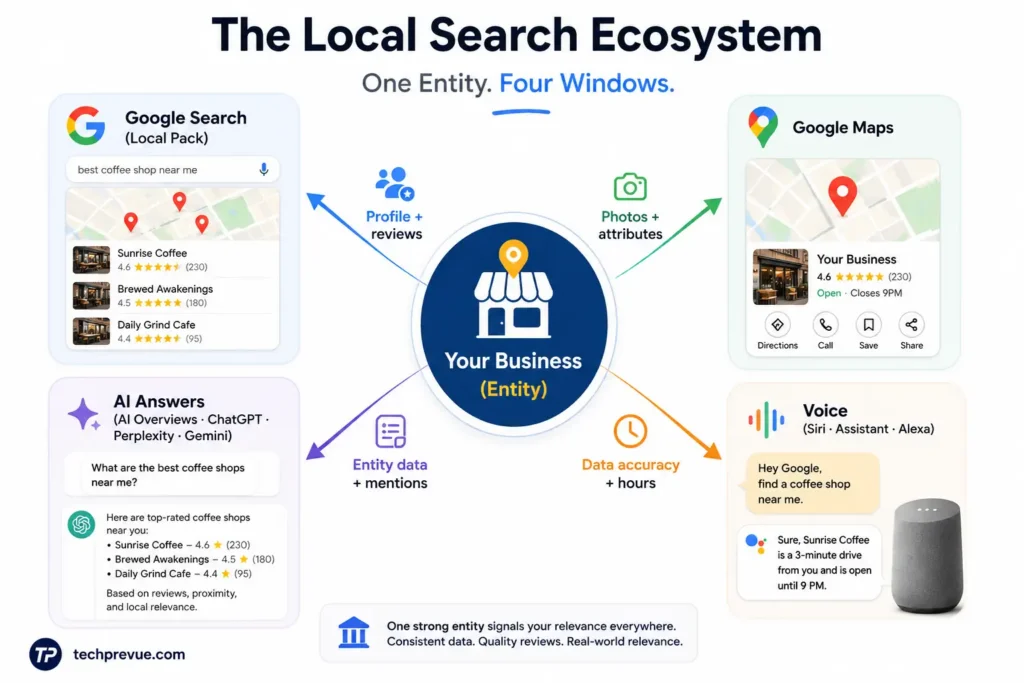
Most guides list tactics. Almost none explain the machine underneath. Here’s the model that makes every tactic in this guide click into place:
The Entity Confidence Chain
Google doesn’t rank your website for local searches. It ranks your business as an entity — a real-world thing it must understand and verify. Confidence builds link by link:
Your business → Google Business Profile (you claim your identity) → Website (you confirm and expand it) → Reviews (customers vouch for you) → Citations & mentions (the wider web agrees on your facts) → Links (authoritative sites endorse you) → Schema markup (you translate it all into machine-readable data) → Maps & behavioral data (real-world actions confirm demand) → Entity confidence → Rankings
Every tactic in this guide strengthens one link in that chain. When you understand the chain, you stop asking “does this tactic still work?” and start asking “does this make my business easier to verify?”
Why this matters more in 2026: AI systems — Google’s AI Overviews, ChatGPT, Perplexity, Gemini, Claude — build answers the same way. They cross-reference your profile, your site, your reviews, and what others say about you. A business with high entity confidence gets recommended. A business with contradictory data gets skipped. One framework now powers both Google rankings and AI citations.
Understanding Local Search Intent: Near Me, City-Based, and Implicit Local Searches
Local search intent is a query’s underlying goal of finding a nearby business, service, or place. It shows up three ways: explicit “near me” searches, city-modified searches (“roofer in Phoenix”), and implicit local searches (“coffee shop”) where Google infers location automatically.
Understanding intent types tells you what to optimize for:
1. “Near me” searches
“emergency plumber near me,” “coffee near me open now”
High urgency, high conversion, decided almost entirely by proximity + Google Business Profile quality + reviews. You don’t put “near me” in your content — you win these by having a complete profile, strong ratings, and accurate hours.
2. City- and neighborhood-modified searches
“personal injury lawyer Chicago,” “dentist in Capitol Hill Seattle”
The searcher named the location, so proximity matters less and relevance + prominence matter more. These are won with dedicated location pages, city-specific content, and local authority. A law firm in the suburbs can rank for the downtown query if its signals are strong enough.
3. Implicit local searches
“oil change,” “sushi,” “urgent care”
No location mentioned — but Google knows the intent is local and localizes results automatically. This is the biggest and most invisible category. Google increasingly treats plain service queries as local queries, which means your Local Pack presence affects far more searches than your keyword tool shows.
4. Service-area and “who does X” searches
“who installs tankless water heaters,” “mobile dog grooming that comes to you”
Conversational, question-shaped queries — and the fastest-growing type thanks to voice assistants and AI chat. These are won with FAQ-style content that answers the question directly (more on this in the AEO section).
Practical takeaway: audit your own market. Search your top five services from your service area (use incognito mode) in all four styles. Note who appears in the Local Pack, Maps, organic, and any AI Overview. That 20-minute exercise is your real competitive landscape — not a keyword tool export.
Google Local Pack vs Google Maps vs Organic Results vs AI Search Results
Local searches surface four different result types: the Local Pack (the 3-listing map box in normal search), Google Maps (the full map app/tab), localized organic results (standard blue links), and AI results (AI Overviews and chatbot answers). Each has its own ranking dynamics — and strong local SEO wins all four.
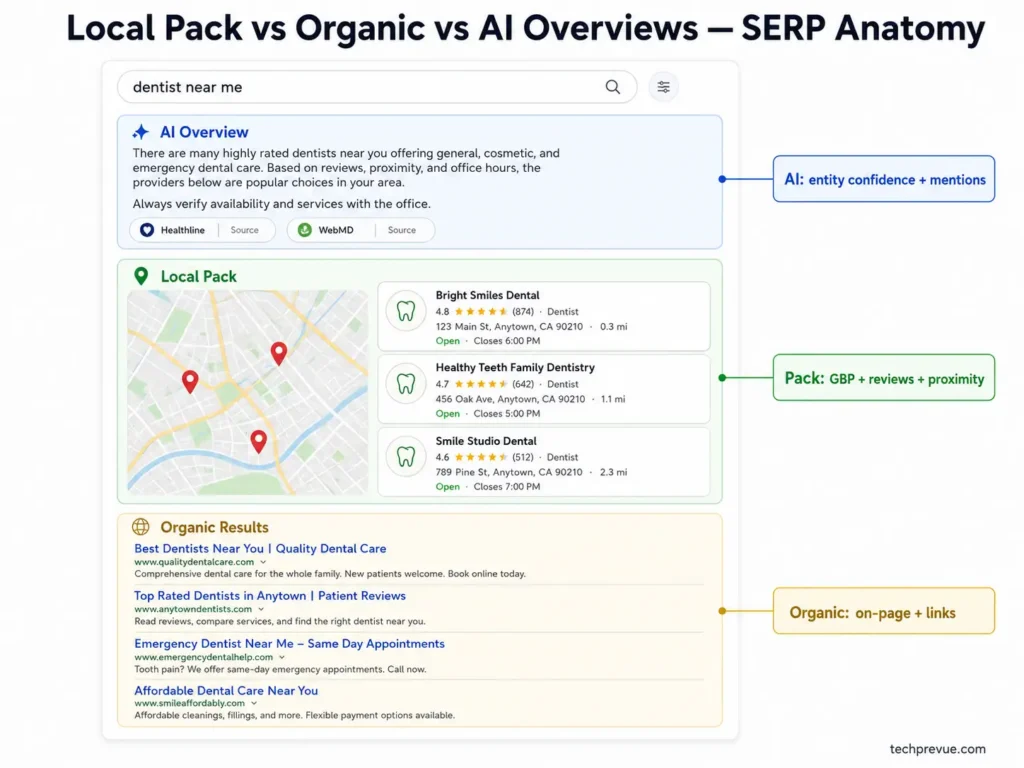
Most competitor guides explain two of these. You need all four, because your customers use all four:
The Local Pack (Map Pack / 3-Pack)
The map box with three business listings that appears above most organic results for local queries. It’s prime real estate — for many queries it sits at the very top of the page. Rankings here are driven by your Google Business Profile, reviews, proximity, and prominence signals. Your website supports it but doesn’t control it.
Google Maps
The full map experience — the Maps app or the “expand” view from the Local Pack. Rankings are similar to the Local Pack but browsing behavior differs: users compare more options, read more reviews, and look at photos heavily. Photos, review volume, and complete business attributes carry extra weight here because users see them side by side.
Localized organic results
The standard web listings below (and sometimes above) the Local Pack — localized to the searcher. These are won with traditional on-page SEO plus local signals: location pages, local content, schema, and backlinks. A business can rank in the Pack but not organic, or vice versa. You want both — businesses appearing in Pack and organic capture a disproportionate share of clicks.
AI results: AI Overviews and chat assistants
AI Overviews now appear on a large share of local queries, summarizing options above everything else. Beyond Google, assistants like ChatGPT, Perplexity, and Gemini answer “best dentist in Plano” with a short list of specific recommendations. These systems pull from your Google Business Profile, reviews, your website’s clarity, and third-party mentions. This is the newest front, and this guide dedicates a full section to it below.
One strategy, four surfaces. You don’t need a separate “Maps strategy” and an “AI strategy.” You need one high-confidence entity — the four surfaces are just different windows into it.
How Google Ranks Local Businesses: The Three Core Local Ranking Factors
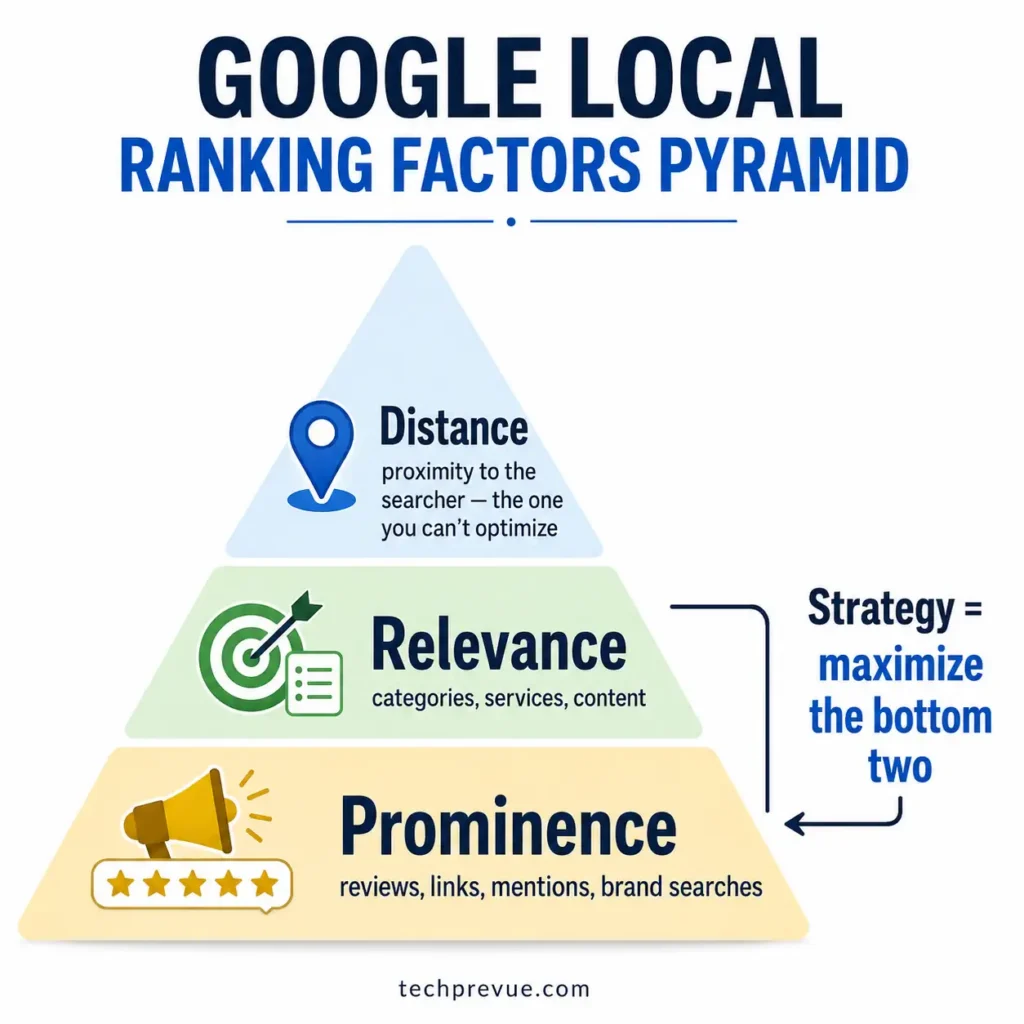
Google ranks local businesses on three factors it states publicly: Relevance (how well you match the search), Distance (how close you are to the searcher), and Prominence (how well-known and well-reviewed you are). You can’t change distance — so local SEO is the practice of maximizing relevance and prominence.
Google publishes these three factors in its own documentation. Everything else in local SEO is a lever on one of them.
Relevance — “Are you what they’re looking for?”
Google matches the query to what it knows about your business. You control this more than anything else.
How to increase relevance:
- Choose the most specific primary category on your Google Business Profile (“Emergency Plumber” beats “Plumber” for emergency searches; “Personal Injury Attorney” beats “Lawyer”).
- Fill out every service and product field with the words customers actually use.
- Build service pages and location pages on your website that describe each offering in plain language.
- Keep your business description specific: “family dental clinic offering same-day crowns, Invisalign, and pediatric dentistry” — not “we provide quality care.”
Distance — “Are you close enough?”
Google calculates proximity between the searcher and your location. You can’t move your building for each search, but you can stop distance from unfairly limiting you:
- Rank for neighborhood and suburb queries, not just city-center ones, with location-specific content.
- Service-area businesses: set your service areas accurately in your profile so Google knows your true footprint.
- Multi-location businesses: each location needs its own profile and page (covered later) so each competes in its own radius.
- Accept the physics: a searcher two blocks from a competitor may see them first. Your job is to win everywhere your prominence can overcome their proximity.
Prominence — “Does the world vouch for you?”
Prominence is offline reputation reflected online: review count and quality, citations, backlinks, press mentions, branded search volume, and engagement with your listing.
How to increase prominence:
- Build a steady stream of reviews (system in the Reviews section below).
- Earn local links and mentions — sponsorships, chambers, local press, community events.
- Keep your citations consistent across the major directories.
- Grow branded searches: people googling “Rosa’s Kitchen” by name is itself a prominence signal, which is why brand building (ads, signage, community presence) quietly feeds local SEO.
The strategic insight competitors miss: these three factors interact. High prominence lets Google show you at greater distances. High relevance lets a newer business beat an older, more prominent one for specific services. The winning play is to be the most relevant option for your core services and the most prominent option in your immediate area — then expand outward.
The Complete Local SEO Ranking Signals, Explained
Local rankings are driven by seven signal groups: Google Business Profile signals, on-page website signals, review signals, citation signals, backlink signals, behavioral signals, and entity/brand signals. No single group wins alone — Google cross-checks them against each other to decide which businesses to trust.
Here’s each group, what’s inside it, and how much attention it deserves:
1. Google Business Profile signals (highest impact for Pack/Maps) Primary and secondary categories, completeness, services, attributes, photos, posts, Q&A, hours accuracy. This is the engine of Local Pack rankings — and the 7x click gap between complete and incomplete profiles shows it affects conversions too.
2. Website signals Location pages, service pages, title tags, local content, mobile speed, internal linking, embedded maps. Your website is what lets Google (and AI) verify the claims your profile makes — and it drives your localized organic rankings.
3. Review signals Volume, average rating, recency, velocity, keyword content inside reviews (“best root canal experience”), and owner responses. Reviews influence rankings and the click decision — 87% of consumers read them before choosing a local business.
4. Citation signals Consistent Name, Address, Phone (NAP) across Yelp, Apple Maps, Bing Places, Facebook, industry directories. Citations are table stakes: inconsistency actively hurts, consistency quietly helps.
5. Backlink signals Links from local news, chambers of commerce, community organizations, and industry sites. Fewer, locally relevant links beat many generic ones for local rankings.
6. Behavioral signals Clicks, calls, direction requests, website visits from your listing, photo views, booking actions. Real-world engagement confirms to Google that searchers found what they wanted.
7. Entity and brand signals Unlinked mentions of your business name, branded search volume, social profiles, Knowledge Graph presence, schema markup. The fastest-growing signal group — and the one AI systems lean on most.
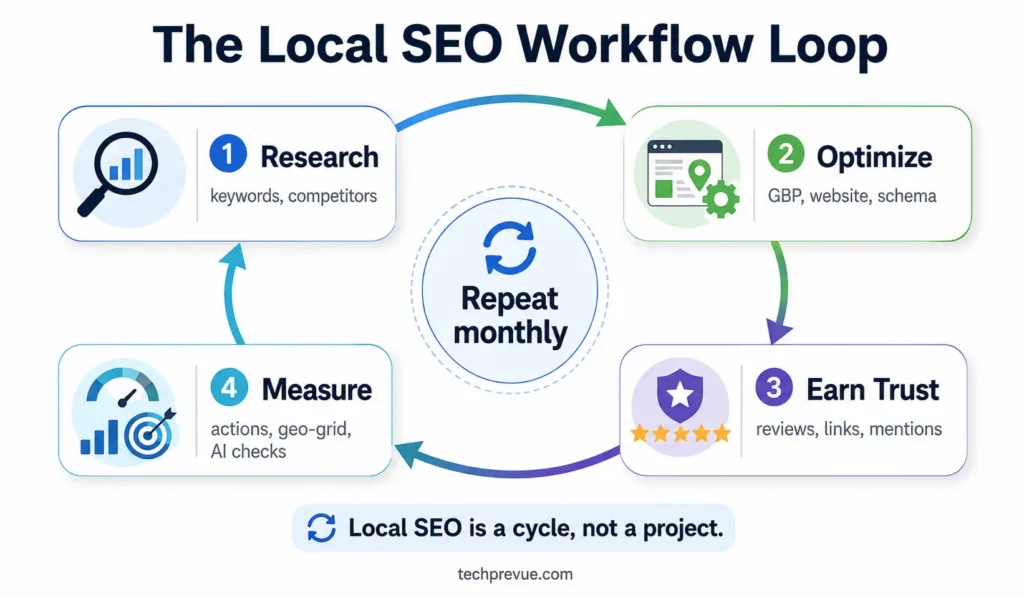
Priority order for a new campaign: Fix citations (once) → Optimize GBP (deeply) → Build review flow (forever) → Strengthen website (steadily) → Earn links and mentions (monthly). That sequence front-loads the highest-impact, lowest-cost work.
Google Business Profile Optimization for Better Local SEO Rankings
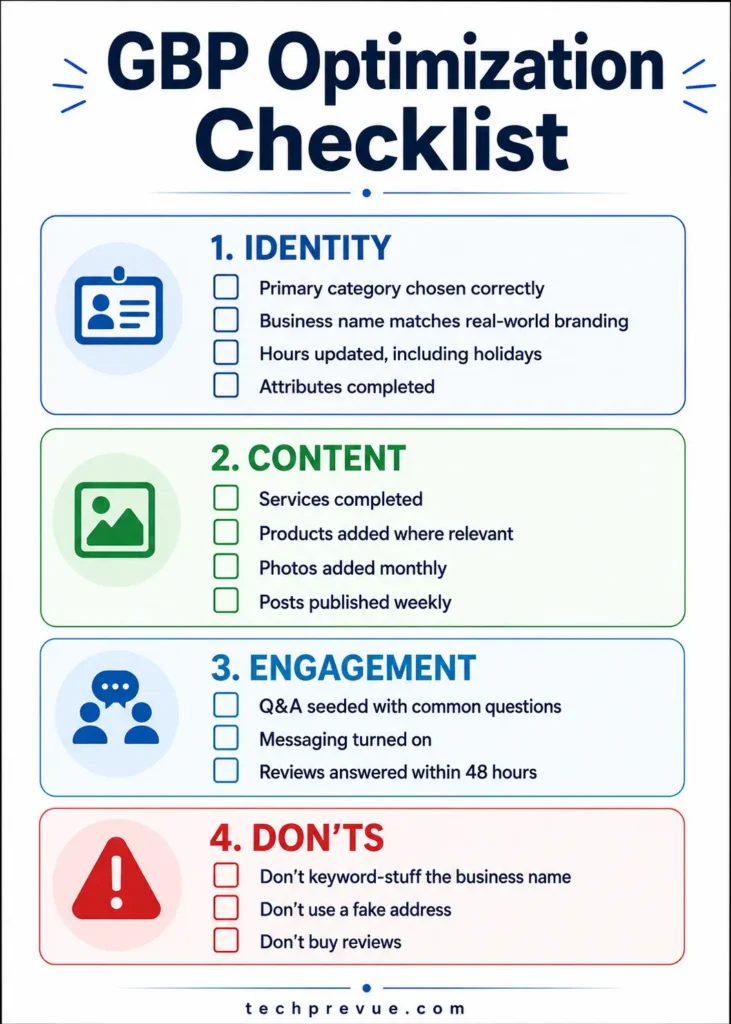
To optimize a Google Business Profile: verify your listing, choose the most specific primary category, complete every field (services, products, attributes, hours), upload photos monthly, post weekly, answer Q&A proactively, and respond to every review. Complete profiles earn about 7x more clicks than incomplete ones.
Your Google Business Profile (GBP, formerly Google My Business) is the single highest-leverage asset in local SEO. Here’s the full optimization pass, field by field:
Categories: the highest-impact 60 seconds in local SEO
- Your primary category is the strongest relevance signal you control. Be specific: “Roofing Contractor” → fine; but if you mostly do repairs, “Roof Repair Service” may match more searches you can win.
- Add every accurate secondary category — a medical clinic might add “Urgent Care Center,” “Walk-In Clinic,” and “STD Testing Service.”
- Test: search your top service and note the categories of the three Pack winners (tools or the listing itself reveal them). Match the winner’s primary category if it’s accurate for you.
Services and products
- List every service with a description — write them like mini-answers: “Tankless water heater installation — same-week installs, all major brands, 5-year labor warranty.”
- Restaurants and retail: load products/menu items with photos and prices. These appear directly in search and Maps.
Photos: the most underrated ranking-adjacent asset
- Upload real photos monthly: exterior (helps people find you), interior, team, work-in-progress, before/after.
- Name files descriptively before upload (summit-dental-office-lobby-boise.jpg).
- Example: a coffee shop that adds latte art, pastry case, and seating photos every month gives Maps browsers a reason to choose it over the identical-rated shop with two dark photos from 2021.
Posts, Q&A, and messaging
- Post weekly — offers, events, seasonal services (“Furnace tune-up special — book before October”). Posts show engagement and occupy more listing space.
- Seed your own Q&A: anyone can ask a question on your profile, and anyone can answer. Post your ten most common customer questions yourself and answer them officially (“Do you take walk-ins?” “Is parking free?”).
- Turn on messaging and booking if you can respond fast. Every completed action from your listing is a behavioral signal.
Hours, attributes, and the boring fields that decide clicks
- Keep hours perfect, including holidays. “Closed when it said open” is the fastest route to a 1-star review.
- Fill every attribute: wheelchair accessible, women-owned, free Wi-Fi, outdoor seating. Attributes are filters — miss one, miss those searches.
What not to do
- Don’t keyword-stuff your business name (“Joe’s Plumbing | Best Plumber Near Me Dallas”). It violates guidelines and gets listings suspended.
- Don’t buy reviews or use fake addresses. Google’s filters and competitor reports catch both, and suspension recovery can take months.
Local Keyword Research for Google Maps and Local Search
Local keyword research means finding the exact service + location phrases customers use: service keywords (“water heater repair”), geo-modified keywords (“water heater repair Mesa AZ”), and near-me/implicit terms. Map each keyword group to one page or profile element, and validate intent by checking what Google actually shows.
Local keyword research is simpler than national research — but the mapping step is where most businesses fail. Here’s the working process:
Step 1: Build the service × location grid
List every service you offer down one axis, every city/neighborhood you serve across the other. An HVAC company with 6 services and 5 cities has a 30-cell grid. That grid is your keyword universe:
- ac repair mesa az
- furnace installation gilbert
- duct cleaning chandler
- emergency hvac tempe
- …and so on.
Step 2: Expand with real customer language
- Mine your GBP Insights for the actual queries that surfaced your profile.
- Read your own reviews and competitor reviews — customers name services in their own words (“they fixed our blown capacitor same day” → “ac capacitor replacement”).
- Add question keywords for AI and voice: “how much does ac repair cost in Phoenix,” “who fixes heat pumps on weekends.”
Step 3: Run the discovery toolbox (free first, paid when you scale)
Methods before subscriptions — the free stack surfaces most local keywords:
- Google Autocomplete: type “ac repair m…”, “ac repair near…”, “best dentist in…” letter by letter in an incognito window. Autocomplete is live demand data, pre-sorted by popularity.
- People Also Ask: search your core service + city and harvest every PAA question — these become your FAQ, voice, and AI-answer targets. AlsoAsked or AnswerThePublic bulk-collect them.
- Google Keyword Planner (free with a Google Ads account): set location targeting to your metro to get geo-filtered volume ranges instead of useless national numbers.
- Google Trends: compare services regionally and catch seasonality — “furnace repair” vs “ac repair” by month tells an HVAC company exactly when to publish and promote each page.
- Competitor category mining: the free GMB Everywhere Chrome extension reveals the primary and secondary GBP categories of every Pack winner — the closest thing to reading a competitor’s homework.
- Paid suites, when volume justifies them: Semrush or Ahrefs for competitor keyword gaps (“what do the top three rank for that we don’t?”) and difficulty scores; KWFinder for budget-friendly local volume checks.
Step 4: Validate intent in the live SERP
Search each keyword and look at what Google shows:
- Local Pack appears → local intent confirmed; your GBP competes here.
- Only informational articles appear → it’s a content keyword; write a blog post, don’t build a service page.
- AI Overview appears → note what sources it cites; that’s your AEO target.
Step 5: Map keywords to assets (the step everyone skips)
One primary keyword group → one asset. Never two pages chasing the same query:
| Keyword group | Asset |
|---|---|
| ac repair mesa | Service page: /ac-repair-mesa/ |
| hvac company mesa | Homepage + GBP |
| furnace installation gilbert | Location-service page |
| how much does ac repair cost | Blog post / FAQ |
| emergency hvac near me | GBP (category, hours, “emergency” in services) |
Reality check on volume: local keyword volumes look tiny — “roof repair boise” might show 90 searches a month. Don’t be fooled. Tools undercount local queries badly, implicit searches don’t show up at all, and 90 searchers who need a roofer this week are worth more than 9,000 casual readers.
Local On-Page SEO Optimization
Local on-page SEO means structuring your website so search engines connect it to your services and service area: city-specific title tags, dedicated location and service pages, locally relevant content, descriptive headings, internal links, and optimized images. It’s how your website earns localized organic rankings and reinforces your Google Business Profile.
Your GBP gets you into the Pack. Your website gets you into localized organic — and doubles your page real estate. The essentials:
Title tags and meta descriptions that name the place
- Formula: Primary Service in City | Brand — “Emergency Plumber in Tacoma | Rapid Rooter Plumbing.”
- Homepage: Brand | Core Service in City — “Reyes & Cole | Personal Injury Lawyers in Chicago.”
- Meta descriptions are your ad copy: include the city, a differentiator, and a call to action. “Tacoma’s 24/7 emergency plumbers. Licensed, upfront pricing, 60-minute response. Call now.”
Location pages that aren’t doorway spam
The difference between a location page that ranks and one that gets ignored is local proof. Each city page should include:
- Unique intro naming the area and neighborhoods you serve
- Services offered in that city (with any local differences — permits, response times)
- Reviews or case examples from that city
- Local photos (your team at a job site there beats stock photos every time)
- Embedded Google map, driving directions or service-radius note
- City-specific FAQs (“Do you serve homes in the historic district?”)
Anti-example: ten pages that swap only the city name in otherwise identical text. Google treats these as doorway pages, and they underperform or get filtered.
Headings, internal links, and images
- H1 names the service and place once, naturally: “Furnace Repair in Gilbert, AZ.”
- H2s answer sub-questions searchers have — which doubles as snippet and AI-answer bait.
- Internal-link every location page ↔ related service pages with descriptive anchors (“furnace repair in Gilbert,” not “click here”).
- Images: real photos, descriptive filenames, alt text that describes the image honestly (“technician installing Trane heat pump in Chandler backyard”) — and compressed, because mobile speed is a local ranking reality: most local searches happen on phones (the technical SEO guide covers speed, Core Web Vitals, and crawlability in depth).
Local content that earns its keep
Skip “5 Reasons You Need a Plumber.” Write content only a local business could write:
- “What Tacoma’s 2026 water heater code change means for your replacement”
- “The 6 most common AC failures in Phoenix heat (and repair costs)”
- Neighborhood guides, local project galleries, seasonal service calendars for your climate.
This content ranks for question searches, feeds AI answers, and proves local expertise — three wins per article.
Local Business Schema Markup and Entity SEO
Schema markup is structured data code (JSON-LD) that translates your business facts — name, address, hours, services, reviews — into a format machines read directly. Combined with entity SEO (making your business a verified, interconnected entity across the web), it’s how Google and AI systems confirm exactly who you are.
This is the section most competitor guides skim. It’s also the one that pays off twice — once in search, once in AI answers.
The schema types every local business should implement
- LocalBusiness (or its specific subtype —
Dentist,Attorney,Plumber,Restaurant): your core identity block. Include name, address, phone, geo-coordinates, hours, price range, andsameAslinks to your profiles. - Organization: ties your brand, logo, and official profiles together.
- Service: one per major service, linked to the business.
- FAQPage: on pages with genuine Q&A content — feeds snippets, PAA, and AI answers.
- Review/AggregateRating: only for first-party reviews displayed on your site, per Google’s guidelines.
- BreadcrumbList: clarifies site structure for multi-location sites.
A minimal example for a dental clinic:
{
  "@context": "https://schema.org",
  "@type": "Dentist",
  "name": "Summit Dental",
  "image": "https://summitdental.com/office.jpg",
  "address": {
    "@type": "PostalAddress",
    "streetAddress": "412 W Main St",
    "addressLocality": "Boise",
    "addressRegion": "ID",
    "postalCode": "83702"
  },
  "telephone": "+1-208-555-0142",
  "url": "https://summitdental.com",
  "openingHours": "Mo-Fr 08:00-17:00",
  "sameAs": [
    "https://www.facebook.com/summitdentalboise",
    "https://www.yelp.com/biz/summit-dental-boise"
  ]
}
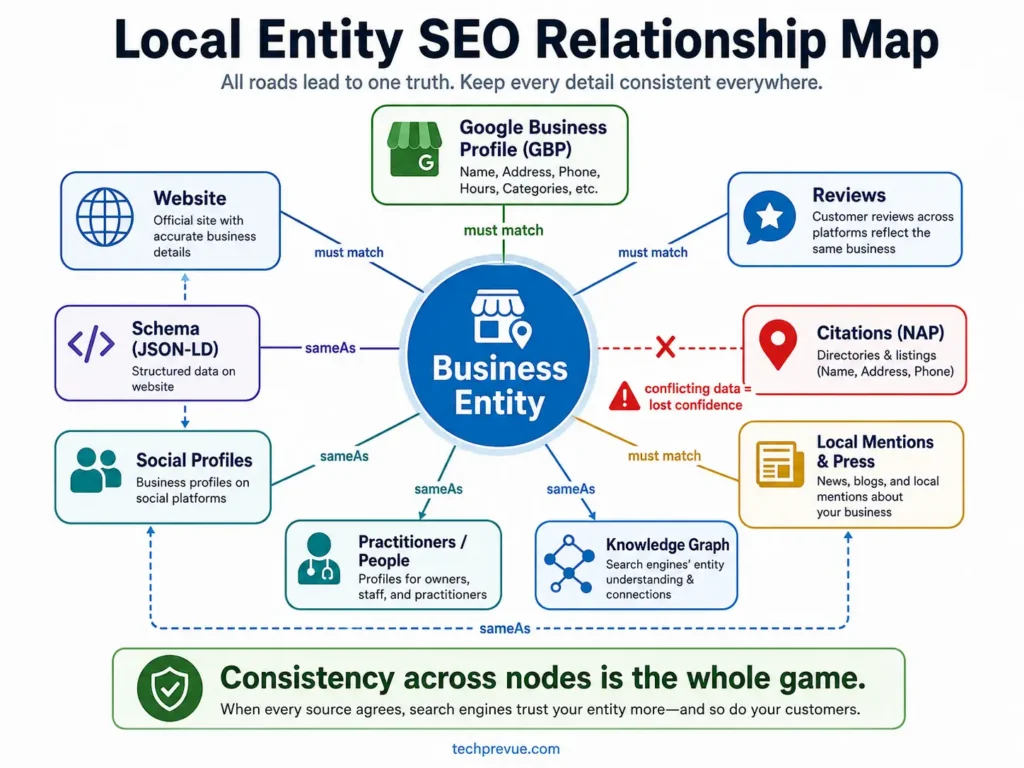
The critical rule: schema must match your GBP and citations exactly. A different phone number in your schema doesn’t just waste the markup — it lowers entity confidence. Full property lists live at schema.org/LocalBusiness; validate your code with Google’s Rich Results Test.
Entity SEO: your business as a node in the Knowledge Graph
Google increasingly understands the web as entities and relationships, not pages and keywords. Your business is (or should be) an entity connected to:
Organization ↔ Location(s) ↔ Services ↔ Reviews ↔ People (owners, practitioners with their own credentials) ↔ Social profiles ↔ Schema ↔ Knowledge Graph
How to strengthen your entity in practice:
- Use one canonical version of your name, address, and phone everywhere — website, schema, GBP, directories, social bios.
- Link everything with
sameAsand complete profile cross-links (your Facebook links your site, your site’s schema lists your Facebook). - Build practitioner authority: an “About Dr. Chen” page with credentials, plus author bylines on your content, adds E-E-A-T that generic business sites lack.
- Earn consistent third-party descriptions: when your chamber, Yelp, and a local news feature all describe you the same way (“family-owned HVAC company serving the East Valley since 2009”), machines converge on a confident answer about who you are.
Entity SEO is slow, unglamorous — and it’s the direct input to whether AI assistants recommend you. File it under “compounding assets.”
NAP Consistency, Business Citations, and Directory Management
NAP stands for Name, Address, Phone number. Citations are mentions of your NAP on other websites — directories, maps, social platforms. Consistent citations confirm your business data to search engines; inconsistent ones (old addresses, name variations) create doubt that suppresses local rankings.
Citations were oversold for a decade, then underrated. The truth in 2026: consistency is the win, volume is not. Fifty perfect citations beat five hundred messy ones.
The core set every US business needs:
- Google Business Profile
- Apple Maps (Apple Business Connect) — Siri and iPhone Maps run on it
- Bing Places — feeds Bing and Microsoft Copilot
- Yelp — heavily used as a data source by AI assistants
- Facebook/Instagram business profile
- Nextdoor (for consumer services)
- Better Business Bureau
- Your industry’s big directories: Avvo/Justia (lawyers), Healthgrades/Zocdoc (medical), Angi/HomeAdvisor (home services), TripAdvisor/OpenTable (restaurants)
- Local: chamber of commerce, city business directory
The cleanup workflow (do once, then quarterly):
- Decide your canonical NAP — exact spelling, suite format, tracked vs. main phone (use your main line for citations).
- Search: your phone number in quotes, your old address, name variants (“Joe’s Plumbing” vs “Joes Plumbing LLC”).
- Fix or remove every mismatch. Prioritize the core set above.
- If you’ve moved or rebranded, hunt the old data aggressively — stale citations are the #1 cause of mysterious ranking drops after a move.
Manual cleanup costs an afternoon. Services like Yext, BrightLocal, or Whitespark automate it for a fee. Either path works — what doesn’t work is ignoring it.
Online Reviews and Reputation Management for Local SEO
Reviews affect local SEO three ways: review volume, rating, and recency are ranking signals; review text tells Google which services you’re known for; and star ratings drive click-through. The winning system is simple — ask every customer, make it one tap, and respond to every review.
87% of consumers read reviews before choosing a local business. Google reads them too — a profile with 150 recent, detailed reviews outranks and out-converts a 4.9-star profile with 12 old ones.
The review acquisition system (steal this)
- Get your review link: GBP dashboard → “Ask for reviews” → short URL. Make a QR code from it.
- Ask at the moment of satisfaction — job complete, meal finished, treatment done. Not three days later.
- Make it one tap: text the link (“Thanks for choosing Apex HVAC! Mind sharing your experience? [link]”). Text beats email roughly 5-to-1 on completion.
- Systematize per business type: QR card on the restaurant check; front desk asks at checkout with a tablet; technicians send the text before leaving the driveway; lawyers ask at case close.
- Aim for steady velocity — a few reviews every week forever beats 40 in launch month and silence after.
Never buy reviews, review-gate (only asking happy customers via a filter screen violates Google policy), or run “review contests.” The penalty risk exceeds the upside.
Responding: the free ranking-and-conversion tool
- Respond to every review within 48 hours. Owner responses signal an active, engaged business — and prospects read your replies as a preview of your customer service.
- Positive reviews: thank them, naturally reference the service (“Glad the same-day crown worked out!”). This reinforces service keywords without stuffing.
- Negative reviews: respond calmly, own what’s yours, take it offline (“Please call me directly — I’d like to make this right”). Prospects judge you on the reply, not the complaint. A well-handled 1-star review often builds more trust than another 5-star.
Beyond Google
Google reviews matter most for rankings, but AI assistants read Yelp, Facebook, industry sites, and Reddit threads when forming recommendations. Spread perhaps 20% of your review asks across the platform your industry cares about second-most.
Local Link Building Strategies That Improve Authority
Local link building means earning backlinks from geographically and topically relevant sites — local news, chambers of commerce, community organizations, sponsorships, and industry associations. For local rankings, a handful of genuinely local links routinely outperforms large volumes of generic ones.
Forget mass outreach. Local links are earned through participation, which is why they’re hard for competitors to copy:
- Sponsor things that publish: Little League teams, 5K runs, school fundraisers, festivals — sponsorships routinely include a website link. $300 for a youth soccer sponsorship is often the cheapest legitimate link in SEO.
- Join organizations with member directories: chamber of commerce, BNI, downtown associations, industry guilds.
- Be quotable for local media: local journalists need expert sources. Pitch seasonal angles — a roofer on hail season prep, a CPA in March, a plumber before the first freeze. One TV segment or newspaper quote = authoritative link + brand mention + entity signal.
- Host or teach: free workshops (“First-time homebuyer’s inspection checklist” by a home inspector) get listed on event calendars, libraries, and community sites.
- Partner up: wedding venues link photographers and caterers; realtors link inspectors and lenders. Build a referral page network with your non-competing peers.
- Create the local resource nobody else will: “Every farmers market in Summit County, with dates” earns links for years. A coffee shop’s “Best laptop-friendly cafés in town, ranked honestly (including our competitors)” is link bait and a branding move.
- Reclaim what you’re owed: search your business name — every unlinked mention (news, blogs, supplier pages) is one polite email away from a link.
Cadence matters more than intensity: one or two genuinely local links per month, sustained for a year, changes your prominence profile.
Multi-Location Local SEO Strategy
Multi-location SEO requires a separate Google Business Profile and a unique location page for every branch, each with its own reviews, citations, photos, and local links. The fatal mistake is centralizing everything — each location must compete as its own local entity.
The rules for franchises and multi-branch businesses:
- One GBP per location, each verified at its real address, each with its own local phone number where possible.
- One substantial page per location at /locations/city/ — unique content, that branch’s team, reviews, photos, and hours (the location-page checklist from the on-page section applies here per branch).
- Reviews accrue per profile, so every branch needs its own review system. Corporate can build the tooling; the ask happens locally.
- Structure the site with a locations hub → individual location pages, each marked up with its own LocalBusiness schema.
- Localize prominence: each branch joins its own chamber, sponsors its own teams, gets its own local press. The Phoenix location’s links don’t help the Tucson branch in the Tucson Pack.
- Franchise trap to avoid: duplicate GBPs, shared 800 numbers, and one national page for 40 locations. That configuration makes every location invisible in its own market.
Local SEO for Service-Area Businesses (SABs)
A service-area business (SAB) serves customers at their location — plumbers, cleaners, mobile groomers — often without a public storefront. SABs hide their address on their Google Business Profile, define service areas instead, and compensate for weaker proximity signals with reviews, service-area pages, and prominence.
SAB rules differ enough to trip people up:
- Hide your address in GBP if customers don’t visit you (Google requires it for home-based businesses) and set your service areas — up to 20, defined by city or zip.
- Reality check: Google still weights your actual base location. You’ll rank strongest near home base and progressively weaker toward your service-area edges. Service areas describe coverage; they don’t guarantee rankings across it.
- Compensate with the website: build genuine service-area pages for your key cities (see the location-page standards above — job photos in that city, city-specific reviews, response-time notes).
- Reviews are your proximity substitute. A cleaning company with 300 reviews will pull jobs from towns where a 12-review competitor is physically closer.
- Use LocalBusiness schema with
areaServedlisting your cities, and keep an address on file with Google for verification even though it’s hidden publicly. - Verification warning: SAB verification (often video) is stricter than storefront verification. Legit setup — real base, real vehicles, real tools — sails through; virtual offices and P.O. boxes get suspended.
Local SEO for Different Business Models: Which Playbook Fits You
Local SEO strategy depends on your business model: single-location businesses optimize one profile deeply; multi-location and franchise businesses replicate the system per branch; service-area and home-based businesses hide the address and define coverage; online businesses targeting local clients rely on localized organic content instead of a map presence.
Six models, six playbooks — find your row:
| Business model | Map presence | Biggest lever | Watch out for |
|---|---|---|---|
| Single-location (restaurant, clinic, coffee shop) | One GBP, address shown | Deep GBP optimization + review velocity | Set-and-forget decay |
| Multi-location (branches) | One GBP per branch | Per-location pages, reviews, links (see multi-location section above) | Centralizing everything |
| Franchise | One GBP per franchisee location | Corporate tooling + local execution | Duplicate profiles, shared 800 numbers |
| Service-area business (plumber, cleaner) | GBP with hidden address + service areas | Reviews as proximity substitute (see SAB section above) | Ranking expectations at coverage edges |
| Home-based | GBP with hidden address (required) | Same as SAB, stricter verification | Virtual offices — suspension bait |
| Online business with local clients (web agency, software firm) | Only if you have a staffed office clients visit | Localized organic: “web design company in Denver” pages, local links, local case studies | Creating a map listing you don’t qualify for |
The two models nobody writes about:
Home-based businesses follow every SAB rule, plus one: Google requires the address hidden, and verification (usually video) checks for a real base of operations — actual equipment, actual vehicle, actual you. Legitimate setups pass; kitchen-table lead-gen fronts don’t. Your competitive weapons are reviews, city-specific service pages, and response speed.
Online businesses targeting local clients — a software company selling to Chicago restaurants, say — often shouldn’t chase the Local Pack at all. Without a customer-facing office, the honest play is localized organic: service-plus-city pages, local client case studies, membership in the local tech and business community, and sponsorships that earn local links. You win the “software for restaurants Chicago” search, not the map.
The 30-second investment test: Would a reasonable customer add a city name (or “near me”) when searching for what you sell? Yes → local SEO is a primary channel. No → put the budget into traditional SEO and skip the map entirely.
Local SEO and the Customer Journey: Before, During, and After the Visit
Local SEO shapes every stage of the customer journey: discovery and comparison before the visit (search, Maps, AI answers), verification during the decision (reviews, photos, website proof), and the post-visit loop — where review requests and follow-up turn today’s customer into tomorrow’s ranking signal.
Most guides treat local SEO as a pre-visit discipline. The businesses that dominate treat it as a loop:
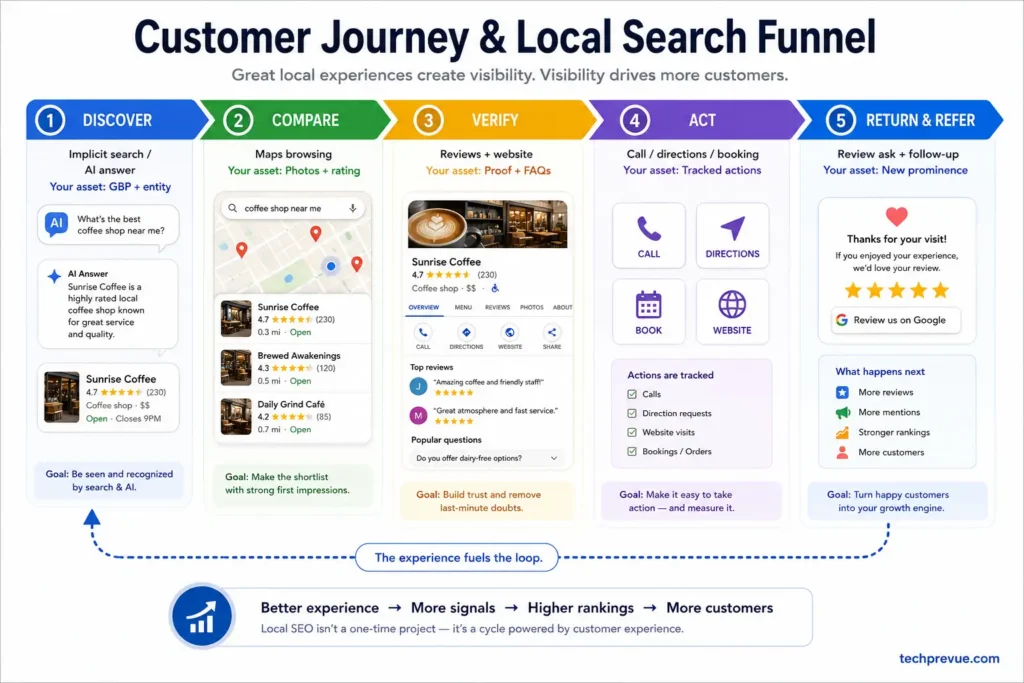
Before the visit: discover → compare → verify
- Discover: the customer searches “urgent care” or asks an AI assistant — your GBP, entity data, and Pack position decide whether you exist to them.
- Compare: in Maps, they flip between three tabs. Photos, rating, review count, and “open now” do the selling — this is why monthly photo uploads and accurate hours are revenue work, not housekeeping.
- Verify: they read two negative reviews and your responses, then skim your website for proof (pricing, FAQs, real people). Losing here after winning discovery is the most common — and most invisible — local SEO failure.
During the visit: earn the signal
- Deliver the experience your profile promised — mismatch is where 1-star reviews are born.
- Make the digital touchpoint physical: a review QR code on the counter, the receipt, or the technician’s leave-behind card.
- Capture the moment: a quick photo of the finished job (with permission) becomes next month’s GBP upload and location-page proof.
After the visit: close the loop
- The ask: text the review link within an hour of the happy moment — completion rates collapse by day three.
- The response: reply within 48 hours; prospects in the verify stage are reading it.
- Retention and referral: booking reminders, seasonal service prompts (“time for your fall furnace tune-up”), and a simple referral nudge turn one customer into repeat visits and branded searches — both of which feed prominence.
One customer, handled well, generates a review, a photo, a repeat visit, and a referral. That’s four ranking inputs from a single transaction — the compounding engine competitors who stop at “rank #1” never build.
Common Local SEO Mistakes That Hurt Google Maps Rankings
The most common local SEO mistakes: an incomplete or keyword-stuffed Google Business Profile, inconsistent NAP data, ignoring reviews, doorway-style location pages, no local links, and treating local SEO as a one-time project. Most ranking problems trace back to one of these.
The quick diagnostic list — audit yourself against it:
- Keyword-stuffed business name — suspension risk, and Google strips them in rankings anyway.
- Wrong or vague primary category — the #1 silent relevance killer.
- Old NAP data living in directories after a move or rebrand.
- Review silence — no asks, no responses. Velocity dies, prospects notice the unanswered complaints.
- Copy-paste location pages — filtered as doorway pages.
- Ignoring Apple Maps and Bing — you’re invisible to Siri users and Copilot.
- No schema, or schema that contradicts your GBP.
- Chasing national keywords while the winnable local grid sits unclaimed.
- Set-and-forget syndrome — profiles decay: hours change, Google accepts public “suggested edits” you never see, photos age. Check monthly.
- Fake signals — bought reviews, virtual-office listings, spam citations. In 2026 detection is good and recovery is slow; the honest path is genuinely faster.
Local SEO for AI Search: AI Overviews, AEO, GEO, and AIO
AI search optimization means making your business easy for AI systems — Google’s AI Overviews, ChatGPT, Perplexity, Gemini, Claude — to find, verify, and recommend. It rests on the same foundation as local SEO (entity confidence, reviews, structured data) plus answer-shaped content that AI can quote directly.
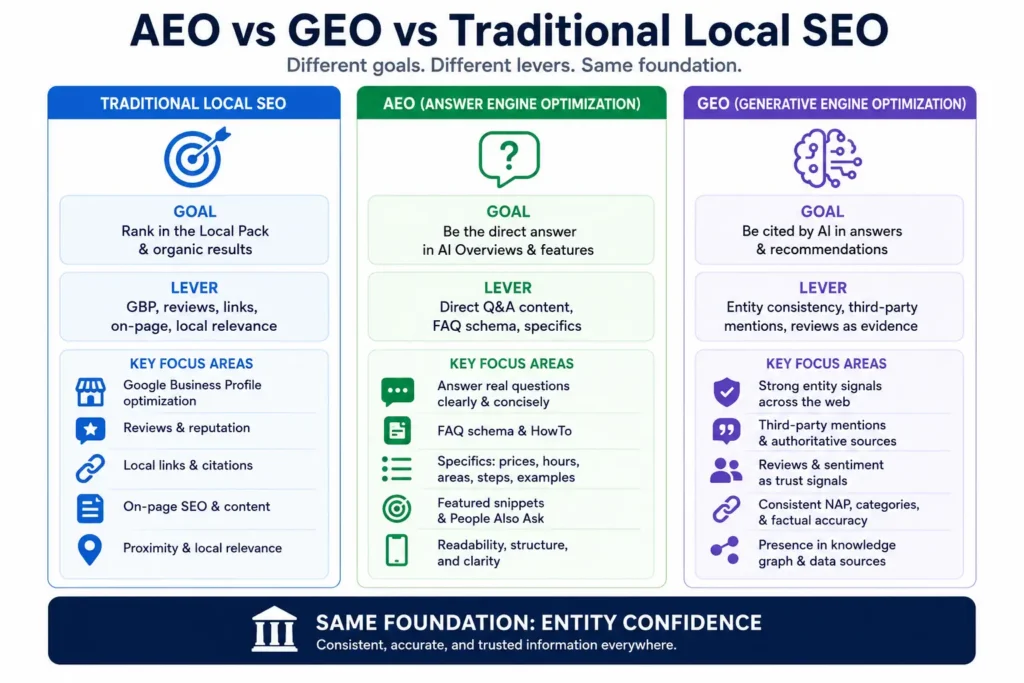
This is where this guide leaves the competition behind. AI Overviews now appear on a large share of local queries, and nearly half of consumers report using AI tools for local business recommendations. Three overlapping disciplines matter:
AEO: Answer Engine Optimization — become the answer
When someone asks “who’s the best emergency dentist in Plano that takes weekend appointments?”, an answer engine returns two or three specific businesses. AEO is engineering your presence so you’re one of them.
How to do it:
- Answer questions explicitly on your site. A page section titled “Do you offer weekend emergency appointments?” with a direct two-sentence answer is exactly the unit AI systems extract. Vague marketing copy is not.
- Front-load facts: put your differentiators in plain, quotable sentences. “Summit Dental offers same-day emergency appointments, including Saturdays, in downtown Boise.” An AI can lift that sentence whole.
- Mark up FAQs with FAQPage schema so the Q&A structure is machine-explicit.
- Match answer shape to question shape: cost questions get real ranges (“water heater replacement in Tacoma typically runs $1,800–$3,500 installed”). AI systems favor sources that commit to specifics.
GEO: Generative Engine Optimization — become citable
Generative engines assemble answers from sources they trust, then often cite them. GEO increases the odds you’re in the source set:
- Entity consistency is the entry ticket. AI systems cross-check your GBP, website, Yelp, and mentions. Contradictions get you dropped from the answer, not footnoted.
- Third-party corroboration beats self-description. “Best of the City” lists, local news features, active Reddit and Nextdoor threads, and industry directories are precisely what generative engines read when deciding who’s reputable. One genuine local “best barbecue in Austin” roundup placement can drive AI recommendations for years.
- Reviews are training data. Detailed review text (“they rebuilt our sewer line in one day and left the yard spotless”) gives AI concrete, quotable evidence of what you’re good at.
- Publish original local substance: data, pricing guides, project galleries. Generative engines preferentially cite sources that add information rather than recycle it.
AIO: AI Optimization — the operational habit
AIO is the maintenance layer: treat AI answers like a rankings report.
- Monthly, ask ChatGPT, Perplexity, and Gemini your money questions (“best HVAC company in Mesa,” “who should I call for a burst pipe in Tacoma?”).
- Note whether you appear, what’s said, and what sources are cited.
- Fix gaps at the source: wrong hours cited from an old directory → fix the directory; a competitor cited from a listicle you’re absent from → pitch your inclusion.
AI Citation Readiness Checklist
Run this quarterly:
- [ ] Identical NAP + description across GBP, website, schema, Apple, Bing, Yelp, Facebook
- [ ] LocalBusiness + FAQPage schema live and validating
- [ ] Every core service stated in a plain, complete, quotable sentence on your site
- [ ] Published price ranges or “starting at” figures for main services
- [ ] 10+ common questions answered directly on your site
- [ ] Recent reviews on at least two platforms mentioning specific services
- [ ] At least one third-party feature (news, roundup, directory profile) describing your business accurately
- [ ] Tested your top 5 “best X in [city]” questions in 3 AI assistants and logged results
Voice Search Optimization for Local Businesses
Voice search optimization for local businesses means winning spoken queries like “find a pizza place open now near me.” Because assistants read out one or two results, it depends on accurate business data everywhere (Google, Apple Maps, Bing), strong reviews, and conversational content that matches how people actually talk.
Voice is a results format, not a separate strategy — but three specifics matter:
- Cover all three data ecosystems. Siri leans on Apple Maps and Yelp; Alexa uses Bing-linked data; Google Assistant uses your GBP. The Apple Business Connect listing you skipped is why iPhone users can’t find you by voice.
- Hours and attributes decide voice results. “Open now,” “takes reservations,” “has a drive-through” — voice queries filter hard on these fields. Wrong hours means excluded, period.
- Write how people speak. Voice queries are full questions (“who can fix a garage door spring today in Frisco”). Your FAQ content and conversational headings from the AEO section do double duty here.
- Sanity-test it: ask your own phone for your business category in your town. If you’re not in the spoken results, work back through data accuracy → reviews → proximity.
Measuring Local SEO Success
Measure local SEO with four layers: Google Business Profile performance (calls, direction requests, bookings), Google Search Console (localized organic queries and clicks), Google Analytics 4 (conversions from local traffic), and geo-grid rank tracking (Map Pack position across your service area). Judge success by customer actions, not rankings alone.
Track what pays the bills, in this order:
1. Actions (weekly): calls, direction requests, website clicks, and bookings from your GBP performance dashboard — plus form fills and calls tracked in GA4. These are customers, not proxies.
2. Visibility (monthly):
- Geo-grid rank tracking (Local Falcon, BrightLocal, Places Scout): your Pack position sampled across a map grid of your service area. This is the honest view — you might be #1 at your address and #14 three miles east, and the grid shows exactly where to push.
- Search Console: filter queries by city names and service terms; watch localized organic clicks and impressions trend.
3. Reputation (monthly): review count, average rating, velocity vs. your top three Pack competitors.
4. AI presence (monthly): the AIO check from the previous section — appearance and accuracy across ChatGPT, Perplexity, Gemini, and AI Overviews.
Benchmarks for sanity: expect first measurable movement in 60–90 days, meaningful Pack improvement in 3–6 months for moderate markets, longer for lawyers/dentists in big metros. Local SEO compounds — the review base and link profile you build in year one is the moat competitors face in year two.
Best Local SEO Tools: Free and Paid Options for Every Job
The essential local SEO toolkit starts free: Google Business Profile, Search Console, Analytics 4, Keyword Planner, and Google Trends cover most single-location needs. Paid tools add scale — citation managers (BrightLocal, Whitespark), geo-grid rank trackers (Local Falcon), review platforms (Birdeye, Podium), and keyword suites (Semrush, Ahrefs).
Tools don’t rank you — the work does. But the right tool per job saves hours every month. Organized by job, names only:
| Job | Free option | Paid option |
|---|---|---|
| Profile & listings management | Google Business Profile, Apple Business Connect, Bing Places | BrightLocal, Semrush Local, Yext (multi-location) |
| Keyword research | Keyword Planner, Autocomplete, Google Trends, People Also Ask | Semrush, Ahrefs, KWFinder |
| Competitor analysis | GMB Everywhere extension, manual Pack audits | Places Scout, Local Falcon competitor scans |
| Citations & NAP cleanup | Manual audit (the phone-number search method above) | BrightLocal, Whitespark, Yext, Moz Local |
| Geo-grid rank tracking | Manual incognito checks from different areas | Local Falcon, BrightLocal, Local Viking |
| Review management | GBP review link + QR code + a spreadsheet | Birdeye, Podium, NiceJob, GatherUp |
| Schema markup | Rich Results Test; Yoast or Rank Math on WordPress | Rarely worth a standalone paid tool |
| Call & conversion tracking | GBP performance report, GA4, Search Console | CallRail, WhatConverts |
| AI visibility monitoring | Manual monthly prompts (the AIO routine above) | Profound, Otterly.AI, Peec AI, Semrush AI tracking |
The $0 starter stack — fully sufficient for a single location: Google Business Profile + Search Console + GA4 + Keyword Planner + GMB Everywhere + Rich Results Test + one tracking spreadsheet.
The working stack (~$50–150/month) — once you’re executing monthly: one citation/reporting platform (BrightLocal or Whitespark), a geo-grid tracker (Local Falcon), and call tracking (CallRail) when call volume justifies real attribution.
The buying rule: a tool earns its subscription when it replaces hours you’re actually spending — never buy dashboards to feel productive. Every item in the checklist below can be completed on the $0 stack.
Local SEO Checklist: Step-by-Step Optimization Workflow
This is the practical core of the guide. Work top to bottom; each phase builds on the last. Print it, or paste it into your task manager — or use the interactive checklist tracker to check off each item and save your progress automatically.
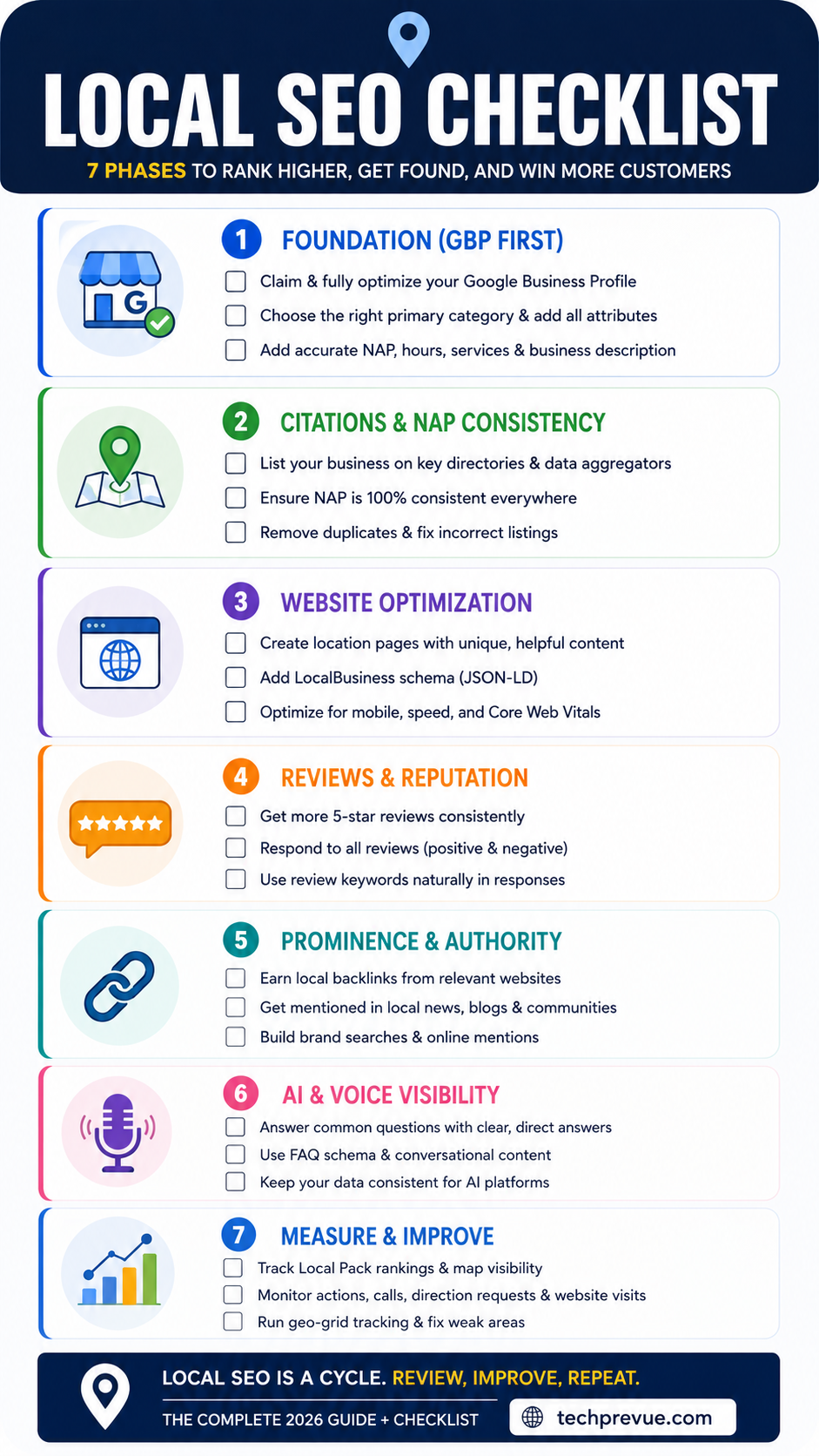
This covers the local layer; pair it with the sitewide complete SEO checklist for technical health, content, and links.
Phase 1 — Foundation (Week 1)
- [ ] Claim/verify Google Business Profile
- [ ] Set canonical NAP (exact name, address format, main phone) in one reference doc
- [ ] Choose specific primary category + all accurate secondary categories
- [ ] Complete every GBP field: description, services (with descriptions), attributes, hours, holiday hours
- [ ] Upload 10+ real photos (exterior, interior, team, work)
- [ ] Set up Apple Business Connect and Bing Places with identical data
- [ ] Claim Yelp, Facebook, and your industry’s top directory
Phase 2 — Citations & data cleanup (Week 2)
- [ ] Audit citations: search your phone number, old addresses, name variants
- [ ] Correct/remove every inconsistent listing (core set first)
- [ ] Standardize NAP in your website footer and contact page
- [ ] Add LocalBusiness (specific subtype) + Organization schema matching your GBP exactly
Phase 3 — Website (Weeks 2–4)
- [ ] One page per core service, titled “Service in City | Brand”
- [ ] Location/service-area pages with unique local content, photos, city reviews, embedded map
- [ ] FAQ section answering your 10 most common customer questions, with FAQPage schema
- [ ] Internal links between service and location pages with descriptive anchors
- [ ] Mobile speed check (test on a real phone over cellular)
- [ ] Publish plain, quotable sentences stating each service + area + differentiator
Phase 4 — Reviews (Week 3, then forever)
- [ ] Generate your Google review short link + QR code
- [ ] Build the ask into your close-of-service moment (text script for every customer)
- [ ] Respond to all existing reviews; commit to 48-hour responses ongoing
- [ ] Route ~20% of asks to your second platform (Yelp/industry site)
Phase 5 — Prominence (Monthly, ongoing)
- [ ] Post to GBP weekly; add new photos monthly
- [ ] Seed/answer GBP Q&A
- [ ] Earn 1–2 local links/month (sponsorship, chamber, press quote, event, partner page)
- [ ] Publish one genuinely local content piece per month
- [ ] Reclaim unlinked brand mentions
Phase 6 — AI & voice readiness (Quarterly)
- [ ] Run the AI Citation Readiness Checklist (above)
- [ ] Test voice results on Siri, Google Assistant, Alexa
- [ ] Verify AI assistants describe you accurately; fix source data where they don’t
Phase 7 — Measurement (Monthly)
- [ ] Record GBP actions: calls, directions, clicks, bookings
- [ ] Run geo-grid rank check for top 5 keywords
- [ ] Log review count/rating vs. top 3 competitors
- [ ] Review Search Console localized queries; find rising keywords to build pages for
Frequently Asked Questions About Local SEO
What is local SEO in simple terms?
Local SEO is making your business easy to find when nearby people search for what you sell — in Google’s map results, regular search results, and AI-generated answers. It mostly involves optimizing your Google Business Profile, collecting reviews, and keeping your business information accurate everywhere online.
How long does local SEO take to work?
Expect first movement in 60–90 days and meaningful Local Pack improvement in three to six months. Timelines stretch in competitive metros and litigation/medical niches, and shrink in small markets. Reviews and citations produce the fastest early wins; links and content compound over 6–12 months.
Is local SEO free?
Mostly. Google Business Profile, Apple Business Connect, Bing Places, and most core citations are free, and you can execute everything in this guide yourself. Typical paid options: citation management tools (~$300–500/year), rank tracking, or an agency ($400–$3,000+/month depending on market and scope).
What’s the difference between local SEO and Google Business Profile optimization?
Google Business Profile optimization is one component of local SEO — the most impactful single one for map rankings. Local SEO is the whole system: your profile plus website optimization, reviews, citations, local links, schema, and content. A great profile with a weak everything-else hits a ceiling fast.
Do I need a website for local SEO?
You can appear in the Local Pack with only a Google Business Profile, but a website roughly doubles your surface area: localized organic rankings, question content for AI answers, schema markup, and a place to convert visitors. Businesses ranking well long-term almost always have both.
How do reviews affect local SEO rankings?
Review volume, rating, recency, and content all feed the “prominence” ranking factor, and keywords inside reviews reinforce relevance (“great sewer line repair”). Reviews also drive click-through from the Pack — and AI assistants read them as evidence when deciding which businesses to recommend.
What are local citations and do they still matter?
Citations are mentions of your name, address, and phone on other sites — directories, maps, social platforms. In 2026 they matter as a consistency signal: clean, matching citations confirm your data; conflicting ones suppress trust. Fix the core 10–15 platforms; skip mass citation blasts.
How is local SEO changing with AI search?
The surfaces are multiplying — AI Overviews summarize local options above traditional results, and assistants like ChatGPT and Perplexity recommend specific businesses. The inputs, though, are familiar: consistent business data, strong reviews, structured markup, and third-party mentions. Businesses with high “entity confidence” win both Google and AI.
Can I do local SEO myself or should I hire someone?
The foundation — profile, citations, reviews, basic on-page — is absolutely DIY-able with the checklist above; budget a focused week, then a few hours monthly. Consider hiring for competitive markets, multi-location complexity, penalty/suspension recovery, or when your hourly rate makes delegation obvious.
What are the best free local SEO tools?
The complete free stack: Google Business Profile (listing management), Google Search Console (organic queries), Google Analytics 4 (conversions), Google Keyword Planner and Google Trends (keyword research), the GMB Everywhere Chrome extension (competitor categories), and Google’s Rich Results Test (schema validation). A single-location business can run an entire local SEO campaign without paying for software.
What’s the most important local SEO ranking factor?
No single factor wins alone, but for Local Pack rankings the highest-leverage cluster is your Google Business Profile (especially primary category) combined with review volume and velocity. For localized organic results, on-page relevance and local links lead. Proximity matters throughout — and it’s the one factor you can’t optimize.
Final Thoughts: Building Long-Term Local Visibility Beyond Rankings
Every tactic in this guide serves one strategy: make your business the easiest option for machines to verify and the most obvious option for humans to choose.
That framing future-proofs you. Google will keep redesigning its results. AI assistants will keep multiplying. Voice interfaces will keep growing. But every one of these systems answers the same underlying question — “which nearby business can I confidently recommend?” — and they all answer it by cross-referencing your profile, your website, your reviews, and what your community says about you.
Start with Phase 1 of the checklist this week. Fix your data, complete your profile, ask your next customer for a review. Local SEO rewards the businesses that simply keep showing up — online exactly as they do in real life.
Keep going: What Is SEO? · What Is Technical SEO? · The Complete SEO Checklist — or have TechPrevue’s SEO team run this playbook for you.
