
Backlinks are links from other websites pointing to yours. Search engines treat them as votes of confidence, judging how authoritative and trustworthy your content is. AI search tools track a similar signal: which sources get cited across the web, linked or not, when deciding what to recommend.
What are Backlinks in SEO?
Quick answer: Backlinks are links on other websites that point to a page on yours. Search engines and AI systems both treat them as a signal that your content is worth referencing, which is why backlinks remain central to both SEO and AI visibility.
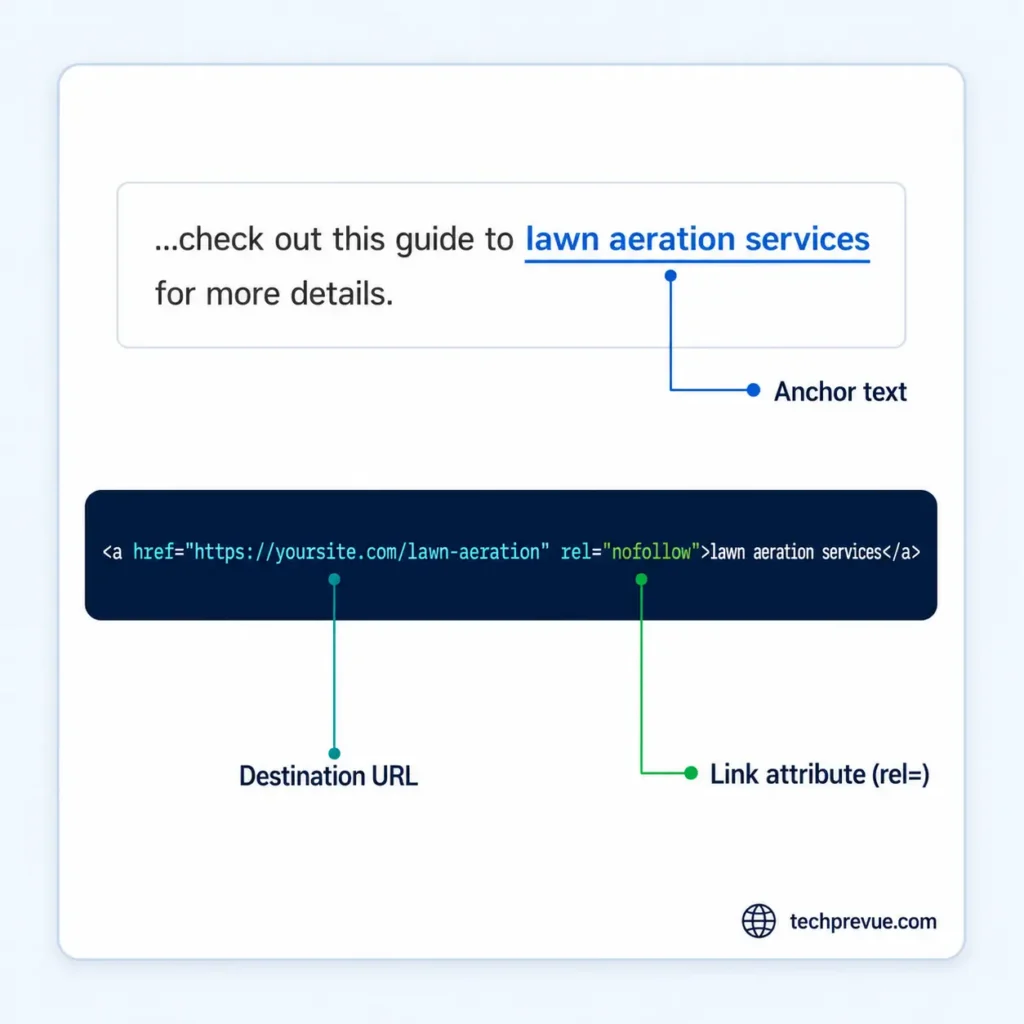
Backlinks are also called inbound links or incoming links. From the linking sites’ point of view, that same links are outbound or external links.
Say a food blog publishes a “best bakeries in Austin” roundup and links to a local bakery’s website. That link is a backlink for the bakery and an outbound link for the blog that wrote the roundup.
Backlinks vs. Internal Links
Backlinks aren’t the same as internal links, which connect pages within your own site, like a homepage linking to a blog post. Internal links help with navigation and site structure, while backlinks bring authority in from outside. That distinction matters in practice too: when you’re auditing your link profile, internal and external links get counted and evaluated completely differently by SEO tools.
Backlinks Also Drive Referral Traffic
Beyond the authority signal, a backlink is a live path for real visitors: anyone who clicks it lands directly on your site, already interested in the topic that got them there. A backlink from a high-traffic, relevant page, like a well-read industry blog or news site, can send meaningful referral traffic on its own, independent of anything it does for rankings.
Backlinks and Off-Page SEO
Backlinks sit on the off-page side of SEO, the work you do outside your own site to build authority, as opposed to on-page factors like content and structure. If you’re building out a full SEO foundation, it’s worth pairing an on-page checklist with an off-page checklist, since the two halves reinforce each other; a broader introduction to SEO fundamentals is a good starting point if any of this is new.
How Do Backlinks Work?
Search engines find, process, and rank pages in three stages: crawling, indexing, and ranking. Backlinks play a role in all three. They’re often how a crawler discovers a page in the first place, they feed into how that page gets evaluated once indexed, and they factor into the final ranking alongside hundreds of other signals.
PageRank and Link Equity
Google’s original ranking algorithm, PageRank, treated links between pages like votes. A link from a well-established, authoritative page carried more weight than one from an obscure site. Nearly three decades and countless algorithm updates later, that basic premise still holds: pages that earn links from credible sources tend to outrank pages that don’t.
Google calls the value passed through a link “link equity” (older SEO writing sometimes calls it “link juice”). A page with strong link equity passes some of that value to the pages it links to, without losing any of its own authority in the process.
Worth being precise here: PageRank isn’t the only way Google assesses authority today, and Google has never claimed it is. It’s one signal among many, but it’s the one most directly tied to backlinks, which is why it’s still the starting point for understanding how links affect rankings.
How Authority Moves Through a Site
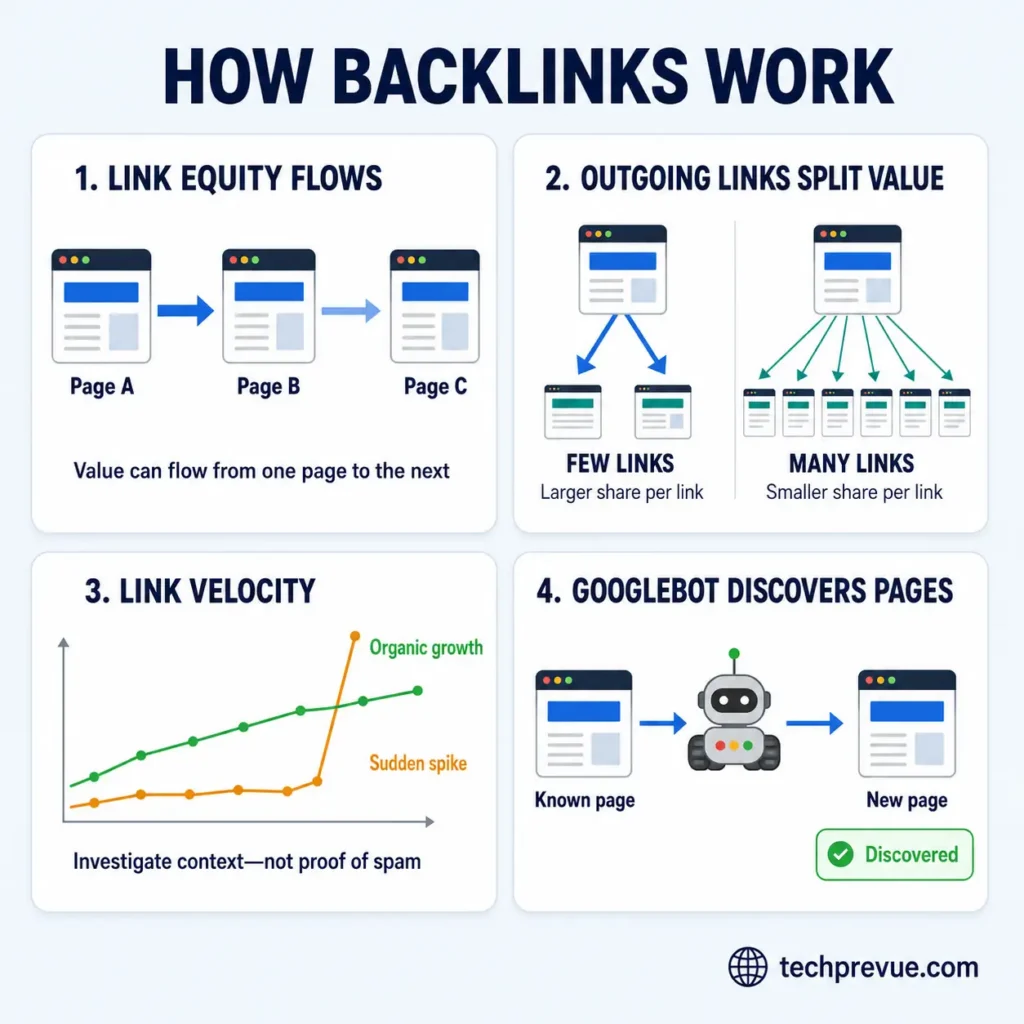
A simplified example makes this concrete: if Page A links to Page B, and Page B links to Page C, some of Page A’s authority flows to Page B, and some of that combined authority flows onward to Page C. A page that links out to dozens of other pages splits its authority many ways, so each individual link carries a smaller share than one from a page that links out sparingly.
One more factor worth knowing: link velocity, or how quickly a site accumulates new backlinks. A sudden, unnatural spike, like dozens of new links in a day after months of nothing, can look more like manipulation than organic growth, even if every individual link looks fine on its own.
Backlinks also help Google find new content in the first place. Google’s own documentation on crawlable links confirms this directly: when Googlebot follows a link to a page it hasn’t crawled before, that’s often how the page gets discovered and indexed.
Backlinks and AI Search Visibility
Quick answer: Backlinks now feed three related AI optimization disciplines: GEO, AEO, and AIO. All three draw on the same underlying signal — backlinks and citations — that classic search rankings already use.
Backlinks now do a second job that has nothing to do with rankings directly. AI Overviews, AI Mode, ChatGPT, and other answer engines don’t just crawl and index pages the way Google’s classic search does. They read context.
When your brand shows up consistently in credible articles alongside recognized names in your industry, these systems start associating you with that topic, whether or not the mention includes a clickable link.
This pattern is sometimes called co-citation: appearing in the same trusted content as authoritative sources, even without a direct link. Semrush’s research on backlinks and AI visibility, conducted with SEO analyst Kevin Indig across roughly 1,000 domains, found something that surprised a lot of SEOs. Nofollow links performed almost as well as dofollow links when it came to influencing AI visibility.
The takeaway isn’t that link attributes stopped mattering for classic rankings. It’s that AI systems are grading a different exam, one where being mentioned by the right sources counts almost as much as being linked by them.
GEO, AEO, and AIO Explained
It’s worth naming the three disciplines this feeds, since you’ll see all three referenced in current SEO discussion:
- GEO (Generative Engine Optimization) is about earning citations inside AI-generated summaries, on platforms like ChatGPT, Perplexity, and Gemini. Backlinks from sources those systems already treat as credible make your brand more likely to get pulled into that summary.
- AEO (Answer Engine Optimization) is about getting your own content extracted directly as the answer, in a featured snippet, an AI Overview, or a voice-assistant response. This depends more on how a page is structured (clear, direct answers near the top of a section) than on backlinks alone, but backlinks from pages that already rank for related questions help put a page in the running.
- AIO or LLMO (AI/LLM Optimization) is the broader, slower discipline of shaping how a model represents your brand across many mentions and citations over time, not just for one query. Unlinked mentions and co-citations matter most here: consistent, accurate references to your brand, linked or not, build a model’s underlying association between you and the topics you cover.
None of these replace backlinks as a ranking signal. They’re additional lenses on the same underlying signal: who’s willing to cite you, and in what context.
Measuring Your AI Visibility
Worth knowing why this connection exists at all: Google’s AI Overviews and AI Mode are built on top of its existing search infrastructure rather than a separate system from scratch. That means the backlink signals that already influence classic rankings carry over into what Google’s AI features surface, rather than starting from zero.
If you want to know whether any of this is actually moving the needle, AI visibility tools now exist specifically to measure it: they check whether your brand surfaces in AI Overviews, ChatGPT, Perplexity, and Gemini responses for relevant queries, which is the closest thing to a direct read on GEO, AEO, and AIO progress currently available.
Are Backlinks Still Important in 2026?
Quick answer: Yes. Backlinks remain one of the most consistent differentiators between top-ranking pages and everyone else, and the same authority signal now extends into how AI systems decide what to cite.
This question comes up every year, usually followed by a fresh “SEO is dead” headline. The data keeps telling a different story.
Top-ranking pages consistently have more referring domains than the pages below them. One large-scale analysis of Google search results found the #1 result averages roughly 3-4 times more backlinks than pages ranked #2 through #10, and recent research into AI search visibility has found a similar authority-based pattern. Authoritative backlinks and brand mentions still separate the sources that get cited from the ones that don’t.
What’s genuinely changed is which backlinks count. A pile of low-relevance, easily-bought links does less for you today than it did a decade ago. A handful of backlinks from credible, topically relevant sources still moves the needle, for rankings and for AI visibility alike.
What Makes a Backlink High-Quality?
Quick answer: A high-quality backlink is topically relevant, comes from a credible source, was earned rather than paid for or exchanged, appears somewhere a reader would actually click it, and uses a link attribute that matches how it was obtained.
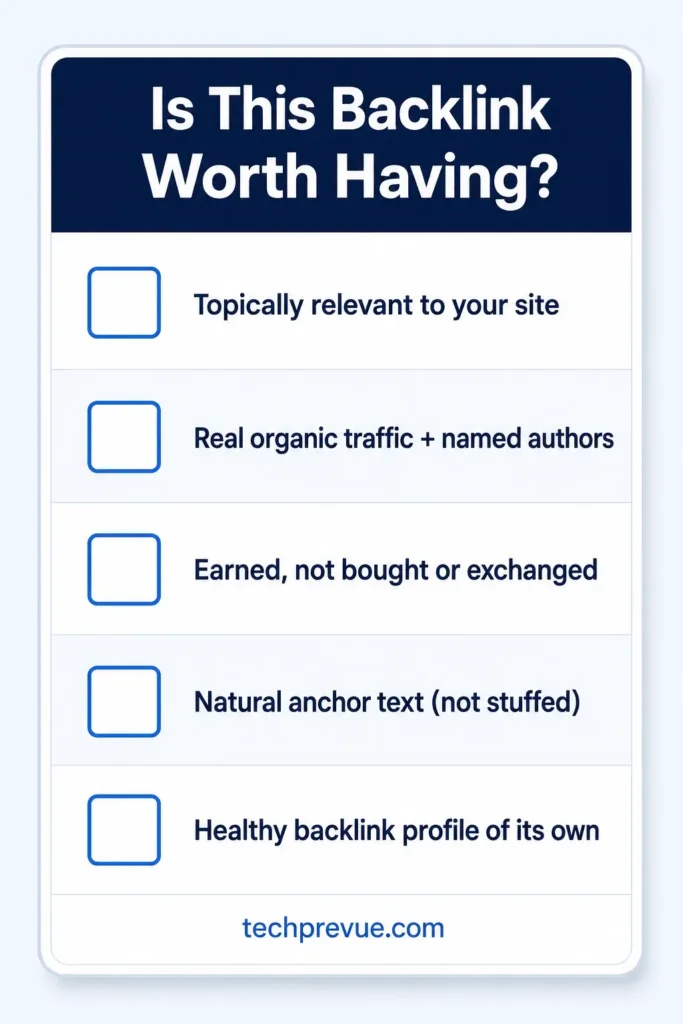
Not every backlink carries the same weight. Before you chase a link, or count one you’ve already earned, run it through these five questions.
1. Is Backlink Topically Relevant?
Does the site linking to you cover a topic close to yours? Healthline, for example, has earned backlinks from health authorities like the CDC — a link like that carries far more weight for a health site than an equally authoritative link from a sports or finance site would.
Relevance works on three levels: the linking page itself, the content surrounding the link, and the anchor text used. Healthline’s own in-depth article on daily water intake gets cited by outlets like HuffPost in related coverage — all three levels line up (health publication, health topic, relevant anchor text), which is exactly why it carries real weight instead of just looking like a passing mention.
2. Does the Source Have Real Credibility?
Ask whether the linking site would pass a basic credibility check: real organic traffic, named authors, and a healthy backlink profile of its own. A site that fails all three isn’t likely to be treated as a meaningful vote by Google or by AI systems, no matter how the link is coded.
A backlink from a well-known industry publication or a government or university site tells search engines something a random blog with a generic “About Us” page and an open “write for us” listing cannot.
3. What About Domain Authority and Page Authority?
Domain Authority (DA) and Page Authority (PA) are Moz’s own metrics, scored 1-100, that estimate how likely a whole domain or a single page is to rank in search results. Ahrefs has its own version, Domain Rating and URL Rating, and Semrush calls its equivalent Authority Score.
None of these are Google metrics. Google has never published an official “authority” score and doesn’t use DA, DR, or Authority Score directly in its ranking algorithm. They’re third-party approximations built from each tool’s own backlink data, useful as a quick reference point when deciding which prospects to prioritize, but not something to chase for its own sake.
A high-DA or high-DR page linking to you is a reasonable proxy for “this is probably a credible, well-linked site,” which is exactly why it’s worth checking before you invest time in outreach. Just don’t treat any specific score as a magic number: a DA 40 site that’s genuinely relevant to your topic is usually worth more than a DA 70 site that has nothing to do with what you do.
4. Was backlink Earned, Paid, or Exchanged?
Did you earn this link because your content genuinely helped someone, or because you paid for it, swapped it, or asked repeatedly until someone said yes? Google’s spam policies specifically call out a handful of practices as link schemes: paying for links that pass ranking credit, large-scale link exchanges, automated link-building programs, links stuffed into low-quality directories or forum signatures, and content created purely to attract links rather than to help anyone.
An earned editorial link, like a journalist citing your data because it’s useful or a blogger linking to your guide because it answered their question, is exactly what search engines were built to reward. A paid placement isn’t automatically against the rules, but it needs the right attribute and shouldn’t be the backbone of your link profile.
5. Where Does the backlink Appear?
Position matters more than most people assume. Google has patented a “reasonable surfer” model that weighs how likely a real visitor is to actually click a given link, and a link’s position is a big part of that.
A link sitting in the main body of an article, surrounded by relevant text, is far more likely to get clicked, and treated as valuable, than the same link buried in a footer, a sidebar widget, or a long list of “additional resources” at the bottom of a page. If you have any influence over placement when pitching a link, ask for it in the body copy, not the footer.
6. What Attribute Does It Use?
Every link carries an attribute that tells search engines how to treat it:
| Attribute | What It Signals | Best Use |
|---|---|---|
| Dofollow (standard) | Passes link equity and ranking credit | Earned editorial links |
Nofollow (rel="nofollow") | Doesn’t pass ranking credit directly, but still counts for referral traffic and AI context | Unverified or lower-trust sources |
Sponsored (rel="sponsored") | Marks a paid placement | Paid links, affiliate content |
UGC (rel="ugc") | Marks user-generated content | Forum posts, comments, reviews |
A healthy backlink profile naturally includes a mix of all four. An all-dofollow profile can actually look suspicious to Google, since it doesn’t match how links occur naturally across the real web.
Quick quality checklist:
- The linking site covers a topic close to yours
- It has real organic traffic and named authors
- The link was earned, not bought or exchanged
- The anchor text reads naturally, not stuffed with exact-match keywords
- The domain has its own healthy backlink profile
Types of Backlinks (by How They’re Earned)
Quick answer: Backlinks fall into three categories based on how they’re earned: natural (editorial) links nobody had to ask for, manual (outreach) links earned through deliberate effort, and self-created links you place yourself. Search engines weight these very differently.
Beyond the dofollow/nofollow attribute, backlinks also differ by how they came about. Most fall into three buckets.
Natural (Editorial) Backlinks
Natural backlinks happen without any request from you — a writer cites your research, links to your guide, or references your data because it’s genuinely useful, with no outreach and no transaction involved. These are the gold standard.
Manual (Outreach) Backlinks
Manual backlinks come from deliberate effort: guest posts, digital PR and journalist pitches, promoting a webinar until other sites link to the recording, or asking a partner to link to a case study. These are legitimate when the content is genuinely useful and the target site is relevant, and become a problem when pursued at scale purely for the link.
Self-Created (UGC) Backlinks
Self-created backlinks are links you place yourself: forum signatures, blog comments, directory listings, social profiles. Search engines assign these very little weight on their own, since anyone can create them in bulk, but they’re not inherently harmful in small, natural amounts.
Specific Formats Worth Knowing by Name
Within these buckets, a few specific formats are worth knowing by name:
- Guest post links — from articles you write for other sites, usually in the author bio or body copy
- Digital PR and journalist links — from being quoted or cited in news coverage
- Directory and local citation links — from business listings, useful mainly for local SEO
- Social media links — mostly nofollow, but still valuable for referral traffic and discovery
Ways to Build Valuable Backlinks
Quick answer: The most reliable paths to earning backlinks fall into six categories: reclaiming unlinked mentions, fixing broken links, earning media and podcast placements, publishing guest content, replicating competitor citations, and creating something genuinely worth citing.
Getting good backlinks comes down to earning attention rather than manufacturing links. Six categories account for most of the backlinks worth having:
- Reclaim unlinked brand mentions — ask sites that already mention you to add a link, usually the fastest win available.
- Fix broken links — replace dead links, yours or a competitor’s, with your own working resource.
- Get featured on resource pages and podcasts — earn placement on curated lists and in show notes.
- Answer journalist and expert-source requests — earn editorial links from major publications through digital PR.
- Publish guest content and replicate competitor citations — build relationships with relevant publishers and join lists your competitors are already on.
- Create something genuinely worth citing — original data, tools, and guides that earn links without ongoing outreach.
Each category above breaks down into specific tactics with its own outreach template and realistic conversion expectations in How to Get Backlinks: A Practitioner’s Playbook(10 Proven Tactics).
Should You Buy Backlinks?
Google’s spam policies specifically count paying for links that pass ranking credit as a violation, and sites caught doing this at scale have received manual penalties that took months to recover from. Properly disclosed paid placements, marked with a rel="sponsored" attribute, aren’t against the rules. They just don’t pass authority the way an earned link does.
If you’re weighing whether to pay for backlinks: the downside, a penalty that can take months to undo, usually outweighs the upside of a handful of links from a low-effort seller. That budget tends to go further spent on digital PR or a genuinely useful asset.
Auditing and Disavowing Backlinks
Remove Links Before You Disavow
If you find harmful backlinks pointing at your site, the first move is asking the linking site to remove them directly, not disavowing. Disavowing tells Google to ignore a link entirely, which is a blunter, riskier tool than simply asking for removal.
When Disavowing Actually Makes Sense
Reserve disavowing for cases where you have a genuine volume of harmful links you can’t get removed, and you either have an active Google penalty or a clear reason to expect one. Disavowing links that were never actually hurting you can suppress backlinks that were quietly helping, so treat it as a last resort rather than routine maintenance.
AI-assisted analysis is increasingly built into backlink tools themselves, and it’s genuinely useful for a first pass: flagging which links in a long list look suspicious versus merely low-authority but harmless. The actual removal-request and disavow decisions still deserve a human look before you act on them.
Common Backlink Mistakes to Avoid
- Chasing quantity over quality. One relevant link from a credible site outperforms dozens from low-authority ones.
- Repeating the same exact-match anchor text. This is a pattern Google’s spam systems are specifically built to catch.
- Assuming only dofollow links count. Nofollow links still carry referral traffic and AI-visibility value.
- Disavowing links reactively. Without clear evidence they’re causing harm, disavowing can do more damage than the links themselves.
- Assuming every toxic link is your fault. A sudden pile of spammy backlinks sometimes comes from a competitor’s negative SEO attack, not your own link building. Investigate before you panic-disavow.
- Treating Domain Authority as a Google metric. It’s a third-party score Moz created and some tools use, not something Google’s algorithm references directly.
FAQs about Backlinks
What is a backlink?
A backlink is a single link from another website that points to a page on yours, also called an inbound or incoming link. The plural, “backlinks,” refers to your site’s entire collection of these links from across the web, which is what the rest of this guide covers.
Is “backlinks in SEO” the same as SEO backlinks?
Yes. “Backlinks in SEO,” “SEO backlinks,” and “SEO and backlinks” all describe the same thing: links from other websites that function as a trust and ranking signal for search engines.
Are backlinks still important for SEO in 2026?
Yes. High-quality, relevant backlinks remain one of the clearest signals search engines and AI systems use to judge whether content deserves visibility, even as the emphasis shifts toward relevance and credibility over raw link counts.
How many backlinks do I need to rank?
There’s no fixed number. Referring-domain diversity, topical relevance, content quality, and competitor strength all matter more than hitting a specific count. A page with ten highly relevant backlinks can outrank one with a hundred low-quality ones.
Do nofollow backlinks help SEO?
Yes, indirectly. Nofollow links don’t pass ranking credit the way dofollow links do, but they still drive referral traffic, brand visibility, and increasingly, AI search context.
What’s the difference between a backlink and a referring domain?
A backlink is a single link. A referring domain is a unique website linking to you, regardless of how many times it links. Ten backlinks from one site count as a single referring domain, which is generally less valuable than ten backlinks from ten different sites.
What’s a backlink profile?
Your backlink profile is the complete picture of every link pointing to your site: which domains link to you, which pages they link to, what anchor text they use, and the mix of attributes across all of them. A healthy profile has variety, not just volume.
Should I disavow harmful backlinks?
Only as a last resort. Ask the linking site to remove the link first; disavowing is a blunter tool best reserved for cases where you have a real volume of harmful links you can’t get removed and a genuine penalty risk. See How to Get Backlinks: A Practitioner’s Playbook for the full outreach playbook, including realistic timelines and how many pitches a given tactic typically takes.
Key Takeaways
- A backlink is a link from another site to yours, a signal both search engines and AI systems use to judge trust and authority.
- Quality (relevance, credibility, placement, how the link was earned) matters more than raw quantity.
- A healthy backlink profile mixes dofollow, nofollow, sponsored, and UGC links naturally.
- Backlinks now feed GEO, AEO, and AIO alongside classic rankings, so co-citation and consistent brand mentions matter even without a link.
- Buying backlinks risks a Google penalty that can take months to recover from. It’s rarely worth the trade-off.
- For the full outreach playbook and realistic timelines, see How to Get Backlinks: 10 proven tactics.
