
Getting good backlinks comes down to earning attention rather than manufacturing links. The 10 tactics below explain how to get backlinks and are ordered roughly the way most practitioners actually work through them: quick, low-effort wins first, then slower plays that take longer but compound over time.
New to the topic? What Are Backlinks in SEO? covers the definition, why backlinks matter for rankings and AI visibility, and what makes one high-quality before you start building any.
- Set Your Expectations Before You Start
- Getting Started: Your First Week
- Which Link Building Techniques Are Worth in 2026 (and Which Are Obsolete)
- 10 Tactics to get Good backlinks & build Authority
- How Long This Actually Takes
- Track What's Actually Working
- Outreach Readiness Checklist
- Outreach Mistakes to Avoid
- FAQs – How to Get Backlinks
- Key Takeaways
Set Your Expectations Before You Start
One honest note before diving in: outreach is a numbers game with a low hit rate, and that’s normal. Ahrefs’ own CMO, Tim Soulo, ran an outreach campaign for a single article: 111 personalized emails sent, 19 backlinks landed, a 17% success rate he considers surprisingly good, since anything above 10% is usually treated as strong.
A well-targeted broken-link pitch might land somewhere in that range. A cold “my content is better than yours” pitch with no real incentive attached, by his own account, can be as low as 5 in 100, and that’s with an established brand behind it. A brand-new site should expect meaningfully lower.
Don’t judge a tactic as “not working” after five emails. Judge it after fifty.
AI tools genuinely help with the two slowest parts of this process: researching a prospect fast enough to reference something specific, and drafting a first-pass pitch instead of staring at a blank subject line. What they can’t do is replace the one line in each email that actually gets replies, the detail that only makes sense if you’ve actually looked at the page you’re pitching. Use AI to go faster on research and drafting, not to skip personalization; a handful of tactic-specific tips on this are below where they’re genuinely useful.
Getting Started: Your First Week
If this is your first outreach campaign, don’t try all 10 tactics at once. A simple way to begin:
- Pick one tactic — reclaiming unlinked mentions or fixing broken links, since both convert fastest for beginners
- Find 10-15 real prospects using the search techniques described in that tactic’s section below
- Personalize and send, one specific line per email, not a mail-merge blast
- Log every pitch, who, when, which tactic, and whether it converted
- Follow up after about a week if you haven’t heard back; most replies come from the second touch, not the first
Once you’ve run through that cycle two or three times, add a second tactic and repeat.
Which Link Building Techniques Are Worth in 2026 (and Which Are Obsolete)
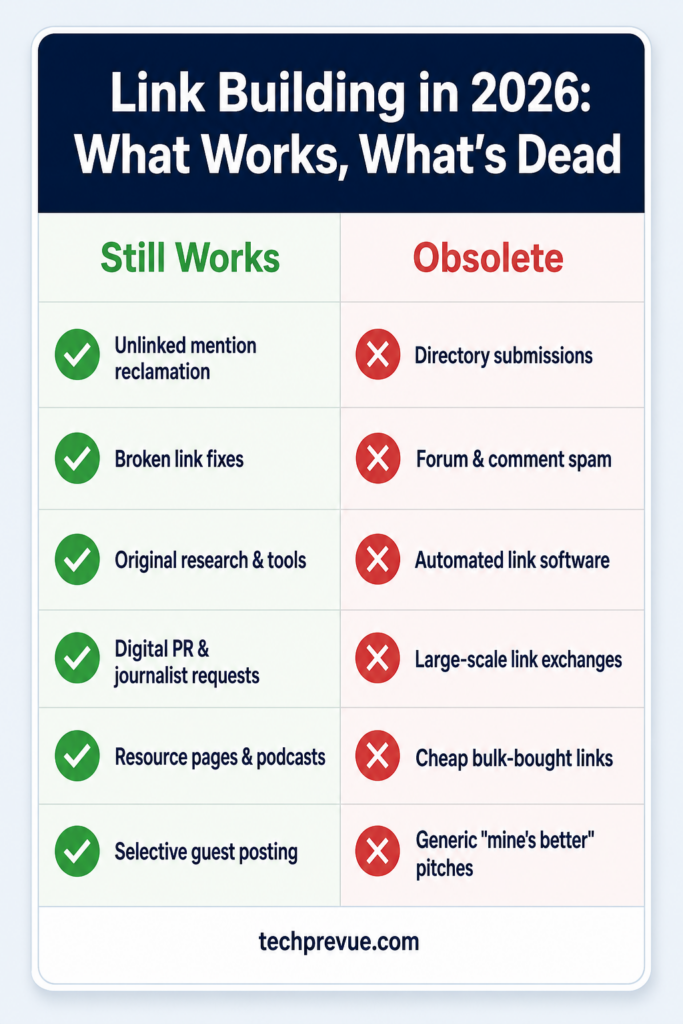
Quick answer: Techniques that produce genuine context, a real mention, a real citation, a real reason someone referenced you, are worth more than ever, because AI systems read that context the same way search engines read links. Techniques that only produce a raw link with no context behind it have been declining for years and are effectively dead in 2026.
Ahrefs has a useful way to think about this: nearly every link-building tactic falls into one of four buckets. You add a link yourself, you earn one naturally, you ask someone for one, or you buy one. Where a tactic sits in that list is a good predictor of whether it still works, and it’s a large part of why the AI era rewards some techniques and punishes others.
Still Worth Doing in 2026
| Technique | Why it holds up |
|---|---|
| Reclaiming unlinked mentions | Fastest, highest-converting, and the mention already existed before you asked |
| Fixing broken links, yours or a competitor’s | Solves a real, visible problem for the site owner, not just a favor |
| Original research, tools, and definitive guides | Produces genuine citations, which AI systems read the same way search engines read links |
| Digital PR and journalist requests | Editorial placements carry real context and credibility that survive into AI summaries |
| Resource page and podcast placements | Curated, rarely updated, and crawlable or transcribable for AI extraction |
| Selective guest posting | Still works when the content and the fit are genuinely good |
Obsolete or Actively Risky in 2026
| Technique | Why it’s declined |
|---|---|
| Directory submissions | Even Mailchimp’s own guide now admits directories are “mostly considered a bad idea” |
| Forum and comment spam | Almost always nofollow, heavily moderated, and can get you banned outright; Reddit is a well-known example of a platform that actively polices this |
| Automated link-building software | Ahrefs calls this what it is: not link building, just spam |
| Large-scale link exchanges | Named directly in Google’s spam policies; an occasional genuine reciprocal link is fine, a strategy built around them isn’t |
| Buying cheap backlinks at volume | A founder Ahrefs worked with bought 1,000+ backlinks at $3 each in a single month and watched his traffic drop to zero |
| Generic “my content is better, please link to it” pitches | Ahrefs’ own honest critique of the classic Skyscraper-style ask: no real value for the recipient means a weak response rate, even with genuinely better content |
The Declining Middle Ground
Business directories and Chamber of Commerce-style local listings still have a place, mainly for local SEO, but multiple sources now describe them as a starting point rather than a serious ongoing strategy. Treat them as a small, easy win, not a plan.
10 Tactics to get Good backlinks & build Authority
Some backlink building tactics can earn links with minimal setup, while others require consistent publishing, outreach, and relationship-building.
1. Reclaim Unlinked Brand Mentions
This is usually the fastest, highest-converting tactic available, because the hardest part of outreach, getting someone to notice you exist, is already done. The site already decided you were worth mentioning. You’re just asking them to finish the job.
Search "Your Brand Name" -site:yourdomain.com, then cut the noise by excluding social platforms: add -site:facebook.com -site:x.com -site:linkedin.com -site:reddit.com -site:youtube.com. “Best tools” roundups, comparison pages, and newsletter archives are good hunting grounds, since they mention brands constantly and don’t always link every one.
Before you pitch, check the surrounding copy. If a mention is vague (“some teams use [Brand] for this”), you can ask for more than just a link. A short, polite note suggesting a clearer sentence does two things at once: it earns the link, and it improves how accurately that page describes what you do, which matters when AI systems read that same page later.
If you’re working through a long list of mentions, an AI tool can help triage: paste in a batch of snippets and ask which read as positive, neutral, or negative, and which already have a link. That turns an hour of manual scanning into a few minutes, leaving your actual time for outreach.
Subject: Quick question about [Article Title]
Hi [Name],
I noticed you mentioned [Your Brand] in your piece on [topic] — appreciate the mention.
Would you be open to linking it to [specific URL]? It’d give readers a direct way to check it out.
Thanks either way, [Your Name]
If you’ve never done outreach before, start here. Reply rates tend to run higher on this tactic than almost anywhere else, since you’re not asking for a favor, you’re asking for a five-second edit to something the writer already chose to include.
2. Fix Broken Links
Find pages that used to link to a resource that no longer exists, and offer your content as the replacement. Site owners want to fix broken links anyway; you’re just making it easy for them to do it.
A simple way to start: search for your topic alongside phrases like “resources” or “useful links,” then check those pages for dead URLs. Most backlink tools include a broken-link filter that speeds this up considerably, and the Wayback Machine is worth a quick check if you’re unsure what used to live on a dead page.
Subject: Broken link on [Page Title]
Hi [Name],
I was reading your piece on [topic] and noticed the link to [resource description] no longer works.
I recently published [your resource title], which covers similar ground and might work as a replacement: [your URL].
Either way, wanted to flag the broken link. Thanks for the resource!
[Your name]
3. Inherit a Competitor’s Broken Backlinks
A close cousin of fixing your own broken links: find a competitor’s dead page, and offer yourself as the replacement everywhere that dead page is still linked from.
Run a competitor’s domain through a backlink tool and filter for pages returning errors, sorted by how many domains still link to them. A page with 40 referring domains and a 404 status is 40 separate outreach opportunities pointed at content that no longer exists.
Subject: Broken link on [Page Title]
Hi [Name],
I was reading your piece on [topic] and noticed the link to [dead resource] no longer loads.
We recently published [your resource], which covers similar ground and might work as a replacement: [URL].
Either way, thought you’d want to know about the broken link.
[Your Name]
This tends to convert better than pitching an active competitor’s page cold, since you’re solving a visible problem instead of asking someone to swap out something that currently works fine.
If you’re not sure what the dead page used to cover, pull its Wayback Machine snapshot and ask an AI tool to summarize it. Referencing the specific old content in your pitch reads as far more credible than a generic “noticed a broken link” email.
One agency, Nico Digital, ran exactly this play against a competitor’s deleted pricing page that still had roughly 3,000 referring domains pointing to it: they built one strong replacement page, reached out to the sites still linking to the dead URL, and reported earning 311 backlinks in about 90 days. The tactic scales with how many domains are still pointing at the dead page, so it’s worth checking that number before investing in a replacement.
4. Get Featured on Resource Pages
Many sites, especially educational institutions, industry associations, and long-running blogs, maintain a “resources” or “recommended tools” page that curates external links for readers. These pages are usually updated rarely, which means once you’re on one, you tend to stay there.
Search combinations like [your topic] "resources", [your topic] intitle:resources, or [your topic] inurl:resources. Prioritize pages updated within roughly the last year with links that still work; a resource page nobody has touched since 2019 is a much colder pitch.
Subject: Resource suggestion for [Page Title]
Hi [Name],
I came across your resource page on [topic] and noticed you’ve put together a solid list.
I recently published [your content], which covers [specific value]. Thought it might be worth adding, but no worries either way.
Thanks for keeping the page useful.
[Your Name]
These pitches work best when you can point to something genuinely distinct from what’s already listed. Pitching a fifth generic “SEO guide” to a page that already has four rarely lands.
5. Answer Journalist and Expert-Source Requests
Platforms that connect journalists with expert sources remain one of the more efficient ways to earn backlinks from major publications, though the landscape keeps shifting. HARO shut down in December 2024, was sold to Featured in 2025, and has been through more than one rebrand since. Treat any specific platform name here, including this one, as worth double-checking before you sign up.
Qwoted has stayed a stable option through the changes.
What Actually Gets You Picked
Journalists working on deadline choose the first genuinely useful answer, not the most polished one. Responding within two to four hours of a request going live matters more than almost anything else you can control. A specific, concrete answer beats a well-written generic one every time: “we tested this with 40 customers and saw X” beats “many experts agree that X is important.”
Your source profile matters too. “Content strategist” gets skipped over; “B2B SaaS content strategist who’s worked with 20+ fintech companies” gets a second look. Always include the exact attribution and URL you want used, since a journalist on deadline won’t go looking for it.
Speed matters more here than anywhere else on this list, which is exactly where AI tools earn their keep: turning a rough, half-formed answer into a tight, publication-ready quote in a couple of minutes instead of twenty. The substance still has to be yours, though, since a journalist can usually tell the difference between a real answer that’s been polished and a generic paragraph with no actual expertise behind it. Use AI for the polish, not the substance.
Realistic Expectations
Expect a low hit rate here, especially early on. Most sources answer dozens of requests before landing a placement, and specificity is usually what separates the ones who get picked from the ones who don’t.
For a sense of scale: Greg Heilers of Jolly SEO has reported sending upward of 200,000 journalist pitches across his campaigns, with a large share of his recent placements coming through a single platform. That volume is an agency running this at scale, not a benchmark for a first attempt, but it’s a useful reality check on how much this tactic rewards persistence over any single perfectly-worded email.
6. Get Interviewed on Podcasts
An underused one: podcast guest appearances almost always come with a link in the show notes, and increasingly a transcript page too, both of which are fully crawlable.
Search [your industry] podcast, browse Apple Podcasts or Spotify by category, or check which shows your competitors have already appeared on. Prioritize shows that publish written show notes or transcripts over audio-only shows with no companion page. The link only exists if there’s a page for it to live on.
Subject: Guest idea for [Podcast Name]
Hi [Host Name],
Been listening to [Podcast Name] for a while, really liked the episode on [specific topic].
I’m [title] at [company], and I’ve spent a lot of time on [relevant experience]. Happy to share specifics on [2-3 topic ideas] if it’s useful for your audience.
Open to having me on?
[Your Name]
Smaller, niche shows accept guest pitches far more often than the handful of huge, well-known ones everyone else is also pitching. A show with 500 listens per episode that says yes beats a huge show that never replies.
7. Write Guest Posts, for the Relationship, Not Just the Link
Guest posting still works, but the bar for a link-worthy pitch is higher than it used to be. Editors have seen every version of the generic “I’d love to write for you” email.
Finding the Right Sites
Search [your industry] "write for us" or [your industry] "guest post guidelines". Prioritize sites with visible editorial standards over ones that will publish almost anything for a fee; Google names large-scale, low-quality guest posting as a link scheme, and it rarely moves the needle anyway.
Pitching a Guest Post
Pitch 2-3 specific angles, not one vague topic, and link to your best previous writing so the editor can judge quality in ten seconds instead of fifty. It’s worth asking upfront whether contextual links within the body are allowed, or only in the author bio, since that changes what you write and where the link lands.
Researching a publication’s recent coverage before you pitch used to take real time. An AI tool can summarize a site’s last dozen posts in seconds, which is often enough to write one genuinely specific line in your pitch instead of a generic “I love your content.”
Subject: Guest post idea: [specific topic]
Hi [Editor Name],
I’m [title] at [company] — [one line of relevant credibility]. Been reading [Publication], noticed your recent piece on [specific topic].
A few ideas that might fit:
- [Angle 1, one sentence]
- [Angle 2, one sentence]
Previous writing here if useful: [link].
Worth a draft?
[Your Name]
The sites worth writing for are also the ones that reject the most pitches. Expect a lower acceptance rate here than with resource pages or broken links, in exchange for a link from a site with a real, engaged audience.
8. Replicate Competitor Backlinks and Citations
If a site already links to two or three of your competitors, it’s a reasonable bet they’d consider linking to you too, especially on comparison pages, “best of” roundups, and review sites that already cover multiple vendors in your category.
Run your domain against 3-4 direct competitors in a backlink-gap tool. The report surfaces sites linking to at least one competitor but not to you, a prospect list that’s already pre-qualified by the fact that they cover your space.
Pitch these differently than a cold outreach email: reference the specific competitors already on the page, and make the case for why you belong alongside them, not instead of them. A roundup page adding a fifth relevant tool is a much lower-friction ask than a page swapping one tool for another.
This tends to convert better than pure cold outreach precisely because you’re not introducing an unfamiliar concept. You’re asking to join a list the site owner has already decided is worth maintaining.
9. Build on Relationships You Already Have
Look at the businesses you already work with: vendors, partners, clients who’d give you a testimonial, and ask whether any of them would link to you. A testimonial on a partner’s site, a case study for a vendor, or a mention in a joint announcement are all backlinks that don’t require cold outreach.
This extends beyond direct business relationships. Sponsoring a local event, volunteering with a community organization, or simply being an active, helpful presence among niche bloggers in your industry tends to lead to natural mentions and links over time. Unlike a cold pitch, nobody has to be convinced you’re worth linking to first.
10. Create Something Worth Citing
Original data, free tools, and genuinely in-depth guides earn backlinks because writers need something to point to that they can’t get anywhere else. Wistia’s State of Video report is a good example: built from a survey of hundreds of professionals, it has earned backlinks from well over a thousand referring domains because it’s primary data other writers can’t get anywhere else.
The bar here is usefulness, not length. A focused, genuinely useful tool or dataset beats a generic listicle every time a journalist is looking for something worth citing.
“Ego Bait” and Other Content People Promote Themselves
One specific version of this is what’s sometimes called “ego bait”: content flattering enough to specific brands or people that they promote it themselves. Aira’s State of Link Building industry survey is a real example: some of its findings favored Ahrefs enough that Ahrefs linked to it from their own homepage, and it went on to earn backlinks from more than 570 other referring domains.
AI tools are genuinely useful for the analysis and first-draft side of this: summarizing survey responses, spotting patterns in a dataset you already have, drafting the copy for a calculator or tool. What they can’t do is generate the underlying data itself. A “study” built on invented numbers isn’t a citation magnet, it’s a liability the moment anyone checks.
Naming Your Approach
Some of the most durable link magnets aren’t just useful content, they’re a named approach. Brian Dean’s “Skyscraper Technique” and Bryan Harris’s “Moving Man Method” are, at their core, fairly ordinary tactics (find good content and improve on it; find people mid-switch from one tool to another and catch them at the right moment) that earned thousands of citations because they were given a specific, memorable name and published as the canonical source.
Worth separating two things here: naming and owning a genuinely original approach still works, but using “I made a better version of your content, please link to it” as a generic cold-outreach line doesn’t carry the same weight it used to, precisely because there’s no real incentive for the recipient beyond the ask itself.
You Don’t Always Need Outreach
This is really an extension of good content marketing with backlinks specifically in mind. It also compounds with social sharing: content strong enough to earn a backlink is usually the same content people share on social platforms, and the visibility from one tends to feed the other.
It’s also possible to earn backlinks with close to zero outreach if the underlying product or content is genuinely useful enough. Plausible Analytics reports generating hundreds of thousands of backlinks without running a single manual link-building campaign, mostly through word-of-mouth reviews, marketplace listings, and customers linking to their policies as a natural side effect of using the product. That’s not a realistic starting point for most sites, but it’s a reminder that outreach is a way to speed up what good products and content eventually earn anyway.
How Long This Actually Takes
Realistic expectations save you from abandoning a tactic too early, or expecting a resource-page pitch to behave like a six-month content campaign.
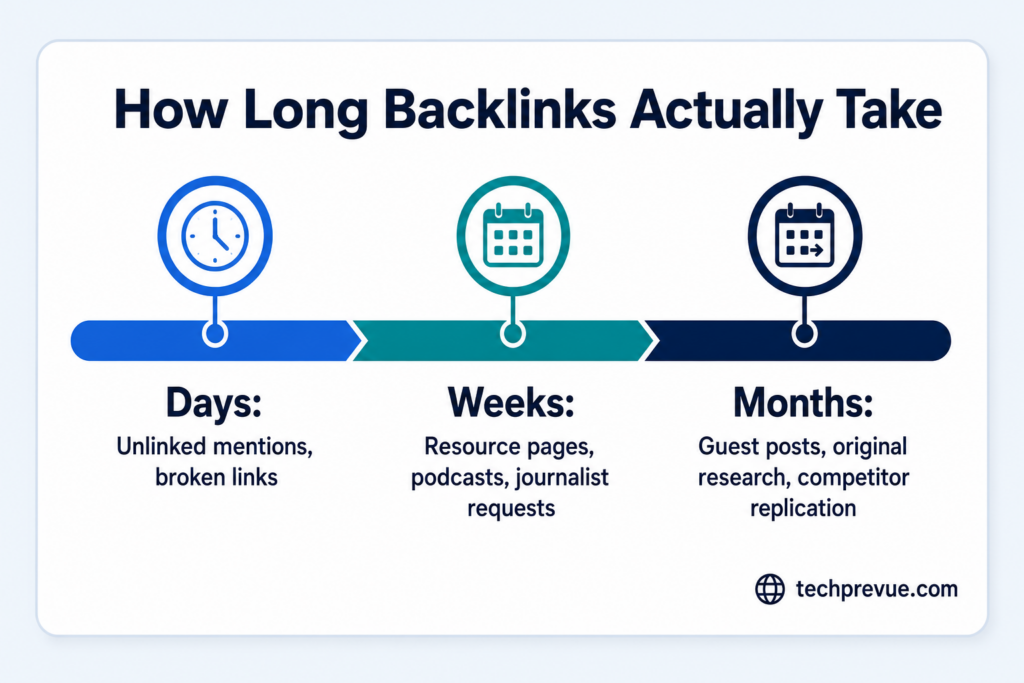
Days, not weeks: reclaiming unlinked mentions and fixing broken links. The content already exists; you’re asking for a small edit to something already live.
Weeks: resource page pitches, podcast guest spots, and journalist requests. These involve someone else’s editorial calendar, so expect some waiting even when the answer is yes.
Months: guest posts on selective sites, competitor-backlink replication at scale, and anything built around original research or a free tool. These require you to build something first, promote it, then wait for it to be discovered and cited, and that citation curve tends to compound rather than spike.
None of this moves in a straight line. A month with three replies and zero live links is normal, not a sign the tactic has failed.
Track What’s Actually Working
Outreach without tracking is just activity. At minimum, keep a simple log of who you pitched, when, which tactic, and whether it converted to a live link.
Over a few months, that log tells you which tactics are actually worth your time for your specific site and niche, rather than which ones sound good in a guide. Watch your real conversion rate tactic by tactic, whether new links are landing from a healthy variety of domains rather than the same few sites, and, increasingly, whether your brand’s AI visibility shifts after a batch of placements goes live. That last signal is harder to attribute cleanly, but a bump in branded AI mentions a few weeks after a run of resource-page or podcast placements is a reasonable sign they’re doing more than just sitting there as links.
Tracking outreach activity is only half the picture. The other half is whether the links you’re landing actually move anything: check referral traffic from your best placements directly in your analytics, and watch organic traffic and keyword rankings over weeks and months rather than days. Don’t try to credit any single backlink for a traffic bump; look at the overall trend across referral and organic channels instead, since that’s what’s actually attributable.
A few months of logged outreach is exactly the kind of dataset AI tools are good at finding patterns in: which subject lines get opened, which tactic converts best for your niche, whether Tuesday pitches do better than Friday ones. Ask it to summarize the patterns rather than trying to eyeball a spreadsheet for them.
Outreach Readiness Checklist
Before you hit send on any pitch, run through this:
- The recipient’s site is genuinely relevant to your niche, not just high-authority
- You’ve referenced something specific about their page or content, not a generic compliment
- The ask is small and clear: add a link, fix a broken link, consider this pitch
- You know exactly which URL you’re asking them to link to
- You’ve scheduled a follow-up for about a week out if you don’t hear back
Outreach Mistakes to Avoid
- Sending the same pitch to fifty sites. A template is a starting point, not a finished email. The line that references something specific about their content is what gets replies; the rest is scaffolding.
- Letting AI write the whole pitch unedited. It’s a fast way to produce fifty polished emails that all still read like the same generic pitch. Use it to draft faster, not to skip the one personal line that makes a reply likely.
- Giving up after five emails. A 20% reply rate feels bad on your fifth pitch and looks completely normal on your fiftieth.
- Pitching without checking relevance first. A high-authority site that has nothing to do with your niche is a wasted email, regardless of how impressive its metrics look.
- Skipping the follow-up. Most replies come from a second, polite nudge a week later, not the first email.
FAQs – How to Get Backlinks
How long does it take to get backlinks?
Anywhere from a few days to several months, depending on the tactic. Reclaiming unlinked mentions or fixing broken links can land a live link within days. Content-based approaches, like original research or a free tool, often take months to build momentum, but tend to keep paying off long after outreach stops.
How many outreach emails should I expect to send per link?
There’s no universal ratio, but a realistic range for cold tactics like guest posting or journalist requests is somewhere between 10 and 20 pitches per link, sometimes more when you’re new to a niche. Warmer tactics like unlinked-mention reclamation or broken-link fixes convert at a noticeably higher rate since you’re not introducing a cold ask.
Which tactic should I start with?
Reclaiming unlinked brand mentions and fixing broken links, in that order. Both convert well for beginners because you’re asking for a small edit rather than introducing yourself cold.
Should I buy backlinks to speed this up?
No. Paid links that pass ranking credit violate Google’s spam policies and risk a manual penalty that can take months to undo. See What Are Backlinks in SEO? for the full risk breakdown.
Are directories and link exchanges still worth doing?
Mostly no. Directories have declined to the point that even directory-friendly guides now call them a weak, last-resort tactic, and large-scale link exchanges are explicitly named in Google’s spam policies. An occasional genuine exchange with a relevant site isn’t harmful, but neither is worth building a strategy around in 2026.
Key Takeaways
- Techniques that produce real context (a mention, a citation, a reason someone referenced you) are worth more than ever in the AI era. Techniques that only produce a raw link (directories, exchanges, cheap paid links) are declining or dead.
- Outreach is a numbers game. Warm tactics (unlinked mentions, broken links) convert fastest; cold tactics (guest posts, journalist requests) take more attempts and more patience.
- Start with the highest-converting tactics before moving to slower, content-based plays.
- Every pitch needs one specific, personalized line. Templates are scaffolding, not finished emails.
- Track both activity and results: what you send and what converts, but also whether referral and organic traffic are actually trending up.
- Don’t judge a tactic as failed until you’ve tried it at real volume, not five emails.
