
Most articles about the pros and cons of online learning were written before generative AI reached students, and it shows. They list flexibility, cost, and isolation, then stop. They rarely cite a study, and the statistics they do repeat mostly trace back to sources nobody can find.
This guide takes a different approach. Every claim here is sourced to a named study, government dataset, or regulator, and it covers what changed once AI tools became standard equipment for online students.
It applies to learners in both the United States and India, because the two markets face very different rules and very different constraints.
Quick Answer: Online learning offers real advantages in flexibility, cost, and access, and real disadvantages in self-discipline, isolation, and hands-on subjects. Research published in 2025 and 2026 shows the format works well for motivated, well-supported learners and poorly for those who need external structure. The single biggest risk is enrolling in a program that employers or regulators will not recognize.
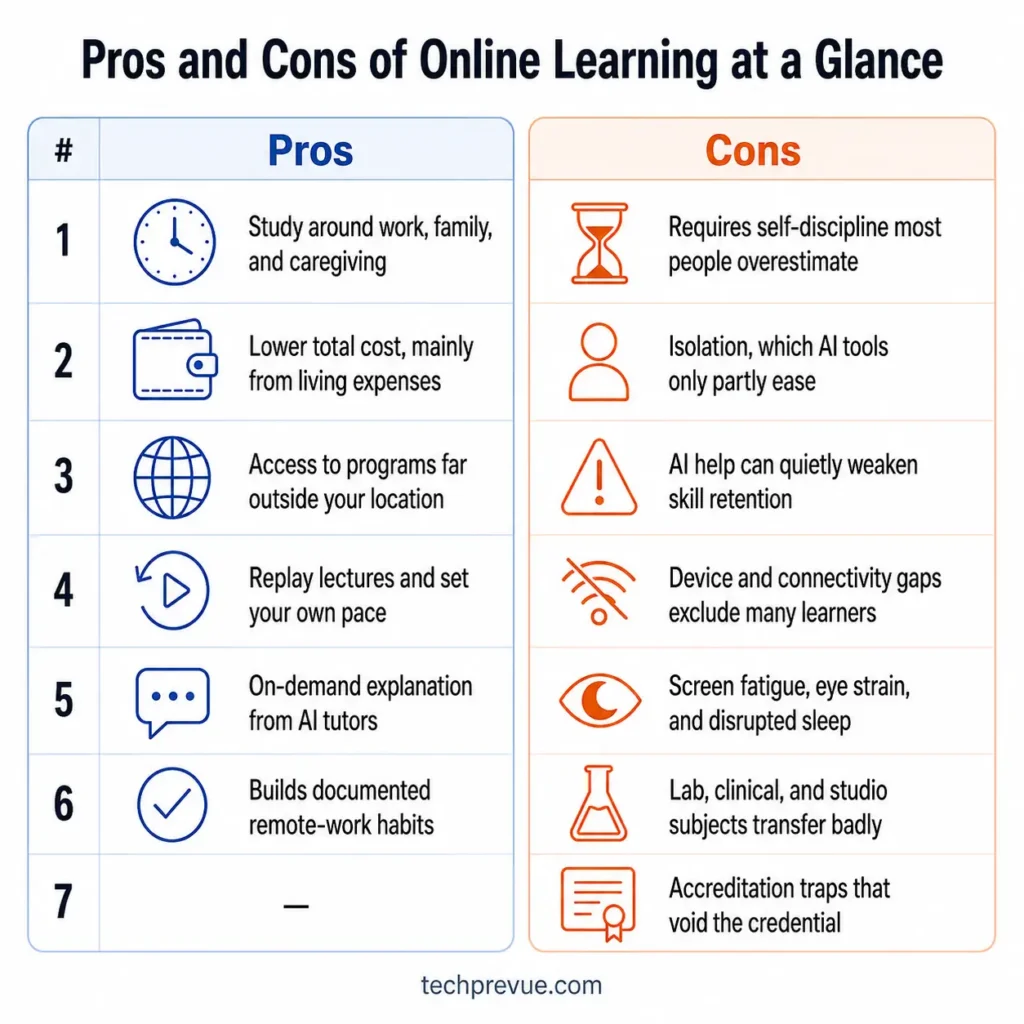
Pros and Cons of Online Learning at a Glance
| # | Pros of Online Learning | Cons of Online Learning |
|---|---|---|
| 1 | Study around work, family, and caregiving | Requires self-discipline most people overestimate |
| 2 | Lower total cost, mainly from living expenses | Isolation, which AI tools only partly ease |
| 3 | Access to programs far outside your location | AI help can quietly weaken skill retention |
| 4 | Replay lectures and set your own pace | Device and connectivity gaps exclude many learners |
| 5 | On-demand explanation from AI tutors | Screen fatigue, eye strain, and disrupted sleep |
| 6 | Builds documented remote-work habits | Lab, clinical, and studio subjects transfer badly |
| 7 | — | Accreditation traps that void the credential |
- Pros and Cons of Online Learning at a Glance
- What Counts as Online Learning in 2026?
- 6 Pros of Online Learning
- 7 Cons of Online Learning
- Online Classes vs In-Person Classes: A Direct Comparison
- How the Decision Changes for School-Age Children
- What Changed Between 2020 and 2026
- Does Online Learning Actually Work? What the Research Says
- Do Employers Respect Online Degrees?
- Which Subjects Work Online, and Which Do Not
- Online Learning in India: The Rules That Decide Whether Your Degree Counts
- Is Online Learning Right for You?
- Mistakes That Make Online Learning Fail
- Frequently Asked Questions
- Key Takeaways
What Counts as Online Learning in 2026?
Online learning is any structured education delivered primarily over the internet, from a single university course to a complete degree to corporate upskilling. The term covers far more ground than most readers assume, which is why generic advice about it so often misses.
Three related terms get used interchangeably, and the difference matters when you are making a decision.
Online learning is the umbrella. It includes degrees, individual courses, professional certifications, and self-paced platforms.
Online classes are individual courses taken remotely, often by students who also attend campus. The decision here is about one course, not one institution.
Online school means a complete institution, whether a virtual K-12 school or a fully online university. This decision involves accreditation, tuition, student services, and graduation outcomes.
Synchronous, Asynchronous, and Hybrid
These three delivery modes determine your daily experience more than the subject does.
Synchronous learning happens live on a fixed schedule. You join at a set time, and you can ask questions in the moment.
Asynchronous learning is recorded and self-paced. You get maximum flexibility and minimum accountability, which is the trade-off at the heart of this entire topic.
Hybrid or blended programs combine online coursework with required in-person sessions. For lab sciences, nursing, and engineering, this is often the only honest option.
6 Pros of Online Learning
The advantages below are real, but each carries a condition. Reading the condition is more useful than reading the advantage.
1. Flexibility That Fits Around Work and Family
Online study lets you fit coursework around a job, children, or caregiving, which is why adult learners dominate online enrollment. This is the single most cited advantage, and the evidence supports it.
The catch is that flexibility is not the same as less work. The reading, assignments, and assessments usually match the campus version exactly.
What changes is when you do them, not how much there is. Learners who expect a lighter load are the ones who fall behind first.
2. Lower Total Cost, Though Not Always Lower Tuition
Online programs usually cost less overall, but the savings come from living expenses rather than tuition. This distinction gets flattened in most advice, and it leads people to expect discounts that do not exist.
In the United States, many institutions charge the same per-credit rate regardless of delivery mode. Your savings come from skipping housing, meal plans, commuting, and campus fees.
In India, the gap is wider. Online degree programs from recognized universities frequently cost a fraction of their campus equivalents, before you account for relocation to a metro city.
3. Access to Programs Far Outside Your Location
Online delivery removes geography as a constraint, which matters most for learners who cannot relocate. A student in Lucknow can enroll in a Delhi or Bengaluru university program without moving; a working parent in Ohio can take a specialized course their local college does not offer.
This benefit is largest for people with the fewest options. It is smallest for students who already live near a strong institution.
4. Replay, Pause, and Set Your Own Pace
Recorded material lets you review difficult concepts as many times as you need, which no live lecture allows. Students who process slowly, learners studying in a second language, and anyone returning to education after years away all benefit from this.
Learning science supports the underlying mechanism. Spaced review and repeated retrieval produce more durable knowledge than a single exposure.
5. On-Demand Explanation From AI Tutors
AI tutors have removed one of online learning’s oldest limitations, which was having nobody to ask at 2 a.m. The research on this is genuinely strong, and it is the most significant change to the format in a decade.
In a randomized controlled trial at Harvard published in Scientific Reports, 194 introductory physics students learned significantly more in less time using a custom AI tutor than through in-class active learning. The comparison condition was not weak teaching. Active learning is a method physics education research has spent decades validating.
A separate randomized trial in Edo State, Nigeria, evaluated by the World Bank, used Microsoft Copilot as an English tutor for secondary students over six weeks. Learning gains equated to roughly 1.5 to 2 years of ordinary schooling, with the largest effects among female students.
That second study matters for readers in low-connectivity regions. It shows the gains are not limited to elite institutions.
Read the condition carefully, though. Both studies used structured, supervised deployments. Unsupervised AI use produces a very different result, covered in the cons section below.
6. Builds Documented Remote-Work Habits
Completing an online program demonstrates self-direction, written communication, and digital tool fluency. Employers hiring for hybrid and remote roles increasingly read these as signals in their own right.
This is a modest advantage, not a decisive one. It helps most when you can point to specific evidence, such as a portfolio or a completed capstone.
Section summary: The advantages of online learning are real but conditional. Flexibility helps disciplined learners, cost savings come mostly from living expenses, and AI tutoring works well when it is structured rather than open-ended.
7 Cons of Online Learning
The disadvantages are where most guides go soft, usually because the publisher sells online programs. These are the ones the evidence actually supports.
1. The Self-Discipline Tax
Online learning shifts the burden of structure from the institution to you, and most people overestimate how well they handle that. Nobody notices when you skip a recorded lecture. Nobody follows up when you fall two weeks behind.
Completion data reflects this. Peer-reviewed reviews of persistence in online higher education consistently find lower completion than in comparable in-person programs, and open-enrollment online courses report completion rates in the single digits to low teens.
Those figures deserve a caveat. Many learners enroll in free courses with no intention of finishing, which drags the numbers down.
Even accounting for that, the direction is clear. If you have abandoned an online course before, treat that as data about yourself.
2. Isolation, and Why AI Is Not the Fix
Reduced peer contact remains the most commonly reported drawback of online study, and the newest data complicates the assumption that AI companionship helps. This is the part no competing article covers.
The Higher Education Policy Institute’s 2026 student survey of 1,054 UK undergraduates found that 15% now use AI tools for friendship or advice, and 8% use counselling or therapy services delivered entirely by AI.
The outcomes split almost evenly. Around 21% of students said AI made them feel less lonely, while 20% said it made them feel lonelier, and 59% reported no change.
That is not a solution. That is a coin flip with a large group in the middle.
Practical implication: treat social contact as something you schedule deliberately, not something the platform will supply. Study groups, cohort programs, and in-person meetups do more than any chatbot.
3. The Crutch Effect: When AI Help Backfires
Unrestricted AI access improves your work while you have it and can leave you worse off once it is removed. This is the most important finding in this entire guide, and it hits online learners hardest because they study unsupervised.
Researchers from Wharton and the University of Pennsylvania ran a field experiment with nearly a thousand high school mathematics students, published in PNAS. Students got one of two tools: a standard ChatGPT-style interface, or a version prompted with learning safeguards.
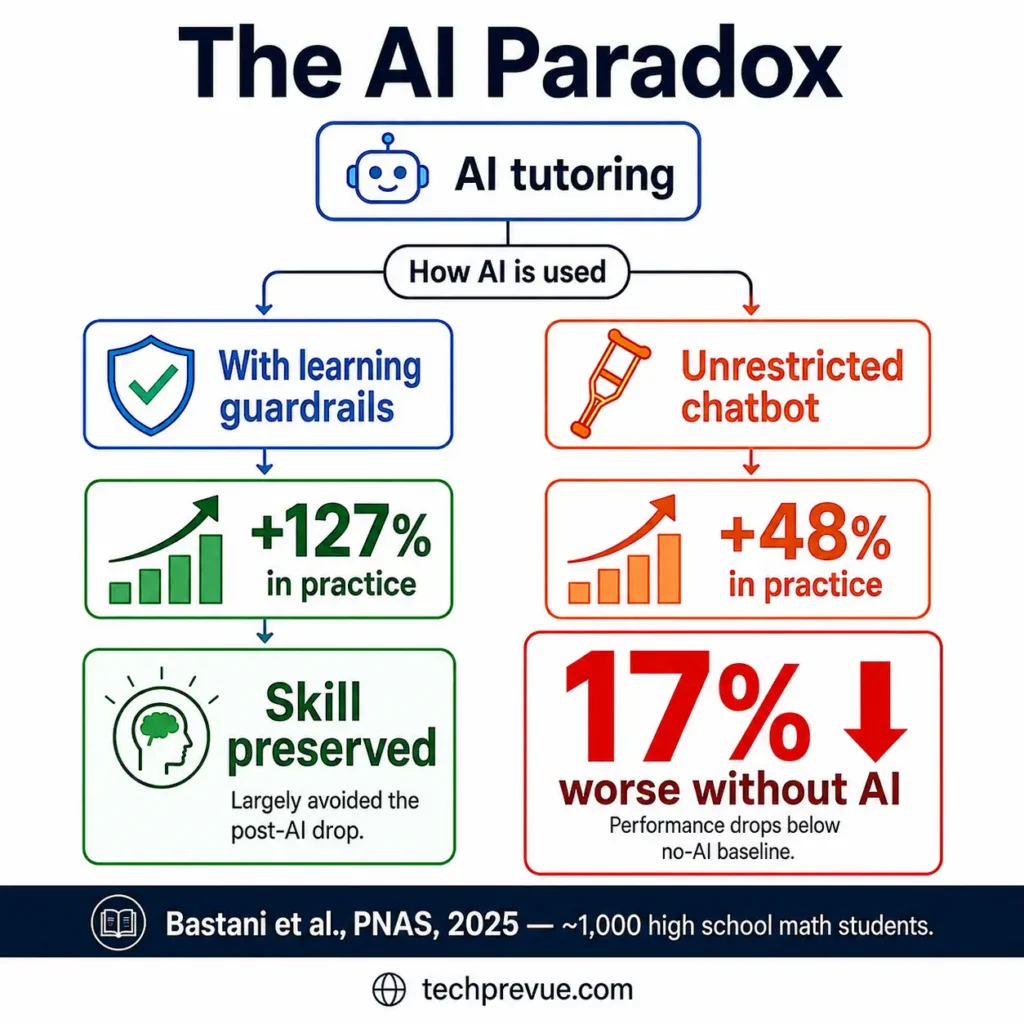
During practice, both helped enormously. Grades rose 48% with the standard interface and 127% with the safeguarded tutor.
Then the researchers took the AI away and tested them. Students who had used the standard interface scored 17% worse than students who never had AI access at all.
The safeguarded version largely prevented this. The mechanism the authors describe is straightforward: students copied answers instead of working problems, and they either could not detect the model’s errors or did not bother checking.
Practice performance felt like learning. It was not.
What to do about it: ask the AI to explain the method and check your reasoning, never to produce the finished answer. Attempt every problem before you open the chat window. If you cannot reproduce the work without the tool, you have not learned it.
4. Connectivity, Devices, and Who Gets Left Out
Reliable internet and a capable device are prerequisites, and large populations in both countries still lack them. This is treated as a footnote in most guides. For millions of learners it is the deciding factor.
India’s National Sample Survey data illustrates the scale. Household internet access has risen sharply, reaching roughly 76% in the Comprehensive Annual Modular Survey, up from about 27% a decade earlier.
But the Comprehensive Modular Survey on Telecom, conducted in early 2025, found only 7.2% of households have fibre-optic connections, falling to 3.2% in rural areas. Mobile data is not the same as a stable connection for a three-hour proctored exam.
The device gap is sharper still, and it is gendered. Among young people, device ownership reached about 82% in urban areas against 69.3% in rural areas, and 83.3% among males against 63% among females.
That last figure deserves attention. Online learning is routinely promoted as an equalizer for women, yet in India a substantial share do not control a device to learn on.
In the United States, the constraint is less about coverage and more about consistency. Rural broadband quality and shared household devices still block participation for a meaningful minority, a gap we examine further in our piece on how central connectivity has become to daily life.
5. Screen Time, Fatigue, and Physical Health
Extended screen exposure carries physical costs that campus study spreads out across a day of movement. Indian education writers cover this far more thoroughly than US ones, and they are right to.
A full online course load can mean six or more continuous hours at a screen, followed by homework at the same screen. Reported effects include eye strain, headaches, disrupted sleep from evening blue-light exposure, and postural problems from improvised study setups.
The sleep effect deserves particular attention. Asynchronous study encourages late-night sessions, and shifting your schedule later degrades the memory consolidation that learning depends on.
Practical countermeasures are unglamorous but effective. Take a genuine break every 45 to 60 minutes, position your screen at eye level, study in daylight hours where possible, and keep coursework off the device you use in bed.
For school-age learners, this is a supervision question rather than a self-management one. Parents should treat total daily screen time, not just class time, as the number that matters, and our guide to the negative effects of smartphones covers the wider pattern.
6. Subjects That Do Not Survive the Transfer
Practical, clinical, and studio disciplines lose something essential when moved online, and no amount of simulation fully replaces it. This is the most durable disadvantage on the list.
Wet labs, clinical placements, workshop training, and performance disciplines all require supervised physical practice. Hybrid programs address this by requiring in-person components, which removes much of the flexibility you enrolled for.
Assessment integrity compounds the problem. Remote proctoring remains contested, and institutions have responded by shifting weight toward projects and oral defenses.
7. Accreditation Risk and Outright Scams
An unrecognized online credential is worth nothing, and this is the failure mode that costs learners real money. It is also the risk that enrollment-driven articles are least likely to mention.
⚠️ Warning: In India, an online degree is only valid if the university and your specific program appear on the UGC Distance Education Bureau approved list for your enrollment year. Approval is granted annually and is program-specific. A university approved for MBA may not be approved for MCA.
Warning signs worth walking away from:
- The institution is not listed on the official regulator’s portal
- Admission is handled only through third-party agents
- The program is offered through a franchise arrangement, which UGC prohibits for online programmes
- Promises of a degree in an unusually short time
- Fees far below every comparable program
In the United States, the equivalent check is institutional accreditation recognized by the Department of Education or CHEA, plus programmatic accreditation where the field requires it. Nursing, engineering, counselling, and accounting all have additional bodies whose approval determines licensure eligibility.
Section summary: The disadvantages of online learning cluster around structure, isolation, access, and recognition. AI has made the structure problem worse, not better, for learners who use it without discipline.
Online Classes vs In-Person Classes: A Direct Comparison
For readers weighing a single course rather than a whole program, the pros and cons of online learning compress into a narrower question: which format suits this particular subject, this semester?
Here is how the two compare across the dimensions that actually affect outcomes. For a course-level view of the format on its own, see our breakdown of the pros and cons of online classes.
| Dimension | Online classes | In-person classes |
|---|---|---|
| Schedule control | High, especially asynchronous | Low, fixed timetable |
| Workload | Comparable | Comparable |
| Instructor access | Email and forums, often slower | Immediate, before and after class |
| Peer interaction | Limited, requires effort | Built into the format |
| Cost | Lower total, similar tuition in the US | Higher total |
| Self-discipline required | High | Moderate |
| Suitability for lab work | Poor | Strong |
| Assessment integrity | Contested, proctoring dependent | Established |
| Replay and review | Full recordings available | Notes only |
How to read this table: if more than three rows in the online column look like problems for your situation, take the in-person section. The format does not reward optimism.
How the Decision Changes for School-Age Children
Everything above assumes an adult learner who can supply their own structure. For children that assumption breaks, and it shifts the calculation more than any other factor in this guide.
Self-regulation is not developed yet. The self-discipline tax in con #1 gets paid by a parent, not the student. Virtual school is a family commitment rather than an individual one.
Social development has no online substitute. Adults compensate through professional networks. Children lose the peer negotiation, unstructured play, and conflict practice that classroom time supplies by default.
Screen exposure is harder to bound. An adult can enforce break discipline. A child who studies and socializes on one device rarely does.
The format still works well in specific situations, including chronic illness, competitive training schedules, remote locations, or an unsafe school. The deciding variable is whether an adult is available daily, not whether the curriculum is good.
Graduation data, provider models, costs, and grade-level guidance sit in our dedicated guide to the pros and cons of online school.
What Changed Between 2020 and 2026
Most guidance on the pros and cons of online learning still reflects pandemic-era conditions, and four things have changed materially since then. Recognizing them prevents you from making a 2021 decision in 2026.
AI became standard equipment. In the HEPI 2026 survey, 95% of undergraduates reported using AI in at least one way, up from 66% in 2024. Any assessment of online study that ignores this is describing a format that no longer exists.
Regulation tightened. India moved from emergency permissiveness to annual, program-specific approval with mandatory digital IDs at admission. Verification is now a concrete step rather than general advice.
Employer attitudes settled. The pandemic normalized online delivery at institutions that had resisted it, and experimental evidence now shows parity in established fields rather than merely improving sentiment.
The market segmented. Exclusively-online enrollment grew at four-year US institutions while contracting at two-year ones, which suggests the format consolidates where student support is strongest.
Does Online Learning Actually Work? What the Research Says
Online learning produces outcomes comparable to in-person instruction for motivated, well-supported students, and worse outcomes for students who need external structure. The format is not inherently better or worse. It amplifies whatever study habits you bring to it.
Statistics You Will See Everywhere That Nobody Can Source
Several of the most repeated numbers in this niche cannot be traced to a real study, and they appear on university and vendor sites alike. Before you trust any article on this topic, check whether it repeats these.
| Claim | Attributed to | Problem |
|---|---|---|
| “Online students retain 25-60% more material” | “Research Institute of America” | No such organization is locatable |
| “E-learning takes 40-60% less time” | Brandon Hall Group | Original report is not publicly available |
| “IBM learners learned five times more material” | IBM | Recycled from the early 2000s, source untraceable |
| “Online dropout is 10-20% vs 30-50% in person” | Unattributed | Contradicted by the peer-reviewed literature |
| “54% of employers value online degrees equally, GMAC 2025” | GMAC | The 54% figure is from GMAC’s 2023 survey, misdated across dozens of sites |
That last row is worth pausing on. We traced it while researching this article: the figure circulating as a 2025 statistic predates that survey by two years.
What the Credible Evidence Shows
US federal data establishes the scale. The National Center for Education Statistics reported roughly 5.8 million undergraduates enrolled exclusively in distance education, and Fall 2023 enrollment figures showed exclusively-online undergraduate enrollment rising 5.9% at four-year institutions while falling 6.1% at two-year institutions.
That divergence is informative. Online study is consolidating at four-year institutions and shrinking at community colleges, which suggests it works better where student support is stronger.
On effectiveness, the honest summary is that delivery mode explains far less variance than course design, instructor presence, and student preparation. Well-designed online courses match well-designed in-person courses. Poorly designed ones fail faster online, because there is no classroom to carry them.
The AI Tutoring Paradox
The two strongest AI studies of 2025 point in opposite directions, and both are correct. Understanding why resolves most of the confusion.
The Harvard trial used a purpose-built tutor with pedagogical safeguards, deployed as a structured lesson. Students learned more.
The Wharton-led trial included an unrestricted chatbot used during independent practice. Those students ended up worse off.
The variable is not AI. It is whether the tool is designed and used to make you think, or to save you from thinking.
Independent synthesis supports this reading. A 2026 Brookings review of randomized trials concluded that the effective model is human-AI collaboration, with teachers guiding use rather than being replaced by it.
Do Employers Respect Online Degrees?
Employers largely accept accredited online degrees, though acceptance varies by country, sector, and how the question is asked. Self-reported surveys paint a rosier picture than experiments do.
What US Employers Actually Do
The strongest available evidence uses revealed preference rather than opinion polling. Ithaka S+R published a study in May 2026 in which 543 recruiters and hiring managers evaluated pairs of hypothetical candidates through a discrete choice experiment, without knowing that their treatment of online credentials was being measured.
The finding: candidates with online degrees in business, health care, and education were about as likely to be selected for interview as candidates with traditional degrees. Those are precisely the fields where online programs are best established.
This methodology matters. Asking recruiters whether they discriminate produces flattering answers; watching what they choose produces reliable ones.
The 2025 GMAC Corporate Recruiters Survey adds a regional wrinkle. Recruiters across most regions reported valuing in-person and online degrees equally, with the United States as the exception, where positive perceptions of online delivery attached mainly to technical skills rather than to leadership. Within the tech sector, 57% valued online and in-person graduates equally.
What Indian Employers and Government Recruiters Require
In India the question is regulatory before it is cultural. A UGC-recognized online degree is treated as equivalent to a campus degree for employment, higher study, and competitive examinations.
An unrecognized one is not equivalent to anything. Large employers verify credentials against the regulator’s records, and government recruitment does so systematically.
This is why the verification step in the next section is not optional paperwork. It is the entire question.
Which Subjects Work Online, and Which Do Not
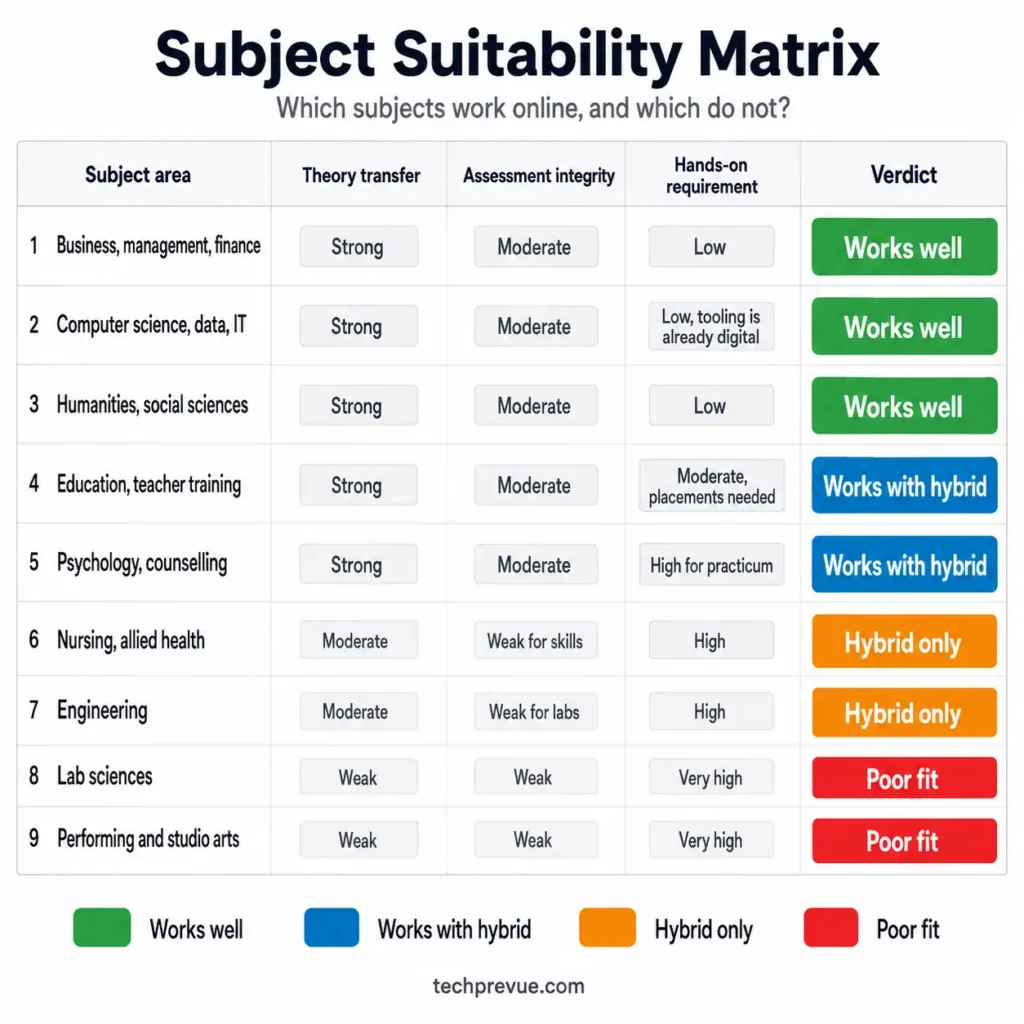
Subject suitability predicts online success better than any personal trait. Use this matrix before you commit.
| Subject area | Theory transfer | Assessment integrity | Hands-on need | Verdict |
|---|---|---|---|---|
| Business, management, finance | Strong | Moderate | Low | Works well |
| Computer science, data, IT | Strong | Moderate | Low, tooling is already digital | Works well |
| Humanities, social sciences | Strong | Moderate | Low | Works well |
| Education, teacher training | Strong | Moderate | Moderate, placements needed | Works with hybrid |
| Psychology, counselling | Strong | Moderate | High for practicum | Works with hybrid |
| Nursing, allied health | Moderate | Weak for skills | High | Hybrid only |
| Engineering | Moderate | Weak for labs | High | Hybrid only |
| Lab sciences | Weak | Weak | Very high | Poor fit |
| Performing and studio arts | Weak | Weak | Very high | Poor fit |
If your field sits in the bottom four rows, a fully online program is the wrong instrument. Look for a hybrid pathway or a program with structured in-person residencies.
Online Learning in India: The Rules That Decide Whether Your Degree Counts
In India, the pros and cons of online learning are secondary to one gating question: is the program recognized? Everything else follows from the answer.
For the 2025-26 academic session, the University Grants Commission published separate lists covering different modes. Roughly 113 universities were entitled to offer online programmes, with a further 13 institutions recognized for Online Learning programmes, while 101 universities and 20 Category-1 institutions were approved for Open and Distance Learning.
Those numbers are frequently confused in online guides. They describe different modes, not competing counts of the same thing.
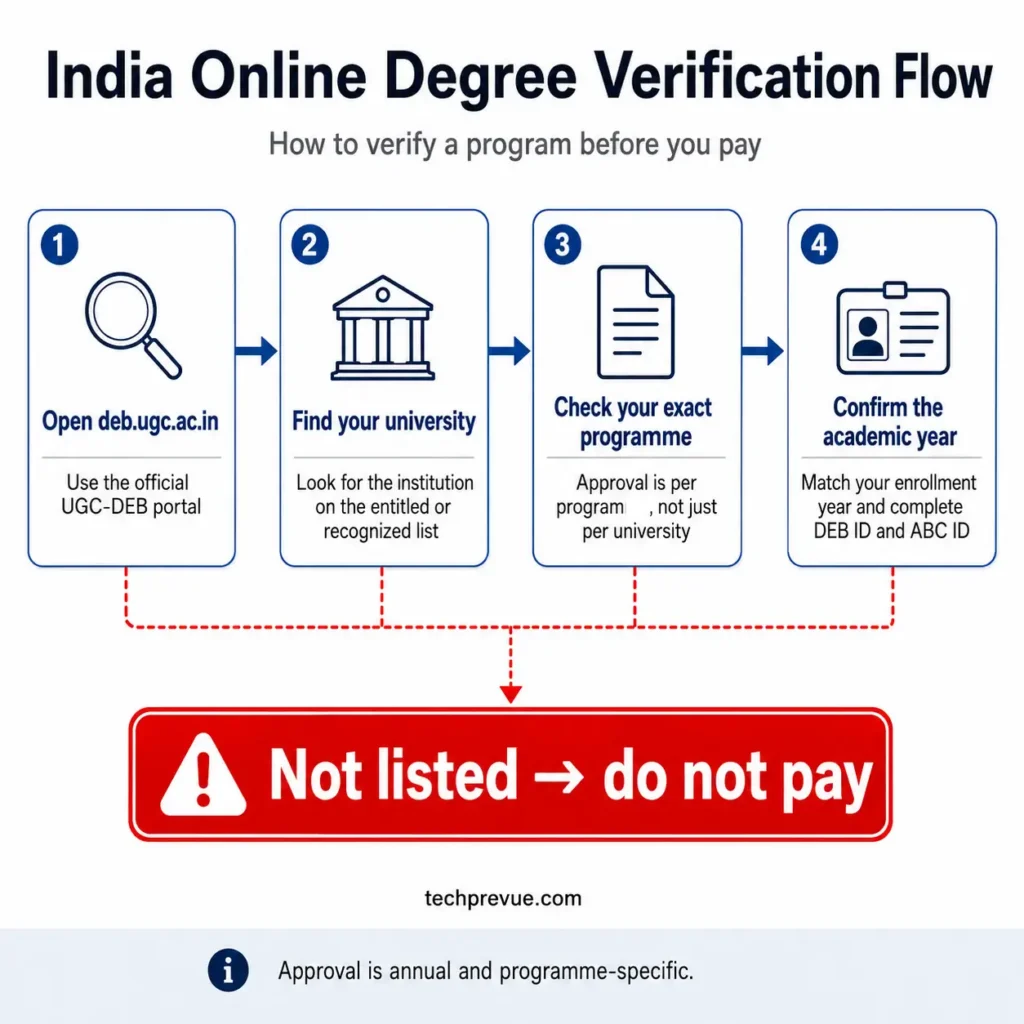
How to Verify a Program Before You Pay
Follow these four steps in order. Skipping any one of them is how learners lose a year and a fee.
- Open the official portal at deb.ugc.ac.in. Third-party lists go stale and some are marketing.
- Find your university on the entitled or recognized institutions list.
- Check your exact program. Approval is granted per program, not per institution.
- Confirm the academic year matches your admission year, then complete your DEB ID and ABC ID registration during admission.
Also check the portal’s public notices for any institution that has been restricted or de-recognized recently.
One further safeguard is worth knowing. UGC regulations require entitled institutions to own their online programmes outright and prohibit offering them through franchise arrangements, so any provider operating a university’s programme under licence is a signal to stop and verify directly with the institution.
The Device and Connectivity Gap
Before enrolling, audit your own setup honestly. Proctored examinations require a stable connection and a functioning camera for extended periods, and mobile-only access fails this test more often than learners expect.
If you share a household device, establish access at fixed hours before the term begins rather than after.
Is Online Learning Right for You?
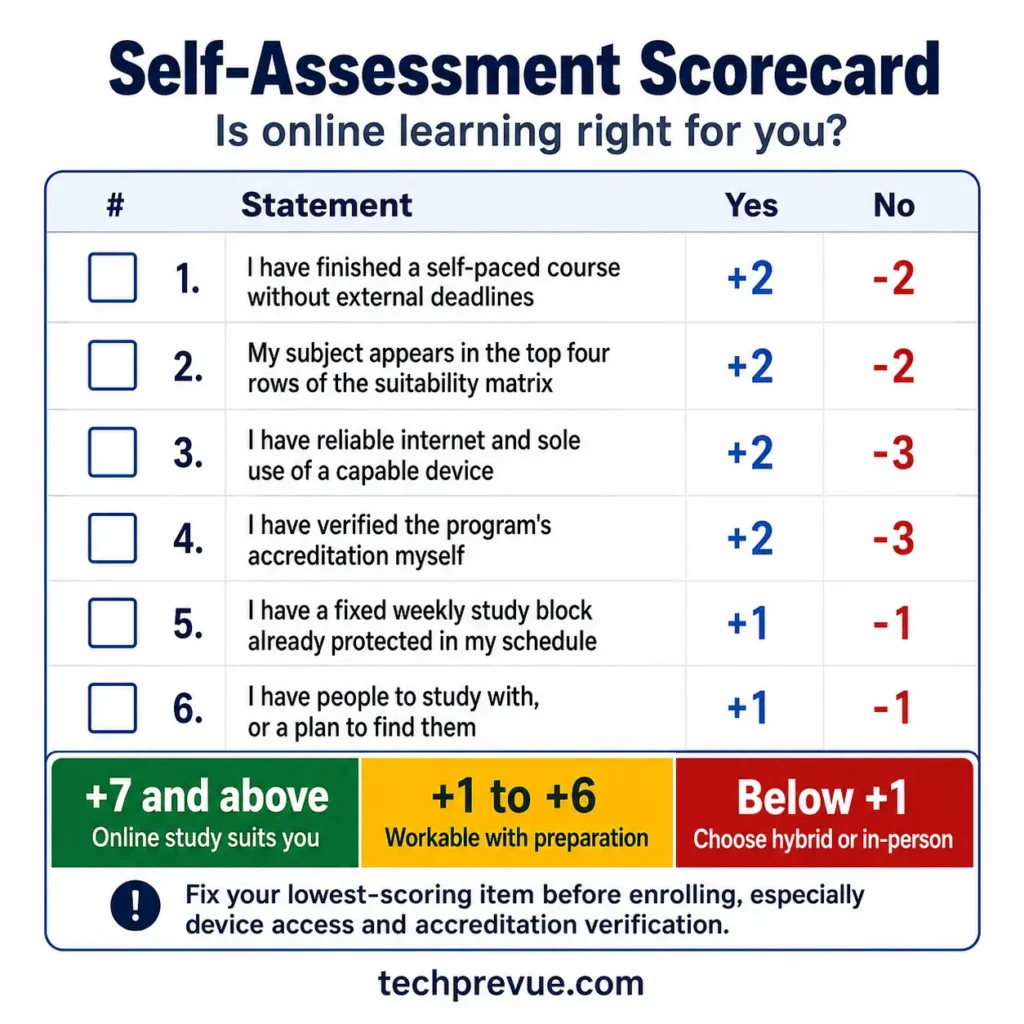
Score yourself against these six statements. This converts the pros and cons of online learning into an answer for your situation rather than a general list.
| # | Statement | Yes | No |
|---|---|---|---|
| 1 | I have finished a self-paced course without external deadlines | +2 | -2 |
| 2 | My subject appears in the top four rows of the suitability matrix | +2 | -2 |
| 3 | I have reliable internet and sole use of a capable device | +2 | -3 |
| 4 | I have verified the program’s accreditation myself | +2 | -3 |
| 5 | I have a fixed weekly study block already protected in my schedule | +1 | -1 |
| 6 | I have people to study with, or a plan to find them | +1 | -1 |
How to read your score.
+7 or above: Online study suits you. Proceed, and set up your accountability structure in week one.
+1 to +6: Workable with preparation. Fix your lowest-scoring item before enrolling, particularly items 3 and 4.
Below +1: Choose hybrid or in-person, or fix the structural problems first. Enrolling now means paying for a course you will probably not finish.
Mistakes That Make Online Learning Fail
These account for most of the failures we see discussed in learner communities.
1. Treating flexibility as spare time. Coursework expands to fill nothing. Block fixed hours in a calendar and defend them.
2. Enrolling before verifying accreditation. Do this in ten minutes, before payment, not after graduation.
3. Using AI to produce work instead of to check it. The PNAS evidence above shows exactly what this costs you.
4. Waiting to ask for help. Online instructors cannot see confusion on your face. You have to write the email.
5. Studying alone by default. Isolation is the format’s known weakness. Join or build a cohort in the first two weeks.
6. Choosing asynchronous when you need structure. Synchronous classes cost you flexibility and buy you accountability. For many learners that trade is worth making.
7. Underestimating the cost of not finishing. An abandoned course costs the full fee, the time already spent, and the confidence you would have carried into the next attempt. When weighing the pros and cons of online learning, price the failure case, not just the tuition.
Frequently Asked Questions
What are the main disadvantages of online learning?
The main disadvantages are the self-discipline required, social isolation, unreliable device or internet access, poor fit for hands-on subjects, and the risk of enrolling in an unrecognized program. Research also shows that unrestricted AI use during independent study can reduce skill retention.
Is online learning as effective as classroom learning?
For well-designed courses and motivated students, outcomes are broadly comparable. Delivery mode explains less variance than course design, instructor presence, and student preparation. Learners who depend on external structure generally do worse online.
Do employers accept online degrees?
Most do, particularly for accredited programs in business, health care, education, and technology. A 2026 Ithaka S+R experiment found online degree holders in those fields were about as likely to be interviewed as traditional graduates. Acceptance is weakest where licensure requires programmatic accreditation.
Is an online degree valid in India?
Yes, if the university and your specific program appear on the UGC Distance Education Bureau approved list for your enrollment year. A recognized online degree carries the same standing as a campus degree for jobs, higher study, and competitive examinations. An unrecognized one has no standing at all.
Why do students fail online courses?
Most failures come from lost structure rather than difficulty. Without fixed class times, work slips, then compounds. Isolation removes the peer pressure that keeps campus students on schedule.
Does using AI help or hurt online students?
Both, depending on how you use it. Structured AI tutoring improved learning in a Harvard randomized trial, while unrestricted chatbot access left students 17% worse off once the tool was removed. Use AI to explain methods and check reasoning, never to generate finished answers.
Is online learning cheaper than campus study?
Usually, though in the United States the savings come mainly from living costs rather than tuition, which is often charged at the same per-credit rate. In India the tuition gap between online and campus programs is typically much wider.
Is online school good for children?
It depends almost entirely on supervision. Virtual school works well for children with health conditions, demanding training schedules, or unsafe school environments, provided an adult supplies daily structure. Without that, the pros and cons of online learning tilt sharply negative for this age group, because social development and self-regulation both suffer.
Which subjects should not be studied fully online?
Lab sciences, engineering, nursing and allied health, and performing or studio arts all require supervised physical practice. Hybrid programs with in-person components are the appropriate option for these fields.
Key Takeaways
- The pros and cons of online learning depend far more on your situation than on the format itself.
- Flexibility is real, but the workload matches the campus version.
- In the US, expect savings on living costs, not tuition; in India, expect both.
- AI tutoring helps when structured and harms when unrestricted, with a measured 17% penalty in one large trial.
- Isolation remains the format’s core weakness, and AI companionship is as likely to worsen it as improve it.
- Verify accreditation before you pay. In India that means checking the university, the program, and the year on the regulator’s portal.
- If your subject requires supervised physical practice, choose hybrid.
Online learning rewards preparation and punishes optimism. Score yourself honestly against the framework above, fix the weakest item, and then enroll.