
Registration opens, and the same course appears twice: one section on campus, one online. Most advice about the pros and cons of online classes will tell you the online one is flexible and cheaper, then stop.
That advice skips the part that matters. Large studies of actual course records show students withdraw and fail online sections at higher rates than in-person ones, and the gap varies by subject and by student.
This guide covers what the research shows at the course level, so you can pick the right section rather than the convenient one.
Quick Answer: Online classes offer schedule control, no commute, replayable lectures, and lower total cost. They also carry higher withdrawal and failure rates, slower instructor access, and proctoring requirements. The format suits self-directed students taking theory-heavy courses, and works poorly for students who need structure or subjects that require supervised practice.
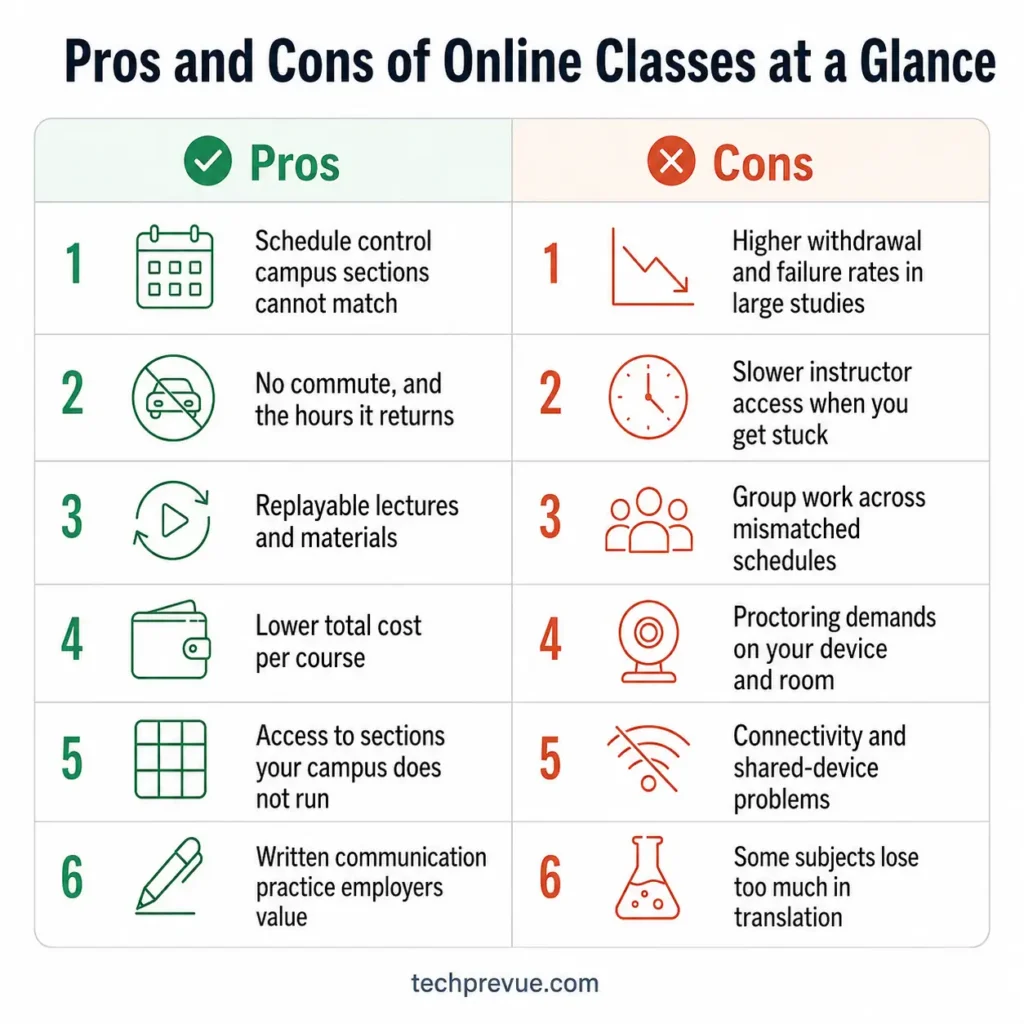
Pros and Cons of Online Classes at a Glance
| # | Pros | Cons |
|---|---|---|
| 1 | Schedule control campus sections cannot match | Higher withdrawal and failure rates in large studies |
| 2 | No commute, and the hours it returns | Slower instructor access when you get stuck |
| 3 | Replayable lectures and materials | Group work across mismatched schedules |
| 4 | Lower total cost per course | Proctoring demands on your device and room |
| 5 | Access to sections your campus does not run | Connectivity and shared-device problems |
| 6 | Written communication practice employers value | Some subjects lose too much in translation |
What Counts as an Online Class?
An online class is a single course delivered over the internet, taken either alongside campus courses or as part of a fully remote program. The decision is course-level, which makes it different from choosing an online degree or a virtual school.
That distinction matters because the same student can succeed in one online section and struggle in another. Format fit is per-course, not permanent.
Synchronous, Asynchronous, and Hybrid Sections
Synchronous sections meet live at fixed times. You lose schedule freedom and gain accountability plus real-time questions.
Asynchronous sections are recorded and self-paced. Maximum flexibility, minimum external structure, and the format where most students who fall behind do so.
Hybrid sections combine online coursework with required campus sessions, usually labs, studios, or exams. Check the in-person dates before you register, because they are not optional.
6 Pros of Online Classes
1. Schedule Control Campus Sections Cannot Match
Asynchronous sections let you attend at whatever hour suits your job, commute, or caregiving. For working students this is often the difference between taking a course and postponing it a year.
The trade-off is that nobody notices when you skip. Flexibility is a tool, not a cushion.
2. No Commute, and the Hours It Returns
A campus course with a 40-minute round trip costs roughly 20 extra hours across a semester. Online sections return that time and remove parking, fuel, and transit costs.
This advantage scales with distance. It is substantial for commuter students and negligible for those living on campus.
3. Replayable Lectures and Materials
Recorded lectures let you rewatch the part you missed, at the speed you need. Students studying in a second language and those returning to study after a gap benefit most.
Evidence supports the mechanism, with a caveat. Research on introductory courses found students who accessed materials daily outperformed those who accessed them weekly, and the effect was stronger for online sections than campus ones.
Replay only helps if you actually use it. Availability is not review.
4. Lower Total Cost Per Course
Online sections cut commuting, parking, and campus fees. Some institutions also price online general education courses below their campus equivalents, though many charge identical per-credit rates.
Check your institution’s fee schedule rather than assuming. Online sections sometimes carry their own technology or proctoring fee that offsets the savings.
5. Access to Sections Your Campus Does Not Run
Online delivery lets you take a course your own campus offers only in alternate semesters, or not at all. For students on a tight graduation timeline, this is often the single strongest reason to choose the online section.
6. Written Communication Practice Employers Value
Discussion boards, email, and asynchronous group coordination force you to write clearly for an audience that cannot ask follow-up questions in the moment. That is the default mode of most hybrid and remote workplaces.
It is a modest benefit, not a decisive one. But it is real, and campus sections rarely build it deliberately.
6 Cons of Online Classes
1. Higher Withdrawal and Failure Rates
This is the finding almost no article on this topic mentions, and it is the most important one. Studies of actual course records, not surveys, consistently find students perform worse in online sections.
Researchers at Columbia University’s Community College Research Center analysed hundreds of thousands of course enrolments across two statewide systems. Their Virginia and Washington studies found robust negative relationships between the online format and both course persistence and final grade.
These studies date from 2011 to 2013, and they remain the reference point because nothing of comparable scale has replaced them. Administrative datasets covering entire state systems are rare, and no later study has matched their statistical power on course-level outcomes.
The gap is not uniform. A follow-up found performance differences were widest in the social sciences and applied professions such as business, law, and nursing.
2. Slower Instructor Access
On campus you ask a question after class and get an answer in seconds. Online, the same question becomes an email answered in a day or two, by which time you may have submitted the assignment.
Some instructors run frequent virtual office hours and reply quickly. Many do not. Check the syllabus for stated response times before you register.
3. Group Work Across Mismatched Schedules
Online group projects gather students whose whole reason for choosing the format is incompatible schedules. Coordinating four people who each study at different hours is genuinely harder than meeting after class.
If a course lists a major group component, the campus section is usually the safer choice.
4. Proctoring Demands on Your Device and Room
Remote proctored exams typically require a working webcam, a stable connection for the full exam window, and a room where you can be alone and uninterrupted. Some systems require a scan of your workspace.
Shared accommodation makes this difficult. Mobile-only access usually fails outright.
5. Connectivity and Shared Devices
An online section assumes a reliable connection and a device you control. Both assumptions exclude a substantial number of students, especially in rural areas and shared households.
Audit this before registering, not during your first exam.
6. Some Subjects Lose Too Much
Courses built on supervised physical practice do not survive the move. Wet labs, clinical skills, workshop training, and studio work all lose their central component online.
Simulations help with theory. They do not replace supervised hands-on repetition.
Online Classes vs Traditional Classes
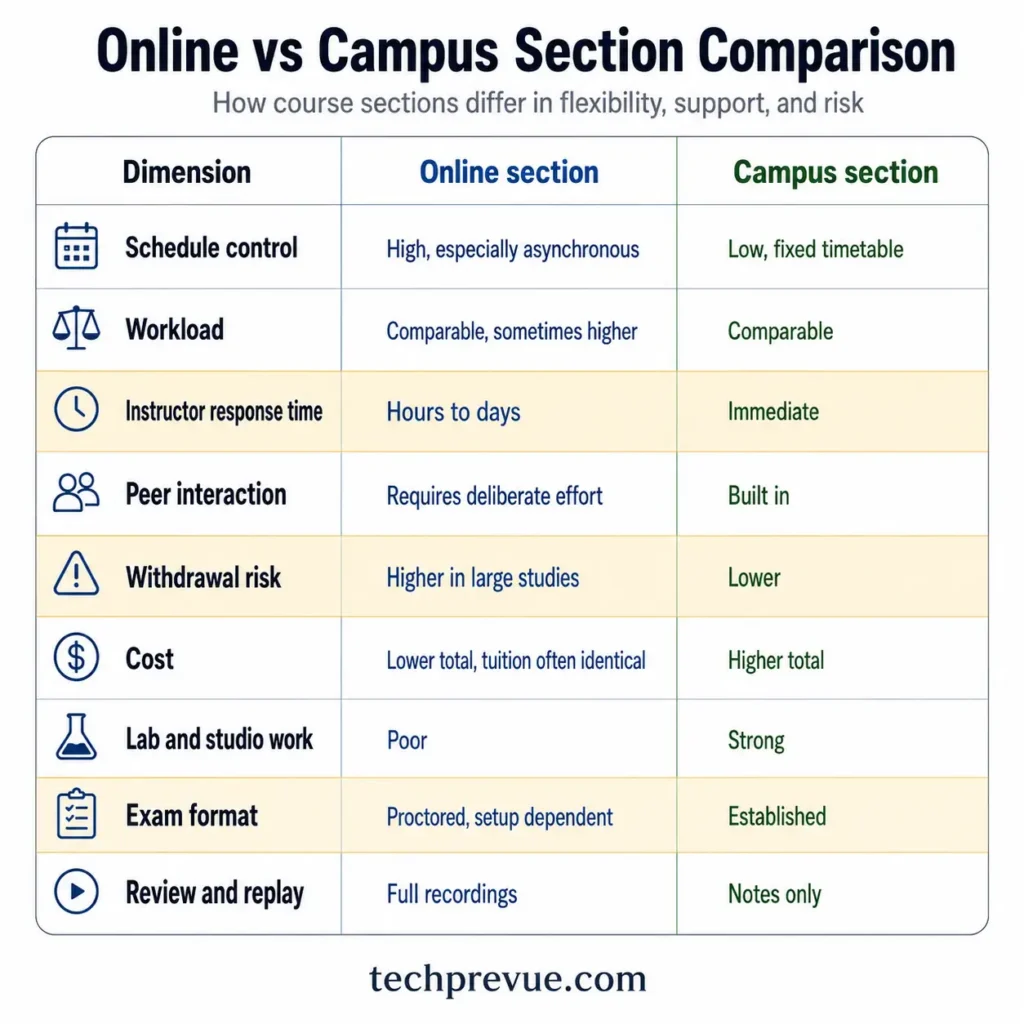
| Dimension | Online section | Campus section |
|---|---|---|
| Schedule control | High, especially asynchronous | Low, fixed timetable |
| Workload | Comparable, sometimes higher | Comparable |
| Instructor response time | Hours to days | Immediate |
| Peer interaction | Requires deliberate effort | Built in |
| Withdrawal risk | Higher in large studies | Lower |
| Cost | Lower total, tuition often identical | Higher total |
| Lab and studio work | Poor | Strong |
| Exam format | Proctored, setup dependent | Established |
| Review and replay | Full recordings | Notes only |
Most summaries of the pros and cons of online classes stop at the first two rows. The rows that decide your grade are withdrawal risk, instructor response time, and exam format.
How to read this: if three or more rows in the online column describe a problem for your situation, take the campus section. The format rewards preparation, not optimism.
Are Online Classes Easier or Harder?
Online classes are not easier. The evidence points toward harder for most students, though the picture is genuinely contested and the honest answer depends on the student.
The case that they are harder. The CCRC administrative studies above found lower persistence and lower grades in online sections across two entire state systems, controlling for student characteristics.
The case against. A national analysis published in Online Learning examined US Department of Education longitudinal data and found community college students with online coursework were significantly more likely to attain an associate degree, with no significant difference in transfer or dropout. Those findings are summarised in the journal’s published record.
Reconciling them. Course-level outcomes and degree-level outcomes are different questions. Individual online courses appear harder to pass, while access to online courses appears to help some students finish degrees they otherwise could not fit around their lives.
Both can be true at once. The practical reading is that online courses cost you something in performance and buy you something in access, and whether that trade is worth it depends on whether you could take the course at all otherwise.
This is why the pros and cons of online classes cannot be settled in the abstract. A student choosing between two available sections faces a different calculation from one whose only alternative is not taking the course this year.
Synchronous or Asynchronous?
Neither format is reliably better for learning, so choose on structure and personality rather than on outcomes.
What the meta-analyses found. A 2023 meta-analysis of 14 studies covering roughly 2,000 participants found a trivially small advantage for asynchronous delivery, small enough to carry no practical meaning. Earlier US Department of Education work synthesising 45 studies found the same thing: format alone did not determine outcomes, while blended designs outperformed pure formats.
The personality factor. Research published in 2023 found impulsivity was more strongly linked to poor performance in synchronous courses, where sustained live attention matters, while extraversion was negatively related to performance in asynchronous courses. If you know you drift during live sessions, that is useful information about which section to pick.
Cognitive load. A 2024 study measuring mental load across both formats found synchronous delivery produced significantly lower cognitive load, with satisfaction essentially equal.
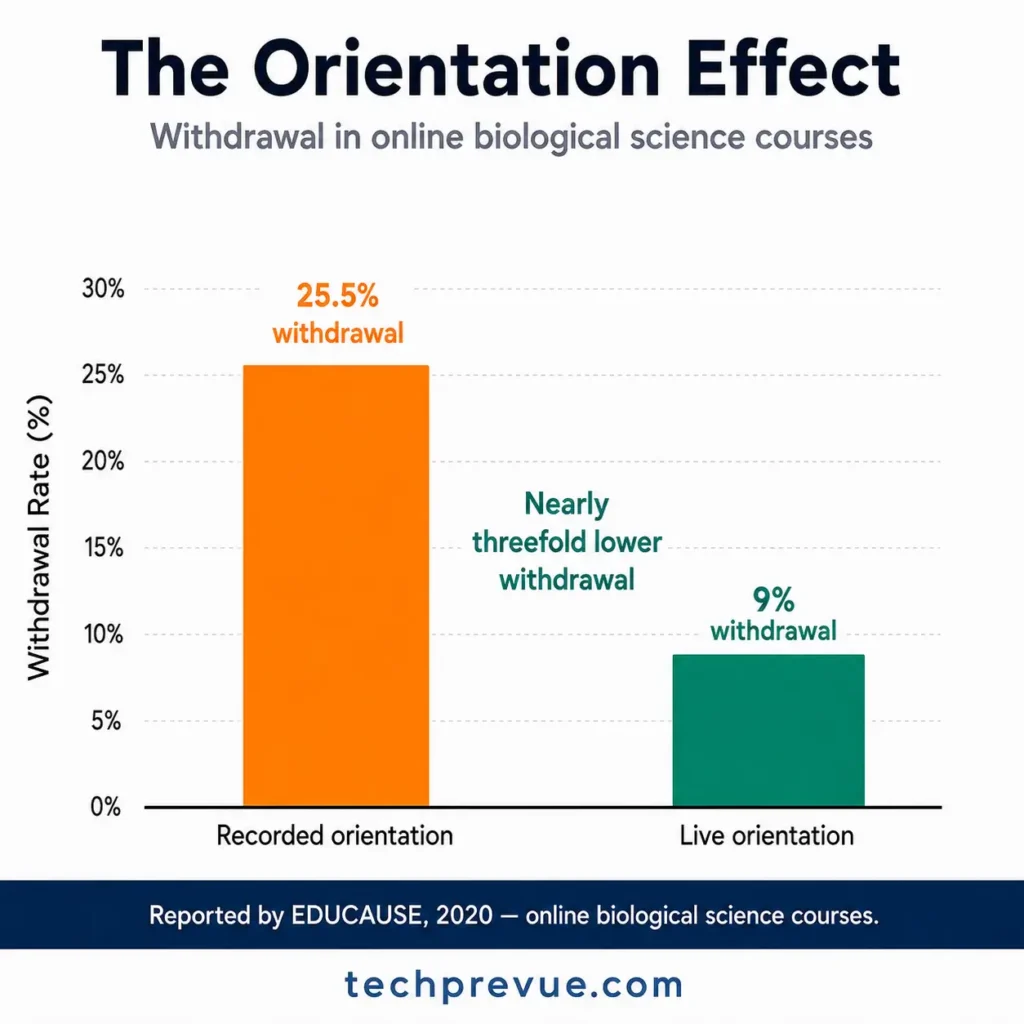
The one finding worth acting on. EDUCAUSE reports that when online science courses used a live orientation instead of a recorded one, withdrawal fell from 25.5% to 9%.
A single live session at the start changed the withdrawal rate by a factor of nearly three. If your asynchronous course offers any live component, attend it.
Does AI Actually Help in Online Classes?
AI helps when it makes you think and hurts when it saves you from thinking, and the current evidence is less flattering than the marketing.
A randomized controlled field experiment with roughly 500 undergraduates tested a generative AI chatbot across in-person and asynchronous online sections. It found no statistically significant impact on interest, self-efficacy, engagement, or achievement.
Other research is starker. A large field experiment found students given unrestricted chatbot access during practice performed worse on later assessment than students who never had AI at all, once the tool was removed.
Practical rule for coursework: ask AI to explain the method and check your reasoning, never to produce the submitted answer. If you cannot reproduce the work without it, you have not learned it, and the proctored exam will find that out.
Our guide to the pros and cons of online learning covers this evidence in full.
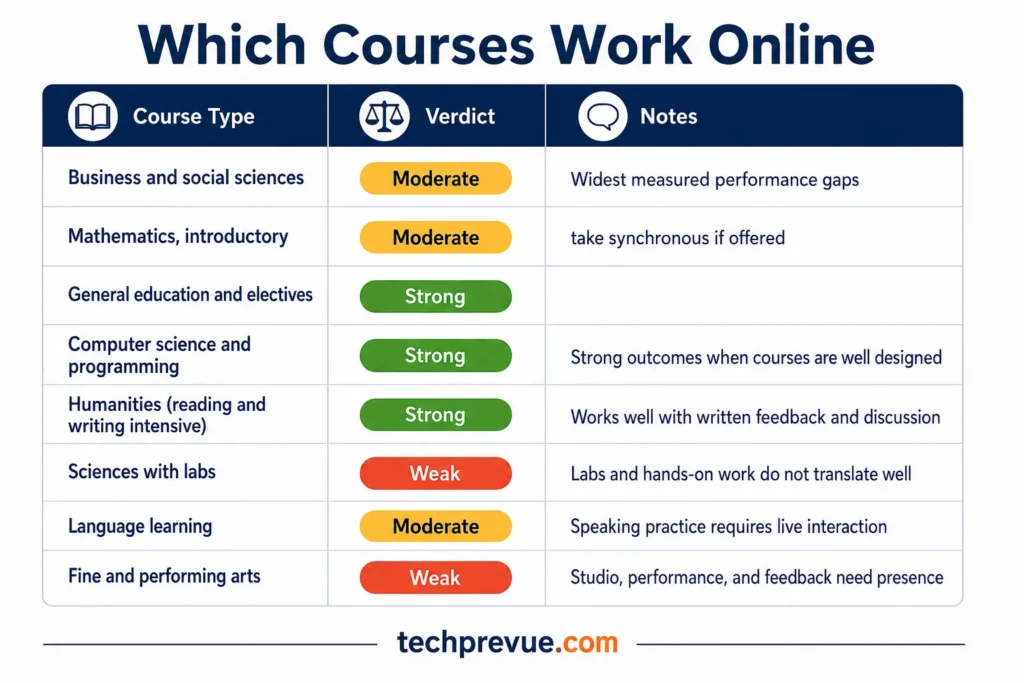
Which Courses Work Online
| Course type | Online suitability | Notes |
|---|---|---|
| General education and electives | Strong | The lowest-risk place to start |
| Computer science and IT | Strong | Tooling is already digital |
| Humanities and writing | Strong | Discussion transfers well in writing |
| Mathematics, introductory | Moderate | Higher measured withdrawal; take synchronous if offered |
| Business and social sciences | Moderate | Widest measured performance gaps |
| Nursing and allied health | Weak | Clinical components cannot move online |
| Engineering and lab sciences | Weak | Lab work requires supervised access |
| Studio and performance | Weak | Physical practice is the course |
Practical sequencing: take your first online course in the top three rows. Learn how the format behaves before you risk a major requirement on it.
Before You Register
Five checks that take ten minutes and prevent most problems.
- Credit transfer. If the course is from another institution, confirm in writing with your advisor that it transfers and counts toward your requirement. Verbal assurance is not enough.
- Synchronous requirements. Check for fixed meeting times or mandatory live sessions buried in an otherwise asynchronous course.
- Proctoring rules. Find out which system is used and what it requires of your device, connection, and room.
- Instructor response time. The syllabus usually states it. If it does not, email and see how long the reply takes.
- Withdrawal deadline. Note the date now. Students who fall behind online typically realise too late to withdraw without penalty.
Online Classes in India
For Indian students, two checks matter more than any general advice.
Recognition. If the online course carries credit toward a degree, confirm the university and the specific programme appear on the UGC Distance Education Bureau approved list for your academic year. Approval is annual and programme-specific. Our guide to the pros and cons of online school covers school-level recognition separately.
Device access. National Sample Survey data from early 2025 found only 7.2% of Indian households have a fibre-optic connection, falling to 3.2% in rural areas. Device ownership among young people reached about 82% in urban areas against 69.3% rural, and 83.3% among males against 63% among females.
Mobile data is adequate for recorded lectures and inadequate for a three-hour proctored exam. If you share a device, agree fixed study hours with your household before the term starts rather than after.
Mistakes That Make Online Classes Go Wrong
1. Taking too many at once. Online sections need more self-management, not less. Start with one alongside campus courses.
2. Treating it as spare time. Book fixed hours in a calendar and defend them the way you would a timetabled class.
3. Waiting to ask. Your instructor cannot see confusion online. Email in week two, not week eight.
4. Skipping the optional live session. The withdrawal data above makes this the highest-value hour in the course.
5. Choosing asynchronous by default. If you need structure, the synchronous section is worth the lost flexibility.
6. Ignoring the withdrawal deadline. Know the date before you need it.
Frequently Asked Questions
What are the main pros and cons of online classes?
The main advantages are schedule control, no commute, replayable lectures, lower total cost, wider course access, and written communication practice. The main drawbacks are higher withdrawal and failure rates, slower instructor access, difficult group work, proctoring requirements, connectivity demands, and poor fit for practical subjects.
Are online classes easier than in-person classes?
No. Large studies of course records found lower persistence and lower grades in online sections. The workload is usually identical while the external structure is removed, which makes them harder for most students rather than easier.
Do online classes transfer for credit?
Often, but never assume. Transfer depends on the awarding institution’s accreditation and your own institution’s policy. Confirm in writing with your advisor before registering.
Is synchronous or asynchronous better?
Neither is reliably better for learning outcomes. Choose synchronous if you need accountability or drift without fixed times, and asynchronous if your schedule genuinely cannot accommodate live sessions.
Why do students fail online classes?
Structure loss rather than difficulty. Without fixed meeting times, work slips, then compounds, and slower instructor access means confusion goes unresolved for longer.
How many online classes should I take at once?
Start with one. Add a second only after you have completed the first without falling behind, since the self-management demand scales faster than the course count.
Do employers care whether classes were online?
Employers generally assess the degree and the institution rather than individual course formats. Transcripts do not usually distinguish online sections from campus ones.
Can I use AI for online coursework?
Use it to explain methods and check your reasoning, not to produce submitted work. Research shows unrestricted AI use during practice can leave students performing worse once the tool is removed.
What equipment do online classes require?
A device you control, a stable connection, a working webcam for proctored exams, and a quiet space where you can be alone during assessments. Mobile-only access is usually insufficient.
Key Takeaways
- The pros and cons of online classes are course-level decisions, not permanent preferences.
- Online sections show higher withdrawal and failure rates in the largest available studies.
- Performance gaps are widest in business, social sciences, and applied professions.
- Neither synchronous nor asynchronous is reliably better, but live orientation sessions cut withdrawal sharply.
- Verify credit transfer, proctoring requirements, and the withdrawal deadline before you register.
- Take your first online course as a general education elective, not a major requirement.
Pick the section that fits the course and your circumstances, not the one that fits your calendar most conveniently.