
In 2024, Google’s Gary Illyes told a conference audience that his employer needs “very few links to rank pages.” He added that Google had spent years making links less important. Then he posted on X that he shouldn’t have said it.
That moment captures the confusion around this subject perfectly. The industry spent two decades treating backlinks as the closest thing SEO had to a cheat code, and Google now says they matter less than you think.
Meanwhile agencies still charge $500 a link. One survey found the share of marketers prioritising links dropped from 73.3% to 53.3% in a single year.
So who’s right? Both, partly. This guide sorts out which parts of the old playbook still pay, which ones burn budget, and what changed once AI answers started eating the search results page.
Quick answer: Link building is the practice of getting other websites to link to yours. Those links help search engines discover your pages, judge their credibility, and rank them. Google says links carry less weight than they once did, but they remain a core off-page signal in 2026.
Key takeaways
- Google has stated on the record that links have not been a top-three ranking factor “for some time”
- Buying links to influence rankings violates Google’s spam policies; paying for advertising links marked
rel="sponsored"does not - The term “toxic backlink” was invented by SEO tools, not Google — most bad links are simply ignored
- Earned links compound; added links plateau immediately
- Brand mentions correlate roughly three times more strongly than backlinks with citations in AI answers
- A quality link costs $150–$1,500 in the US and ₹3,000–₹40,000 in India, depending on the publisher
- Internal linking is the only form of link acquisition you fully control, and most sites neglect it
- What Is Link Building?
- Why Is Link Building Important?
- What Makes a Backlink Valuable? The Eight Factors
- The Four Ways to Get Links: Add, Ask, Buy, Earn
- White Hat Link Building vs. Grey Hat vs. Black Hat
- 18 Link Building Strategies for SEO That Work in 2026
- How to Run a Link Building Campaign, Step by Step
- How to Build an SEO Link Building Strategy That Compounds
- Toxic Backlinks: What Google Says and What You Should Actually Do
- Link Building Tools: Free and Paid
- Link Building Services, Agencies and Packages: How to Buy Without Getting Burned
- Link Building in India versus the United States: What Changes
- How to Measure Link Building Results
- 12 Link Building Mistakes That Waste Budget
- Your Link Building Checklist
- Frequently Asked Questions About Link Building
- The Bottom Line: Build the Kind of Site People Want to Cite
What Is Link Building?
Link building is the process of getting other websites to place hyperlinks pointing to your pages. Search engines treat those links as signals of credibility and use them to discover, evaluate and rank content. The practice sits within off-page SEO, alongside brand mentions and digital PR.
Link building borrows its core idea straight from academia. A research paper cited by two hundred other papers is presumed more significant than one cited by nobody. Larry Page and Sergey Brin borrowed that logic when they built Google, and you can read the reasoning in their original Stanford research paper from 1998.
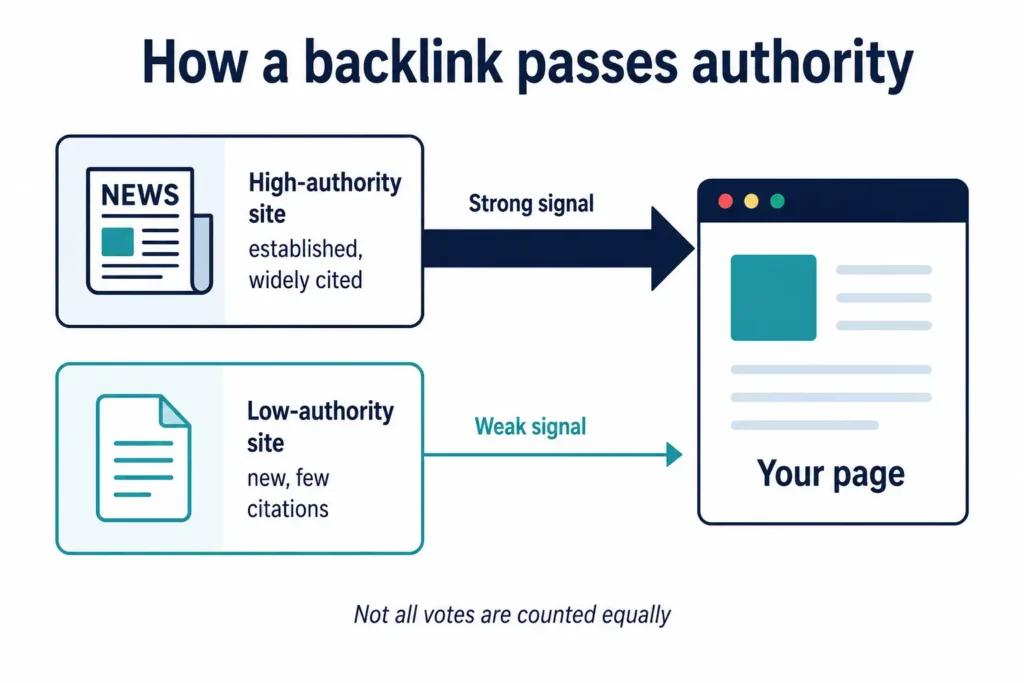
A link, in that model, is a vote. But votes are weighted. A citation from a Nobel laureate in your field counts differently from a citation in an undergraduate essay, and search engines apply the same asymmetry.
Here is where most beginners go wrong. They hear “votes” and start counting. The count stopped being the point around 2012, and the rest of this guide explains what replaced it.
Link Building vs. Backlinks vs. Link Earning
These three terms get used interchangeably and shouldn’t be.
| Term | What it means | Who controls it |
|---|---|---|
| Backlink | The link itself — an inbound hyperlink from another site to yours | The publisher |
| Link building | Any deliberate activity aimed at acquiring backlinks | You |
| Link earning | Backlinks acquired without you asking, because something you made was worth citing | Nobody, directly |
The distinction matters for budgeting any link building programme. Link earning has no marginal cost per link but a high fixed cost — you have to make something worth citing first. Deliberate acquisition has a low fixed cost and a high marginal cost, because every link needs its own outreach.
Most teams need both. Purely earned strategies are too slow for a new site. Purely acquired strategies stop working the moment you stop paying.
Where Link Building Sits Inside Off-Page SEO
Off-page SEO covers every signal about your site that lives somewhere other than your site, and it is the counterpart to everything covered in our guide to what SEO is. Backlink building is the largest component, but not the only one.
- Backlinks — hyperlinks from third-party sites
- Brand mentions — your name appearing without a link
- Citations — structured listings on directories and business platforms
- Reviews — third-party ratings on platforms like G2, Trustpilot or Google Business Profile
- Social and community presence — discussion on Reddit, LinkedIn, YouTube and niche forums
Until recently, only the first of these was measurable enough to build a strategy around. That has changed, and the AI section below covers why. If you want the full off-page picture, our off-page SEO checklist breaks down every signal in sequence.
How Link Building Got Here: PageRank to AI Search
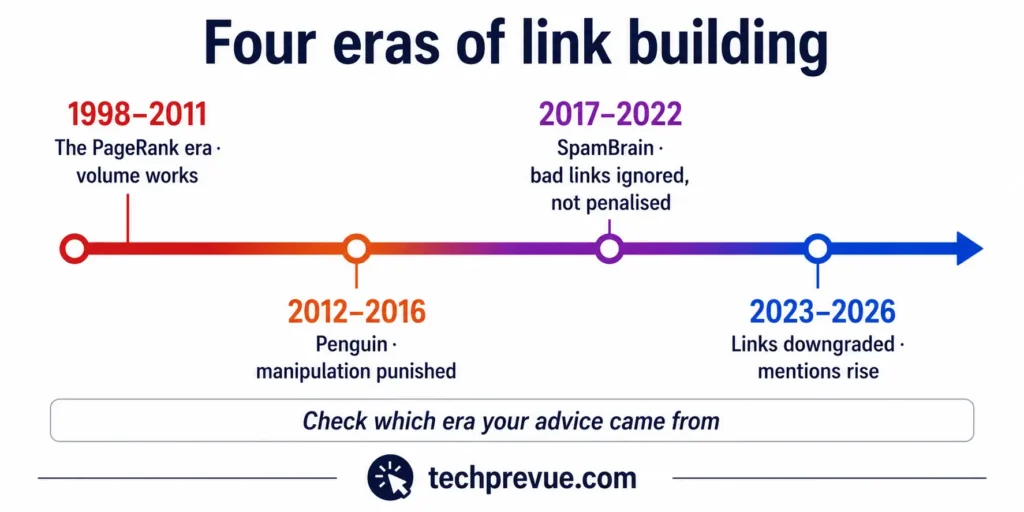
You cannot judge current link building advice without knowing which era it came from. A tactic that worked in 2011 may now carry a penalty risk, and a lot of published guidance was written before the rules changed.
1998–2011: The PageRank Era
Google launched with PageRank as its signature innovation, and for over a decade, link volume was close to a direct ranking dial. More links meant higher positions, and the quality bar was low.
The industry responded predictably. Directory submissions, article farms, comment spam, footer link networks and reciprocal link exchanges became standard practice. Some of it worked embarrassingly well.
Anchor text was the second lever. Point five hundred links at a page with the exact phrase you wanted to rank for, and you frequently got it.
2012–2016: Penguin and the Great Cleanup
Google launched the Penguin update in April 2012 with one job: demote sites with manipulative link profiles. It worked, and it hurt.
Entire link building business models disappeared. Sites that had bought their way to page one lost most of their organic traffic overnight, and recovery often took a year or more.
Penguin also introduced a lasting behavioural change. SEOs started worrying about links pointing at them, not just links they wanted — which is where the disavow tool and the whole “toxic link” industry came from.
By 2016, Penguin had become part of the core algorithm and shifted from penalising sites to devaluing links. That distinction still confuses people, and it matters enormously.
2017–2022: Link Spam Updates and SpamBrain
Google spent these years building automated systems that identify manipulated links and quietly discount them. The December 2022 link spam update, powered by the SpamBrain system, was the clearest statement of intent.
The practical consequence: most bad links stopped being dangerous and started being worthless. That is a much better outcome for site owners, and a much worse one for anyone selling link cleanup services.
Google also split the nofollow attribute into three in 2019, adding sponsored and ugc, and reclassified all three as hints rather than directives.
2023–2026: Links Downgraded, Mentions Rising
Three things happened in quick succession.
First, in September 2023, Gary Illyes said publicly that links were not among Google’s top three ranking factors and had not been for some time. Second, in March 2024, Google edited its spam policy documentation to remove the word “important” from its description of links. Third, in April 2024, Illyes said Google needs very few links to rank pages.
Then generative AI arrived in the results page, and the question changed from “how do I rank” to “how do I get cited.”
Why Is Link Building Important?
Links help search engines find your pages, understand what they cover, and decide how much to trust them. They also send direct referral traffic. Their ranking weight has fallen since 2020, but no comparable signal has replaced their role in establishing third-party credibility.
Here is the part most link building guides skip. Authority is the one thing you cannot claim about yourself.
You can demonstrate experience on your own pages with first-hand detail. You can demonstrate expertise with credentials and depth. Authoritativeness only exists in what other people say about you — and a hyperlink is the oldest machine-readable version of somebody else saying something about you.
That is why links persist even as their ranking weight declines. They are evidence, and evidence is hard to manufacture credibly.
How Does Link Building Help SEO?
Backlink building does four separate jobs. Conflating them is why so much advice sounds contradictory.
1. Discovery and Crawling
Search engine crawlers find new pages by following links. A page with no inbound links — internal or external — may never be discovered unless you submit it directly.
For most established sites this is a solved problem, handled by sitemaps and internal navigation. For new sites and new sections, it is a real bottleneck.
Illyes has described a case of a page ranking first with zero links of any kind, discovered only through the sitemap. Discovery is necessary, but no longer strictly dependent on links.
2. Ranking and Authority
This is the job everyone means when they say links matter. Links from credible, relevant sources raise the likelihood that your page ranks for competitive terms.
The mechanism is a descendant of PageRank, though enormously more sophisticated now. Machine learning systems for language understanding carry weight that simply did not exist when links were the dominant signal.
Practical translation: links move you up a competitive SERP, but they will not rescue a page that fails to answer the query.
3. Anchor Text and Topical Relevance
The clickable text of a link tells search engines what the destination page is about. Google’s founders named this explicitly as one of the techniques improving their search quality.
Anchor text still works. It is also the fastest way to trigger a spam classifier, which is why the section on anchor distribution below matters more than most people realise.
4. Referral Traffic and Revenue
A link on a page that people actually read sends people to your site. This is the only benefit that requires no algorithmic cooperation whatsoever.
It is also the benefit most teams forget to measure. A link from a niche newsletter with three thousand engaged subscribers may be worth more commercially than a link from a high-authority site nobody reads.
Judge placements on whether a real human might click. That single filter eliminates most of what the cheap end of the market sells.
What Google Has Actually Said About the Weight of Links
If you take one thing from this link building guide, take this section. The gap between what Google has said and what the SEO industry repeats is enormous, and it costs people money.
The On-Record Timeline
| Date | Who | What was said |
|---|---|---|
| Nov 2022 | Duy Nguyen, Google Search Quality | Backlinks as a signal have far less impact than in Google’s early years |
| Sept 2023 | Gary Illyes, PubCon Pro Austin | People overestimate links; they are not in the top three and have not been “for some time” |
| Sept 2023 | Gary Illyes | Cited a site ranking first with no links at all, discovered via sitemap |
| Mar 2024 | Google documentation | The word “important” was removed from the spam policy’s reference to links, alongside the March 2024 core update |
| Apr 2024 | Gary Illyes, SERP Conf | “We need very few links to rank pages… over the years we’ve made links less important” |
| Apr 2024 | Gary Illyes on X | “I shouldn’t have said that… I definitely shouldn’t have said that” |
| Apr 2024 | John Mueller | Advised against focusing on the absolute count of links |
Notice the pattern. This is not one offhand comment. It is a consistent multi-year message from several people, reinforced by a documentation edit.
Now notice what nobody at Google said: that links stopped mattering. Illyes explicitly called them important in the same breath as demoting them from the top three.
How to Read Google’s Statements Without Overcorrecting
Google has an obvious incentive to discourage link buying, so treat these statements as directionally honest rather than neutral. They are also consistent with observable evidence.
Three reasonable conclusions follow.
- Links still work at the margin. In competitive commercial SERPs where every result has good content, links remain a differentiator.
- Links are not a substitute for anything. They will not fix thin content, poor topical coverage, or the crawl and speed problems covered in our guide to technical SEO.
- The volume game is over. “Get more links than the competitor” is a strategy from a previous decade, and it now costs more than it returns for most sites.
You should also be sceptical of any vendor whose claim about link importance happens to align perfectly with what they sell. That applies to the tool companies and to us.
Nav43’s guide, to take one live example, states that backlinks are among Google’s top three ranking factors and attributes this to Google Search Central. No such statement exists in Google’s documentation, and the Google employee who addressed the question directly said the opposite. Check citations before you act on them.
Do Backlinks Still Matter for AI Overviews and LLM Citations?
Backlinks influence AI visibility indirectly. Generative systems retrieve from pages that already rank, so links that improve rankings improve citation eligibility. But once a page clears that threshold, brand mentions and content structure decide whether it gets cited.
What the 2025–26 Correlation Studies Show
Several independent datasets point the same direction.
This is the newest part of link building, and the part where the most nonsense is currently being sold.
| Signal | Correlation with AI citation | Source |
|---|---|---|
| Unlinked web mentions | 0.664 | Ahrefs, 75,000 brands |
| Backlinks | 0.218 | Ahrefs, 75,000 brands |
| YouTube mentions | 0.737 | Ahrefs |
| Branded anchor text | 0.527 | Ahrefs |
| Branded search volume | 0.334 | Ahrefs |
| Domain authority score | ~0.65 | Semrush, 1,000 domains |
| Google first-page ranking | ~0.65 | Independent analysis |
Read those two Ahrefs figures together and the headline writes itself: mentions correlate roughly three times more strongly than backlinks. That number has been circulating all year, usually without the caveat that follows.
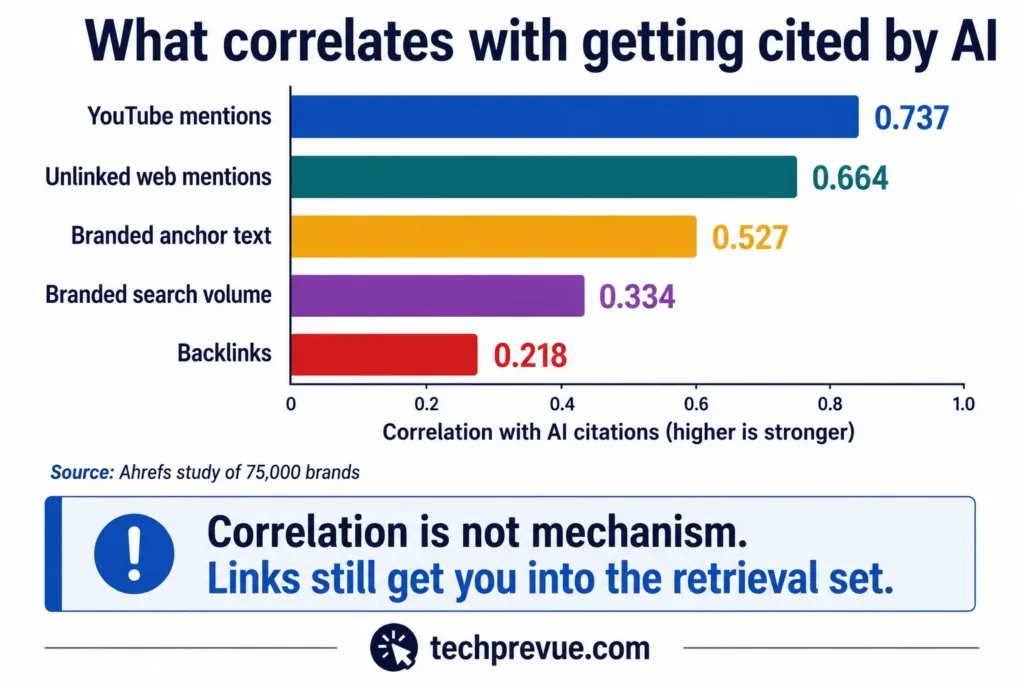
Correlation is not mechanism. A brand mentioned everywhere is usually a brand with links, traffic, reviews and a reputation — the mention is a symptom of relevance, not necessarily the cause of citation.
There is also a threshold effect worth noting. Authority correlates with AI mentions, but the gains concentrate once a domain crosses a certain authority level, which suggests links function as an entry requirement rather than a scaling lever.
What Google Officially Says About Chasing “Mentions”
Google addressed this directly in its official guidance on generative AI features, last updated in July 2026. The guide contains a mythbusting section listing things you can ignore.
Among them: seeking inauthentic mentions across the web. Google’s position is that its generative features draw on what is genuinely being said about products and services, while its core systems focus on content quality and its spam systems block manipulation.
The same guide dismisses several other popular tactics. You do not need llms.txt files, you do not need to chunk your content into fragments, and you do not need to rewrite copy specifically for AI systems.
That is an uncomfortable read for anyone selling AI-visibility packages built on manufactured mentions. It is also entirely consistent with how Google has handled every previous manipulation of a ranking signal.
The Practical Verdict: Links as Threshold, Mentions as Multiplier
Here is how to reconcile the correlation data with Google’s guidance without doing anything stupid.
Links get you eligible. They help your pages rank, and ranking makes your pages retrievable by the systems that generate AI answers. Below a certain authority level, you are not in the retrieval set at all.
Mentions decide whether you get named. Once you are eligible, what determines citation is whether models have encountered your brand repeatedly in credible third-party contexts — reviews, community discussion, editorial coverage, video.
Structure decides which passage gets used. Generative systems evaluate passages, not pages. If your answer is buried under four hundred words of preamble, a clearer competitor gets quoted instead.
The link building budget implication is a reweighting, not a reversal. A team that spent 70% of its off-page budget on link placements and 30% on earned coverage should probably invert that ratio. The tactics that produce genuine mentions — digital PR, original research, expert commentary, community participation — happen to produce links as a byproduct.
Which is a useful reminder. Every activity in this guide that Google would endorse produces both.
What Makes a Backlink Valuable? The Eight Factors
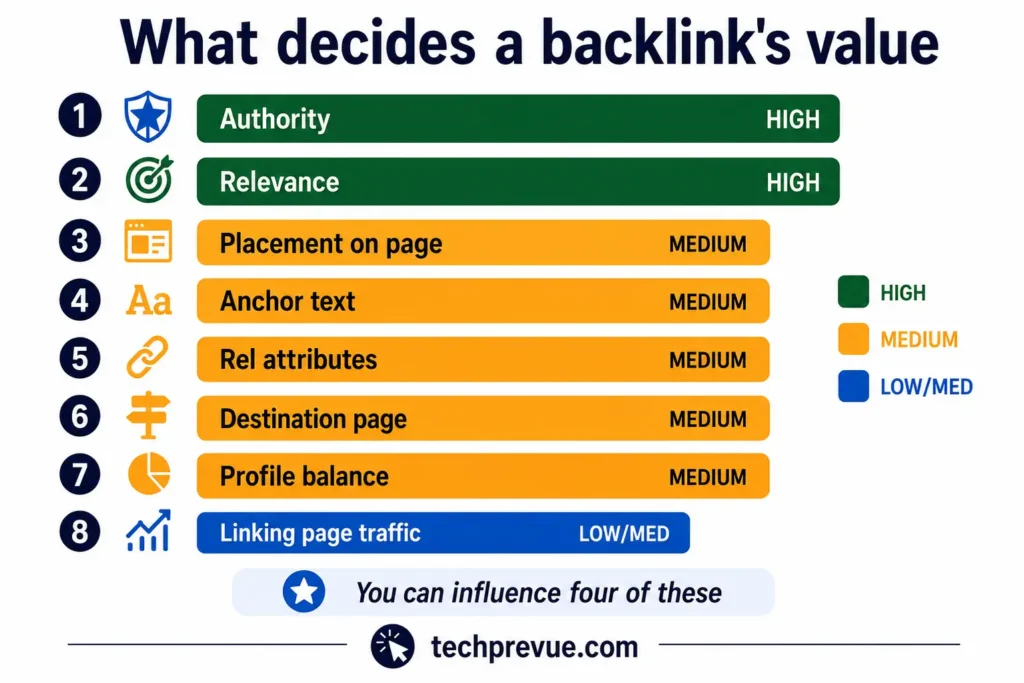
Link value is decided by the credibility of the linking site, its topical relevance to yours, where the link sits on the page, its anchor text, its rel attributes, the page it points to, and how naturally it fits your existing profile. Authority and relevance carry the most weight.
| Factor | Influence | How to check it | Can you influence it? |
|---|---|---|---|
| Authority | High | Third-party metrics, organic traffic | Only by choosing targets |
| Relevance | High | Manual review of site and page topic | Yes, through prospecting |
| Placement | Medium | Where the link appears on the page | Sometimes, by asking |
| Anchor text | Medium | Backlink tool anchor report | Partly — and you shouldn’t push |
| Rel attributes | Medium | View source, or a backlink tool | Rarely |
| Destination page | Medium | Your own reporting | Fully |
| Profile balance | Medium | Anchor and velocity distribution | Fully, over time |
| Linking page traffic | Low–medium | Traffic estimate tools | Yes, through prospecting |
1. Authority: Domain Level and Page Level
A link from a widely cited publication carries more weight than one from a blog nobody reads. This is the least controversial claim in link building and the one most often measured badly.
Two layers exist. Domain-level authority reflects the whole site’s standing. Page-level authority reflects the specific page linking to you, which is closer to how PageRank actually worked.
Page-level matters more than most people account for. A link from a brand-new page on a strong domain passes far less than a link from an established page on that same domain that has accumulated its own citations.
DR, DA and Authority Score Are Not Google Metrics
Domain Rating, Domain Authority and Authority Score are proprietary estimates built by Ahrefs, Moz and Semrush respectively. Google does not use them, does not see them, and has repeatedly said so.
They are still useful as rough filters. They are not useful as targets, and buying links priced purely by these scores is how you end up paying premium rates for placements with no readers.
A better filter combines three checks: does the site get real organic traffic, does it publish content a human would read, and would you be comfortable if a client saw the placement?
That last question eliminates more bad prospects than any metric.
2. Relevance: Topical and Contextual
Relevance operates at two levels, and both matter.
Site-level relevance asks whether the linking site covers your subject area. Page-level relevance asks whether the specific page and the surrounding paragraph make the link sensible to a reader.
Google’s own explanation of how search works notes that links from prominent sites on the subject are a good indicator of quality. The emphasis on on the subject is doing real work in that sentence.
Consider three hypothetical links to a page selling running shoes:
- From a gardening blog, in a post about composting — near zero value
- From a fitness site, in a post about knee injuries — moderate value
- From a running site, in a review of trail shoes — high value
The third link would exist even if search engines didn’t. That is the test.
One caveat, because rigid relevance thinking causes its own problems. Adjacent topics are legitimate. A fitness site linking to an article about sleep, nutrition or scheduling is entirely natural, and refusing such links because they aren’t an exact topical match is overthinking it.
3. Placement on the Page
Where a link appears changes how much weight it carries. Links in the main body of an article outperform links in sidebars, footers and author bios.
Position within the body matters too. A link in the second paragraph tends to be worth more than the same link in the final section, because more readers reach it.
The Reasonable Surfer Model, Explained Simply
The reasoning behind this comes from a Google patent commonly called the reasonable surfer model, documented in patent US8117209B1.
The original PageRank model assumed a browser clicking links at random, treating every link on a page as equally likely to be followed. The reasonable surfer model refines this by weighting links according to how likely a real person would be to click them.
A link in a prominent paragraph gets clicked. A link in a template footer replicated across ten thousand pages does not. The model adjusts the value passed accordingly.
This is also why site-wide footer links have almost no ranking value despite appearing on every page. You are not getting ten thousand links. You are getting one weak one.
4. Anchor Text
Anchor text tells search engines what the linked page covers. Descriptive anchors help; generic ones like “click here” waste the opportunity.
The trap is that anchor text is the easiest signal to over-optimise, and over-optimisation is one of the clearest fingerprints of paid link acquisition. Google’s spam policies specifically name links with optimised anchor text in guest posts and press releases.
A Safe Anchor Text Distribution Model
Natural profiles are messy. Manufactured ones are tidy, and tidiness is the tell.
| Anchor type | Example | Healthy share |
|---|---|---|
| Branded | TechPrevue | 35–50% |
| Naked URL | techprevue.com | 10–20% |
| Generic | read more, this guide, here | 10–20% |
| Partial match | guide to building backlinks | 15–25% |
| Exact match | your target keyword, verbatim | Under 5% |
Two operating rules follow.
Do not dictate anchors in outreach. Asking a publisher to use an exact phrase is a request no genuine editor would grant, and it converts a legitimate placement into an obvious one.
Audit inbound anchors quarterly. A sudden spike in exact-match anchors is often the first visible sign of a negative SEO attempt or an agency cutting corners on your behalf.
5. Link Attributes: nofollow, sponsored and uGC
Publishers can qualify outbound links with an attribute that tells search engines how to treat them. Google documents all three in its guidance on qualifying outbound links.
| Attribute | Intended use | Effect |
|---|---|---|
rel="nofollow" | The publisher does not want to endorse the destination | Usually not used for ranking |
rel="sponsored" | Paid or compensated placements | Not used for ranking |
rel="ugc" | User-generated content such as comments and forum posts | Not used for ranking |
| No attribute | A normal editorial link | Eligible to pass ranking signals |
Since 2019 Google has treated these as hints rather than absolute directives, meaning it reserves the right to consider them in some contexts.
Three practical points get missed.
Nofollow links still have value. They send traffic, build brand familiarity and contribute to a natural-looking profile. A profile consisting only of followed links looks manufactured.
Sponsored links are not a punishment. Marking a paid placement correctly is what keeps it compliant. The problem is unmarked paid links, not marked ones.
You cannot control which attribute a publisher uses. Refusing coverage from a major outlet because their CMS adds nofollow is a decision made for the algorithm rather than the business.
6. Destination: Homepage, Linkable Asset or Money Page
Every link points somewhere, and where it points determines what it does for you.
Most sites face the same problem. The pages that need to rank — product pages, service pages, category pages — are the pages nobody wants to link to. Publishers link to things their readers benefit from for free.
The standard solution is a two-step flow. Attract external links to genuinely useful resources, then pass authority internally to the commercial pages that need it.
That internal step is where most teams stop paying attention, which is why internal linking gets a full strategy slot later in this guide.
7. Link Velocity and Profile Balance
Link velocity is the rate at which you acquire new links. There is no correct number, and anyone quoting one is guessing.
What matters is coherence. A site publishing weekly and earning three or four links a month is coherent. The same site suddenly acquiring two hundred links in a fortnight is not, unless something newsworthy happened.
Balance matters similarly. Real profiles contain a spread of authority levels, a mix of followed and nofollow links, varied anchors and links to many different pages. Profiles that are uniformly high-authority, uniformly followed and uniformly pointed at three commercial URLs look exactly like what they are.
8. Traffic and Indexation of the Linking Page
Two final checks that filter out a surprising amount of what gets sold as premium inventory.
Does the linking page get traffic? A page with no visitors sends no visitors, and a site with no organic traffic despite a high authority score is usually a network property with purchased metrics.
Is the linking page indexed? Search site: plus the URL. If the page is not in the index, the link is invisible to the system you are trying to influence.
Both checks take under a minute and should be part of every prospect review.
The Four Ways to Get Links: Add, Ask, Buy, Earn
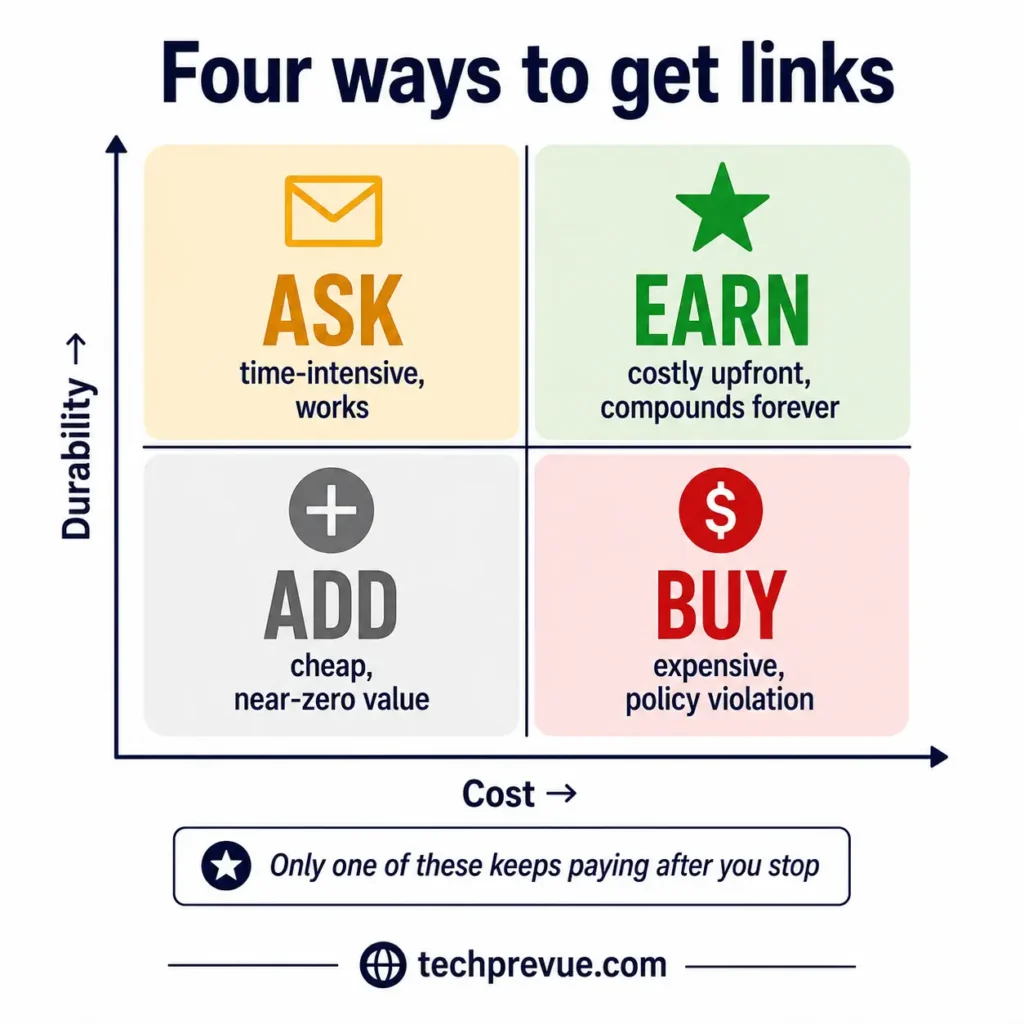
Every link building method reduces to one of four approaches. You add the link yourself, you ask someone to add it, you pay someone to add it, or you make something good enough that people add it without being asked.
| Method | Cost | Risk | Ceiling | Use when |
|---|---|---|---|---|
| Add | Time only | Low if restrained | Very low | Launching a new site |
| Ask | Time or salary | Low | Medium | You have something worth linking to |
| Buy | Money | High | Medium | Almost never, for ranking purposes |
| Earn | High upfront | None | Very high | You can invest in real assets |
1. Adding Links: Foundational Links That Still Have a Job
These are links you place yourself: social profiles, business directories, review platforms, forum signatures, community profiles.
Google’s position is blunt. Its spam policies list low-quality directory and bookmark links, and forum comments with optimised links, as examples of link spam. These placements pass little or no ranking value.
They still have a narrow legitimate use. A new business should exist on the platforms where businesses in its category exist — the major social networks, the relevant review sites, the industry associations, the local listings. That is a few dozen placements, not a few hundred.
The reason is not ranking. It is entity confirmation. Google builds its understanding of your brand from consistent information across the places a real business would appear.
Stop when you run out of platforms a customer might actually check. Everything past that point is time you could have spent on something that compounds.
Directory submission and social bookmarking are still worth understanding, provided you understand them accurately: they are foundational hygiene with near-zero ranking value, not a strategy.
2. Asking for Links: Outreach
Outreach means contacting site owners, editors or writers and requesting a link. It is the workhorse of link building and the source of most wasted effort in it.
The honest success rate is low. Five links from a hundred well-researched, personalised emails is a respectable result. Most agency campaigns quietly run below that.
Two things separate campaigns that work from campaigns that don’t.
The thing you’re pitching has to deserve the link. No amount of email craft rescues a pitch for a mediocre page.
Relationships beat cold contact by an enormous margin. An email from someone an editor recognises gets read. An email from a stranger gets deleted with forty others.
The implication is uncomfortable for anyone wanting quick results: the work that makes outreach effective happens months before the outreach.
3. Buying Links: What Google’s Spam Policy Actually Says
Buying links to influence rankings violates Google’s spam policies. This is not ambiguous, and the spam policies documentation spells out what counts.
The listed violations include exchanging money for links or for posts containing links, exchanging goods or services for links, and sending someone a product in exchange for coverage with a link. Advertorials and native advertising with links that pass ranking credit are named specifically, as are optimised anchors in guest posts and press releases.
Excessive reciprocal linking, automated link creation, links required by contract without the option to qualify them, widget links and site-wide template links all appear on the same list.
When Paid Links Are Legitimate
Google’s documentation includes an important carve-out that most summaries omit.
Buying and selling links is described as a normal part of the web’s advertising economy. It does not violate the policies as long as the links are qualified with rel="nofollow" or rel="sponsored".
So the rule is not “never pay for a placement.” The rule is that paid placements must not pass ranking credit.
That distinction has a practical consequence people rarely think through. If you pay for a placement and mark it correctly, you have bought advertising — brand exposure, referral traffic, audience access. If you pay for a placement and leave it unmarked to gain rankings, you have bought a policy violation.
Both can be reasonable business decisions. Only one of them is what most vendors are actually selling when they say “link building services.”
4. Earning Links: The Only Method That Compounds
Earned links arrive because something you published was worth referencing. No outreach, no payment, no negotiation.
This is the only method with an unlimited ceiling, and the only one that keeps producing after you stop working. A well-executed research study can accumulate links for a decade.
It is also the slowest to start and the easiest to do badly. Most “linkable assets” earn nothing because nobody knows they exist.
The uncomfortable arithmetic: earning links requires you to be genuinely worth citing, and most sites are not. Fixing that is a content and product problem, not an SEO problem, which is why so many teams skip past it to the tactics that feel more actionable.
White Hat Link Building vs. Grey Hat vs. Black Hat
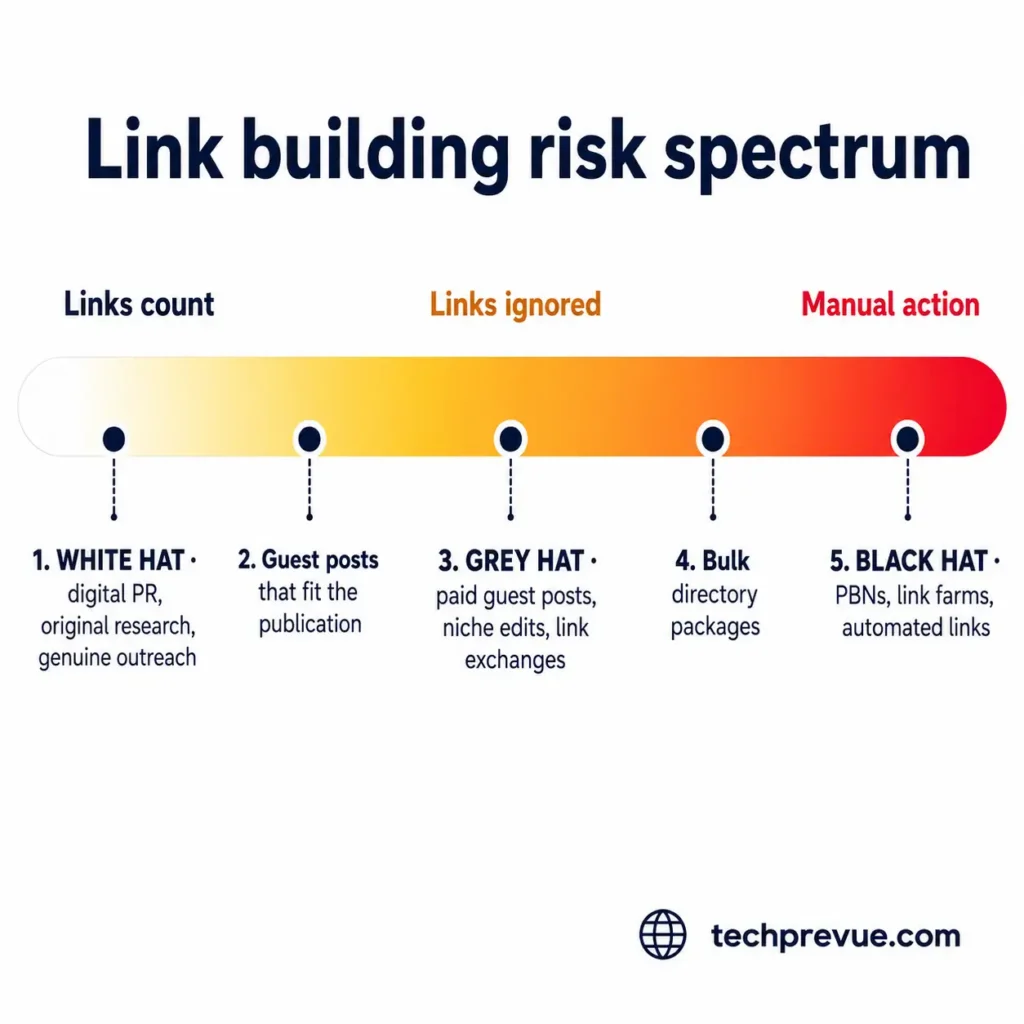
These link building labels describe risk tolerance, not morality. The useful question is not which category a tactic falls into but what happens to your site when Google’s systems classify it correctly.
| White hat | Grey hat | Black hat | |
|---|---|---|---|
| Definition | Fully compliant with Google’s policies | Technically violates policy, hard to detect | Clearly violates policy |
| Examples | Digital PR, original research, genuine outreach | Guest posts with a fee, niche edits, link exchanges | PBNs, link farms, automated link creation, hacked links |
| Cost per link | High | Medium | Low |
| Speed | Slow | Medium | Fast |
| Downside | Opportunity cost | Links devalued, budget wasted | Manual action, deindexing |
| Survives an audit? | Yes | Awkwardly | No |
| Recommended | Yes | Case by case, with eyes open | No |
White Hat Link Building: Slow, Sustainable, Defensible
White hat link building means acquiring links through methods Google endorses: creating things worth citing, contributing genuine expertise, and asking honestly.
The trade-off is real. These methods cost more per link and take longer to produce results, and anyone claiming otherwise is selling something.
What you get in exchange is durability. Links earned this way survive algorithm updates, survive due diligence during an acquisition, and survive the moment a new SEO lead audits your profile.
For any business that plans to exist in five years, this is the only sensible default.
Grey Hat: Where Most of the Industry Actually Lives
Grey hat covers tactics that violate the letter of the policy but are difficult to detect at scale: paying a publication a “content fee” for a guest post, buying a link insertion into an existing article, arranging three-way link exchanges.
Pretending this doesn’t happen would be dishonest. A large share of what link building agencies deliver falls in this band, and the industry has largely normalised it.
Two things are worth understanding before you participate.
The risk is usually devaluation, not penalty. Google’s automated systems increasingly ignore these links rather than punishing the sites receiving them. The common outcome is a wasted budget, not a catastrophe.
The economics are getting worse. Placement fees have risen sharply while the ranking benefit has fallen. A tactic that was cheap and effective in 2019 is now expensive and marginal.
If you go this route, go in knowing that you are buying a depreciating asset.
Black Hat: PBNs, Link Farms and Automation
Black hat tactics manipulate links at scale with no pretence of editorial legitimacy. Private blog networks, automated link generation, hacked placements, link injection into compromised sites.
These carry genuine penalty risk, including manual actions and removal from search results. Google’s spam policies also cover policy circumvention — using new subdomains, subdirectories or sites to continue violating the rules after being caught.
What Is PBN Link Building and Why It Fails Now
A private blog network is a group of websites, often built on expired domains that retained authority, created for the sole purpose of linking to a target site.
The theory was sound in 2013. Buy expired domains with existing backlink profiles, rebuild them with thin content, and point links wherever you need them.
Three things broke it.
Google added expired domain abuse to its spam policies explicitly. Repurposing an expired domain primarily to manipulate rankings is now a named violation.
Footprint detection improved dramatically. Shared hosting, registrant patterns, template reuse, link patterns and content signatures all give networks away.
The economics collapsed. Maintaining a network that survives detection now costs more than earning real links, and the links are worth less than they were.
Sites still using PBNs typically operate on a churn-and-burn model where the site itself is disposable. If your domain is your business, this is not a strategy available to you.
Google’s Link Spam Policy, Decoded
The full list of practices Google names as link spam, translated into what each one looks like in the wild:
| Policy language | What it looks like in practice |
|---|---|
| Buying or selling links for ranking | Paying a blog for an unmarked followed link |
| Exchanging goods or services for links | Sending free product in return for coverage with a link |
| Excessive link exchanges | “Link to me and I’ll link to you”, partner pages built for cross-linking |
| Automated link creation | Software that posts links across sites |
| Links required by contract | A supplier agreement mandating an unqualified link |
| Text links that don’t block ranking credit | Paid ad links missing sponsored |
| Advertorials and native advertising with credit-passing links | Sponsored articles with normal editorial links |
| Optimised anchors in guest posts and press releases | Exact-match keywords in contributor bios |
| Low-quality directory or bookmark links | Bulk submission packages |
| Widget links | Keyword-rich links inside an embeddable tool |
| Footer or template links across many sites | “Website by…” links replicated site-wide |
| Forum comments with optimised links | Signature spam |
| Low-value content made to manipulate linking | Content produced solely as a link vehicle |
Read that list against any link building package you are being sold. If more than one row applies, you know what you are buying.
Site Reputation Abuse: The Policy That Changed Guest Posting
This one deserves separate attention because it altered the calculus for an entire tactic and almost nobody has connected the two.
Site reputation abuse describes third-party content published on a host site primarily to exploit that host’s established ranking signals. Google added it as a named policy and it applies regardless of who wrote the content.
Third-party content is not itself a violation. It becomes one when the content is placed there mainly because the host site ranks well.
The examples Google gives are unambiguous: an education site hosting sponsored payday loan reviews, a medical site hosting casino content, a news site hosting white-label coupon pages.
For guest posting, the implication is direct. A contributed article that genuinely fits the publication and serves its readers is fine. An article placed on an unrelated high-authority site because the domain is strong is precisely what the policy targets.
Google’s exclusions matter too. Wire services, syndicated news, forums and comment sections, editorial columns and opinion pieces, and advertorials genuinely aimed at that publication’s readers are all explicitly not violations.
The test to apply before any contributed placement: would this publication have wanted this article if the link weren’t in it?
18 Link Building Strategies for SEO That Work in 2026
The link building strategies below are grouped by how the link is acquired: content that earns links, outreach that asks for them, PR that generates them at scale, and internal linking you control outright. Each entry includes realistic effort, cost and success expectations.
| # | Strategy | Effort | Link quality | Scalability | Risk | Time to result | Skip it if |
|---|---|---|---|---|---|---|---|
| 1 | Original research | High | Excellent | Medium | None | 3–9 months | You have no data access |
| 2 | Free tools | Very high | Excellent | Low | None | 6–12 months | No dev resource |
| 3 | Statistics hubs | Medium | Good | Medium | None | 3–6 months | Your niche has no data |
| 4 | Definitive guides | High | Good | Medium | None | 6–12 months | The topic is already saturated |
| 5 | Original visuals | Medium | Good | High | None | 2–6 months | No design capability |
| 6 | Targeted outreach | Medium | Good | Medium | Low | 1–3 months | Your page isn’t strong |
| 7 | Broken link building | Medium | Good | Medium | None | 1–2 months | You lack replacement content |
| 8 | Resource pages | Low | Medium | High | Low | 1–2 months | You have nothing reference-worthy |
| 9 | Skyscraper | High | Medium | Low | Low | 3–6 months | The niche is competitive |
| 10 | Unlinked mentions | Low | Good | Low | None | Days | Nobody mentions you yet |
| 11 | Lost link reclamation | Low | Good | Low | None | Days | Your site is new |
| 12 | Image attribution | Low | Medium | Medium | None | 1–2 months | You publish no original visuals |
| 13 | Guest posting | Medium | Variable | Medium | Medium | 1–3 months | You can’t write for that audience |
| 14 | Podcasts and panels | Medium | Good | Low | None | 1–3 months | No credible spokesperson |
| 15 | Digital PR | High | Excellent | Medium | Low | 1–4 months | Budget under $3k/month |
| 16 | Expert source platforms | Low | Variable | High | Low | Weeks | No genuine expertise |
| 17 | Awards and surveys | High | Excellent | Low | None | 3–6 months | No industry to survey |
| 18 | Internal linking | Low | N/A | High | None | Weeks | Fewer than 20 pages |
Content-Led Strategies (Earn)
These require investment before any link appears, which is where this discipline overlaps almost entirely with content marketing. They also produce the only links that keep arriving after you stop working.
1. Original Research and Data Studies
Publish something nobody else can, and people cite you because there is no alternative source.
The raw material is usually already in your business. Anonymised customer data, platform usage patterns, pricing observations, survey results from your own audience. A company processing ten thousand transactions a month is sitting on a dataset nobody else has.
Ahrefs’ study on how long ranking takes accumulated links from roughly 1,700 domains and was still gaining new ones six years after publication. That is the compounding effect in one example.
How to execute it. Pick a question your industry argues about. Gather data you can defend. Publish the methodology alongside the findings. Give the study a citable headline number — journalists and bloggers link to specific figures, not general conclusions.
Realistic outcome. A competent study in a mid-sized niche earns 20–80 referring domains over twelve months. An exceptional one in a large niche earns several hundred.
2. Free Tools and Calculators
A tool that solves a recurring problem earns links indefinitely because resource pages and how-to articles need something to point at.
Ahrefs credits its free keyword and authority checkers as major link sources. Mortgage calculators, tax estimators, conversion tools and unit converters do the same job in less glamorous niches.
Where teams get this wrong. They build a tool that already exists in twenty better versions. The opportunity is in niches where the current best option is a spreadsheet somebody emailed around.
Cost reality. A simple calculator costs a few thousand dollars or two weeks of developer time. Anything with real logic behind it costs considerably more, which is why this tactic sits mostly with funded companies.
3. Statistics Hub Pages
Writers need numbers, and they link to whoever collected them. A well-maintained statistics page becomes the default citation for an entire subject.
The tactic works because it fills a genuine need cheaply. You are not generating original data; you are assembling and maintaining a reference.
Two rules make or break it. Cite every original source properly, since a page of uncited numbers earns nothing and deserves nothing. And update it on a schedule, because a statistics page with 2022 figures stops getting cited.
4. Definitive Guides and Glossaries
Comprehensive guides earn links when someone needs to explain a concept and would rather link than explain it themselves.
The bar has risen sharply. “Comprehensive” no longer means long — it means covering something the existing guides don’t, which is precisely the gap analysis approach used to build the article you are reading.
Practical test. Before writing, list what the top five results cover and what they miss. If your only differentiator is word count, pick a different topic.
5. Original Charts, Diagrams and Visual Assets
Publishers embedding a chart usually credit its source. Original visuals travel further than original prose because they slot into other people’s articles without rewriting.
Infographics as a standalone tactic are past their peak, and mass-submission campaigns are dead. What still works is a single genuinely clarifying diagram inside a strong article.
A useful adjustment. Design the visual so it makes sense out of context, with a readable title and a source line rendered into the image. Every republication then carries an attribution even when the embedder forgets to add one.
Outreach-Led Strategies (Ask)
These convert existing content into links through direct contact. Success rates are low by nature — plan volume accordingly.
6. Targeted Link Outreach
The core link building tactic. Identify pages that could reasonably link to yours, contact whoever controls them, make a case.
How to build the prospect list. Pull the top-ranking pages for your target term and examine who links to them. Those sites have already demonstrated willingness to link to content on this subject.
Then widen the net to pages that mention your topic without linking to anyone authoritative. A search across indexed content for your subject typically surfaces thousands of candidates; filtering by language, traffic and authority narrows it to a workable few hundred.
Expected reply rates. Cold outreach to unqualified prospects: under 2%. Well-researched outreach with a specific, relevant ask: 8–15% reply, 3–6% converting to a link.
7. Broken Link Building
Find dead pages that still have links pointing at them, create or nominate a replacement, and tell the linking sites.
This converts better than cold outreach because you open with a favour. Nobody wants broken links on their site, and you are reporting a problem before asking for anything.
Execution. Identify broken pages on competitor domains sorted by referring domains. Pick one you have a genuine alternative for. Work through the sites linking to the dead page, checking each context for fit before contacting anyone.
Reported success rates sit around 10–15%, roughly double standard cold outreach.
The common failure. Pitching a loosely related page as a replacement. If your content does not actually replace what was lost, you have wasted the goodwill of the opening.
8. Resource Page Link Building
Resource pages exist to list useful links on a subject. Getting added is a low-effort request with a reasonable hit rate.
Search for pages combining your topic with terms like resources, useful links or recommended reading. Check what they already list, then determine honestly whether yours belongs alongside it.
Why it underperforms for most sites. Resource pages list references, not marketing pages. If you have nothing genuinely reference-grade, this tactic has nothing to work with.
9. The Skyscraper Technique, and Why It Underperforms Now
The method: find heavily linked content, build something better, contact everyone who linked to the original.
It worked well when it was novel. It now suffers from saturation — the people you are contacting receive several identical pitches a month, and the technique’s own popularity destroyed its reply rates.
When it still works. In niches where the best-linked resource is genuinely outdated and nobody has replaced it. That is rarer than it sounds.
When it doesn’t. In any competitive subject where three people are running the same play against the same prospect list.
10. Unlinked Brand Mention Reclamation
Somebody wrote about you without linking. Ask them to add the link.
This is the highest-conversion tactic available, often above 30%, because the editorial decision has already been made. You are requesting a formatting change, not a favour.
How to find them. Set up alerts for your brand name and variants, then filter for mentions without an accompanying link. Check quarterly at minimum.
Its limit. It scales with your existing profile. A brand nobody mentions has nothing to reclaim, which makes this a tactic for established businesses rather than new ones.
11. Lost Link Reclamation
Links disappear. Pages get deleted, articles get rewritten, sites get redesigned, URLs change.
Recovering a lost link is easier than earning a new one because the relationship and the editorial judgement already existed.
Process. Review lost links monthly. Establish why each disappeared. If the page still exists and your content is still relevant, ask. If your own URL changed without a redirect, fix that first — a meaningful share of “lost” links are self-inflicted.
12. Image and Data Attribution Links
Sites using your original images, charts or data without credit are candidates for a polite request.
Reverse image search finds unattributed uses of your visuals. Searching for distinctive phrases from your research finds uncredited citations of your data.
Tone matters enormously. A friendly note asking for attribution converts well. A legal threat converts to a removal.
13. Guest Posting, Done Legitimately
Guest posting remains one of the most-used link building tactics and one of the most abused, and the site reputation abuse policy above changed what “legitimate” means for the publisher as much as the contributor.
The short version: the publication’s audience has to genuinely want the article, and no payment can change hands for a link that passes ranking credit. How this works in practice covers finding opportunities, vetting a publisher, and what to expect on link attributes.
14. Podcasts, Webinars and Expert Panels
Appearing as a guest usually produces a link from the episode page, and often from write-ups covering it.
The links are moderate in value. The secondary benefits are not — appearances build the relationships that make every other outreach tactic work, and they generate the brand familiarity that increasingly drives AI citation.
Getting booked. Pitch a specific angle you can speak to with authority, not a general availability note. Podcast hosts are commissioning topics, not guests.
PR-Led Strategies (Earn at Scale)
These generate coverage from publications you cannot reach through outreach. They cost more and produce the strongest links available.
15. Digital PR and Newsjacking
Digital PR means creating stories worth covering and getting journalists to cover them. Done well, it produces links from publications no outreach email would ever reach.
Two modes exist. Proactive campaigns build a story from data, research or a creative concept. Reactive newsjacking supplies expert commentary on breaking stories within hours.
Why it works when outreach doesn’t. Journalists need stories. You are supplying inventory, not requesting a favour.
Why it fails. Most campaigns are press releases about company news, and company news is not a story to anyone outside the company. The bar is whether a journalist would cover it if you weren’t involved.
Cost. Meaningful campaigns start around $3,000 per month and run considerably higher. Below that, expect little.
16. Expert Source Platforms After HARO’s Collapse
Journalist request platforms connect reporters seeking expert comment with people who have it. Get quoted, get credited, often get a link.
The landscape changed completely and most published guidance is wrong about it. Here is the actual sequence. HARO was acquired by Cision, rebranded as Connectively in 2024, and shut down entirely on 9 December 2024. In April 2025, Featured.com bought the HARO brand from Cision and relaunched it as a free email newsletter — a different product under a familiar name.
Guides that still direct you to Connectively are pointing at a service that closed nineteen months ago. Several of the highest-ranking articles on this subject do exactly that.
| Platform | Cost | Best for |
|---|---|---|
| HARO (Featured-owned) | Free | Volume of requests |
| Featured.com | Paid | Curated placements |
| Qwoted | Free tier and paid | High-authority publications |
| Source of Sources | Free | Broad coverage, run by HARO’s original founder |
| SourceBottle | Free | Lifestyle and consumer niches |
What determines success. Speed, mostly. Being among the first responses in a journalist’s inbox matters more than the quality of the twentieth. Answer only where you have real expertise, since generic AI-written pitches flooded these platforms and editors now filter aggressively.
17. Awards, Rankings and Industry Surveys
Running an annual survey or award programme creates a recurring event people cite.
The mechanism is partly social. Everyone included in a ranking mentions it, and everyone who participated in a survey wants to see the findings.
Aira’s annual industry survey earned links from over six hundred domains through exactly this dynamic.
Requirements. A defined industry, enough participants to make results credible, and a commitment to repeat it. A one-off survey earns a fraction of what an established annual one does.
Owned Strategies
18. Internal Linking: The Free Link Building Nobody Prioritises
Every factor that makes an external link valuable — anchor text, placement, page authority, relevance — also applies to internal links. The difference is you control all of them.
This is the most neglected link building tactic there is. Teams spend $5,000 a month chasing external links while their strongest pages link to nothing.
What internal linking does. It distributes authority from pages that earned links to pages that need to rank. It helps crawlers find and understand your content. It defines topical relationships across your site.
How to do it properly.
- Identify your pages with the most referring domains
- Identify the commercial pages you need to rank
- Add contextual links from the first group to the second, using descriptive anchor text
- Map each target page to its intended keyword so contributors know which anchors to use where
- Audit quarterly for orphaned pages and broken internal links
Why it beats most external tactics on ROI. It costs nothing but attention, it takes effect within weeks rather than months, and no publisher has to agree to anything.
Our on-page SEO checklist covers anchor text and content structure in more detail.
How to Run a Link Building Campaign, Step by Step
A link building campaign is a defined effort to acquire links to specific pages within a set period, using a chosen set of tactics and measured against a stated goal. The seven steps below take you from audit to reporting.
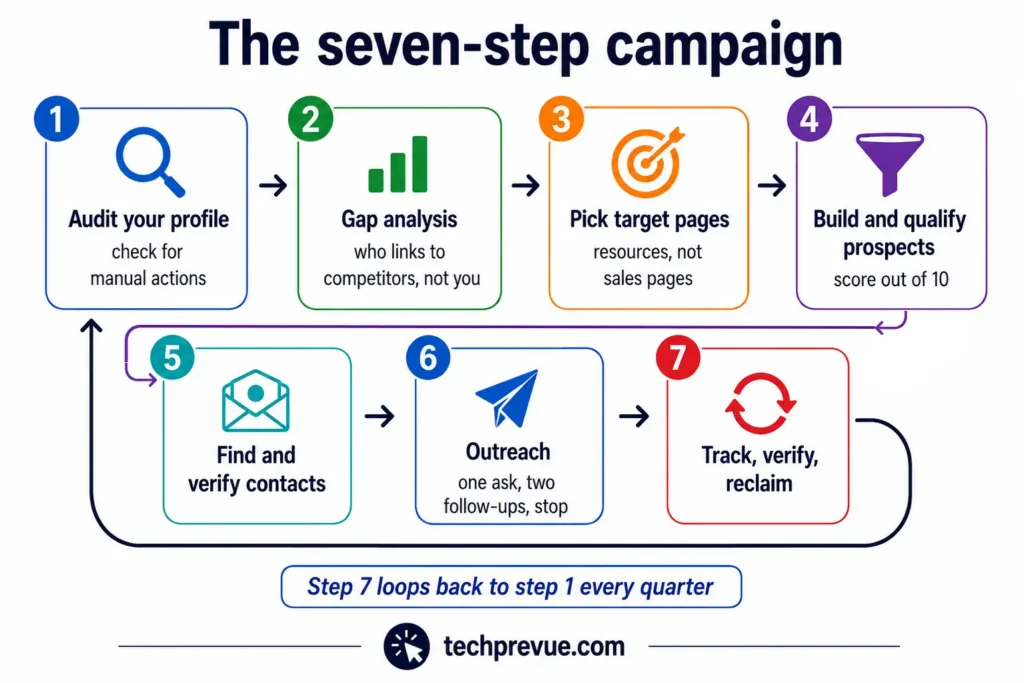
Step 1: Audit Your Existing Backlink Profile
Before acquiring anything, understand what you have.
Pull your full backlink profile and record four things: total referring domains, your anchor text distribution, your followed-to-nofollow ratio, and which pages hold the most links.
Check Search Console for manual actions at the same time. If overall organic performance is the real concern rather than links specifically, work through the technical SEO checklist before spending anything on outreach. If one exists, stop everything else and read the toxic backlinks section below.
What you’re looking for. Anchor distributions skewed toward exact match. Clusters of links from unrelated networks. Strong pages with no internal links pointing outward. Lost links worth recovering.
Step 2: Run a Backlink Gap Analysis
Find sites linking to your competitors but not to you. These prospects have already proven they link to content in your subject area.
Enter your domain alongside three to five competitors in any backlink gap tool. The sites linking to several competitors but not to you are the strongest prospects on the internet for your business.
Sort by relevance before authority. A niche publication linking to four competitors is a better target than a general news site linking to one.
Step 3: Decide Which Pages Deserve Links
Not every page warrants investment. Pick deliberately.
The Linkable Asset to Money Page Model
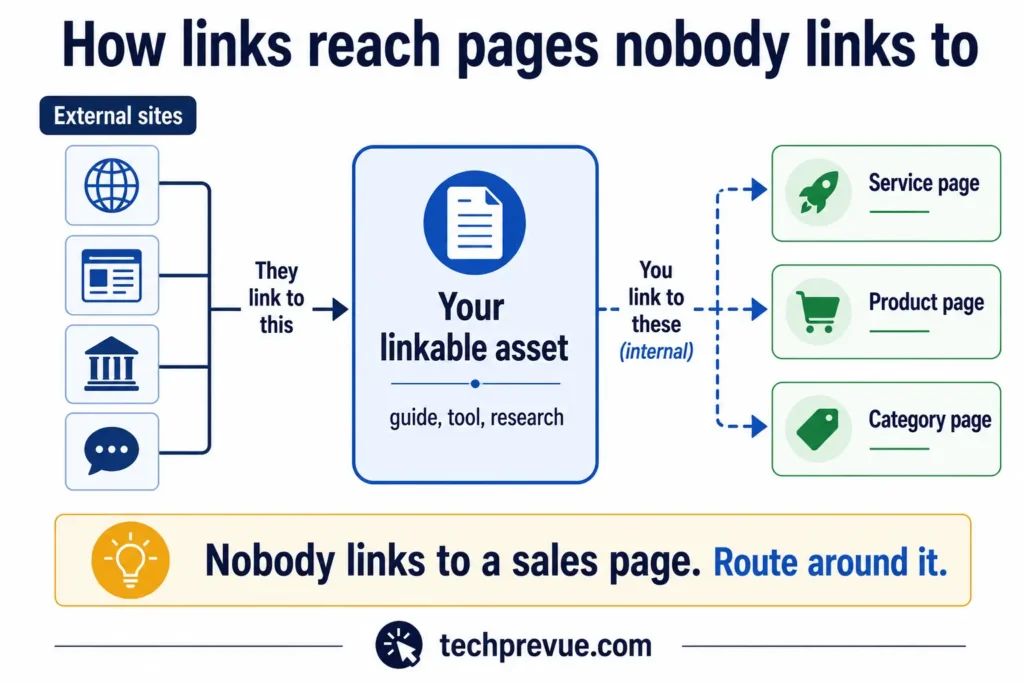
Commercial pages are difficult to build links to because publishers do not link to sales pages. The workaround is structural.
- Build external links to genuinely useful, non-commercial resources
- Link internally from those resources to the commercial pages that need to rank
- Use descriptive anchor text on those internal links
This is why the strategy section put internal linking last but the campaign section puts it first. It is the mechanism that makes everything else pay.
Selection criteria for external targets: pages that solve a problem, contain original information, or serve as a reference. If you cannot articulate why a stranger would link to it, it is not a target.
Step 4: Build and Qualify a Prospect List
Volume without qualification wastes everyone’s time, including yours.
Prospect Qualification Scorecard
Score each prospect out of 10. Pursue 7 and above.
| Check | Points | Why |
|---|---|---|
| Topically relevant to your page | 3 | The largest single value factor |
| Receives real organic traffic | 2 | Confirms the site is alive |
| Links out to external sources | 2 | Confirms they will link at all |
| Published in the last 6 months | 1 | Confirms active editorial |
| Reasonable authority for your tier | 1 | Rough quality filter |
| Not a direct competitor | 1 | They will not link to you |
Anything scoring below 7 goes in a maybe list you never get to. Be honest about that when you build it.
Step 5: Find and Verify Contacts
Generic contact forms have poor response rates. Find the specific person.
Look for the article’s author, the editor for that section, or whoever owns content. Check the site’s team page, then the byline, then professional networks.
Verify every address before sending. Bounced emails damage sender reputation, and a damaged domain reputation quietly kills campaigns that otherwise would have worked.
Step 6: Write Outreach That Gets Replies
The email matters less than the fit, but a bad email wastes a good fit.
What works: a subject line describing the actual content of the email, a first line proving you read their work, one specific request, and a reason the link benefits their readers rather than you.
What fails: flattery about their “amazing blog”, multiple requests in one email, any mention of your domain authority, and attached documents.
Three Outreach Templates
Broken link
Subject: Broken link on your [topic] page
Hi [name] — I was reading your piece on [specific topic] and the link to [resource] in the [section] returns a 404. Looks like [original site] took it down.
We published something covering the same ground: [URL]. Useful as a replacement if you think it fits — either way, wanted to flag the dead link.
[Your name]
Resource page
Subject: Suggestion for your [topic] resources page
Hi [name] — your resources page on [topic] is the most thorough one I’ve found, and I’ve sent it to two colleagues this month.
One gap I noticed: nothing covering [specific subtopic]. We published [URL], which handles it in depth. Worth adding if you agree it fills the gap.
[Your name]
Data citation
Subject: Updated figure for your [topic] article
Hi [name] — you cite [statistic] in your [topic] article, sourced from a 2022 study.
We ran the same analysis this year across [sample size] and got [new figure]. Full methodology here: [URL]. Might be worth updating, since the shift is significant.
[Your name]
A Follow-Up Cadence That Works
Somewhere between a third and 40% of positive responses arrive after a follow-up. Two follow-ups is the ceiling.
| Contact | Timing | Content |
|---|---|---|
| Initial email | Day 0 | Full pitch |
| First follow-up | Day 4 | Two lines, one new detail |
| Second follow-up | Day 12 | One line, close the loop politely |
| Stop | Day 12 | No further contact |
Each follow-up should be shorter than the last, and each should add something rather than repeating the ask.
Step 7: Track, Verify and Reclaim
Getting a yes is not getting a link. Verify placement.
Check that the link exists, points to the right URL, uses the intended attribute, and sits in the body rather than a footer. Roughly one in ten agreed placements never appears or appears incorrectly.
Then monitor. Links get removed during redesigns and content updates, and a monthly lost-link check recovers more than most new outreach.
What to Expect at 30, 90, 180 and 365 Days
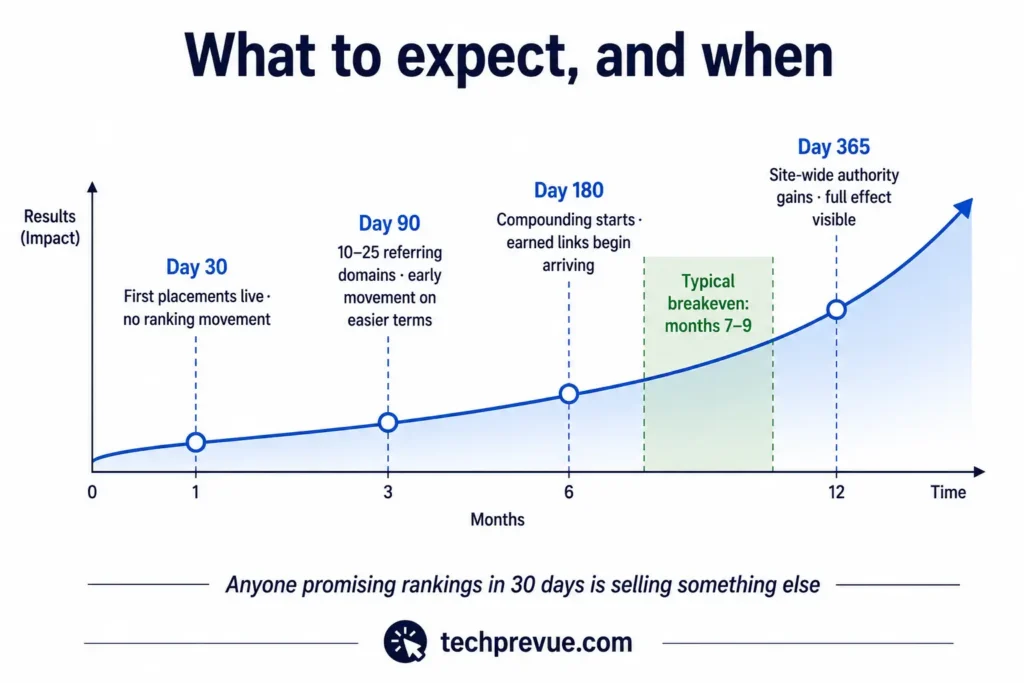
Unrealistic timelines cause more link building campaigns to be cancelled than poor execution does.
| Timeframe | What to expect |
|---|---|
| 30 days | First placements live. No ranking movement. Prospect list built, outreach systems working. |
| 90 days | 10–25 referring domains for a mid-sized campaign. Early ranking movement on lower-competition terms. |
| 180 days | Compounding begins. Clear movement on target terms. Earned links start arriving unprompted if content is strong. |
| 365 days | Full effect visible. Authority gains apply across the site, not only to linked pages. |
Anyone promising ranking changes in thirty days is describing a different product from the one this guide covers.
How to Build an SEO Link Building Strategy That Compounds
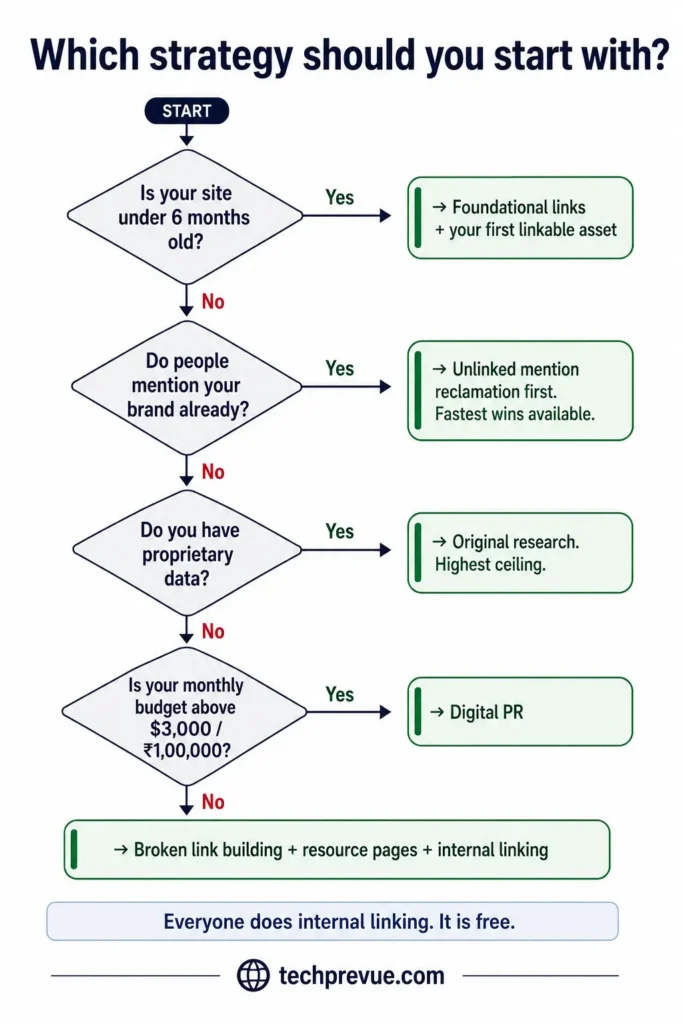
An effective seo link building strategy matches tactics to your site’s current authority, allocates budget between earned and acquired links, and pairs every external link with internal distribution. The right approach for a new domain looks nothing like the right approach for an established one.
Match Your Strategy to Your Site’s Authority Tier
Generic link building advice fails because a tactic that works at one authority level wastes money at another.
Brand-New Site: 0 to 6 Months
Priority: existence and foundation, not authority.
Claim your presence on the platforms a real business in your category occupies — major social networks, relevant industry directories, review platforms, professional associations. Two to three dozen placements, then stop.
Publish your first genuine linkable asset. Set up internal linking properly from the start, since retrofitting it later is far more work.
Do not buy links, run outreach campaigns for pages nobody will link to, or measure authority scores weekly. Nothing will move for months, and watching will only cause bad decisions.
Growing Site: DR 20 to 40
Priority: outreach and earned content, in combination.
You now have enough credibility that outreach gets replies. Run broken link building and resource page campaigns, which convert best at this stage. Publish one substantial linkable asset per quarter.
Start reclaiming unlinked mentions if any exist. Begin building relationships with editors and journalists in your space before you need anything from them.
Budget guide: $1,500–$5,000 a month, or the Indian equivalent, weighted toward content rather than placements.
Established Site: DR 50 and Above
Priority: digital PR and defending what you have.
Outreach returns diminish because you already have links from the obvious prospects. Digital PR and original research reach publications outreach cannot.
Maintenance becomes a real workload. Monitor lost links, audit anchor distributions, and reclaim mentions systematically — established brands accumulate unlinked mentions faster than they can process them.
Internal link architecture matters more here than anywhere. A site with hundreds of linked pages and no deliberate internal structure is wasting most of its accumulated authority.
Set a Link Budget You Can Defend
Work backwards from the gap, not from a number somebody quoted you.
- Identify the pages ranking above you for your priority terms
- Compare their referring domain counts to yours
- Multiply the gap by a realistic cost per link for your market
- Divide by the months you are willing to wait
- Compare that figure to the revenue the ranking would produce
If step five does not comfortably exceed the total in step three, the honest answer is that link building is not your best available investment. That conclusion is unavailable to any vendor selling links, which is why you rarely encounter it.
Reported industry practice puts around a third of total SEO budget into link acquisition. On a $10,000 monthly SEO spend, that is roughly $3,000–$3,600.
The Passive-versus-Manual Split
One agency publicly halted most manual link building after concluding the returns did not justify the cost, then returned to outreach only with a data-led approach. Their reasoning is worth borrowing even if you reach a different conclusion.
Passive acquisition means links arriving because your content ranks and gets found. Manual acquisition means links arriving because you asked.
The trade-off. Passive costs more upfront, returns nothing for months, then compounds indefinitely. Manual returns quickly, costs the same every month, and stops the moment you stop.
A defensible split for most mid-market sites: 60–70% of budget into content and PR that earns links, 30–40% into direct acquisition. Reverse that ratio only if you need short-term movement and can afford to keep paying for it.
Adjusting the Strategy by Business Model
SaaS
Original research and free tools outperform everything else, because your product generates data nobody else has and your engineering team can build utilities.
Integration and comparison pages attract links naturally from partners and reviewers. Community presence on developer platforms increasingly drives AI citation.
Ecommerce
Product pages are the hardest link targets in existence. Build authority through buying guides, sizing and materials resources, and original photography.
Supplier and manufacturer pages often list retailers. Local and category directories retain value here longer than in other verticals.
Local Business
Citations matter more than links. Consistent business information across local directories, chambers of commerce and industry associations does most of the work.
Local news coverage of genuine community involvement outperforms any national link. Sponsoring something real in your city produces links a national campaign cannot buy.
Publisher and Affiliate
Original reporting and reviews based on genuine testing earn links; aggregated content does not. Affiliate sites face additional scrutiny under the thin affiliation policy, so demonstrable first-hand testing is not optional.
Toxic Backlinks: What Google Says and What You Should Actually Do
Google does not have a toxic backlink score. Its systems ignore most spammy links automatically rather than penalising the sites receiving them. Disavowal is an advanced tool for sites with a manual action or clear evidence of large-scale manipulation, not routine maintenance.
This section exists because the gap between what Google says and what tools sell is wider here than anywhere else in link building.
Does Google Have a “Toxic Link” Score?
No. The term was created by SEO software companies as a way to quantify link risk and sell cleanup services.
The metrics you see labelled toxicity, spam score or similar are vendor estimates built from observable patterns. They are not readings from Google’s systems, and no third-party tool has access to Google’s internal ranking or spam classifiers.
This matters practically. A link flagged as toxic by a tool may be entirely harmless, and a genuinely problematic pattern may not be flagged at all. Treat these scores as a triage aid, not a verdict.
Google’s own framing is different. Its spam policies describe manipulative link practices. The concern is what you did, not what happens to point at you.
When Bad Links Actually Hurt You
Two mechanisms exist and they behave completely differently.
Algorithmic Handling versus Manual Action
Algorithmic handling is the default. Google’s automated systems identify manipulated links and discount them. Nothing visible happens to your site. The links simply stop counting.
This covers the overwhelming majority of bad links, including the spam every site accumulates without doing anything wrong. Google has said its systems are designed to prevent spammy links from affecting rankings.
Manual action is different. A human reviewer examines your site, determines that your link profile violates the policies, and applies a penalty. You receive a notification in Search Console, and rankings drop sharply.
The distinction determines your entire response. If no manual action exists, aggressive link cleanup is usually solving a problem you do not have.
How to Check for a Manual Action
- Open Search Console for the property
- Go to Security and Manual Actions, then Manual actions
- Read what it says
“No issues detected” means no manual action. If you see a notice referencing unnatural links to your site, you have one, and the recovery process below applies.
Do this before any link cleanup work. It takes thirty seconds and determines whether the next several weeks of effort are necessary.
How Real Is Negative SEO?
Negative SEO means someone pointing spam links at your site to trigger a penalty. It is real in the sense that people attempt it, and largely ineffective in the sense that it rarely works.
Asked directly how to alert Google to sabotage through harmful links, Google’s Gary Illyes advised ignoring them, on the basis that Google’s systems are good at identifying and disregarding irrelevant or harmful links pointed at a site. He noted that people who feel compelled to act can use the disavow tool or file a spam report.
Read that carefully. The first recommendation is to do nothing. The alternatives are offered as reassurance rather than as advice.
Mueller has separately suggested Google might eventually retire the disavow tool altogether, which tells you something about how necessary Google considers it.
What to do if you spot an attack. Document it. Check for a manual action. If none exists and rankings are stable, take no action. If you see a sudden flood of links with foreign-language or unrelated commercial anchors and rankings fall, then disavowal becomes reasonable.
When to Use the Disavow Tool, and When Not To
Google’s own documentation calls this an advanced feature to be used with caution, and warns that incorrect use can harm your site’s performance in search results.
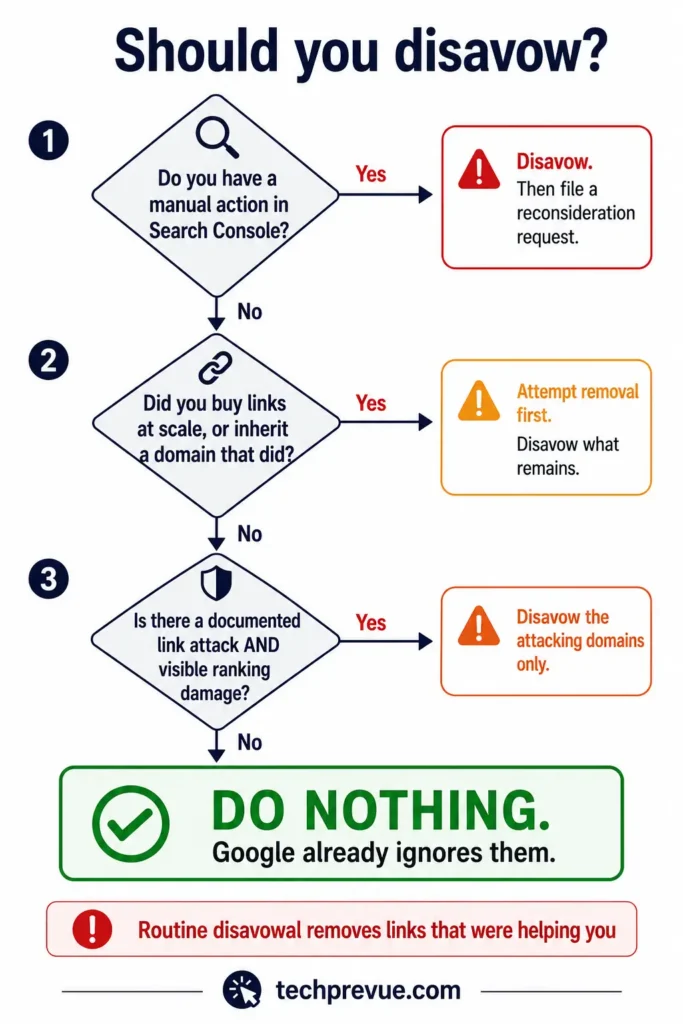
The stated conditions for using it are narrow: a considerable number of spammy, artificial or low-quality links pointing at your site, and confidence that those links are causing you problems.
Use the disavow tool when:
- You have a manual action for unnatural links
- You previously bought links at scale and cannot get them removed
- You inherited a domain with a history of manipulation
- You are under a documented negative SEO attack with visible ranking damage
Do not use it when:
- A tool flagged some links as toxic and nothing else is wrong
- Your traffic dropped and you are looking for a cause
- You accumulated spam links passively, like every site does
- You are doing it as routine housekeeping
That fourth item is the expensive one. Routine disavowal is not maintenance; it is an opportunity to remove links that were helping you.
How to Build a Disavow File Correctly
If you have established that you need one:
- Export your full backlink profile from Search Console and at least one third-party source
- Review manually — no automated tool should make this decision for you
- Attempt removal first by contacting site owners, and document those attempts
- Prefer domain-level entries using the
domain:prefix over individual URLs - Add comment lines with
#explaining your reasoning - Upload the plain text file through the disavow tool
- If a manual action exists, file a reconsideration request describing what you did
The file is a plain .txt document. One directive per line.
Three Mistakes That Make Disavow Files Dangerous
Disavowing by metric. Removing every link below an arbitrary authority score deletes legitimate niche publications, local sites and small blogs — exactly the links that make a profile look natural.
Disavowing on tool output alone. Automated flagging produces false positives at a meaningful rate, and every false positive is a link you voluntarily discarded.
Disavowing without a diagnosis. If you cannot state what problem the file solves, you do not have a problem the file solves.
Recovering from an Unnatural Links Manual Action
If you have a manual action, the sequence is fixed and the standard is high.
- Audit thoroughly. Identify every link that violates the policies, not the easy ones.
- Remove what you can. Contact site owners and request removal. Keep records of every attempt, since Google expects to see genuine effort.
- Disavow the remainder. Domain-level, comprehensive.
- Fix the cause. If an agency built these links, that relationship needs to end before you file anything.
- File a reconsideration request. Describe what happened, what you removed, what you disavowed, and what changed in your process.
- Wait. Reviews take weeks. A rejection means the audit was incomplete.
Recovery typically takes several months, and traffic rarely returns to its previous level immediately. The links that were carrying you are gone, which is the point.
Link Building Tools: Free and Paid
Link building tools handle four jobs: analysing backlink profiles, finding prospects, locating and contacting people, and monitoring mentions and lost links. A free stack covers most of the work for small sites; paid tools mainly buy speed and data depth.
| Job | Free options | Paid options |
|---|---|---|
| Backlink data | Search Console, free backlink checkers | Ahrefs, Semrush, Majestic, Moz |
| Prospecting | Google search operators, Google Alerts | Content research platforms, gap analysis tools |
| Contact finding | Manual site research, professional networks | Hunter, Voila Norbert, Snov |
| Outreach management | Spreadsheet plus email | Pitchbox, BuzzStream, GMass |
| Mention monitoring | Google Alerts | Brand monitoring platforms, Mention, Brand24 |
| AI citation tracking | Manual prompt testing | Dedicated visibility platforms |
Backlink Data and Analysis
Search Console is the only source showing links Google itself has recorded for your site, and it is free. Every third-party dataset is an independent crawl and will differ.
Paid backlink databases are worth the cost when you are analysing competitors, since Search Console only shows your own property. For auditing your own profile, Search Console plus one paid tool is sufficient.
Prospecting and Content Discovery
Search operators do more than most people expect. Combining your topic with resource page phrasing, or searching for pages mentioning your subject within a specific site, surfaces prospects at no cost.
Paid content research platforms matter when your prospect list needs to be thousands of pages rather than dozens. They also apply filters — language, traffic, authority, one result per domain — that would take hours manually.
Email Finding and Outreach Management
Contact finding tools save real time at volume. Verify before sending regardless of the tool’s confidence score.
Outreach management platforms earn their cost above roughly a hundred prospects a month. Below that, a spreadsheet and your normal inbox work fine and cost nothing.
Mention and Alert Monitoring
Google Alerts catches a reasonable share of brand mentions for free and is the single highest-ROI free tool in this list, because unlinked mention reclamation converts better than any outreach tactic.
Paid monitoring catches more, filters better and distinguishes linked from unlinked mentions automatically. Worth it once mention volume exceeds what you can review manually.
The Free Stack That Covers 80% of the Job
For a small site or a solo operator:
- Search Console for your own link data and manual action checks
- Google Alerts for brand mentions
- Search operators for prospecting
- A free backlink checker for quick competitor snapshots
- A spreadsheet for prospect tracking and outreach status
- Your email client for sending
This stack costs nothing and handles everything except competitor backlink analysis at depth.
Which Tools Make Sense on an Indian Budget
Full-price subscriptions to major platforms run ₹8,000–₹40,000 per month, which is difficult to justify for a small agency or a solo consultant.
Practical alternatives, in order of value per rupee:
- Search Console and Google Alerts, free, non-negotiable
- A single mid-tier backlink tool rather than three premium ones
- Trial periods used deliberately for one-off competitive audits
- Shared agency subscriptions where terms permit
- Free tiers of contact-finding tools, which typically allow enough monthly lookups for a small campaign
The temptation is to buy link building tools before you have a process. The reverse order works better. A documented prospecting and outreach process with free tools outperforms a premium subscription with no process.
Link Building Services, Agencies and Packages: How to Buy Without Getting Burned
Link building services range from bulk placement vendors selling guest posts at a fixed price to digital PR agencies earning editorial coverage. The delivery model matters more than the price, and the questions below separate the two.
What Link Building Services Actually Sell
Understanding what you are buying is most of the battle in link building. Providers fall into four categories, and they are not interchangeable.
| Model | What you get | Typical cost per link | Compliance |
|---|---|---|---|
| Bulk placement vendor | Guest posts and link insertions on a fixed network | $50–$250 | Violates policy |
| Managed outreach agency | Prospecting, outreach and negotiation on your behalf | $250–$700 | Mixed |
| Digital PR agency | Story creation and journalist relationships | $600–$2,000+ | Compliant |
| Content and SEO agency | Linkable assets plus promotion | Priced by retainer | Compliant |
An seo link building service quoting a fixed price per link with a guaranteed volume is almost always operating in the first category, whatever the proposal says. Editorial links cannot be guaranteed, because a third party decides.
That single fact — guarantees are impossible for compliant links — is the most reliable diagnostic available to a buyer.
How to Hire a Link Building Agency
Choosing a link building agency is mostly an exercise in filtering. The market contains far more vendors than good ones, and the bad ones are better at sales.
12 Questions to Ask Before You Sign
- Which specific sites have you placed links on in the last quarter for clients in my sector?
- Do you pay publishers for placements? If so, how is that disclosed?
- What is your process for qualifying a prospect?
- Who writes the content, and what are their credentials?
- What reply rate do your campaigns achieve, and on what volume?
- How do you handle a publisher who requests payment mid-negotiation?
- What happens if a link is removed after placement?
- Do you guarantee link counts? If yes, how, given publishers decide?
- How do you report, and can I see a sample report before signing?
- What would make you tell a prospective client not to hire you?
- How do you track whether placements appear in AI-generated answers?
- Can I speak to a client who left, not just current ones?
Question 10 is the most revealing. An agency that has never turned away a client is optimising for revenue, not results.
Question 11 is newly relevant. Providers still measuring only domain authority are working from a 2022 model of what a placement is worth.
Red Flags That Should End the Conversation
- Guaranteed link counts or guaranteed rankings. Neither is within their control.
- Fixed per-link pricing across all publishers. Implies a purchased network.
- A private list of sites they cannot show you until you pay. They can show you. They don’t want to.
- Turnaround under two weeks for editorial placements. Real editorial processes take longer.
- No questions about your business. Anyone who can quote before understanding your sector is selling inventory, not strategy.
- Metric-only reporting. Domain authority averages with no publisher names, traffic figures or context.
- Pressure to sign quickly. Discounts expiring on Friday are a sales technique, not a pricing structure.
How Link Building Packages Are Priced
Link building packages are usually sold three ways: per link, as a monthly retainer with a target volume, or as a project fee for a campaign. Per-link pricing is the most common and the least aligned with your interests, because it rewards volume over quality.
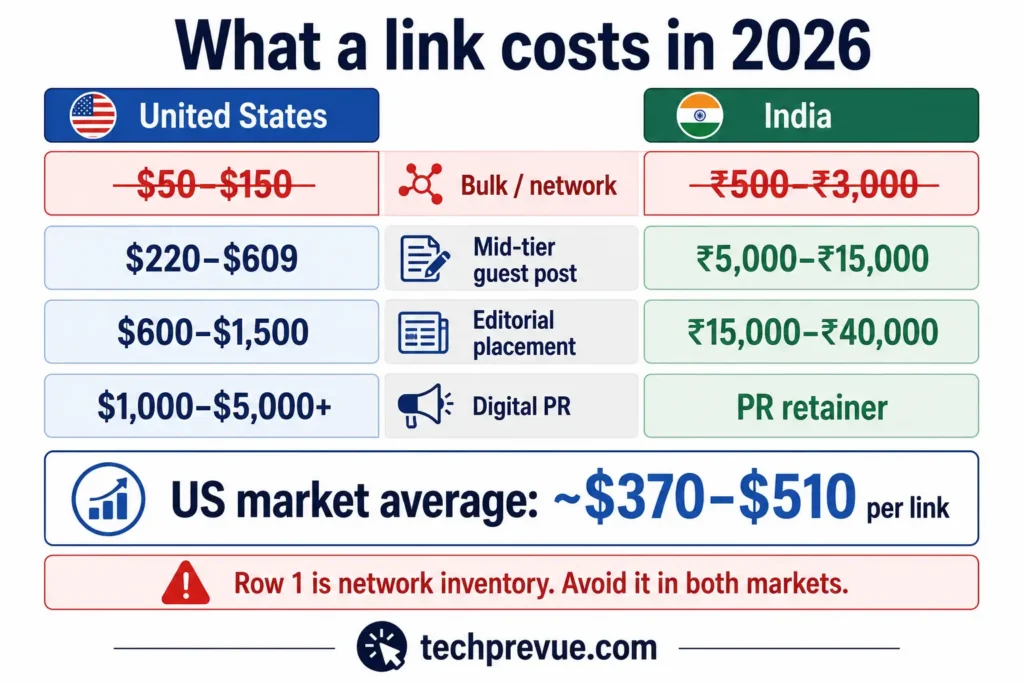
US Pricing Benchmarks
Multiple independent 2026 datasets converge on similar ranges.
| Tier | Typical cost per link | What it buys |
|---|---|---|
| Low quality (DR 20–40) | $50–$150 | Network sites, minimal traffic |
| Mid tier (DR 30–50 guest post) | $220–$609 | Real sites, variable editorial standards |
| Link insertions | Around $141–$361 | Placement in existing indexed articles |
| Editorial (DR 50+) | $600–$1,500 | Genuine publications |
| Top tier digital PR | $1,000–$5,000+ | National and trade press |
Reported market averages for a quality backlink cluster around $370–$510, up substantially from roughly $350 in 2022. A majority of surveyed practitioners report willingness to pay above $300, and close to half above $500.
Monthly retainers commonly run $3,000–$12,000 for agencies targeting tier-one publications, with $1,500–$3,000 as a realistic floor for small campaigns.
India Pricing Benchmarks
The Indian market has a wider spread and considerably more variance in what a given price delivers.
| Tier | Typical cost per link (INR) | Notes |
|---|---|---|
| Bulk and directory packages | ₹500–₹3,000 | Almost always network inventory; avoid |
| Mid-tier Indian publisher guest post | ₹5,000–₹15,000 | Quality varies enormously |
| Established Indian publication | ₹15,000–₹40,000 | Genuine editorial, real readership |
| National Indian media, earned | ₹40,000+ or PR retainer | Usually not sold per link |
| International placement via Indian agency | ₹25,000–₹1,00,000 | Priced close to US rates |
Entry-level monthly packages advertised from around ₹15,000–₹20,000 exist in volume. Understand what they contain: at that price point, links are coming from a network, not from outreach.
Serious Indian retainers for genuine outreach and digital PR run ₹1,00,000–₹5,00,000 per month, which is where the delivery model actually changes.
The arbitrage worth understanding. Indian agencies serving US and UK clients combine international publisher relationships with lower delivery costs. This is legitimate and often excellent value. What is not legitimate is the same agency selling Indian clients recycled network links at a discount, which is common.
Should You Outsource Link Building or Hire In-House?
The decision to outsource link building comes down to volume, permanence and whether you can hire the specific skills involved.
In-House versus Agency versus Freelancer
| In-house | Agency | Freelancer | |
|---|---|---|---|
| Monthly cost, US | $3,000–$8,000 fully loaded | $1,750–$12,000 | $1,000–$4,000 |
| Monthly cost, India | ₹40,000–₹1,20,000 | ₹50,000–₹5,00,000 | ₹25,000–₹80,000 |
| Ramp time | 3–6 months | 2–4 weeks | 2–4 weeks |
| Publisher relationships | Built from scratch | Already exist | Varies wildly |
| Institutional knowledge | Stays with you | Leaves with the contract | Leaves immediately |
| Quality control | Full | Requires active auditing | Requires active auditing |
| Best for | Sustained long-term programmes | Speed and existing relationships | Specific tactics at low volume |
Roughly half of surveyed SEO practitioners outsource at least part of their link acquisition, which reflects a real constraint: the tools cost the same whether you have one client or twenty, and publisher relationships take years to build.
A hybrid model works for most mid-market teams. Keep strategy, content and internal linking in-house. Outsource the outreach labour and the digital PR relationships.
Do not outsource the decision about which pages to build links to, or the final quality review of delivered placements. Those are your risk, not theirs.
How to Audit the Links an Agency Delivered
Check every reported placement against six criteria. This takes about two minutes per link and is the difference between paying for links and paying for the appearance of links.
- Does the link exist? Load the page and find it.
- Is the page indexed? Search for the URL directly.
- Does the page get traffic? Check any traffic estimate tool.
- Is the link in the body? Not the footer, sidebar or author bio.
- Is the attribute correct? View source and check for
nofolloworsponsored. - Would a reader plausibly click it? If the surrounding paragraph makes no sense, the link was inserted for you, not for the audience.
Any placement failing three or more of these should be raised with the provider. A pattern of failures across a month’s delivery is grounds to end the engagement.
Link Building in India versus the United States: What Changes
The link building mechanics are identical. What differs is the publisher landscape, the price of a placement, the proportion of the market selling network inventory, and the value of regional-language and local opportunities that no US-focused guide covers.
Publisher Landscape and Price Differences
The US market has depth. Thousands of niche publications, trade press outlets and independent blogs accept contributed content and cover industry stories.
Most link building SEO advice assumes a US publisher landscape, and that assumption breaks the moment you apply it here. The Indian market is more concentrated. A smaller number of large national outlets sit above a long tail of regional and category publications, with less in between.
The practical consequence. In the US, mid-tier outreach at scale is viable because there are enough mid-tier targets. In India, the same approach exhausts genuine prospects faster, which pushes campaigns either upward into national media or downward into network inventory.
Choose upward. The downward path is where most Indian link building budgets disappear.
Regional-Language and Local Citation Opportunities
This is the clearest structural advantage available to Indian sites and almost nobody uses it.
Hindi, Tamil, Telugu, Bengali, Marathi and Kannada publications have real audiences, real editorial standards and dramatically less competition for coverage. A pitch to a regional business publication faces a fraction of the competition an English-language national pitch does.
Where this pays. Businesses serving specific states or cities. Consumer brands with regional distribution. Any company with a story that matters locally more than nationally.
Where it doesn’t. B2B SaaS selling internationally, where the audience overlap is minimal.
Local citations also carry more weight in India than most guides suggest, because local search results are less mature and consistent business information across regional directories still moves the needle.
Indian Directories and Listings That Still Carry Weight
Directory submission has a bad reputation earned by a decade of bulk packages. A small number of Indian listings remain genuinely useful, and they are useful for the same reason directories were originally useful: people check them.
Focus on platforms with real user traffic and human editorial review — established business listing services, industry associations relevant to your sector, chamber of commerce listings for your city, and category-specific marketplaces where your customers actually search.
Ignore anything sold as a package of hundreds of submissions. Those are the low-quality directory links Google’s spam policies name explicitly.
The honest framing: these are entity and citation signals, not ranking levers. Do about twenty of them properly and stop.
Digital PR in India: Earned Coverage versus Paid Placement in Disguise
Indian digital PR contains a structural complication worth naming plainly. Paid placement in editorial-looking coverage is normalised across a large part of the market, including at outlets with substantial reputations.
This creates a specific risk. You commission what you believe is a PR campaign, receive coverage that reads editorially, and have in fact bought placements that Google’s policies would classify as paid links — often unmarked.
How to tell the difference before you commit.
- Ask directly whether placement fees are paid to publications. A PR agency earning genuine coverage will say no without hesitation.
- Ask what happens if no outlet picks up the story. Genuine PR carries that risk; paid placement does not.
- Check whether delivered links carry
sponsoredornofollow. Unmarked paid placements are the violation. - Ask for the pitch, not just the result. Earned coverage has a pitch behind it.
Genuine Indian digital PR exists and produces excellent results. It costs considerably more than the paid-placement alternative, which is precisely why the alternative dominates.
Traps Specific to the Indian Link Market
- Recycled network inventory sold as outreach. The same fifty domains appear across dozens of clients. Ask for a sample of recent placements and check for overlap.
- Metric-inflated domains. Sites with purchased authority scores and no organic traffic. Always check traffic, not just authority.
- “Do-follow guaranteed” packages. A guarantee of the attribute means the attribute was negotiated, which means it was bought.
- Bulk regional-language content mills. Regional publications are an opportunity; regional content farms are not the same thing.
- International clients, domestic shortcuts. Some agencies deliver genuine outreach for foreign clients and network links for Indian ones. Ask for placement samples from clients in your own market.
How to Measure Link Building Results
Track referring domains rather than total links, anchor text distribution, referral traffic from placements, ranking movement on the specific pages you built links to, and — increasingly — whether those placements appear in AI-generated answers.
The Metrics That Matter, and the Ones That Don’t
| Metric | Worth tracking? | Why |
|---|---|---|
| Referring domains | Yes | The closest proxy for genuine endorsement breadth |
| Total backlinks | No | One site linking a thousand times is still one endorsement |
| Anchor text distribution | Yes | Early warning for over-optimisation and negative SEO |
| Referral traffic per placement | Yes | The only benefit needing no algorithmic cooperation |
| Ranking movement on target pages | Yes | The actual objective |
| Domain authority score | Loosely | Directional only, and not a Google metric |
| Links acquired per month | Only internally | A workload metric, not an outcome |
The distinction between referring domains and total backlinks catches out more reports than any other, and it is the most common way backlink building results get inflated. An agency reporting “340 new backlinks” from eleven domains has delivered eleven results.
Building a Simple Reporting Dashboard
Six lines are enough for most businesses, reviewed monthly.
- New referring domains this month, with publisher names
- Lost referring domains this month, with reasons
- Anchor text distribution, compared to last quarter
- Referral sessions from placements
- Average position for the pages targeted
- Cost per referring domain acquired
Line six is the one agencies rarely volunteer, and the one that tells you whether the programme is working.
Attributing Revenue to Links
Direct attribution is impossible. Directional attribution is not.
Track the pages you built links to as a cohort. Compare their organic traffic and conversion trajectory against a matched cohort of pages you did not build links to. The difference over six months is your best available estimate.
Add referral revenue separately, since it is directly measurable and consistently underreported.
Reported median SEO returns are high, but the breakeven window commonly runs seven to nine months. Any evaluation at thirty days measures nothing.
Tracking AI Citations Alongside Backlinks
This belongs in link building reporting now, and most templates have not caught up.
A workable manual method. Build a list of twenty questions a customer might ask an AI assistant in your category. Run them monthly across the major assistants. Record whether your brand appears, whether it is cited with a link, and which competitors appear instead.
That is thirty minutes a month and produces a trend line. Dedicated platforms automate it if the volume justifies the cost.
Google’s own generative AI performance report in Search Console shows how content performs in its AI features, which is the only first-party data available on this.
Two cautions. Results vary substantially between assistants — a domain appearing in one may be absent from another, and overlap between platforms is limited. And be sceptical of any tool claiming access to internal ranking or AI systems, because none has it.
12 Link Building Mistakes That Waste Budget
These are the link building SEO mistakes that turn up most often when auditing an existing programme, with the fix for each.
1. Chasing authority scores instead of readers. Buying placements on high-DR sites with no traffic. Fix: check organic traffic before authority on every prospect.
2. Building links to pages nobody would link to. Running outreach for a service page. Fix: build links to resources, then pass authority internally.
3. Dictating anchor text. Requesting exact-match phrases in outreach. Fix: let publishers choose; audit your distribution quarterly.
4. Treating volume as the goal. Reporting link counts as progress. Fix: measure referring domains and ranking movement on target pages.
5. Ignoring internal links entirely. Spending thousands externally while strong pages link nowhere. Fix: audit internal linking before the next external campaign.
6. Disavowing routinely. Uploading files because a tool flagged something. Fix: check for a manual action first; if none exists, do nothing.
7. Guest posting on unrelated high-authority sites. Exactly what the site reputation abuse policy targets. Fix: only pitch publications whose readers want the article.
8. Buying links without understanding what you bought. Accepting unmarked paid placements as “outreach”. Fix: ask providers directly whether they pay publishers.
9. Abandoning campaigns at ninety days. Cancelling before the compounding window. Fix: commit to six months or don’t start.
10. Never reclaiming what you lost. Ignoring removed links and unlinked mentions. Fix: monthly lost-link review, quarterly mention sweep.
11. Copying a competitor’s link profile blindly. Replicating placements that may not be working for them either. Fix: use gap analysis for prospecting, not as a target.
12. Optimising only for links in an AI-answer world. Ignoring mentions, reviews and community presence. Fix: reweight budget toward activities that produce both.
Your Link Building Checklist
Monthly
- [ ] Review new referring domains and record publisher names
- [ ] Review lost links and attempt recovery where the page still exists
- [ ] Sweep for unlinked brand mentions and request links
- [ ] Send outreach for the current campaign and log responses
- [ ] Verify all placements agreed in the previous month
- [ ] Run AI assistant visibility spot-checks across your question list
- [ ] Check referral traffic from recent placements
Quarterly
- [ ] Full anchor text distribution audit
- [ ] Backlink gap analysis against your three closest competitors
- [ ] Internal link audit: orphaned pages, broken links, missing paths to money pages
- [ ] Review cost per referring domain against target
- [ ] Refresh your statistics and reference pages
- [ ] Review agency or freelancer delivery against the six-point audit
Annually
- [ ] Check for manual actions in Search Console
- [ ] Review whether your link budget still beats alternative investments
- [ ] Reassess your passive-versus-manual split
- [ ] Publish or refresh at least one substantial linkable asset
- [ ] Re-audit every external partner relationship
Frequently Asked Questions About Link Building
What is link building in SEO?
Link building in SEO is the practice of acquiring hyperlinks from other websites to your own so that search engines can discover your pages and assess their credibility. It sits within off-page SEO and includes both earned links and links acquired through deliberate outreach.
What is a link building campaign?
A link building campaign is a defined effort to acquire links to specific pages within a set timeframe, using chosen tactics and measured against stated goals. A typical campaign runs three to six months and covers prospecting, outreach, placement verification and reporting.
What is link building strategy?
A link building strategy is the plan governing which pages you build links to, which tactics you use, how you split budget between earning and acquiring, and how internal linking distributes the resulting authority. Strategy differs by site authority, business model and market.
What is broken link building?
Broken link building means finding dead links on other websites, creating or identifying suitable replacement content on your own site, and contacting the site owner to suggest the swap. It converts better than cold outreach because you are reporting a problem before making a request.
What is PBN link building?
PBN link building uses a private blog network — a group of sites, often built on expired domains, created solely to link to a target site. Google names expired domain abuse in its spam policies and detects network footprints reliably, so this now carries real penalty risk.
How to outsource link building?
Define which pages need links and keep that decision in-house. Ask prospective providers whether they pay publishers, request recent placement samples, and reject guaranteed link counts. Audit every delivered link against indexation, traffic, placement and attribute before approving payment.
How many backlinks do I need to rank on page one?
There is no fixed number. It depends entirely on how many the current top results have and how strong your content is by comparison. Compare referring domain counts for the pages ranking above you, then judge whether closing that gap is affordable.
How long does link building take to show results?
Expect first placements within thirty days, early ranking movement around ninety days, and clear compounding effects between six and twelve months. Breakeven on investment commonly lands in the seven-to-nine-month range.
Are nofollow links worth getting?
Yes. They send referral traffic, build brand familiarity and keep your profile looking natural. Google treats the attribute as a hint rather than an absolute directive, and a profile containing only followed links is itself a suspicious pattern.
Is link building still relevant in 2026?
Yes, with reduced weight. Google has stated links are not among its top three ranking factors and that it needs very few links to rank pages. They remain the clearest third-party signal of credibility and still differentiate competitive results.
What is the difference between link building and link earning?
Link building covers any deliberate activity aimed at acquiring links, including outreach. Link earning describes links arriving without you asking, because something you published was worth citing. Earning has a higher fixed cost and an unlimited ceiling; building has the reverse.
How much does link building cost?
In the US, quality placements run $150–$1,500 per link, with reported market averages near $370–$510 and retainers between $3,000 and $12,000 monthly. In India, genuine placements run ₹5,000–₹40,000, with serious outreach retainers from ₹1,00,000 monthly.
Can backlinks hurt my website?
Rarely. Google’s systems discount most manipulative links automatically rather than penalising the recipient. Harm typically requires a manual action for unnatural links, which follows deliberate large-scale manipulation rather than passive accumulation of spam.
Do I need to disavow bad backlinks?
Usually not. Google’s documentation restricts the tool to sites with a considerable volume of artificial links that are demonstrably causing problems. Check Search Console for a manual action first — if none exists and rankings are stable, take no action.
Do backlinks help my brand appear in ChatGPT and AI Overviews?
Indirectly. Links improve rankings, and rankings make pages retrievable by generative systems. Once past that threshold, brand mentions and clear content structure matter more. Google explicitly advises against pursuing inauthentic mentions to game this.
The Bottom Line: Build the Kind of Site People Want to Cite
Strip away the link building tactics and one question decides everything: is there a reason for someone to reference your site?
If the answer is yes, most of this guide becomes execution detail. Outreach works because the thing you’re pitching deserves attention, and PR works because you have something to say.
Links then arrive without asking, because people found something worth pointing at.
If the answer is no, none of it works for long. You can buy placements, and they will be ignored or devalued. You can run outreach, and it will be deleted. The tactics are not the problem.
That is also why Google has been comfortable telling everyone that links matter less. They have not stopped valuing endorsement — they have gotten better at telling the difference between an endorsement and a transaction.
So the practical instruction is the boring one. Publish things that are hard to replicate. Say things nobody else in your category is saying. Show up where your industry talks. Fix your internal linking, because it is free and you already own it.
The links follow. They always did.
