
Your teenager lives online. School, friendships, entertainment, even first relationships — all of it now runs through a screen. Most of that is harmless. Some of it is genuinely valuable.
But some of it is not. And the risky parts rarely look risky at first.
So why is the internet dangerous for teenagers, and which threats deserve your attention first? This guide explains why internet dangers for teenagers work the way they do — not just a scary list — then walks through the eleven online risks for teens that matter most and what you can do about each one.
Quick Answer: The internet is dangerous for teenagers because it combines anonymous strangers, algorithm-driven recommendations, and permanent digital records with a teen’s still-developing judgment. The most serious online risks for teens are cyberbullying, sextortion, online grooming, scams, harmful viral content, and social media pressure. The best protection is a mix of open conversation, transparent monitoring, and strong privacy settings — not secret surveillance.
- What Makes the Internet Dangerous for Teenagers?
- 1. Cyberbullying: Harassment That Follows Teens Home
- 2. Sexting and Sextortion: The Fastest-Growing Threat
- 3. Online Grooming and Predators
- 4. Catfishing and Fake Identities
- 5. AI-Generated Fake Images and Deepfakes
- 6. Digital Footprint and Reputation Damage
- 7. Scams, Phishing and Account Theft
- 8. FOMO, Pressure and Mental Health
- 9. Oversharing and Location Privacy
- 10. Dangerous Viral Challenges and Harmful Communities
- 11. Misinformation and Fake News
- Warning Signs Your Teen May Be in Trouble Online
- How to Report Online Abuse: US and India
- FAQ: Why the Internet Is Dangerous for Teenagers
- Final Note
Raising a younger child? The risks look different before age 13. See our guide to the dangers of the internet for kids under 13.
What Makes the Internet Dangerous for Teenagers?
The internet itself is a tool. What makes it dangerous for teenagers is how four of its features interact with adolescence.
Anonymity hides identity. Anyone can create a profile claiming to be anyone. A “15-year-old girl” in a gaming chat may be a 40-year-old man. Teens tend to take online identities at face value, and predators, scammers, and bullies all rely on that.
Algorithms decide what your teen sees. Recommendation systems are built to maximize watch time, not wellbeing. One video about dieting can snowball into a feed full of extreme weight-loss content. One angry post can pull a teen into an outrage spiral. The teen didn’t choose that content — the algorithm did.
Nothing truly disappears. Screenshots outlive “disappearing” messages. A photo shared once can be saved, forwarded, and reposted forever. Teens make impulsive choices; the internet makes those choices permanent.
Access is unlimited and always on. The phone is in their pocket at 2 a.m. Bullying follows them home. Strangers can reach them in their bedroom. There is no closing time.
None of this means your teen is doomed. It means the risks below deserve a plan, not panic.
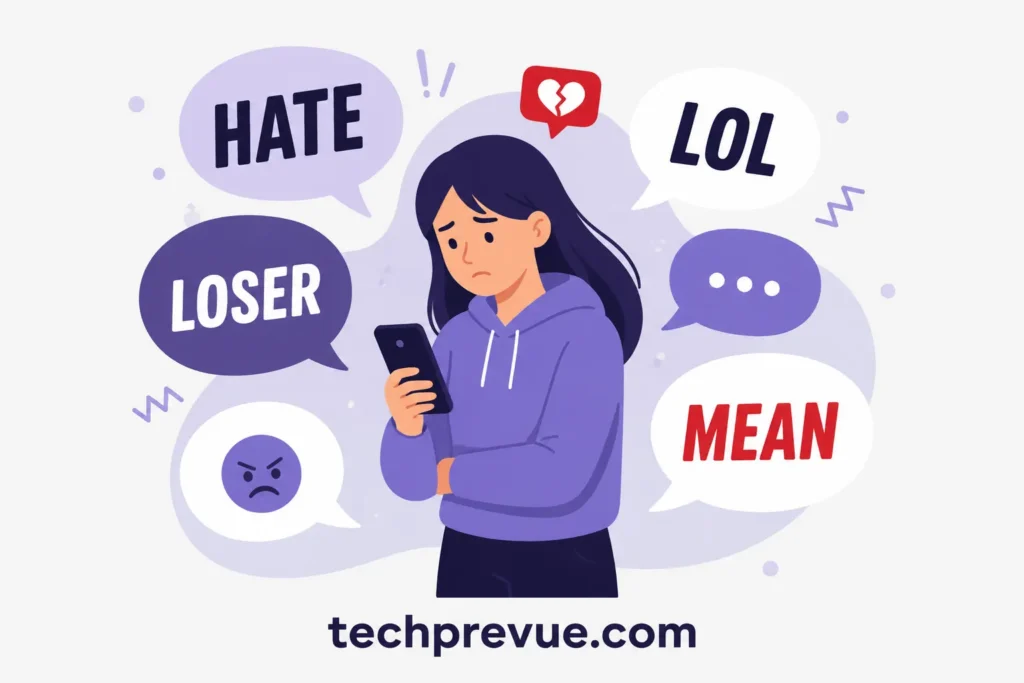
1. Cyberbullying: Harassment That Follows Teens Home
The danger: Cyberbullying is deliberate, repeated harassment through messages, group chats, posts, or gaming platforms. Unlike playground bullying, it runs 24/7 and often stays invisible to adults. It is also extremely common: the Cyberbullying Research Center’s 2025 survey found that 58% of US teens aged 13–17 have experienced cyberbullying at some point — and boys now report slightly higher rates than girls. In India, official NCRB data recorded a 32% rise in cybercrime against children in a single year.
Many teens stay silent because they fear losing their phone if they tell you.
What you can do: Make one promise out loud: “If something bad happens online, you will not lose your phone for telling me.” Then, if bullying happens — save screenshots as evidence, block the bully, report the account on the platform, and involve the school if classmates are behind it. Escalate to police only for threats of violence.
2. Sexting and Sextortion: The Fastest-Growing Threat
The danger: Sexting — sharing sexually explicit images or messages — feels private to teens using vanish mode on Instagram or Snapchat. It isn’t. A 2026 study in the Journal of Adolescent Health found that nearly half of teens who sent an intimate image were later targeted with sextortion: threats to publish the image unless the victim sends money, more images, or complies with demands.
Sextortion is exploding. The National Center for Missing & Exploited Children received about 1.4 million online enticement reports in 2025 — a 156% jump in one year. Financial sextortion overwhelmingly targets teenage boys, usually through fake accounts posing as interested girls. The FBI has repeatedly warned that the shame involved can have devastating consequences, which is why your reaction matters more than any filter.
What you can do: Talk about sextortion by name before it happens. Agree on a family rule: no intimate images, ever, for anyone — and if something has already been shared, come to you immediately, no punishment. If it happens: do not pay, do not delete the chats (they are evidence), block the account, and report it (see the reporting section below). In the US, federal law now requires platforms to remove non-consensual intimate images — including AI-generated ones — within 48 hours of a valid request via Take It Down.
3. Online Grooming and Predators
The danger: Grooming rarely looks like danger. It looks like friendship. Online predators pose as peers on Instagram, Snapchat, Discord, and gaming platforms, then spend weeks building trust — compliments, gifts, in-game currency, “you’re so mature.” Then come requests for secrecy, private chats on encrypted apps, and eventually images or meetings.
The pattern to teach your teen: anyone who asks you to keep the relationship secret from your parents is a red flag, full stop.
What you can do: Ask about online friends the way you’d ask about school friends — casually and often. Watch for a new “friend” your teen is secretive about, gifts or game credits from someone you don’t know, or a sudden switch to encrypted or vanish-mode apps. If you suspect grooming, don’t confront the predator; preserve the messages and report (details below).
4. Catfishing and Fake Identities
The danger: Catfishing is building a fake identity — stolen photos, invented life — to start a relationship. For teens exploring first romances online, a catfish can extract personal information, intimate images, money, or simply cause deep emotional harm. Catfishing is also the standard opening move of both romance scams and sextortion.
What you can do: Teach the two-check habit: reverse-image-search profile photos, and insist on a live video call early — with a parent nearby — before trusting any online-only relationship. A person with endless excuses to avoid video is hiding something.
5. AI-Generated Fake Images and Deepfakes
The danger: Teens no longer need to share a real photo to be victimized. Free AI tools can fabricate realistic intimate images from an ordinary school photo, and these fakes are used for bullying and sextortion. Reports of AI-generated child sexual abuse material have grown explosively in the last two years, and schools worldwide have already dealt with classmate-made deepfake cases.
What you can do: Tell your teen this exists — most victims are blindsided. Keep social profiles private and limit publicly visible photos. If a fake image appears: it is not your teen’s fault, it is illegal in a growing number of jurisdictions, and removal tools like Take It Down accept AI-generated imagery. Preserve evidence and report to the platform and police.
6. Digital Footprint and Reputation Damage
The danger: Colleges and employers search applicants. A joke post at 15 can resurface at 22. Teens underestimate this because consequences feel abstract — until an admissions officer or recruiter finds the post.
What you can do: Run a “Google yourself” session together twice a year. Teach the billboard test: never post anything you wouldn’t put on a billboard with your name on it. Set accounts to private, and clean up old posts together rather than lecturing about them.
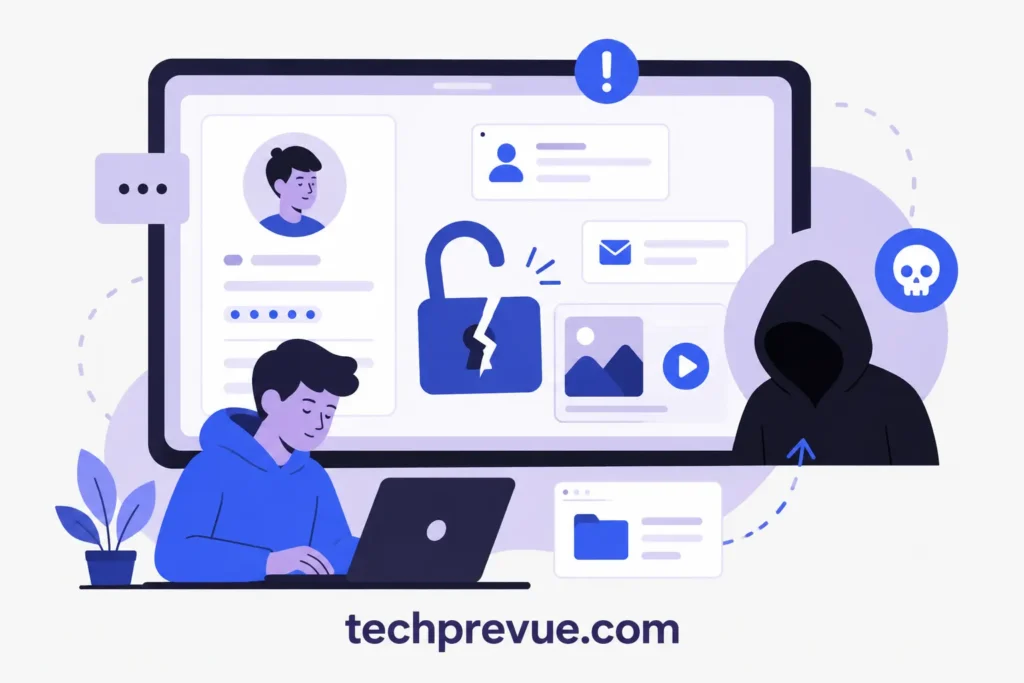
7. Scams, Phishing and Account Theft
The danger: Teens are prime scam targets because they combine confidence with inexperience. The common patterns: fake giveaways and “free” game currency, phishing links that steal passwords, job and influencer-collab scams, and account-recovery cons. In India, OTP and UPI scams are a particular threat — a teen “verifying” a code on a parent’s phone can empty a bank account. Teens also make attractive identity-theft targets because their clean credit goes unmonitored for years.
What you can do: Three rules cover most cases: never share an OTP with anyone, free game currency from strangers is always fake, and any message creating urgency (“act in 10 minutes!”) is a scam until proven otherwise. Turn on two-factor authentication for every account, and use unique passwords with a password manager.
8. FOMO, Pressure and Mental Health
The danger: Feeds are highlight reels. Teens compare their real lives to friends’ curated vacations, bodies, and parties — and the fear of missing out keeps them scrolling at 1 a.m. Heavy social media use is consistently associated with poorer sleep, lower mood, and higher anxiety — among the most studied negative effects of the internet on teenagers — and algorithm-driven feeds can steer vulnerable teens toward harmful content about body image and self-harm. Learn more about why is social media dangerous for teens.
What you can do: Focus on structure, not shame. Set clear screen time boundaries: phones out of the bedroom overnight (charge them in the kitchen), no screens during meals — and model those rules yourself. Talk about how algorithms and filters work — teens respect being treated as savvy media consumers. If you see persistent low mood, withdrawal, or sleep problems, involve your family doctor; screen limits alone are not a mental-health treatment.
9. Oversharing and Location Privacy
The danger: Live location on Snap Map, geotagged photos, a school uniform visible in a story — small details add up to a map of your teen’s daily routine. Combined with an open followers list, that’s exactly the information a stalker or predator needs. Cyberstalking often starts with information the victim shared voluntarily.
What you can do: Audit privacy settings together each school term: location sharing off or friends-only, private accounts, followers pruned to people they actually know. Agree that posting happens after leaving a location, not during. Frame it as controlling their own information, not as parental restriction.
10. Dangerous Viral Challenges and Harmful Communities
The danger: Some viral trends dare teens into risky stunts for views, and the mix of peer pressure and algorithm boosts spreads them fast — several challenges have caused serious injuries worldwide. Alongside them sit harmful communities: accounts and content streams that normalize extreme dieting, self-harm, or extremist ideas. To a teen who feels isolated, these spaces can feel like belonging — which is exactly what makes them dangerous. Some dealers now even market pills openly through social apps, often counterfeit.
What you can do: Talk about what’s trending at school; teens usually know which challenges are reckless but join for status, and naming that dynamic out loud weakens it. If you notice content promoting extreme dieting or self-harm in their feed, don’t just confiscate the phone — reset the recommendations together (most platforms let you clear watch history and mark content “not interested”), and treat it as a prompt to check in on how they’re really doing. If your teen seems drawn toward these communities, involve a counselor or doctor early rather than waiting.
11. Misinformation and Fake News
The danger: Most teens now get news from creators and feeds, where false claims travel faster than corrections — and AI-generated images and videos make fakes more convincing every year. Misinformation shapes real decisions: bogus health advice, “guaranteed” money schemes, and conspiracy content engineered to hook exactly the curiosity teenagers have. A teen who can’t evaluate sources is exposed on every other risk in this list, because scams, catfishing, and manipulation all begin with believing something false.
What you can do: Teach the three-question habit: Who posted this? What’s the original source? What do trusted outlets say? Practice on low-stakes examples so it becomes reflex, not a lecture. And model it — let your teen watch you verify a claim before you share it. Media literacy — the core of your teen’s digital literacy — is the one protection that still works after every filter and rule expires.
Warning Signs Your Teen May Be in Trouble Online
Knowing why the internet is dangerous for teenagers only helps if you can spot trouble early — and you don’t need to read every message to do it. Watch for clusters of these changes: suddenly hiding screens or switching apps when you walk in, new secrecy about an online “friend,” unexplained gifts or game credits, dramatic mood changes after being online, dropping grades or quitting activities, sleeping much less, or asking for money without a clear reason. One sign alone means little. Three at once means it’s time for a calm, curious conversation — not an ambush.
How to Report Online Abuse: US and India
In the United States: Report exploitation, grooming, or sextortion to NCMEC’s CyberTipline or the FBI’s IC3. Use Take It Down to remove intimate images of minors. For bullying resources, see StopBullying.gov. For scams and identity theft, report at ReportFraud.ftc.gov.
In India: Report any cybercrime at the National Cyber Crime Reporting Portal or call the cyber fraud helpline 1930 (act fast for financial fraud — speed improves fund recovery). Children can call Childline 1098 free, 24/7. Sexual offences against minors fall under the POCSO Act and IT Act — file an FIR at any police station; police are required to register it.
In both countries, preserve evidence first: screenshot everything, and never delete conversations before reporting.
FAQ: Why the Internet Is Dangerous for Teenagers
Why is the internet dangerous for teenagers specifically?
Because adolescence and internet design amplify each other. Teens take more risks, care intensely about peer approval, and trust easily — while the internet supplies anonymous strangers, permanent records, and algorithms engineered for engagement. Adults face the same internet with more developed judgment.
Why is social media dangerous for teens?
Because it concentrates the pressure points: constant comparison, public metrics, bullying, and stranger contact — all in one place teens check dozens of times a day. Still, it isn’t always the most severe risk. Gaming platforms and encrypted messaging apps host much of the grooming and sextortion, so focus on behaviors and contacts, not any single app.
Can parental control apps make the internet completely safe?
No. Controls are one useful layer — they filter content and flag risks — but teens can often work around them, and no filter stops a persuasive stranger. Research and expert guidance consistently find that open, judgment-free communication protects teens better than surveillance alone. Use controls transparently, never secretly.
What makes strangers online more dangerous than strangers offline?
Online strangers choose their disguise, reach your teen in their bedroom at any hour, and can contact thousands of potential victims at once. Offline, adults notice a stranger approaching a teen. Online, nobody sees it happen.
At what age should a teenager manage their own accounts without monitoring?
Gradually, not on a birthday. A reasonable path: transparent monitoring at 13, spot-checks by 15, and full independence with open conversation by 16–17 — adjusted to your teen’s judgment and track record. The goal is a young adult who protects themselves, not a teen who was never allowed to try.
Final Note
The internet isn’t going anywhere, and neither is your teenager’s life on it. The parents who keep teens safest aren’t the ones with the strictest filters — they’re the ones their teen actually tells when something goes wrong. Now that you know why the internet is dangerous for teenagers, use the eleven risks above as a checklist: set up protections transparently, and keep the “no punishment for coming forward” promise. That combination beats any app — and it’s the foundation of lasting online safety for teens.
Sources: Cyberbullying Research Center (2025), NCMEC CyberTipline data (2025), Journal of Adolescent Health (2026), NCRB Crime in India report, FBI IC3 alerts.
