
Quick answer: TAT stands for turnaround time — the gap between submitting a guest post and seeing it live on the target site. Most sellers quote 3 to 7 business days as standard. What almost nobody explains is that a very fast turnaround tells you something important, and it isn’t good news.
Been quoted a turnaround time and wondering whether 2 days beats 20?
This page covers what the number measures, what the 4 tiers mean, and what a 24-hour promise actually rules out.
- What Is TAT in Guest Posting?
- The TAT Tiers You'll See Advertised
- Why a Fast TAT Is a Warning, Not a Feature
- What Real Editorial Publishing Takes
- What Legitimately Affects Turnaround Time
- What to Do When a Quoted TAT Is Missed
- Where TAT and Link Spam Actually Connect
- Questions to Ask Before You Accept a Quoted TAT
- Frequently Asked Questions
What Is TAT in Guest Posting?
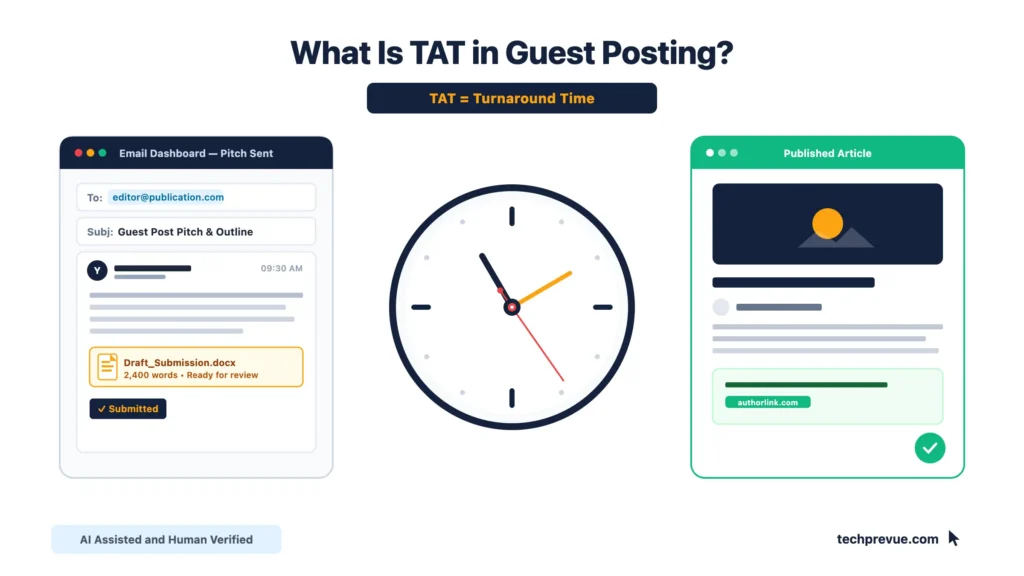
TAT is an acronym for turnaround time. In guest posting it describes the period between handing over your article and the published URL landing in your inbox, and it sits alongside the other signals covered in how placements get evaluated.
Where does the term come from?
Operations and logistics, where it measures how long a process runs from start to finish. Guest post marketplaces borrowed it somewhere around 2015, and it now appears on almost every seller listing alongside domain authority and price.
Worth knowing before you go further: this is marketplace vocabulary.
You will not find TAT in Google’s documentation, in Search Console, or in guidance published by any major SEO platform. Anyone asking what is TAT in guest posting has almost certainly met the term on a seller listing, because that is the only place it appears. It belongs to the market that sells placements rather than to the practice of contributing articles.
Most published turnaround figures cover 5 steps:
- The publisher receives your draft
- Someone reviews it, or doesn’t
- Revisions get requested and returned
- The article is formatted and scheduled
- It goes live and the URL comes back to you
So a five-day turnaround might mean submit Monday, review Tuesday, revisions Wednesday, resubmit Thursday, publish Friday. That’s the version sellers describe, and it’s the version that assumes a human is involved at each stage.
When the Clock Actually Starts
Here’s the detail that causes most disputes, and it’s buried in the fine print of the sellers who mention it at all.
Some publishers begin counting from the moment your content arrives. Others start only once payment clears.
Then there’s a third group starting the clock after topic approval, which can quietly add 7 to 10 days before the stated turnaround even begins.
Three sellers quoting “5 days TAT” can therefore mean three genuinely different delivery dates. Ask which event starts the count before you agree to anything, and get the answer in writing.
The TAT Tiers You’ll See Advertised
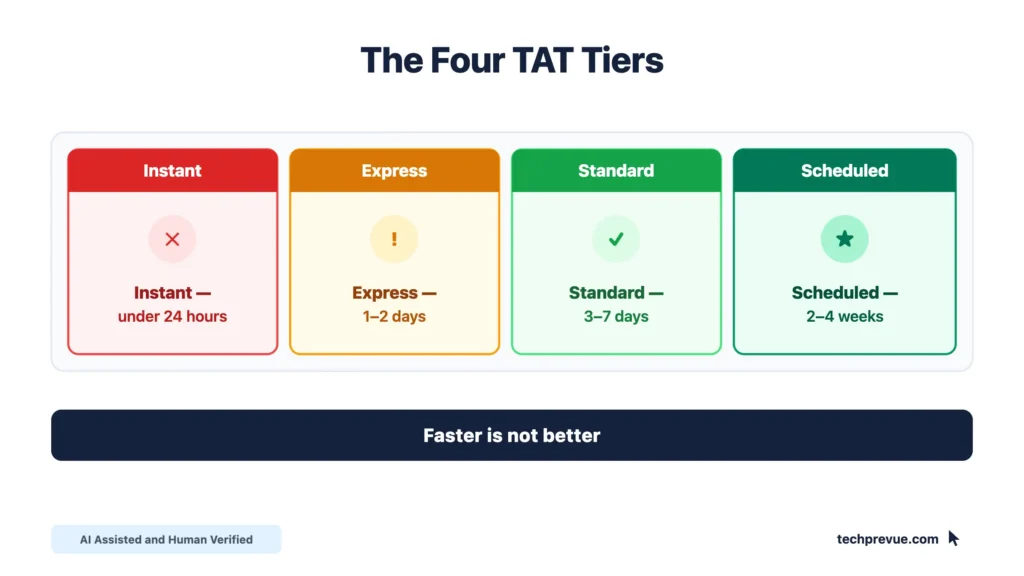
Marketplace listings usually sort turnaround into 4 bands. Labels vary between sellers, but the underlying ranges stay fairly consistent across the industry.
| Tier | Typical range | What it usually means |
|---|---|---|
| Instant | Under 24 hours | Automated or near-automated publishing. No meaningful review. |
| Express | 1–2 business days | A queue with a priority fee attached. Review is minimal at best. |
| Standard | 3–7 business days | The industry default. Some review, depending on the site. |
| Extended | 7+ business days | Often a real editorial calendar. Frequently the better sign. |
Notice which end the industry markets hardest.
Speed is the headline feature on almost every listing, while the slowest tier gets presented as a limitation you’re paying less to tolerate. Why would a seller frame it that way?
Because the thing that takes time is the thing they aren’t doing.
Paying more does not remove the editorial review on a site that has one. It only removes the wait on a site that doesn’t.
Editorial review is the single slowest step in publishing anyone’s article, and it is also the only step that adds value to your placement. Strip it out and the turnaround collapses to however long it takes to paste text into a CMS. That is what you are actually buying when you pay extra for speed.
What Turnaround Looks Like by Site Type
Sellers also publish rough turnaround figures by category, and reading those as a correlation answers what is TAT in guest posting more usefully than any definition does.
| Site type | Typical turnaround |
|---|---|
| Small blogs | 1–3 days |
| Niche websites | 3–7 days |
| Business websites | 5–10 days |
| High-authority websites | 7–21 days |
| News and editorial publications | 2–6 weeks |
Look at the direction of travel. Turnaround climbs steadily as editorial standards rise, and the sites at the bottom of that table are the ones most people actually want a link from.
Sellers present this neutrally, as a fact about workload. It reads better as a fact about scrutiny.
Why a Fast TAT Is a Warning, Not a Feature
Short turnaround is the clearest single signal that nothing stood between your payment and publication.
This isn’t a moral argument about buying links. It’s arithmetic about what can physically happen inside a given number of hours, and it’s the part of what is TAT in guest posting that sellers leave out.
What 24 Hours Rules Out
How long does a real review actually take?
Reading a 1,500-word article properly takes about 15 minutes. Checking it against a style guide takes another 20. Verifying a claim, requesting a change, waiting on the reply, then formatting and scheduling the piece takes days rather than hours.
So when a site promises publication inside 24 hours, at least one of these is true.
Nobody read your article. Nobody checked whether it suits their readers. Nobody would have said no to anything.
Any site publishing your draft untouched publishes everyone else’s untouched too. That is precisely the neighborhood your link is about to sit in, and you’re paying for the privilege.
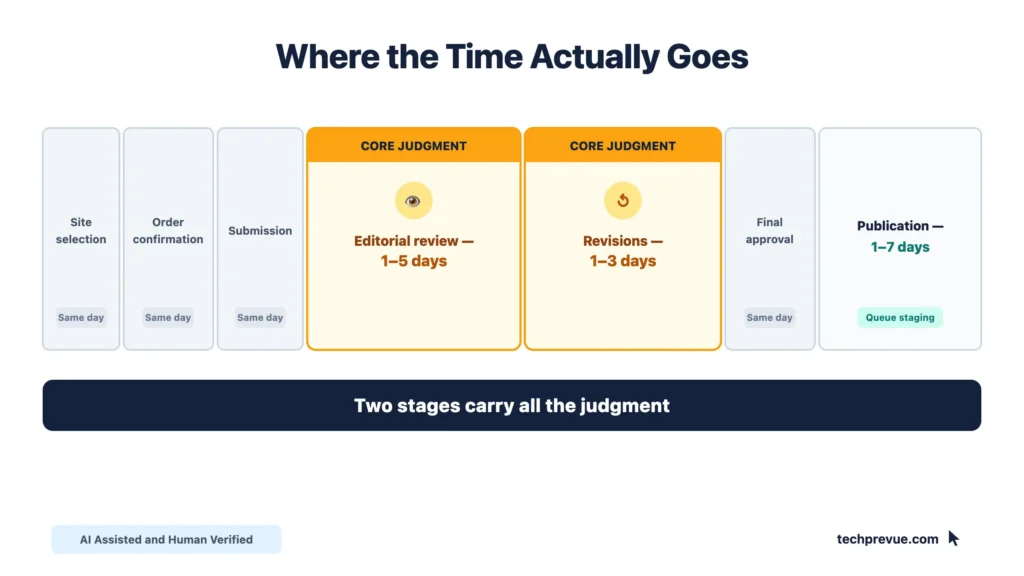
Break a normal timeline into stages and you can see which one gets deleted:
| Stage | Typical time |
|---|---|
| Site selection | Same day |
| Order confirmation | Hours to 1 day |
| Content submission | Same day |
| Editorial review | 1–5 days |
| Revisions | 1–3 days |
| Final approval | Same day |
| Publication | 1–7 days |
Every stage except two runs same-day. Editorial review and revisions account for 2 to 8 days between them, and they are the only stages where a person forms a judgment about your article.
Now compress that whole sequence into 24 hours and work out what had to go.
The Attribute Problem Speed Creates
Instant turnaround almost always comes with a price attached, and paid placement changes the rules.
Google’s spam policies treat buying and selling links as a violation unless the link carries rel="sponsored" or rel="nofollow", and what the rules require on paid links covers the detail. Paying for a placement is not itself the problem. Paying for a placement that passes ranking credit is.
So ask any seller quoting a fast TAT which attribute they apply.
Run a clean operation and you answer that in one line. Dodge the question, or promise a followed link in exchange for money, and you’re selling risk with a delivery estimate attached.
When Fast TAT Signals Site Reputation Abuse
Some of the fastest turnarounds advertised sit on borrowed authority.
You’ll find services selling placements on university subdomains with a 12-hour turnaround at roughly $100 per post.
Institutional domain, instant publication, flat fee. Nothing in that arrangement involves an editor at any point.
Google’s policies cover exactly this under site reputation abuse — third-party content published on a host site mainly to exploit ranking strength the host earned with its own work. Hosts absorb the damage under that policy, and your link disappears along with the page when enforcement catches up.
Tells are always the same. Speed plus a fee plus an authoritative domain, with no editorial process anywhere in the transaction. The domain does the selling, the fee does the qualifying, and the turnaround figure exists mainly to reassure you that nobody will ask difficult questions about your draft.
What Real Editorial Publishing Takes
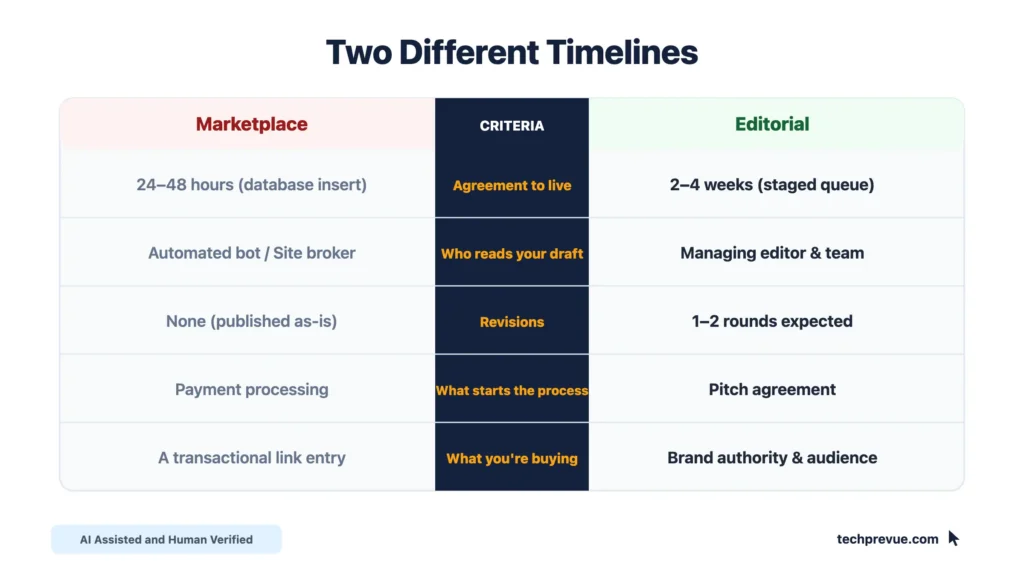
Compare the marketplace timeline against how contributed articles actually get published on sites that run an editorial process.
| Marketplace placement | Editorial contribution | |
|---|---|---|
| From agreement to live | 1–7 days | 2–6 weeks |
| Who reads your draft | Often nobody | An editor, sometimes two |
| Revisions | Rare | Expected |
| What starts the process | Payment | An accepted pitch |
| What you’re buying | A URL | An audience |
Publications stage content two to four weeks ahead because they run calendars, which is why what editorial publishing involves looks nothing like a delivery estimate. Your piece slots into a schedule alongside commissioned work, seasonal coverage, and whatever the editor already promised someone else.
That wait is the product. Waiting means a person judged your article worth their readers’ attention, and that judgment is the only thing making the placement worth anything at all.
What Legitimately Affects Turnaround Time
Does a long turnaround always mean quality?
No. Slow isn’t automatically good, and there are at least 5 honest reasons an otherwise legitimate timeline stretches.
Manual review. Sites that read every submission take longer and produce better placements, which is the trade-off working exactly as it should. Sellers who acknowledge that openly are being straight with you.
Your own response speed. If revisions come back and you sit on them for a week, that week belongs to you, not the publisher. Most quoted turnarounds assume you reply within a day or two.
Editorial calendars. Publishing twice a week gives a site roughly 100 slots a year, and yours goes wherever there’s room.
Volume. January and September run heavy at most publications, while August and late December go quiet. Where does your deadline fall?
Business days, not calendar days. Almost every quoted turnaround counts working days only. Submit late on a Friday, or the week of a public holiday, and a stated 3-day turnaround quietly becomes 5 or 6 on the calendar.
Scope of edits. Structural rewrites take far longer than a proofread, which is a decent argument for reading the guidelines before you write anything.
What to Do When a Quoted TAT Is Missed
Deadlines slip on legitimate sites too, so the useful question is how a seller behaves once the date passes rather than whether it ever passes at all.
Give it 3 working days past the quoted date before chasing. Then send one message asking for a revised publication date and the reason for the delay, because a seller who can answer both is usually just behind rather than gone.
So what should you watch for in the reply? A specific new date is a good sign, and so is an honest explanation about editorial backlog. Vague reassurance with no date attached, repeated twice, means the placement was never scheduled in the first place.
Escalate on the money, not on the article. Most marketplaces operate a refund or replacement window, and that window is far easier to invoke while the post remains unpublished than after a link quietly goes live somewhere you never approved.
One thing to avoid entirely. Do not accept a substitute domain you haven’t vetted just because the original slipped, since a rushed swap is how buyers end up with links on sites they would have rejected on sight.
Where TAT and Link Spam Actually Connect
Anyone researching what is TAT in guest posting eventually runs into the spam question, and it deserves a precise answer rather than a scary one.
Start with what Google doesn’t do. It doesn’t measure turnaround time. There’s no signal for it, no threshold, and nothing in the spam policies mentioning how quickly a site published your article.
So a fast turnaround is not itself a violation. Plenty of small blogs publish inside 2 days because there’s one person to ask and she read it over lunch.
The connection is structural rather than causal. TAT is a proxy for the absence of the thing that stops spam happening in the first place.
Three links hold it together.
Quoting a TAT means selling placements. Editorial publications don’t advertise delivery dates, because they aren’t shipping a product. The moment a site hands you a turnaround figure you’re in the paid market, and Google’s policies name paid links that pass ranking credit as link spam.
No review means nothing gets caught. The four warning signals Google describes — keyword-stuffed anchors, the same article across many sites, writers with no knowledge of the subject, duplicated content — are all things an editor notices. Take the editor out and none of them get noticed, for you or for anyone else publishing there.
Speed enables volume. A site clearing submissions inside 24 hours can run several a day, and a publisher pushing that much contributed content is a red flag on its own.
Put plainly: the presence of a quoted TAT tells you more than the number does.
What a Fast-TAT Habit Does to Your Link Profile
One placement on a fast-turnaround site is a weak link. Forty of them is a pattern.
Google describes link schemes in terms of scale — the same author across many sites, keyword-rich anchors repeated, articles that exist to carry a link. Build most of your backlinks from sites that review nothing and you’ve assembled that exact shape, one purchase at a time.
The fix is not to vary your turnaround times so the pattern looks less obvious. That changes how it appears without changing what you own. The fix is fewer links from sites that publish anything and more from sites that would have said no.
If You’ve Already Bought Fast-TAT Placements
No need for panic. Google’s link systems are built largely to neutralize unnatural links rather than to act against every site receiving them, though manual actions do exist.
Three things worth doing, in this order:
- Check whether each link is still live, because fast-turnaround sites churn and a meaningful share of these vanish inside a year
- Check which attribute you actually received, since a followed link you paid for is the one carrying real exposure
- Stop adding to the pile before you consider removing anything from it
Auditing and disavowing is a separate job with its own rules, and rushing it causes more damage than the links did.
Questions to Ask Before You Accept a Quoted TAT
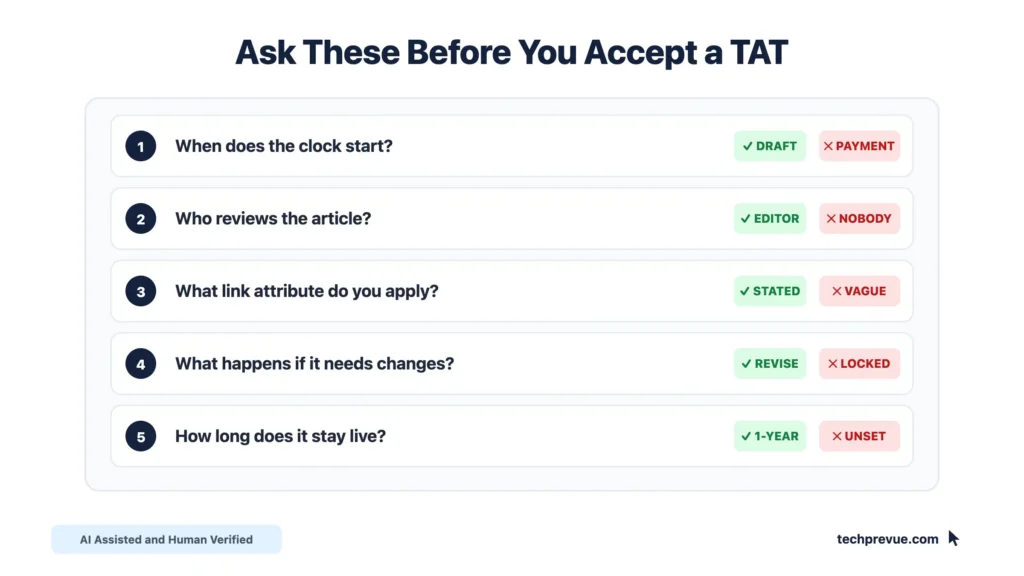
Five questions, and the answers tell you more than the number does.
| Ask | What a good answer sounds like | What should worry you |
|---|---|---|
| When does the clock start? | On receipt of the draft | After payment clears |
| Who reviews the article? | A named editor or content lead | Nobody, or no answer |
| What link attribute do you apply? | A specific answer, immediately | Evasion, or a promised followed link for money |
| What happens if it needs changes? | We send notes and you revise | We publish as received |
| How long does the post stay live? | A stated minimum period | No commitment |
Answer the third and fourth clearly and the turnaround number stops mattering much, because you now know what the process actually contains. Fail them and no turnaround is short enough to make the placement worth buying.
So which number should you be asking about instead?
Ask how many submissions they turn down in a month. A publisher who never rejects anything has no standards to protect, and that single answer tells you more than any delivery estimate on the listing.
Frequently Asked Questions
What is TAT in guest posting?
Turnaround time — the period between submitting your article and the published URL being delivered back to you. It appears on most guest post marketplace listings next to price and domain metrics, and it is not a term Google or any major SEO platform uses.
What is instant TAT in guest posting?
Publication within roughly 24 hours of submission. That indicates automated or near-automated publishing, which means no editorial review took place before your article went live.
What is a normal TAT for a guest post?
Sellers treat 3 to 7 business days as standard. Publications running a genuine editorial process usually take two to six weeks, because contributed articles slot into a planned calendar.
Is a fast TAT a Google penalty risk?
Not on its own. Google doesn’t measure turnaround time and no policy mentions it. The risk sits in what a fast turnaround implies — a paid placement with no editorial review — which is the combination the link spam policies actually describe.
Can TAT be negotiated?
Sometimes. Some publishers sell express publishing for an extra fee, which buys you a place at the front of a queue rather than a faster review. On a site with genuine editorial standards, the review itself is rarely something money shortens.
Is a faster TAT better?
Not for the value of the placement. Short turnaround means less review, and less review means the site accepts almost anything, which ends up determining the quality of the neighborhood your link sits in.
Does TAT affect SEO results?
Not directly. What affects results is whether the site has real readers and real editorial standards, and turnaround time is a useful proxy for the second of those.
Why do two sites quote the same TAT but deliver on different dates?
Because they start counting from different events. One may begin on receipt of your draft, another after payment, another after topic approval. Always confirm which applies.
