
Most guides on how to start a junk removal business open with the truck. That’s the wrong first move.
The truck is the easy part. What stops people is finding out in week 3 that the nearest transfer station won’t take a commercial load without an account, or that their insurance covers nothing they carry for money.
Sort the boring parts first and buy the truck once you know where the junk is going.
Here’s the order that actually works.
Key Takeaways
- Disposal access comes before the truck. Confirm which facilities accept your intended material, at what fee, before any vehicle spend.
- No national startup figure transfers to your market. Build the number from local quotes across one-time cash, monthly commitments, per-job float and reserves.
- There is no single junk-removal license. Permits are set by city, county and state, so every jurisdiction you cross needs its own call.
- Personal auto and homeowners policies rarely cover paid hauling. Get the classification confirmed in writing by a licensed commercial agent.
- A price that ignores your own labor isn’t a price. Owner hours are a cost even when the cash stays in the business.
- Test for 30 days before committing capital. Real job records beat any projection you can write beforehand.
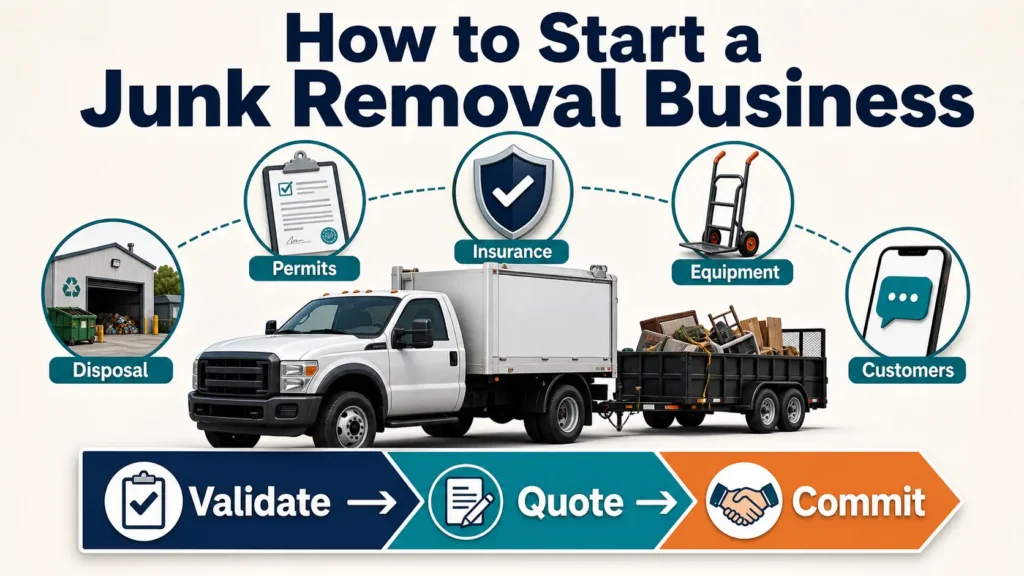
What Do I Need to Start a Junk Removal Business?
Use this as a readiness check before you spend real money.
| Requirement | What ready looks like |
|---|---|
| Defined market | A service area you can cross in reasonable time, plus the job types you’ll accept |
| Disposal network | One lawful primary destination, one backup, and notes on what each rejects |
| Permission to operate | Business registration, local licenses, waste-hauler approval, vehicle registration |
| Suitable insurance | Written quotes matching hauling, customer property, vehicles, and helpers |
| Commercial transport | A vehicle or rental agreement that allows paid hauling |
| Safe equipment | Dollies, straps, tarps, and protective gear sized to the jobs you accepted |
| Financial plan | Local quotes, working cash, a reserve, and a price floor that pays you |
| Customer system | Phone, intake, estimates, scheduling, invoices, and written terms |
| Local presence | A simple website, an accurate business profile, and a review process |
One rule is worth holding absolutely. Don’t take a paid job until every applicable requirement is active.
Customers will push on this. Someone’s closing is Friday. Someone’s landlord is threatening them, and the load happens to include 2 cans of old paint.
A deadline doesn’t make a prohibited load legal. It won’t cover you when something breaks in their hallway, either.
Should You Test, Build, Buy, or Franchise?
Starting a junk removal business from scratch isn’t the only route in. It isn’t automatically the cheapest, either.
A controlled test carries the least risk. You rent a vehicle and take 5 or 6 jobs inside strict limits. That tells you whether the inquiries and route times work before you spend capital.
The catch is paperwork. Rental agreements and insurance policies both have to permit commercial hauling. Plenty of consumer-grade agreements quietly don’t.
Building an independent company gives you full control of the brand and the customer records. You also build every system yourself and generate every lead yourself. That’s the trade.
Buying an existing operation can hand you working assets and a phone number people already call. It can also hand you problems the seller never mentioned.
Before signing anything, pull the tax returns and bank deposits. Then work through vehicle titles and maintenance records. Disposal receipts and past insurance claims come next.
Confirm who actually owns the phone number and the Google profile.
If someone advertises a junk removal business for sale at a generous-looking number, the question isn’t whether the price is fair. It’s what the revenue is made of, and whether it survives the owner walking away.
Some licenses and facility accounts simply don’t transfer, so confirm that with each issuing office directly. Use a lawyer and an accountant on the documents.
Franchising buys a defined model and a known name. You pay fees and royalties for it. You also accept territory rules and limits on how you run your own shop.
How to Start a Junk Removal Business in 10 Steps
1. Define Your Service Area and Accepted Jobs
Start with a route you can actually serve, not the widest circle you can draw on a map.
Every extra mile costs fuel and arrival-window accuracy, and a small job 40 minutes away often loses money before you touch a single box.
Keep the first service menu narrow. Ordinary furniture, nonhazardous household clutter, small office cleanouts.
Leave out demolition debris and chemicals. Refrigerant appliances and medical waste wait until you have partners who can handle them properly.
Then write an accepted-items policy in 3 columns: yes, yes-after-confirmation, and no.
That single page ends up doing a surprising amount of work. It scripts your phone screening, settles crew arguments on site, and becomes website copy almost verbatim.
The EPA identifies paints and cleaners as possible household hazardous waste, along with oils, batteries and pesticides. Much of the detail is set by state and local rules. Confirm your own route rather than trusting a general list.
2. Validate Demand With Local Evidence
Search your proposed service area the way a customer would, then read what comes back properly.
Note what competitors offer and what they refuse. Reviews are where the useful information hides, and complaints about delays or property damage tell you exactly which gap you can fill.
Next, talk to the people who generate this work repeatedly. Property managers and real estate agents. Movers, storage facilities and estate-sale organizers.
Ask what keeps recurring and how fast they need someone. Then ask why they’ve dropped a provider before, which is usually the most useful question you’ll ask all week.
A simple landing page and a dedicated phone number can collect nonbinding requests while you finish setup. Two cautions apply.
Don’t call yourself licensed or insured until it’s true, and don’t accept paid work your current approvals don’t cover.
Page views and encouraging comments are not demand. Real evidence looks like qualified inquiries inside your service area, for jobs matching your accepted-items policy, from people willing to pay what the work costs.
3. Build a Lawful Disposal and Recycling Route
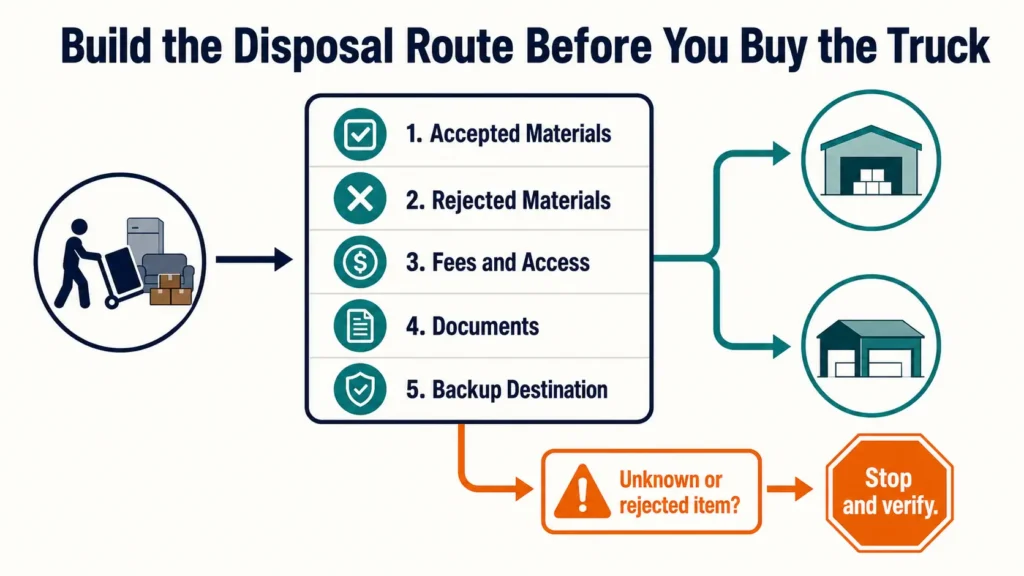
Call every transfer station, landfill and recycler you might use. Ask each one for commercial-hauler rules and current fees in writing where you can get them.
Fill out a route card for each destination:
| Field | What to confirm |
|---|---|
| Accepted material | Exact categories, preparation rules, quantity limits |
| Rejected material | What they’ll turn away at the gate |
| Charges | Weight, load, item, account, or minimum fees |
| Access | Commercial eligibility, vehicle limits, hours, appointments |
| Documents | Account, permit, manifest, or proof-of-origin requirements |
| Backup | A second lawful destination when the first says no |
Donation and resale reduce waste, but neither is a disposal guarantee.
Donation centers turn away damaged and incomplete items constantly, and they’ll do it after you’ve already loaded and driven across town.
Refrigerators and freezers need special handling because of refrigerants. So do window air conditioners and dehumidifiers.
Check the EPA’s appliance-disposal guidance, then confirm what your receiving facility specifically requires.
Never mix unknown chemicals into a load, and never move a leaking container as ordinary junk. Hauling regulated hazardous waste commercially can trigger separate EPA transporter requirements and Department of Transportation rules.
4. Complete a Junk Removal Business Plan
A junk removal business plan doesn’t need to be long. It needs to record what you verified, what you’re assuming, and what would make you walk away.
Unless a lender wants a formal document, 1 page is enough.
Use this junk removal business plan template:
| Plan field | Evidence to record |
|---|---|
| Service area | Cities or postal codes, plus maximum route time |
| Target customers | Problems that keep recurring, and who refers them |
| Accepted jobs | Services matched to your equipment and confirmed facilities |
| Excluded jobs | Materials or conditions you can’t take |
| Competitors | Service gaps, response times, pricing method, review themes |
| Disposal network | Facilities, fees, access rules, backups |
| Compliance | Registrations, permits, vehicle rules, renewal dates |
| Insurance | Quotes, deductibles, exclusions, certificates |
| Startup cash | One-time, monthly, per-job, and reserve requirements |
| Pricing inputs | Disposal, labor, route, vehicle, acquisition, overhead |
| First customers | Website, business profile, partnerships, response standard |
| Decision rule | What means continue, revise, or stop after 30 days |
Need a traditional or lean plan for financing? The SBA’s business-planning guidance covers both formats.
Swap invented projections for local quotes and documented inquiries. A plan built on optimistic numbers only tells you what you already hoped.
5. Calculate Junk Removal Business Startup Costs
There’s no honest national figure for junk removal business startup cost. Be suspicious of any article that hands you one.
The number moves with vehicle ownership, local permits, and insurance classification. It also moves with how long you’ll operate before receipts cover expenses.
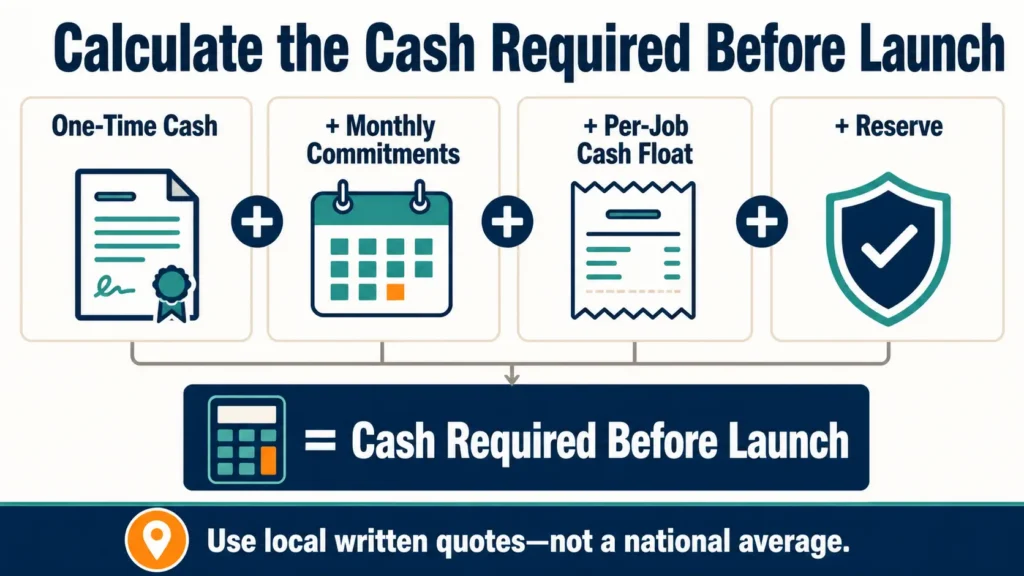
Split junk removal business startup costs into 4 groups.
One-time cash covers formation, permits and inspections. Add tools and protective gear, plus signage and website setup.
Monthly commitments are the ones that arrive whether you work or not. Insurance and vehicle payments. Phone, software and storage, plus bookkeeping and baseline marketing.
Per-job cash is what each load consumes before the customer pays. Disposal fees, fuel and helpers, plus tolls and card processing.
Reserves cover repairs and deductibles, along with rejected loads, refunds and slow periods. Most new operators skip this group entirely, and it’s the one that ends businesses.
Your startup cash requirement is one-time cash plus launch-period monthly commitments. Add a per-job float and that reserve.
Pull every figure from an official fee schedule or a written vendor quote. A facility or insurer works too. Not from a blog post, and not from a video.
Here’s the shape a filled-in worksheet takes. Formation and permits land in one-time cash, alongside a dolly, straps, tarps and a first set of protective gear. Insurance and a phone line sit in monthly commitments, repeating whether you book work or not.
Per-job cash is the float you need before customers pay you: a tank of fuel and 2 disposal runs is a realistic starting point. Reserves cover the first deductible and 1 slow month.
The categories are the transferable part. Your own numbers come from your own quotes.
The SBA startup-cost method uses the same one-time-versus-monthly split. The mistake worth avoiding is treating the truck price as the budget while insurance and maintenance go unplanned.
6. Choose and Register the Business Name and Structure
Search junk removal business name ideas and you’ll get list after generated list, all of them interchangeable. Skip them.
A workable name passes 5 tests. People can say and spell it, and the service is reasonably clear.
It doesn’t falsely imply a location or credential. It still fits if you expand, and you can legally use it.
The strongest junk removal business names are easy to repeat over the phone. They don’t lean on a joke that gets old, and they don’t promise an environmental standard you can’t document.
Four patterns hold up better than the rest. Surname plus service reads established and clears trademark searches easily. Plain descriptive tells callers exactly what you do before you say a word.
A coined or invented word travels well if you expand past your first county. Descriptive-plus-benefit works when the benefit is something you actually deliver, like same-day or full-service.
Skip anything tied to one town if you might cross the county line in year 2. Skip anything that sounds like a national franchise you don’t own.
Check your state business registry and local DBA records, then check domain availability and look for nearby operators already using something similar.
Search the USPTO trademark database for confusingly similar marks, but when you need an actual clearance opinion, that’s attorney work.
Pick your ownership structure with an accountant or lawyer. Liability, tax and funding all move together. The SBA launch guide walks through structures and registration, plus tax IDs and banking.
Need an Employer Identification Number? Apply directly through the IRS.
It’s free, and several third-party sites are built to look like the government application and charge you for it anyway.
7. Confirm Local Permits and Vehicle Rules
There’s no single junk-removal license that settles this nationally. Call the city or county business office first, then the solid-waste or public-works department for every area where you’ll be collecting.
Ask whether you need a general business license or a waste-hauler permit. Vehicle inspection, bonding and tax registration come up too.
Write down the rule name and the issuing office. Note the fee, the renewal date and exactly what geography it covers. You’ll repeat this call for each jurisdiction you cross.
Vehicle rules depend on weight, use, and whether the work crosses state lines. The FMCSA’s USDOT number test covers the federal conditions, and some states require a number for intrastate carriers too.
Check the GVWR on the door sticker, and the combined rating if you’re towing. Never estimate from how big the truck looks.
8. Buy Insurance That Matches the Actual Work
Talk to a licensed commercial agent who understands your vehicles, your service area, and your helpers. Don’t assume a personal auto policy or homeowners coverage extends to commercial hauling.
Frequently it doesn’t, and you find out at the claim.
A package marketed as junk removal business insurance is a reasonable starting point. Confirming that its coverage and exclusions match what you actually do is still your job.
When shopping insurance for a junk removal business, ask each agent:
- How will the insurer classify junk hauling, waste transport, and resale activity?
- Does general liability cover accidental damage at a customer’s property?
- How must trucks, rented vehicles, and trailers be insured?
- When does workers’ compensation become mandatory?
- How are temporary helpers and subcontractors treated?
- Which pollution, loading, or property-in-care exclusions apply?
- Can the policy issue certificates that property managers require?
- What deductibles could strain your cash reserve?
The SBA’s insurance guide recommends assessing risks and revisiting coverage as the business changes. Forming an LLC doesn’t substitute for it.
9. Assemble Transport, Tools, and Safety Equipment
Match the vehicle to payload and towing capacity. Check the unloading method and facility access too.
Renting or borrowing? Get written confirmation that the agreement and the insurance both permit paid hauling of your intended materials.
A workable starting kit runs about 10 items. Dollies or hand trucks, ratchet straps and tarps. Moving blankets, a broom and a shovel.
Then gloves, eye protection and high-visibility clothing, plus boots and a first-aid kit.
Ramps, lift gates and carts come later. Add them once the loads justify the spend and someone’s actually trained on them.
Manual handling risk isn’t just about weight. Reach, repetition and posture all matter just as much. So do grip and carrying distance, along with how stable the object is when you pick it up.
NIOSH’s ergonomic guidelines for manual material handling recommend redesigning the task and using mechanical assistance rather than relying on technique alone. For specific two-handed lifting tasks, the Revised NIOSH Lifting Equation gives qualified users a way to assess risk properly.
No single weight limit replaces job planning. Before quoting, screen for stairs and sharp edges. Watch for unstable items and overhead hazards, then decide whether you’ll need a second trained person.
10. Set Up Quoting, Payment, Marketing, and a Controlled Launch
Your intake form should ask for the address, an item list and photos. Cover access conditions too: stairs, parking, urgency and anything that might carry a special fee.
Say clearly whether the estimate is fixed or subject to an on-site look, and get approval before the scope or price moves.
Build the price from disposal, labor and travel. Vehicle use, payment fees and overhead go in as well. The companion guide on whether a junk removal business is profitable covers job contribution and break-even math in full.
Your first website can be plain. It should state your service area and what you take, plus how to reach you and how estimating works.
Use your own job photos, with permission. Stock images presented as your own completed work get spotted faster than you’d think.
If you work from home and customers never come to you, you’ll usually run as a service-area business on Google. Follow Google’s service-area guidance and keep the address hidden. Maintain 1 accurate profile rather than spinning up a fake one per city.
Junk removal business cards still earn their place in referral conversations. Put the registered name and phone on them. Add a website or QR code and your rough service area.
Leave off your home address, and skip any license or environmental claim you can’t back up.
What converts in a handoff is specificity. A property manager passing your card to a tenant needs to see what you take without calling you first. Printing 3 or 4 accepted items on the back does more work than a logo.
Leave a small stack with each referral partner rather than 1 card. They give them away, and a card in a drawer books nothing.
TechPrevue’s local SEO checklist covers organizing the profile and website, plus citations and reviews. Track how each inquiry found you and how fast you replied. Note whether it booked, and why you lost the ones you lost.
How Should You Plan a Junk Removal Business Owner Salary?
A junk removal business owner salary isn’t revenue, and it isn’t profit either.
Working solo, you’re doing field labor and sales. You’re also driving, estimating and handling admin. One withdrawal from the account can quietly represent 5 different jobs.
So put a real labor cost on your own working hours in the plan, even when the cash stays in the business.
Anything you take beyond that counts as profit only after disposal and helpers are paid. Vehicle costs, overhead and taxes come out first too.
Don’t build a household budget on someone else’s income claim from a blog or a video. Decide about leaving other work based on your own documented results and advice from a qualified tax professional.
Frequently Asked Questions
Do I need a license to start a junk removal business?
Usually yes, though which one depends entirely on where you operate. Most areas want a general business license, and many add a waste-hauler permit before you move material for money. Call the local business office and the solid-waste department directly, because no national guide can answer this for your address.
How much does it cost to start a junk removal business?
Published ranges run from roughly $2,000 to $50,000, and the spread tells you the number isn’t transferable. It depends on whether you already own a suitable vehicle, what your local permits cost, how your insurer classifies you, and how long you’ll operate before receipts cover expenses. Build your own figure from the 4 cost groups above using written local quotes.
Can I start with a pickup truck instead of a box truck?
Yes, and plenty of operators do. A pickup limits you to smaller loads and more trips to the transfer station, which costs time and fuel per job. The bigger question is permission, so confirm your registration and insurance actually allow paid hauling first.
What items can a junk removal business not take?
That list is set by your receiving facility and local rules, not by you. Common exclusions include paints, solvents, batteries, asbestos and medical waste, while refrigerant appliances usually need special handling rather than a flat refusal. Get the accepted and rejected list in writing from every facility before you quote anything.
How long before a junk removal business makes money?
Individual jobs can pay the same day, which is why this business looks fast from the outside. Covering fixed overhead is the slower part, and it depends on booking volume and whether your prices include your own labor. Run the 30-day controlled launch below before you assume a timeline.
Review the First 30 Days Before Spending More
Run a controlled launch inside the limits you verified, and keep records for every job.
That means the disposal receipt, route time and labor time. Log mileage and where the customer came from. Keep the estimate, the final invoice and anything that went wrong.
At the end, pick one of 3 answers honestly.
Continue if qualified demand exists and disposal works. Your prices should cover your costs, and customers should pay on time.
Revise if the demand is real but something specific broke. Usually it’s the service area or the accepted-items list. Sometimes it’s a pricing input or the channel producing your leads.
Stop if the model only works when you take prohibited loads, skip insurance, or don’t pay yourself. Same answer if the prices your market will accept can’t cover the work.
The instinct after a weak month is to finance a bigger truck. Resist it.
Find the assumption that failed, fix that one thing, and test small again. Put more money in only when your own records justify it.
