
Quick answer: Backlinks fall into three broad categories depending on how you earned them (natural, manual, or self-created), four types by link attribute (dofollow, nofollow, sponsored, UGC), and more than 50 once you break them down by source, format, and position. Some help your rankings, some do almost nothing, and a few can actively hurt you.
This guide is organized so you can jump straight to the classification you need, whether that’s a fast answer to how many types of backlinks exist or a full audit-ready breakdown of every category.
What’s a Backlink, Quickly?
A backlink is a link from another website that points to yours. Search engines treat it as a small vote of confidence — the more credible sites that vote for a page, the more Google trusts that page. Where the link sits, how it was earned, what code sits behind it, and even the words used to click it all change how much weight that vote carries — the entire subject of this guide.
For the full definition and how to start earning backlinks, see our complete guide to backlinks in SEO. This article picks up from there and goes deep on one question: what types of backlinks actually exist, and which ones deserve your time.
Backlinks vs. two terms people confuse them with:
- Internal link — connects two pages on your own site (homepage → blog post). Helps crawling and site structure, not outside trust.
- Outbound link — the mirror image of a backlink. When you link out, that link is a backlink for them and an outbound link from you. Every type in this guide is, from the linking site’s view, also an outbound link.
How Many Types of Backlinks Are There?
Quick answer: There’s no single correct number. By acquisition method, there are 3 core categories. By link attribute, there are 4. Once you break links down by source, format, and placement, the list runs past 50 named types — which is why different guides confidently give completely different answers.
Ask five SEOs this question and you’ll get five different numbers, and none of them are lying — different types of backlinks classifications simply answer different questions. “Type” can mean four genuinely different things, and most articles only pick one without saying so.
| Classification method | Answer | Best used for |
|---|---|---|
| By acquisition method (Moz-style) | 3 | Planning a link building strategy from scratch |
| By link attribute (rel tag) | 4 | Auditing an existing backlink profile |
| By source, format & position (this guide) | 50+ | Understanding the full landscape and finding gaps |
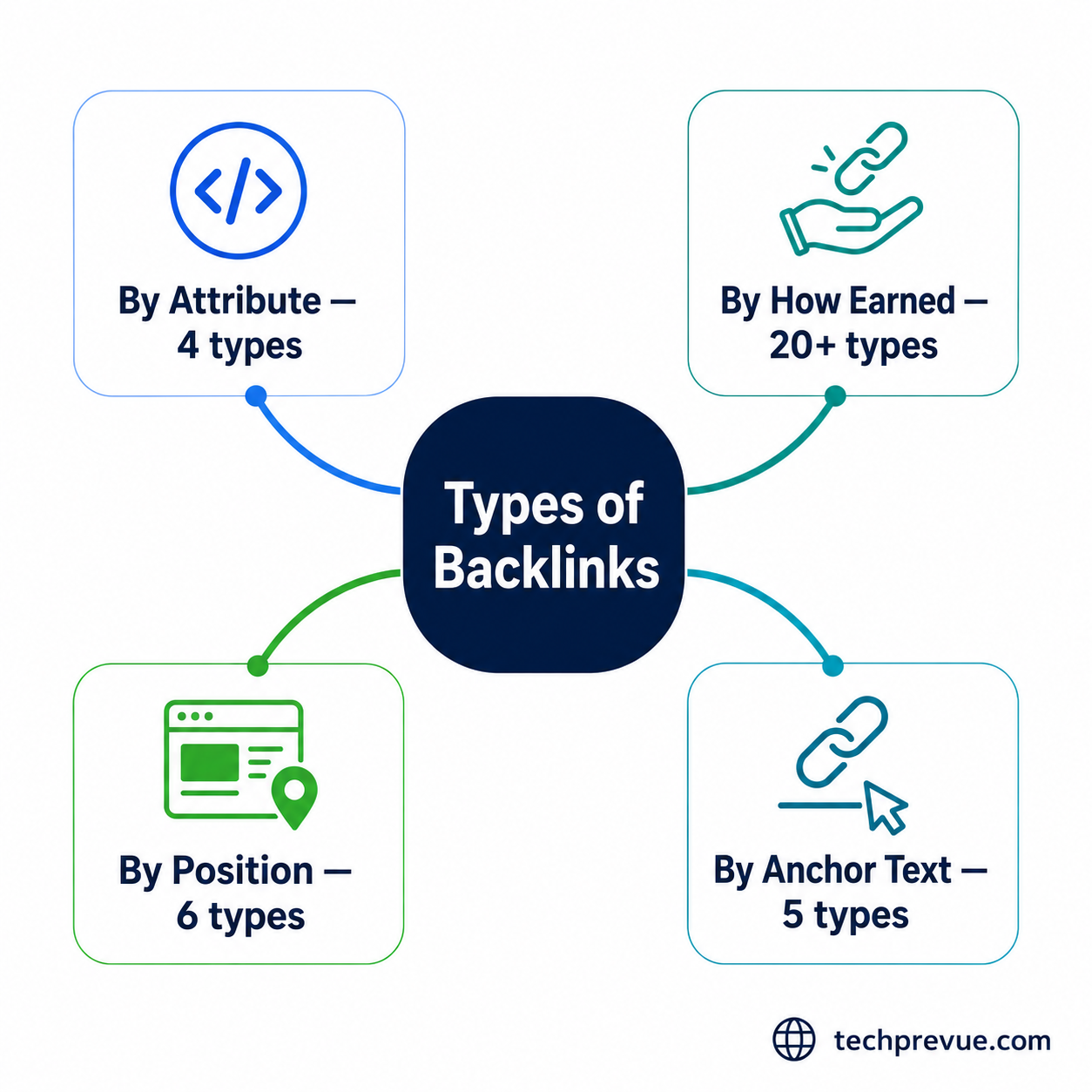
The three frameworks, in brief:
- Moz’s classic 3-way split (source of most “3 types of backlinks” answers) — sorts by how you got them: natural (nobody asked), manual (earned through outreach), self-created (you placed it yourself, e.g. a directory listing).
- The 4-attribute split — sorts by the
relvalue in the HTML: dofollow, nofollow, sponsored, UGC. This is what every backlink checker tool is actually built around. - The 50+ source-based split — sorts by exactly where the link came from: guest posts, directories, widgets, badges, and dozens more. Cross this against attribute, format, and quality tier and you comfortably clear 50 named types — a realistic count, not a padded one.
None of these is more “correct.” The right one depends on what you’re doing with it — planning, auditing, or fully understanding the space. Treating all types of backlinks as interchangeable is the actual mistake, not picking the “wrong” number. If you’ve seen a “50 types of backlinks” claim and wondered whether that’s inflated, it isn’t — once source, format, and position are counted separately, 50-plus named types is a realistic count.
Types of Backlinks by Link Attribute (rel Tag)
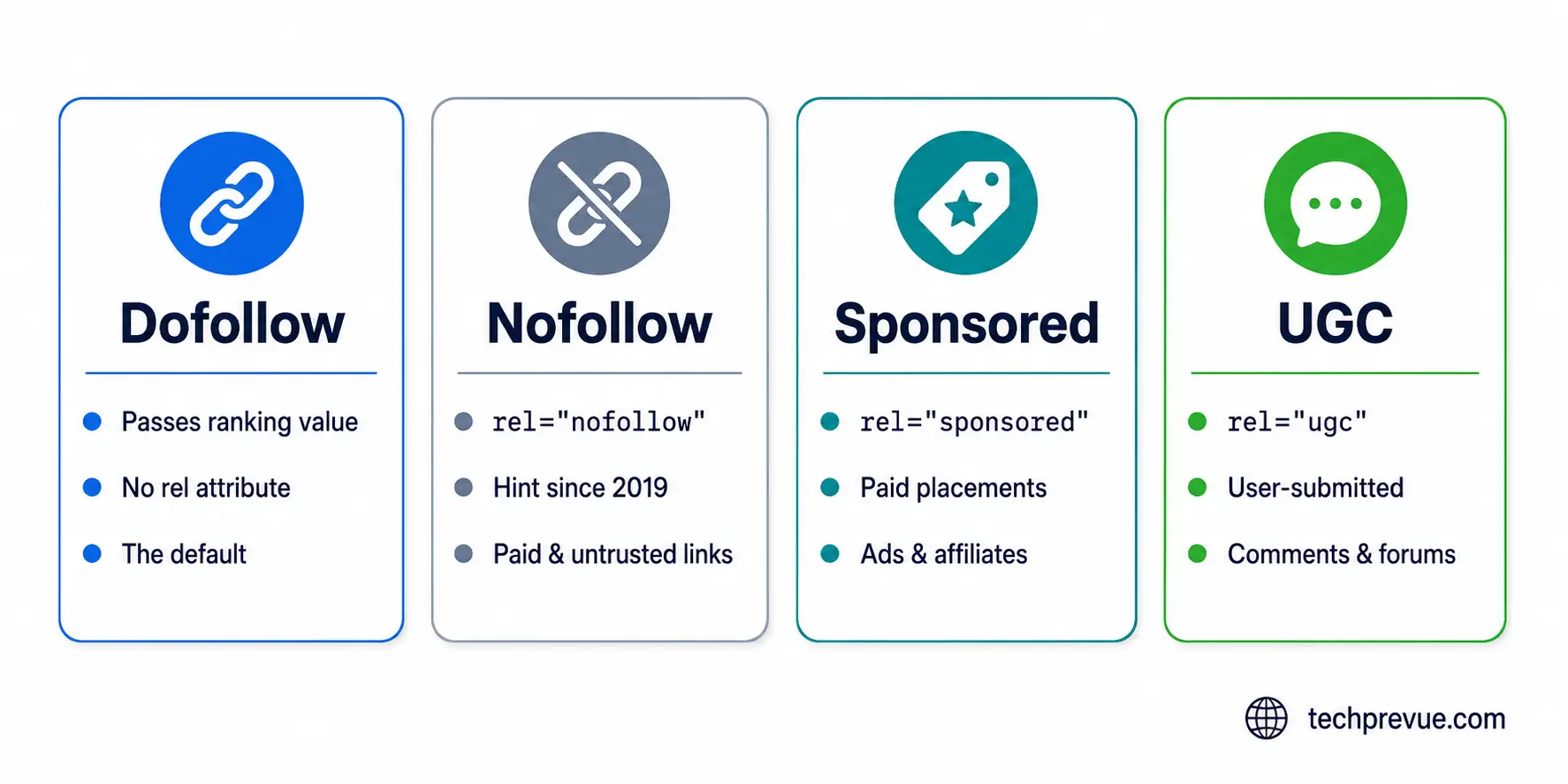
Quick answer: Every backlink carries one of four attributes: dofollow (default, passes ranking value), nofollow (explicitly withheld), sponsored (paid placements), or UGC (user content). Since September 2019, Google treats the three non-default attributes as hints, not hard rules.
This system didn’t arrive all at once: Google added nofollow alone in 2005 to fight comment spam; sponsored and UGC didn’t exist until 2019. Anything describing “two types of backlinks” — just dofollow and nofollow — is working from an outdated framework.
1. Dofollow (Follow) Backlinks
What it is: A standard link with no special attribute — the default behavior of the entire web.
- The only type that passes link equity (“link juice”) to the linked page
- What SEOs mean by “getting backlinks” when they don’t qualify the term
- A profile that’s 100% dofollow looks suspicious, not impressive — real profiles always mix attributes
- Internal links are dofollow by default too
2. Nofollow Backlinks
What it is: A link carrying rel="nofollow", asking search engines not to pass ranking credit. Introduced in 2005 specifically to fight comment and forum spam.
- Since September 2019, Google treats it as a hint it may still consider, not an absolute rule — dismissing all nofollow links as worthless is outdated advice
- High-authority nofollow links (Wikipedia, major news outlets) still send real referral traffic and brand exposure
- Use it deliberately when linking to a competitor or any page you don’t want to endorse
3. Sponsored Backlinks
What it is: A link carrying rel="sponsored", marking a paid relationship — ads, affiliate placements, compensated content. Introduced in 2019 to separate paid links from genuine editorial ones.
- Required for anything paid: sponsorships, affiliate programs, compensated content
- Skipping the tag on a paid link is what turns a legitimate arrangement into a policy violation
- Still drives real referral traffic and audience exposure even without ranking value
4. UGC Backlinks
What it is: A link carrying rel="ugc", marking content added by site visitors — comments, forum replies, open profile fields.
- Carries the least ranking weight of the four, since anyone can create one without review
- Still worth having in moderation for referral traffic and community visibility
- If your site accepts public contributions, auto-apply this attribute to protect yourself from being blamed for others’ spam
- Note: you can’t retroactively change the attribute on a link pointing at you — only request removal, or disavow in genuinely warranted cases (see the toxic backlinks section below)
| Attribute | HTML | Passes ranking value? | Typical source |
|---|---|---|---|
| Dofollow | (no attribute — the default) | Yes | Editorial mentions, natural citations, internal links |
| Nofollow | rel="nofollow" | No (hint since 2019) | Paid links, competitor citations, untrusted pages |
| Sponsored | rel="sponsored" | No | Ads, affiliate links, paid placements |
| UGC | rel="ugc" | No | Comments, forum posts, public profiles |
Types of Backlinks by How They’re Earned
Quick answer: Backlinks earned through content, outreach, listings, or media participation break into 20+ distinct source-based types — from editorial mentions and guest posts to business directories and podcast appearances. Each carries a different cost, risk, and payoff.
Earned Naturally
No outreach involved — the hardest to manufacture, the most valuable to have.
5. Editorial Backlinks
What it is: A link a writer/editor adds because your page genuinely strengthens their article — a stat to cite, a tool to recommend, a source to credit.
- Google’s model example of a healthy backlink: nobody paid, nobody asked
- Can’t be requested directly — earned by publishing something genuinely citation-worthy (original research, a unique tool, exclusive data)
- Slower to build than outreach, but tends to keep generating links for years afterward
6. Natural Citation Backlinks
What it is: A link that appears because someone independently found your content useful, without any pitch from you.
- Close cousin of editorial links; the line between the two is thin
- Difference is source: editorial = professional publications with formal standards; natural citations = anywhere (blogs, forums, academic papers, social posts)
- Both count as dofollow, earned links in Google’s eyes — the distinction matters more for your own tracking than for ranking treatment
Built Through Outreach
Real, deliberate effort: finding the right site, making the case, following up.
7. Guest Post Backlinks
What it is: A link from an article you write for someone else’s site, in the body or author bio.
- Google doesn’t penalize guest posting itself — its guidance targets large-scale, low-quality guest posting done purely for links
- Quality bar has risen sharply; what got published in 2018 needs real editorial standards now
- Use branded or naked-URL anchors in the byline, not exact-match keyword phrases, to keep it reading as editorial
8. Link Insertions (Niche Edits)
What it is: Adding your link into an already-published article, rather than creating new content.
- Faster than guest posting — no new content to write
- Only works when your addition is a genuine improvement to a relevant page
- Often paid — qualify as nofollow/sponsored rather than passing it off as editorial dofollow
9. Broken Link Building
What it is: Replacing a dead link on someone else’s site with a link to your equivalent, working resource.
- A genuinely useful pitch, not a favor — you’re fixing a visible problem for the site owner
- Consistently better response rates than a cold “please link to me” email
- Your replacement needs to genuinely match what the dead page covered — a mismatched pitch reads as opportunistic
10. Resource Page Backlinks
What it is: A link from a curated “further reading” or “useful tools” page maintained specifically to link out.
- One of the more receptive outreach targets, since these pages exist purely to link out
- Popular pages in established niches get pitched constantly — you need to fill a genuine gap, not duplicate what’s listed
11. Digital PR and Expert-Source Backlinks
What it is: A link earned by being quoted or featured by journalists and content creators covering your industry.
- HARO shut down permanently in December 2024 — any guide still pointing you there is outdated
- Current, functioning replacements: Qwoted, Featured, SourceBottle
- Response rates reward speed over polish — a usable answer within the first hour beats a more polished one sent the next day
12. Reciprocal Backlinks
What it is: Two sites agreeing to link to each other.
- Occasional, natural exchanges between genuinely related sites are fine
- Organized “link to me and I’ll link to you” arrangements at scale cross into the link scheme territory Google’s spam policies name directly
- The difference isn’t the presence of a reciprocal link — it’s whether the relationship serves readers or just trades two rankings
13. Comparison and Listicle Inclusion Backlinks
What it is: A link from being featured in a “best tools” or “top alternatives” roundup someone else maintains.
- Differs from resource pages in intent — a listicle helps readers choose, not just points elsewhere
- Getting included means a clear, honest case for why you belong, ideally backed by something the page doesn’t already have
14. Co-Marketing and Partnership Backlinks
What it is: A link from joint content built with another company — shared research, a joint webinar, a partner integration page.
- Transparent relationship, serves both audiences → reads as natural rather than manufactured
Built Through Listings and Profiles
15. Business Listing and Directory Backlinks
What it is: A link from creating a profile on a platform like Google Business Profile or an industry directory.
- Limited direct ranking value individually, but matters enormously for local SEO and NAP consistency
- US priority: Google Business Profile, Yelp, Tripadvisor, Angi
- India priority: Justdial, Sulekha, IndiaMART — these carry the same local trust weight in India that Yelp carries in the US
- Note: many local directories list your name/address/phone as plain text, no link — that’s a citation, not a backlink. Only counts as a backlink type once it includes an actual link.
16. Social Media Backlinks
What it is: A link in a social profile, bio, or post.
- Nearly all nofollow by platform default — value is referral traffic and visibility, not ranking impact
- Content that performs well on social gets noticed by bloggers/journalists browsing for story ideas, occasionally converting into a genuine editorial dofollow link later
17. Badge Backlinks
What it is: A digital badge (award, certification, “featured in” seal) you give another site that links back when displayed.
- Works particularly well for review and comparison platforms — businesses like displaying recognition and tend to keep badges up indefinitely
18. Testimonial and Review Backlinks
What it is: Either you write a testimonial for a product you use (link back from their site), or a customer reviews your product (link back to you).
- Legitimate as long as the link isn’t purchased or incentivized beyond the product itself
- A narrow line: sending a free product with no strings is fine; requiring a link as a condition crosses into contract-mandated-link territory
Built Through Multimedia Participation
19. Webinar, Video, and Podcast Backlinks
What it is: A link earned by participating in someone else’s content — interview, co-hosted webinar, podcast guest spot — via the show notes or description.
- Takes considerably more time than a typical outreach email
- Worth it for a genuinely relevant, well-trafficked show — audience exposure a text-only guest post can’t replicate
Built Through Content Distribution
20. Affiliate Backlinks
What it is: A link tied to a revenue-sharing program — commission on resulting sales.
- Requires the sponsored attribute by definition (it’s a paid link, even without direct payment for the link itself)
- A thin page copying merchant descriptions adds nothing; original testing and honest comparisons earn links on their own merit
21. Syndicated Backlinks
What it is: A link from allowing another outlet to fully republish your content, usually linking back to the original.
- Most common example: a press release picked up by multiple wires
- Typically nofollow by default; Google offers specific guidance to legitimate syndication partners to avoid duplicate-content issues
- Distinction that matters: syndication requires permission — unauthorized republishing is plagiarism, not a backlink type
22. .edu and .gov Backlinks
What it is: A link from an educational or government domain.
- Reputation for high authority is only partly deserved — Google has never confirmed the extension itself carries special weight
- What actually matters: relevance and genuine editorial placement, same as any link
- A real scholarship program or research partnership can earn one; buying from a link broker is a PBN-adjacent risk
23. Acknowledgment Backlinks
What it is: A credit or thanks — “special thanks to,” a contributor credit, a sponsor listing — without necessarily quoting you.
- Rarely arrive in volume, but tend to come from genuinely relevant, high-trust sources — nobody thanks a source they don’t respect
Quick Reference: Types by How They’re Earned
| Type | Effort | Typical attribute |
|---|---|---|
| Editorial | Low (content does the work) | Dofollow |
| Natural citation | Low | Dofollow |
| Guest post | Medium-high | Dofollow (body), often nofollow (bio) |
| Link insertion | Medium | Dofollow or sponsored |
| Broken link building | Medium | Dofollow |
| Resource page | Medium | Dofollow |
| Digital PR / expert-source | Medium-high | Dofollow |
| Reciprocal | Low, but limit volume | Dofollow |
| Comparison/listicle inclusion | Medium | Dofollow |
| Co-marketing | Medium (needs a partner) | Dofollow |
| Business listing/directory | Low | Dofollow or nofollow |
| Social media | Low | Nofollow (platform default) |
| Badge | Low (once built) | Dofollow |
| Testimonial/review | Low-medium | Dofollow |
| Webinar/video/podcast | High | Dofollow |
| Affiliate | Low | Sponsored |
| Syndicated | Low (permission-based) | Nofollow |
| .edu / .gov | High | Dofollow |
| Acknowledgment | Low (unsolicited) | Dofollow |
Types of Backlinks by Position and Format
Quick answer: Where a backlink sits on a page — body text, an image, a footer, a widget — changes how much weight it carries. In-text contextual links carry the most value; footer and widget links carry the least. Position is the axis most competitor guides skip entirely.
24. Text (Contextual) Backlinks
What it is: A link inside a paragraph, surrounded by relevant text.
- The strongest position a link can occupy — surrounding text gives search engines real context and gives readers an actual reason to click
- The paragraph a link sits in matters almost as much as the link itself; an unrelated aside carries far less weight than a directly relevant sentence
25. Image Backlinks
What it is: A link attached to a picture — a photo credit, linked logo, clickable graphic.
- Search engines can’t read images directly — alt text and captions carry the context, making descriptive alt text essential
- Photographers and stock contributors build large, genuinely earned profiles this way, one credit at a time
26. Infographic Backlinks
What it is: A designed graphic other sites embed, crediting you as the source.
- Can generate a real wave of links if the data is trustworthy and the design good enough to reuse
- A simple, ready-to-paste embed code (with credit and link built in) removes the biggest reason credit gets dropped
27. Widget Backlinks
What it is: A link embedded inside a tool other sites install — a calculator, price ticker, weather display.
- Google has specifically warned about hidden or keyword-stuffed widget links distributed at scale
- Any widget link should be visible and nofollow, not buried in the code
- Safest version: a widget genuinely useful enough that sites would embed it even without the link
28. Footer and Sidebar Backlinks
What it is: A link appearing on every page of a site via footer or sidebar.
- Discounted because the same link repeats across every page, not because footers are inherently bad
- Web designers legitimately earn many of these through “site by” credits — fine unless demanded contractually
29. Author Bio Backlinks
What it is: A link in the short bio block under a guest post byline, outside the main article content.
- Carries less weight than an in-text link, but still drives real referral traffic from curious readers
- Publications vary widely in what they allow — check existing bios before pitching to save a round of back-and-forth
Quick Reference: Types by Position and Format
| Position | Relative ranking value |
|---|---|
| Text (contextual) | Highest |
| Image (with strong alt text) | Medium-high |
| Infographic | Medium |
| Author bio | Medium-low |
| Widget | Low (must be visible + nofollow) |
| Footer / sidebar | Lowest |
Types of Backlinks by Anchor Text
Quick answer: Clickable link text falls into five patterns — exact-match, partial-match, branded, generic, naked URL — plus a linkless category called co-citation. A natural profile mixes all of them; one pattern dominating looks manufactured.
Most guides to types of backlinks skip anchor text entirely, but Google watches its distribution closely as one of the clearest manipulation signals.
- Exact-match — your precise keyword as the anchor (e.g., “types of backlinks”). A handful look natural; most links using it is one of the fastest routes to a manual action.
- Partial-match — keyword plus surrounding words (“a helpful guide to backlink types”). Reads naturally, lower risk.
- Branded — your company/site name. The most common anchor type in any healthy, organic profile.
- Generic — “click here,” “this article.” Almost no topical signal, completely normal in natural writing.
- Naked URL — the raw URL as visible text. Common in forums, citations, reference lists.
- Co-citation — not a link at all: your brand mentioned near a topic with no link. AI search systems increasingly weigh these alongside actual backlinks when deciding what to cite.
Google has also described a “reasonable surfer” model, where a link’s position affects its weight — a link a real visitor would actually click counts for more than one buried where nobody looks. A second, independent reason in-text links beat footer links.
Backlink Types That Help Your Rankings
The types worth actively pursuing share three traits: dofollow (or authoritative enough that nofollow still matters), sit in body content, and nobody paid for placement.
| Type | Why it helps |
|---|---|
| Editorial / natural citation | Independently earned, zero bias in placement |
| Guest post (relevant, reputable sites) | Contextual, dofollow, drives referral traffic |
| Digital PR / expert-source | High authority, strong branded anchor text |
| Resource page | Curated, dofollow, topically relevant by design |
| Broken link replacement | Solves a genuine problem for the linking site |
| Business listings (in-niche, quality) | Strong for local SEO and NAP consistency |
This doesn’t mean chasing only these six and ignoring everything else — a diverse profile including some nofollow, directory, and social links looks far more natural than one built exclusively from the “best” category.
The Middle Tier: Situational Backlink Types
Most guides force a binary — helpful or harmful — but a genuinely accurate picture needs a third category: types whose value depends on context and execution, not the type itself.
| Type | Depends on |
|---|---|
| Nofollow links | Source authority — a Wikipedia nofollow beats most dofollow links |
| Social media links | Platform relevance, whether the post drives real engagement |
| Directory listings | Editorial standard of the directory, niche relevance |
| Widget links | Visibility, nofollow tagging, reasonable volume |
| Reciprocal links | Whether the relationship is genuine or purely transactional |
| Guest posts | Site quality, whether content serves that site’s readers |
The type alone doesn’t determine the outcome — execution does.
Backlink Types That Can Hurt Your Rankings
What Makes a Backlink Toxic?
Quick answer: A toxic backlink exists mainly to manipulate rankings rather than help a reader — most commonly paid link schemes, PBNs, or automated spam. Google generally devalues these without penalizing you, but large or systematic patterns can trigger a manual action.
- No official checklist labels an individual link “toxic” — Google evaluates patterns, not isolated links
- A link normal for one industry can look manipulative in another context
- Link velocity matters: a new site suddenly gaining hundreds of links in a week looks fundamentally different from an established site earning a handful monthly, even with identical individual links
Common Toxic Backlink Sources
What connects nearly all of them: the link exists to move a ranking, not help a reader.
- Paid links passing ranking value — money, products, or services for a dofollow link, unqualified. The most common cause, covering everything from outright buying to “free product for an unqualified review link.”
- Private blog networks (PBNs) — sites built solely to funnel links to one “money” site. Google increasingly detects these via shared hosting/template/ownership footprints.
- Automated link building — bots posting at scale into comments, forums, open directories, zero human judgment.
- Excessive reciprocal linking — occasional exchanges fine; systematic “you link to me” arrangements are not.
- Low-quality, pay-to-list directories — no editorial standard, built to sell placements.
- Contract-mandated links — required as a condition of a contract, no option to qualify. A documented form of link spam under Google’s own guidelines.
- Negative SEO attacks — competitors pointing spam links at your domain. Google’s own commentary: a competent competitor gains nothing this way, and an incompetent one won’t build anything effective.
What Google Actually Says About Toxic Backlinks
Google’s current spam policy documentation defines link spam directly: links created mainly to manipulate rankings, whether through buying, excessive exchanges, automated creation, or several other named tactics. The same documentation is explicit that buying and selling links is a normal part of the web’s advertising economy — as long as those links are properly qualified with nofollow or sponsored.
- Google’s position has stayed consistent for years: it primarily devalues manipulative links algorithmically rather than penalizing every site that receives them
- Google’s own communications emphasize a site rarely suffers from backlinks it didn’t build — its systems are designed to recognize when a suspicious pattern wasn’t the owner’s doing
- Not a blanket pass: when manipulative links appear at scale, or a site has a documented history of buying links or running a PBN, manual actions do get applied
- AI search adds a layer: AI Overviews, ChatGPT, and Perplexity evaluate a source’s overall trustworthiness more broadly than one ranking algorithm — a persistent manipulative pattern can affect AI citation even without triggering a traditional penalty
- If a manual action lands, Search Console’s Manual Actions report names the issue; a reconsideration request should document exactly what changed, not just assert the problem is fixed. Google doesn’t publish a fixed recovery timeline
What to Do About Toxic Backlinks
Short version: most toxic backlinks need no action — Google’s systems already discount them. Only investigate after an actual ranking drop, a manual action notice, or if you know you’ve built links that violate the causes above.
When action is warranted:
- Identify the links via Search Console’s Links report or a backlink checker
- Request removal from the site owner first — the cleanest, safest fix
- Disavow only as a last resort — only with an active manual action or documented history of manipulative link building. Google’s webmaster team has publicly warned that disavow files, used unnecessarily or too broadly, can do more harm than the links themselves
For the full walkthrough — checking tools, manual review, the disavow process step by step, and real-world examples — see our complete guide to toxic backlinks.
Outdated and Risky Backlink Types to Avoid
Quick answer: Several types that worked a decade ago now carry real penalty risk with little upside: article directories, forum/comment spam, low-quality social bookmarking, sitewide/blogroll links, auto-generated links, and expired-domain redirects.
- Article directories — accept syndicated, often duplicated content purely to multiply backlinks. Treated as low-quality by Google for over a decade; more likely to hurt than help today.
- Forum and comment spam — links posted purely for SEO rather than genuine contribution. A single relevant comment isn’t a problem; doing it at scale unmistakably is.
- Social bookmarking links — drove real traffic in the late 2000s; Google now largely ignores these for ranking. Worth understanding as history, worth avoiding as a 2026 tactic.
- Sitewide and blogroll links — the same link repeating across every page of a domain, often via footer credit or permanent blogroll entry. Treated as unnatural far more readily than a single contextual mention.
- Auto-generated backlinks — created by bots exploiting open comments/forums/profile fields at scale, zero human review. Any service promising bulk backlinks quickly is almost always selling this.
- 301 redirect backlinks — buying an expired domain with an established profile and redirecting it to inherit authority. Google names this “expired domain abuse” directly in its spam policies.
- Three-way link exchanges — disguising a reciprocal link by routing through a third site (A→B→C→A) so no two sites appear to trade directly. Google’s detection has caught up to this workaround just as thoroughly as ordinary reciprocal linking.
How to Check Which Types of Backlinks You Have
Two free tools cover most of what a typical audit needs:
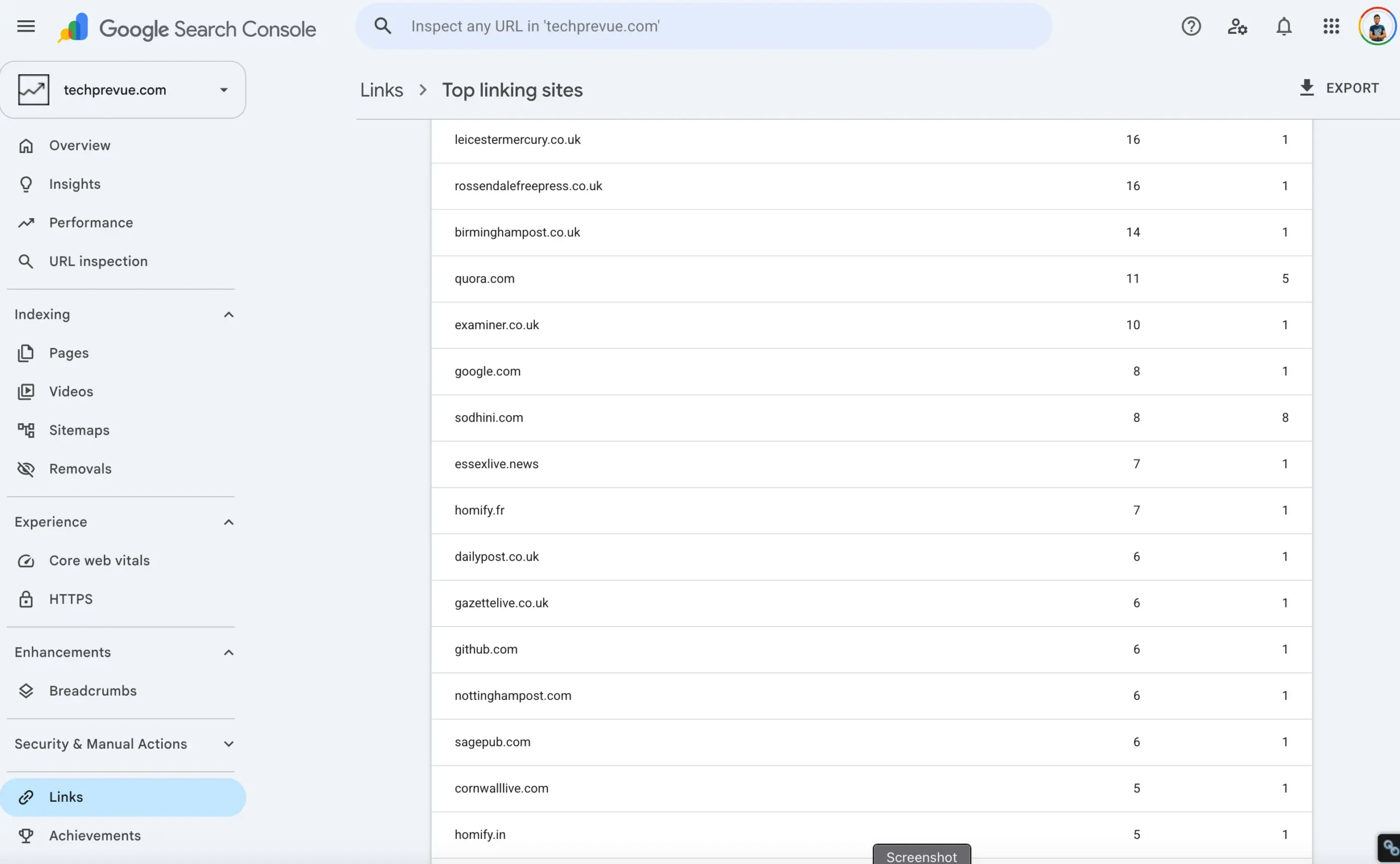
- Google Search Console — shows which sites link to you and how many links from each, under Links. Free, direct from Google, but won’t show attribute (dofollow vs. nofollow).
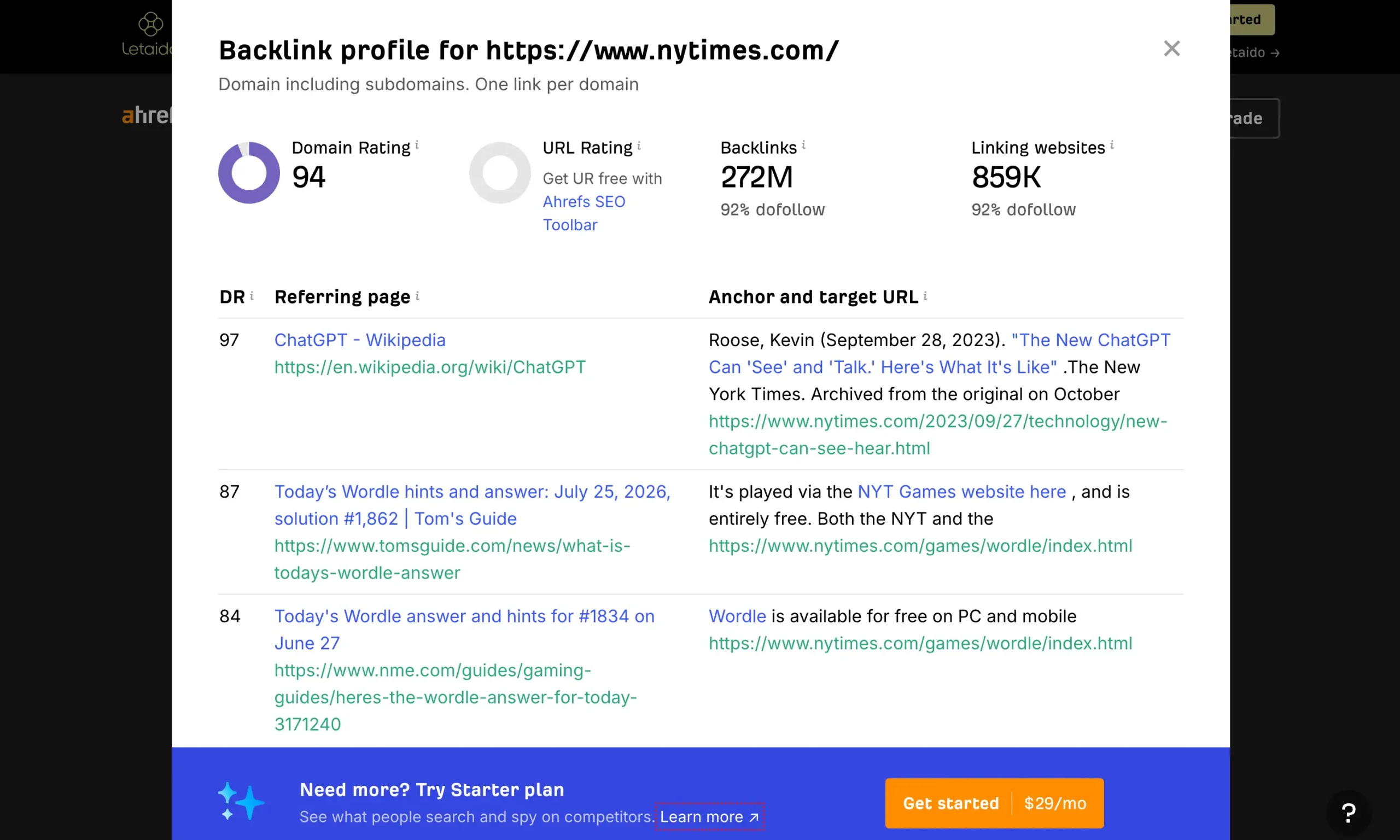
- A backlink checker (Semrush, Ahrefs, SE Ranking, others) — adds attribute, anchor text, referring domain authority, and whether a link is still active.
What to look for in either check:
- Any referring domain you don’t recognize and can’t explain
- A spike in links arriving in a short window rather than accumulating gradually
- Anchor text repeating the exact same keyword across many unrelated sites
Any one of these alone isn’t necessarily a problem — together, they’re worth a closer look. Run either check quarterly, or immediately after a sudden, unexplained ranking drop.
US vs. India: Do Backlink Types Differ by Market?
Quick answer: The core classification (attribute, source, position, anchor text) is identical everywhere. What changes by market is which specific sources actually matter.
- Directories: US priority = Google Business Profile, Yelp, Tripadvisor, Angi. India priority = Justdial, Sulekha, IndiaMART — carrying the same local trust weight Yelp carries in the US.
- Digital PR: US pitches typically target national/trade publications for reach. In India, regional-language and city-specific business journals often deliver stronger relevance than a single national outlet, even with lower raw domain authority.
- Guest posting: a niche Indian industry blog with a smaller, genuinely engaged, geographically relevant audience can outperform a larger US publication for a business whose actual customers search from Mumbai, Bangalore, or Delhi.
- Toxic-link risk reading needs market context too: a sudden batch of Hindi or regional-language backlinks is normal and expected for a business genuinely operating in India — the same way foreign-language links would raise more legitimate suspicion for a purely domestic US brand. Context, not the language or country of the linking site alone, determines whether a pattern looks manipulative.
Building a Healthy Backlink Type Mix
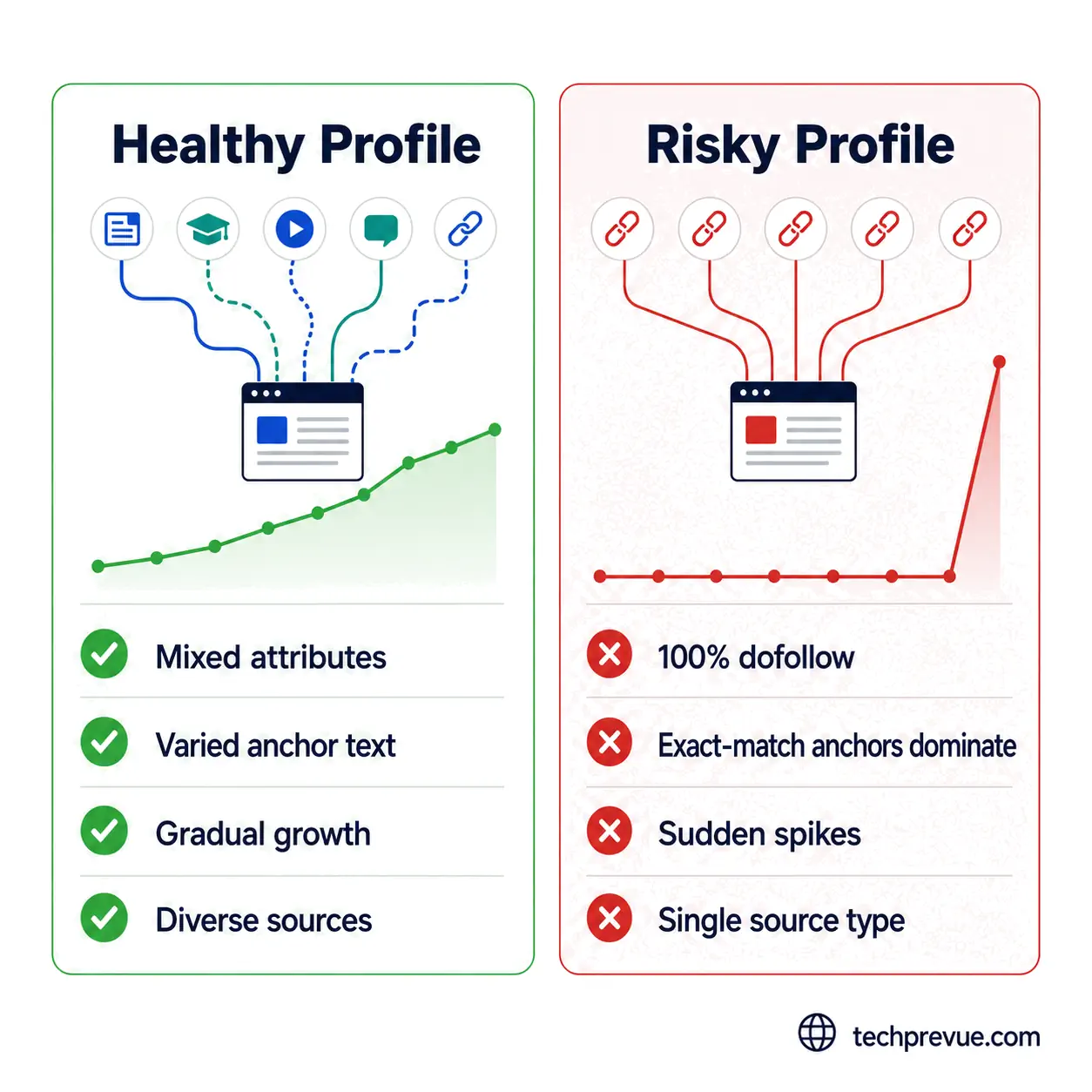
A backlink profile made up of only one type — all guest posts, all directory links, all dofollow links, all exact-match anchors — reads as manufactured to search engines, even when every individual link in it is perfectly legitimate on its own.
Mixing multiple types of backlinks deliberately, rather than defaulting to whichever one is easiest, is what actually keeps a profile looking organic. Use this as a rough, practical target when planning outreach rather than a strict formula:
- Majority editorial and natural citation links. These should make up the largest single share of any genuinely healthy profile, even though they’re the slowest type to build deliberately.
- A real mix of attributes. Some nofollow and UGC links alongside your dofollow ones — a backlink profile that’s 100% dofollow looks unnatural specifically because real, organic profiles never are.
- Branded and generic anchors dominating, with exact-match anchors kept to a deliberately small minority of the total.
- A spread of sources, not total reliance on one single tactic. If guest posting stops working tomorrow for any reason, a profile built entirely on guest post links has nothing left to fall back on.
- Zero tolerance for purchased dofollow links, PBNs, or automated link building. These are the categories with the clearest, most consistent, and best-documented penalty history of anything covered in this guide.
Common Mistakes with Backlink Types
Most of these come from misunderstanding a classification above, not from anything malicious.
- Treating all dofollow links as equally valuable — a dofollow from a spammy, irrelevant site can do nothing (or raise flags), while a nofollow from a trusted source can outperform it
- Chasing volume over relevance in directories — 50 low-quality unrelated listings do less than 5 relevant, well-maintained ones, and past a point start looking exactly like the pattern Google’s policies describe
- Forgetting to qualify paid/sponsored links — the single most common way a legitimate arrangement turns into a violation; the fix is one attribute, added when the link goes live
- Panicking over normal nofollow links — Wikipedia citations, major news mentions, large platform profiles are nofollow by default and still worth pursuing
- Disavowing preemptively without evidence of harm — the opposite of Google’s guidance, and can strip out links quietly helping your authority
- Confusing anchor variety with anchor randomness — a natural mix of branded/generic/partial-match anchors is healthy; deliberately rotating exact-match keyword variations “to look natural” is itself a detectable pattern
Which Types Should You Prioritize First?
Match effort to your actual site stage rather than chasing every type at once.
| Site stage | Prioritize | Deprioritize for now |
|---|---|---|
| New site, few or no backlinks | Business listings, social profiles, a handful of genuine guest posts | Digital PR, competitive resource pages (you likely won’t win the pitch yet) |
| Established site, steady traffic | Editorial links via original content, broken link building, resource pages | Directory submissions (diminishing returns once NAP is set) |
| High-authority site, strong content | Digital PR, expert-source placements, brand mention tracking | Guest posting (usually a net loss of authority at this stage) |
| Recovering from a past penalty | Link removal requests, careful disavow only where warranted | Any new outreach until the underlying issue is resolved |
Common mistake at every stage: treating this as a checklist to complete once, rather than an ongoing mix to maintain. A profile built entirely in one three-month sprint tends to look exactly like what it is.
Quick Glossary
- Link equity (link juice) — the ranking value a dofollow link passes from linking page to linked page
- Referring domain — a unique website linking to yours, distinct from total backlinks (one domain can link many times)
- Anchor text — the clickable, visible text of a link
- Domain Authority / Authority Score — a third-party metric (not a Google metric) estimating how likely a domain’s links help rankings, 0–100 scale
- Manual action — a penalty applied by a human Google reviewer (visible in Search Console), vs. an automatic algorithmic adjustment
- Disavow — a file asking Google to ignore specific backlinks when evaluating your site
- NAP consistency — keeping your business Name, Address, and Phone number identical across every listing
FAQs
These are the questions readers researching types of backlinks ask most often, answered directly first.
How many types of backlinks are there?
Three by acquisition method, four by link attribute, and more than 50 once you break links down by specific source and format. There’s no single correct number — it depends on which classification you’re using and what you’re trying to do with it.
What’s the difference between dofollow and nofollow backlinks?
A dofollow link passes ranking value; a nofollow link explicitly asks search engines not to. Since September 2019, Google treats nofollow as a hint it may still consider, not an absolute rule.
What’s the best type of backlink for SEO?
Editorial backlinks — dofollow links placed naturally because a writer or editor genuinely found your page useful — carry the most consistent ranking value.
Do nofollow backlinks actually help SEO?
Not directly for rankings, but they’re far from worthless. High-authority nofollow links drive real referral traffic and contribute to a natural-looking profile, and Google’s hint-based treatment means some may still factor in.
What’s the ideal dofollow-to-nofollow ratio?
No official target ratio exists. The goal is a natural mix reflecting how real sites actually link — 100% dofollow is the red flag, not any particular percentage.
What are toxic backlinks?
Links created mainly to manipulate rankings rather than help a reader, typically from paid schemes, PBNs, or automated spam. Most need no action, since Google’s systems already discount them.
Are guest post backlinks still effective in 2026?
Yes, when genuinely useful and placed on a relevant, reputable site. Google’s guidance targets large-scale, low-quality guest posting done purely for links, not thoughtful contributions.
What is a PBN backlink?
A link from a private blog network — sites owned by one party, built solely to pass links, with no real independent audience. Carries real, well-documented penalty risk.
How do I check which types of backlinks point to my site?
Google Search Console’s free Links report shows every linking site. A dedicated backlink checker adds attribute, anchor text, and authority data Search Console doesn’t provide.
Do backlink types matter differently for AI search than for Google?
The underlying types are the same, but AI search weighs unlinked brand mentions and overall source trustworthiness more heavily than any single backlink.
Can too many of one backlink type hurt my rankings?
Yes. A profile dominated by any single type — even a generally “safe” one — reads as manufactured regardless of how legitimate each link is. Diversity is itself a trust signal.
Is a backlink the same as a mention?
No. A mention is your brand name in content with no link (co-citation); a backlink includes an actual hyperlink. Only a backlink passes direct link equity — a mention’s value comes through brand and trust signals instead.
Do internal links count as a type of backlink?
No. Internal links connect pages within your own site; a backlink specifically comes from a different, external domain.
Key Takeaways
This guide covered every practical way to classify types of backlinks — by attribute, by source, by position, and by anchor text.
- There’s no single answer to “how many types of backlinks are there” — the honest answer is 3, 4, or 50+, depending on the framework
- The four attribute types (dofollow, nofollow, sponsored, UGC) are what every backlink checker is built around, and the only classification encoded in a link’s HTML
- Editorial and natural citation links remain the most valuable type across any system, because nobody paid for them and nobody had to ask
- Most toxic backlinks need no action — Google’s own systems already discount them. Only investigate after an unexplained ranking drop or an actual manual action notice
- A healthy profile mixes attributes, sources, and anchor text naturally. Uniformity — all dofollow, all guest posts, all exact-match anchors — is the real warning sign
If you’re auditing an existing site rather than starting fresh: pull your current backlink report and sort what you find against the categories above — attribute first, then source, then position. Most profiles turn out less risky than they look, and the ones needing cleanup usually need far less than a full disavow.
