
Most people already know technology reshaped how they work, talk, and pay. The harder questions are which areas genuinely changed, what each change cost, and what shifted in the last two years alone. This guide covers 24 areas with dated, sourced figures instead of adjectives.
Technology has changed our lives by removing physical presence as a requirement — for conversation, money, medicine, learning, and work. Around 6 billion people, roughly 74% of humanity, now depend on that shift, according to the ITU. The newest layer is artificial intelligence, which reached 900 million weekly ChatGPT users by February 2026 and now sits between people and the information they used to look up themselves.
What Is Technology, and How Did We Get Here?
Technology is any tool, method, or system we build to solve a problem or make a task easier. That definition covers the wheel and the smartphone equally, which is the point — what changes is the scale of the problem we can solve, not the nature of what we are doing.
Understanding the arc matters because the change we live through now is the latest step in a long sequence, not a break from it.
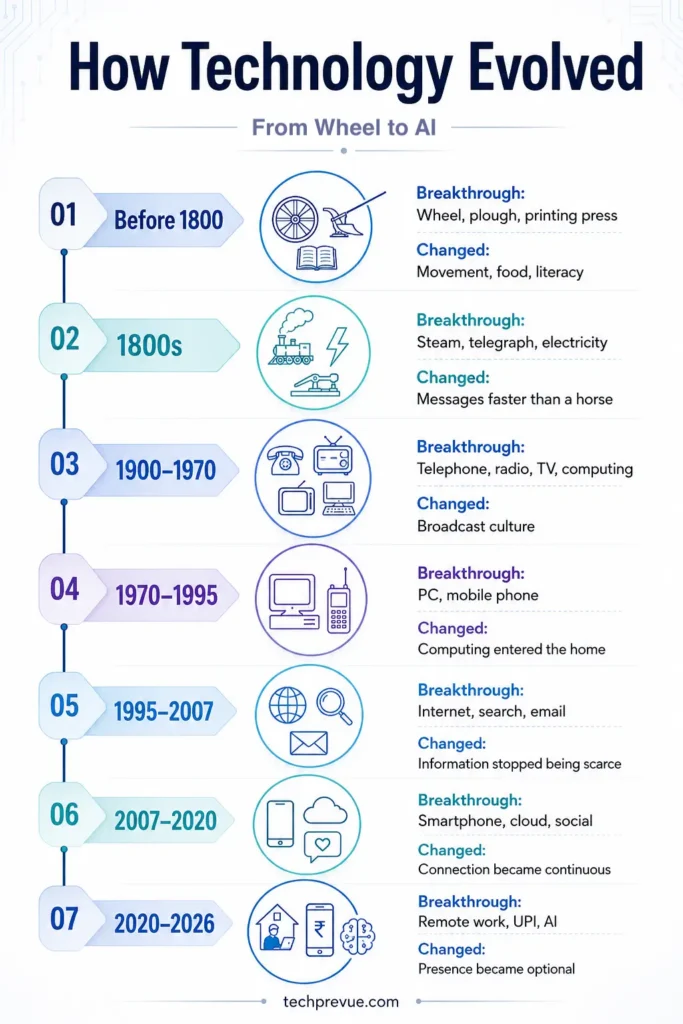
| Era | Breakthrough | What it changed for people |
|---|---|---|
| Before 1800 | Wheel, plough, printing press | Movement, food supply, mass literacy |
| 1800s | Steam, telegraph, electricity | Industry, and messages faster than a horse |
| 1900–1970 | Telephone, radio, television, computing | Broadcast culture and calculation at scale |
| 1970–1995 | Personal computer, mobile phone | Computing left the institution and entered the home |
| 1995–2007 | Internet, search engines, email | Information stopped being scarce |
| 2007–2020 | Smartphone, cloud, social media | Connection became continuous |
| 2020–2026 | Remote work, real-time payments, AI | Presence became optional, answers became generated |
Each row solved the problem the row above created. Cheap printing made information plentiful, which made finding it hard, which is what search solved — and search made answers plentiful, which is the problem AI is now attempting.
Technology and Internet Statistics 2026: Key Numbers
Every figure below is dated and attributed, and each is used again in context further down.
| Measure | Figure | Source and date |
|---|---|---|
| People online worldwide | ~6 billion (73.6%) | ITU, 2025 |
| People still offline | 2.2 billion | ITU, 2025 |
| Social media user identities | 5.79 billion | DataReportal, April 2026 |
| New social identities per second | 9.3 | DataReportal, April 2026 |
| Average daily social media use | ~2 hours 20 minutes | DataReportal, 2026 |
| Platforms used per person | 6.7 | DataReportal, 2026 |
| US adults online almost constantly | 41% | Pew Research Center, 2025 |
| US adults smartphone dependent | 16% | Pew Research Center, 2025 |
| India telecom subscribers | 1,092.79 million | TRAI, Q1 2026 |
| India mobile data per user | 26.70 GB per month | TRAI, Q1 2026 |
| UPI transactions in July 2026 | 23.66 billion (₹29.88 trillion) | NPCI |
| UPI daily average | 763 million | NPCI, July 2026 |
| US card transactions that are contactless | Over 65% | Industry reporting, 2026 |
| ChatGPT weekly active users | ~900 million | OpenAI, February 2026 |
| AI Overviews monthly reach | ~2 billion | Alphabet |
| US organizations that have integrated AI | 38% | Gallup, 2026 |
| Employers moving entry-level tasks to AI | 38% | ZipRecruiter, 2026 |
| Growth in AI data center electricity use | 50% during 2025 | IEA |
| Automated share of web HTML traffic | 57.5% | Cloudflare, June 2026 |
| US reported fraud losses | $15.9 billion | FTC, 2025 |
| India cybercrime losses | ₹22,495 crore | Ministry of Home Affairs, 2025 |
| Internet shutdowns worldwide | 313 across 52 countries | Access Now, 2025 |
How Technology Has Changed Our Lives: Before and After
In almost every case, technology did not invent a new activity. It removed the physical requirement from an existing one.
| Everyday task | Before | Now |
|---|---|---|
| Talking to family abroad | Rationed, expensive calls | Free video, any time |
| Paying a shop | Cash or card | Phone, QR code, or tap |
| Seeing a doctor | Travel, queue, wait | Video consult and e-prescription |
| Learning a skill | Fixed classroom schedule | Recorded course, own pace |
| Finding an answer | Library or dictionary | Search, then an AI summary |
| Renewing a document | Government office, half a day | Online portal, minutes |
How Has Technology Changed Our Daily Lives?
Daily life changed through small savings repeated constantly until the old method stopped being an option. Six areas account for most of it.
Communication
Technology broke the link between distance and cost for us. A message we send to the next street and a message we send to another continent now cost the same, which was never true of post, telegram, or the telephone.
That ended rationing. TRAI’s Q1 2026 data puts average Indian usage at 1,017 voice minutes per subscriber each month alongside 26.70 GB of data — roughly 34 minutes of calling every day.
- Video calls replaced rationed international calling
- Group chats replaced the round-robin phone call
- Voice notes replaced typing for anyone faster in speech than on a keyboard
- Live AI translation replaced needing a shared language, captioning speech as it happens
Drawback — availability became an expectation rather than a choice, and read receipts removed the excuse of not having seen a message. See how technology improved communication for the mechanics.
Social Life and Relationships
Communication changed how we reach people. Something separate happened to relationships: technology changed who we meet in the first place, and how present we are with the people already in the room.
Relationships now routinely begin online and move offline afterward, reversing the old order. Communities also reorganized around shared interest instead of shared geography, so a parent of a child with a rare condition can find others without moving city.
Checking that a stranger is real became a normal step rather than suspicion. AI-generated profiles have since made that check considerably harder.
Drawback — attention splits between the screen and the person in front of you, and the person present usually loses.
Social Media
Social media is the most studied change on this list and the most contested. DataReportal counted 5.79 billion social media identities at the start of April 2026, more than two in three people alive, growing at roughly 9.3 new identities every second.
That headline needs a caveat most coverage skips. These are identities, not people — the average user holds accounts on 6.7 platforms, so the real headcount is meaningfully lower than the number usually quoted.
| Measure | Figure | Source |
|---|---|---|
| Global user identities | 5.79 billion | DataReportal, April 2026 |
| Annual growth | 5.4%, or 294 million added | DataReportal, April 2026 |
| Average daily use | ~2 hours 20 minutes | DataReportal, 2026 |
| Platforms per user | 6.7 | DataReportal, 2026 |
| Share of social time in messaging | ~60% | DataReportal, 2025 |
| Heaviest platform by time | TikTok, ~95 minutes a day | Sensor Tower |
| Problematic use among adolescents | 11% | WHO HBSC, 280,000 teens across 44 countries |
Three shifts matter more than the user count. Publishing became universal, so anyone can reach an audience without a broadcaster. Distribution then became algorithmic, so what spreads is chosen by a ranking model rather than by who follows whom.
The third shift is the least discussed. Around 60% of social time now happens inside messaging apps rather than public feeds, which means the dominant use is private conversation, not broadcasting.
Does social media harm mental health? The effect appears real, modest on average, and far more dependent on how a person uses these platforms than on how long.
A meta-analysis pooling 39 studies covering 45,000 people found correlations between problematic use and psychological distress in the moderate range, around r = 0.27 to 0.35. Correlation cannot establish direction, and the largest longitudinal work complicates the simple story — analysis of 430,000 UK teenagers’ time-use diaries found only weak effects on well-being.
Evidence also runs the opposite way. A 2025 study in Scientific Reports found adolescents already experiencing depression felt roughly twice as insecure after scrolling and nearly twice as rejected in online conversation, which suggests existing symptoms shape the experience rather than only resulting from it.
Two findings hold up better than the headline claim. Sleep disruption has the most consistent supporting evidence of any proposed mechanism. And reducing use helps: a review of 14 randomized trials covering 3,200 participants found roughly a 20% drop in stress when usage limits were applied, consistent with the 24.8% fall in depression symptoms after one week away reported in our social media detox guide, where loneliness notably did not shift.
Regulation caught up in 2025. Australia’s ban on under-16 accounts took effect on 10 December 2025, and Instagram’s Teen Accounts introduced time notifications and an overnight sleep mode.
Users are self-correcting too. Survey data reported in May 2026 found nearly a third of Gen Z respondents had deleted a social media app in the previous 12 months.
Drawback — the design incentive has not changed. Platforms are still optimized for time spent, and the strongest evidence for improvement comes from limiting use rather than from any feature a platform has shipped. The dangers of social media are worth reading alongside the benefits.
Everyday Routines and Errands
An entire category of errand disappeared from our week. Banking, bill payment, appointment booking, and navigation each stopped requiring a trip, and together they removed the planning those trips demanded.
- Standing in a bank queue to pay a bill
- Calling a restaurant to check for a free table
- Buying a paper map or asking a stranger for directions
- Waiting on hold to reschedule an appointment
AI assistants extended this recently from answering to acting. Booking, summarizing, and comparing now happen without opening the individual apps.
Drawback — the dependence is invisible until the connection fails, when payment, work, and travel stop at the same moment. That is why fixing a slow internet connection stopped being a minor annoyance.
Shopping and Delivery
Shopping separated from shops. We compare prices, read reviews, and check stock on the phone, so our decision is usually made before we reach a store.
Delivery closed the loop. Groceries, medicine, electronics, and restaurant food arrive at the door, and in Indian metros much of it arrives within the hour.
Recommendation engines quietly took over discovery. What appears first is now chosen by a model rather than by shelf position or advertising spend alone.
Drawback — ranked results are optimized for the platform’s margin, not your interest, and the cheapest option is rarely the one shown first.
Travel and Transport
Navigation stopped requiring local knowledge. Our maps route around live traffic, ride-hailing puts a car where no taxi ever waited, and we book a ticket in minutes instead of visiting an agent.
Safety improved in ways that are easy to overlook. A solo traveler can share a live route with family, and a logged trip creates a record that did not exist with a street-hailed cab.
Drawback — reliance on turn-by-turn directions erodes the sense of direction it replaced, and a dead battery in an unfamiliar city is a genuinely worse problem than a lost paper map.
Entertainment
Entertainment stopped being scheduled. The change was not that films and music moved online but that the audience took over the timing, breaking a habit built across seventy years of broadcast.
- Discs and downloads became access — nothing is owned, everything is licensed
- Channels became algorithms — what plays next is chosen for you
- Release schedules became instant — whole seasons arrive at once
- Watching became second-screen — most viewing shares attention with a phone
Gaming went furthest, growing from a children’s pastime into a mainstream activity across age groups. Our guide to the pros and cons of video games covers what the research supports.
Drawback — infinite supply removed every natural stopping point, and autoplay is built to prevent one. The negative effects of smartphones show up most clearly here.
How Has Technology Changed Society?
Beyond individual convenience, technology changed the institutions people depend on. These six areas affect people whether or not they personally use the tools.
Education
Technology broke the link between where we live and what we can learn. A student in a district town now opens the same lecture, dataset, and past paper as a student in Delhi or Boston.
Recorded material did something a classroom never could. A difficult explanation can be replayed as many times as needed, at the student’s own pace, without asking anyone to repeat it.
- Open courses from universities including Yale and Harvard, most auditable at no cost
- YouTube as parallel infrastructure, especially for Indian competitive exam preparation
- Class channels where a question can be asked at 11pm
- AI tutors that explain the same concept a different way on request
Drawback — access is not outcome. Remote learning still struggles with laboratory work and supervised assessment, and AI assistance has made take-home work difficult to grade honestly. See the pros and cons of online learning and the pros and cons of online school.
Healthcare
Technology moved our consultations, monitoring, and records out of the hospital building. It has not moved treatment, and that distinction matters more than most coverage admits.
- Consultation — video appointments for follow-ups, chronic care, and mental health
- Monitoring — wearables flagging irregular heart rhythms and sleep disruption
- Records — digital histories a patient carries between doctors
- Prescriptions — e-prescriptions with home delivery
- Screening — AI assisting radiologists with imaging review
The benefit is largest where travel was the barrier. For a patient hours from a specialist, remote consultation is the difference between care and none.
Drawback — searching symptoms is not diagnosis, a video call cannot deliver a physical examination, and patients without a smartphone are quietly excluded from a system that assumes one.
Government and Public Services
Our paperwork moved online, and the queue went with it. We file taxes, renew licenses, claim benefits, and verify identity through portals in both the US and India.
India’s stack went furthest. Aadhaar-linked verification, DigiLocker documents, and direct benefit transfers removed intermediaries who previously extracted a fee at every step.
Drawback — when the online route becomes the default, the offline alternative usually disappears rather than remaining as a backup. Anyone without access stops being inconvenienced and starts being excluded.
News and Information
How we learn what happened changed twice. First the internet removed the publishing gatekeepers, then algorithmic feeds took over distribution, and now AI answers reach us before the source does.
Speed improved enormously. A cyclone warning or a market move reaches phones in seconds rather than waiting for a bulletin.
Drawback — false information travels at exactly the same speed as accurate information, and AI summaries can strip away the sourcing a reader would have used to judge it. Cloudflare measured automated traffic at 57.5% of HTML requests in June 2026, so much of what circulates is no longer written or read by people.
Science, Space and Research
Computing changed what questions we can even ask. Sequencing a human genome once took years and vast sums; it now takes days, which turned personalized medicine from theory into practice.
Climate modeling, particle physics, and drug discovery all depend on processing volumes of data no team could handle by hand. AI extended this recently to protein structure prediction, unlocking work that had stalled for decades.
Space technology touches our daily lives more than we notice. Satellite navigation guides our deliveries, weather satellites give us the cyclone warnings that save lives, and satellite internet is reaching villages no cable will ever pass.
Drawback — research capability concentrated in the institutions that can afford the computing, which widens the gap between well-funded science and everyone else.
Privacy, Security and Fraud
Convenience was paid for in data, and the bill arrives as fraud. Keeping money, identity, documents, and conversation in one place means a single compromised account can expose all four.
| United States (2025) | India (2025) | |
|---|---|---|
| Reported losses | $15.9 billion | ₹22,495 crore |
| Change on prior year | Up from $12.5 billion | Cases up 24% |
| Common pattern | Imposter and investment scams | Digital arrest, investment fraud |
| Where to report | reportfraud.ftc.gov | Helpline 1930 |
AI made impersonation worse rather than better. Voice cloning turns a short clip into a convincing distress call from a relative, and the old tells of bad grammar and odd phrasing no longer apply.
Five habits cut most of the risk:
- Turn on two-factor authentication for email first — it is the recovery route for everything else
- Use a password manager so no two accounts share a password
- Treat any unexpected message about money as fraudulent until verified on a number you looked up yourself
- Agree a spoken code word with family to defeat voice-cloning calls
- Never move money to “protect” it, because no bank or police force will ask you to
Drawback — reviewing your Google activity history shows how much a single account already holds, and most people have never looked.
Environment and Sustainability
Technology sits on both sides of the environmental ledger, and honest essays say so. It reduced some kinds of waste while creating entirely new kinds.
On the positive side, precision farming cut water, pesticide, and fertilizer use on the same land. Remote work removed millions of daily commutes, video calls replaced business flights, and digital documents replaced a great deal of paper.
The costs are physical. Manufacturing our devices consumes mined metals, discarded electronics are among the fastest-growing waste streams, and the servers behind everything draw serious power — the IEA recorded total data center electricity demand rising 17% during 2025, with the AI-focused share up 50%.
Drawback — we replaced visible waste with invisible waste. A paperless office still runs on a data center we never see, and a phone replaced every two years leaves a trail we never handle.
The Digital Divide
Access did not arrive evenly, and the gap widened as services withdrew their offline alternatives. Around 2.2 billion people remain offline entirely.
The divide is not only between countries. Pew found 16% of US adults are smartphone dependent, owning a phone but having no home broadband, a share that has doubled since 2013.
Drawback — exclusion compounds. Missing a benefit claim, an exam registration, or a wage payment because the only route was digital produces consequences that outlast the missed connection.
How Has Technology Changed Work and the Economy?
Work separated from location, money separated from banks, and the entry point into both moved. These four areas changed how people earn rather than how they spend.
Where and How We Work
Location became optional for anything done on a screen. Remote work existed before 2020, but reliable video, shared documents, and project tracking only became the default afterward.
| At work | Before | Now |
|---|---|---|
| Where work happens | One office, fixed hours | Home, office, or both |
| Meeting a colleague abroad | Flight and hotel | Video call the same day |
| Sharing a document | Emailed attachments, version chaos | One live file |
| Hiring | Local candidates only | Anyone in a workable timezone |
Drawback — the commute used to mark the end of the day and nothing replaced it. Employers also gained monitoring powers that would have been unthinkable in an office, from activity tracking to keystroke logs.
Jobs and Skills
The work itself changed, not only where we do it. Drafting, code, meeting notes, and first-pass analysis now arrive machine-generated, which moves our contribution toward judgment and verification.
Adoption is real but uneven. A 2026 Gallup study found 38% of employees say their organization has integrated AI while 41% say it has not, and SHRM’s survey of 5,875 US workers found 34% of individual contributors’ work involves AI against 63% for directors and above.
Drawback — the entry rungs are thinning. ZipRecruiter’s 2026 employer report found 38% of employers moved basic data processing away from junior staff onto AI, and 31% raised experience requirements as a result.
Money and Payments
Payment separated from cash, from bank hours, and from being physically present. India shows the scale most clearly: UPI processed 23.66 billion transactions worth ₹29.88 trillion in July 2026, averaging 763 million a day, according to NPCI.
Tap-to-pay runs on near-field communication, a short-range subset of RFID. The card, phone, or watch never transmits the real card number — it sends a one-time token, so intercepting a transaction yields nothing reusable. By 2026 more than 65% of in-person card transactions in the US were contactless.
QR codes solved the same problem from the opposite direction. Instead of the merchant buying a terminal, the customer’s phone scans a printed code, which is how UPI reached street vendors card networks never touched.
| Method | How it works | Best for |
|---|---|---|
| NFC tap — card, phone, watch | Short-range radio, one-time token | Fast checkout at a staffed till |
| QR code | Phone scans a printed code | Merchants with no terminal |
| Digital wallet | Tokenized cards stored on device | One device, online and in person |
| Wearables | NFC chip in a watch or band | Paying without a phone |
| Account-to-account rails | Real-time bank transfer | Sending money to a person |
| Crypto | Blockchain settlement, no bank | Cross-border transfer |
Blockchain records transactions across many computers instead of inside one bank’s database. For everyday spending it stayed marginal — prices move too much and confirmation is slower than a tap — but stablecoin rails cut the cost of cross-border transfers, which matters most to migrant workers sending money home. Central banks including the RBI are testing digital currencies on similar principles.
Crypto assets are volatile and regulated differently in every market, so treat this as a description of the technology rather than a recommendation.
Drawback — a payment system living on a network stops when the network does, and Access Now recorded 313 internet shutdowns across 52 countries in 2025.
Automation, Industry and Transport
Machines took over the repetitive and the dangerous first. Factory robots now handle welding, painting, and assembly work that injured people for a century, and warehouse systems move goods that once broke backs.
Transport changed more slowly than the headlines suggest. Electric vehicles moved from novelty to ordinary in many cities, satellite navigation reshaped logistics, and shipment tracking gave us delivery windows measured in hours instead of weeks.
Fully autonomous driving remains limited to mapped areas under supervision, despite a decade of predictions. That gap between promise and delivery is itself worth noting in any essay on this topic.
Drawback — automation removes the jobs that used to train people. A factory that needed 200 workers may now need 20 specialists, and the 180 rarely become specialists.
Small Business and Commerce
The cost of reaching customers collapsed. One of us working alone can now accept payment, list products, run ads, and handle support with tools that once needed a finance team and an agency.
AI compressed the remaining gap. Copy, product images, and customer replies that required hiring can now be produced by the owner in an afternoon.
Drawback — the same collapse applies to competitors, so the barrier fell for everyone at once and attention became the scarce resource instead of capability.
How Has Technology Itself Changed?
The tools changed shape roughly once a decade, and each shift moved computing closer to the person using it.
The Devices We Carry
Computing moved from our desk to our pocket to our wrist. The phone absorbed our camera, music player, torch, calculator, map, and wallet, which is why it feels indispensable rather than merely useful.
Smart home devices extended the same logic to the building. Lights, locks, doorbells, and thermostats became addressable from anywhere.
Drawback — consolidation means one lost or dead device removes payment, identity, navigation, and contact simultaneously.
Connectivity and the Cloud
Storage and processing left our devices. Our files, photos, and documents live on servers now, reachable from any screen and lost to a forgotten password rather than a broken hard drive.
That shift is what made everything else work. Streaming, video calling, real-time payments, and AI assistants all assume a connection that is always present and fast enough to be invisible.
Drawback — convenience became dependence on companies that can change terms, raise prices, or close a service holding a decade of personal files.
AI as the Newest Layer
Artificial intelligence moved from a tool you open to a layer you pass through. Search returns an answer before a link, and writing, translation, and code arrive already drafted.
| Measure | Figure | Source |
|---|---|---|
| ChatGPT weekly active users | ~900 million | OpenAI, February 2026 |
| AI Overviews monthly reach | ~2 billion | Alphabet |
| US employees whose organization uses AI | 38% | Gallup, 2026 |
| Share of work involving AI, where present | 46% average | SHRM, March–April 2026 |
| AI handles well | AI still fails at |
|---|---|
| Drafting, summarizing, translating | Knowing when it is wrong |
| Explaining an unfamiliar topic | Recent events outside its training |
| Writing and debugging code | Specialist judgment with real stakes |
| Reformatting and cleaning data | Citing sources that actually exist |
For publishers, this changed distribution rather than just research, which made ranking inside AI-generated answers its own discipline.
Drawback — AI states wrong answers with the same confidence as right ones, so verification became a skill rather than a formality.
What AI Costs
The bill is arriving in electricity and in attention. The IEA recorded 50% growth in AI data center electricity use during 2025, with total data center demand up 17%.
The second cost is epistemic. When answers arrive pre-assembled, the habit of checking a source weakens, and the people who benefit most from these tools remain the ones who know enough to question the output.
Drawback — the web is filling with machine-generated content that trains the next generation of models, and nobody has solved what happens when that loop tightens.
Has Technology Improved Our Lives?
Yes, unevenly, and the honest answer requires holding both columns at once. Treating either as a rounding error produces bad decisions.
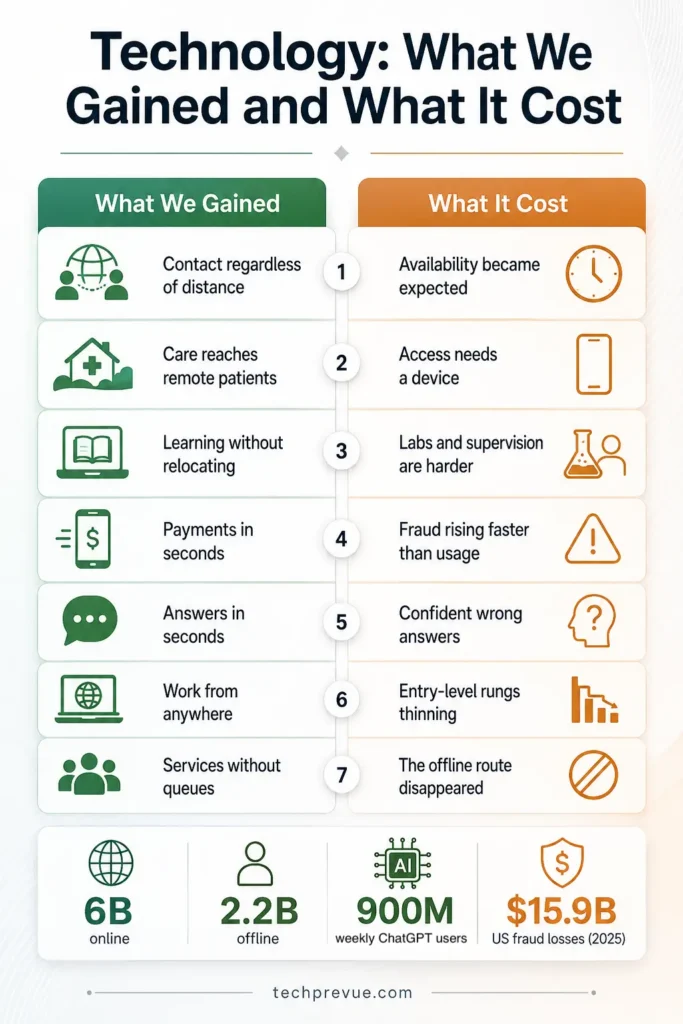
| What improved | What it cost |
|---|---|
| Contact independent of distance | Availability became an expectation |
| Care reaches people far from hospitals | Access now requires a device and a connection |
| Learning without relocating | Labs, supervision and honest assessment are harder |
| Payments settle in seconds | Fraud losses rising faster than usage |
| Answers arrive in seconds | Confident wrong answers, harder to check |
| Work from anywhere | Entry-level rungs thinning |
| Public services without queues | The offline alternative disappeared |
The clearest cost is exclusion, and it is the one least likely to be fixed by better technology. Around 2.2 billion people remain offline while the services they need move online by default.
Our guide to the importance of the internet covers what that dependence is worth in numbers.
How to Write an Essay on How Technology Has Changed Our Lives
Students search this topic more than almost any other, so here is a structure you can build your own essay around. Use the statistics above as evidence, and check each figure against the source named beside it before you cite it.
A five-paragraph structure that works:
- Introduction — define technology in one line, then state your position. A good thesis takes a side rather than saying “there are advantages and disadvantages.”
- Body one: the gains — pick two or three areas from this guide and use specific numbers rather than adjectives.
- Body two: the costs — fraud losses, attention, exclusion, or entry-level jobs.
- Body three: the complication — the strongest essays sit here. Explain why a gain and a cost are the same fact seen twice.
- Conclusion — answer the question you set, and avoid predicting the future.
Thesis angles that avoid the obvious:
- Technology did not create new activities, it removed the physical requirement from old ones
- Every convenience created a dependence that is invisible until it fails
- The benefit is real but unevenly distributed, and the gap is widening
- The debate about social media and mental health is less settled than either side claims
Common mistakes to avoid:
- Listing inventions instead of arguing a point
- Using undated statistics — a 2019 figure in a 2026 essay undermines everything around it
- Claiming social media causes depression as settled fact, when the evidence is contested
- Ending with “technology is a double-edged sword,” which says nothing
Write it in your own words. Examiners recognize copied essays, and the argument you build yourself is the one you can defend in a viva or a follow-up question.
Frequently Asked Questions
How has technology changed our lives the most?
The single largest change is that physical presence stopped being a requirement. Conversation, payment, medical consultation, education, and government services each separated from the building they used to happen in. Every other change follows from that one.
Has technology improved our lives or made them worse?
Both, in different areas. Healthcare access, education reach, and communication improved measurably, while attention, privacy, and entry-level employment moved the other way. The result depends heavily on income and access rather than on technology itself.
How has AI changed everyday life in 2026?
AI now sits between people and information. Search returns summaries before links, drafting and translation happen automatically, and roughly 900 million people use ChatGPT weekly. Workplace adoption sits near 38% of US organizations, so this is early rather than settled.
What are the biggest negative effects of technology?
Four are documented well enough to take seriously: fraud, which cost US consumers $15.9 billion in 2025; misinformation traveling at the speed of accurate information; fragmented attention and disrupted sleep; and exclusion of anyone without a device or connection.
How many people use social media in 2026?
DataReportal counted 5.79 billion social media identities in April 2026, growing 5.4% year on year. These are accounts rather than individuals — the average person holds 6.7 platform accounts — so the true number of users is lower than the headline figure.
Does social media cause depression?
The evidence supports a real but modest association rather than a simple cause. Meta-analyses find moderate correlations with distress, while the largest longitudinal studies find weak effects, and some research shows existing depression worsens the online experience. Sleep disruption is the best-supported mechanism, and trials show reducing use lowers stress.
How is life different from 20 years ago?
In 2006, most people carried a phone that made calls, watched television on a schedule, banked at a branch, and looked things up in books. Today all four run through one pocket device, and an AI layer increasingly answers before anyone searches.
How Technology Has Changed Our Lives: The Bottom Line
Across these 21 areas the pattern is consistent. Technology removed a physical requirement, delivered a real gain, and created a dependence that only becomes visible when the system fails.
Six billion people online, 763 million UPI transactions a day, 900 million weekly AI users, and $15.9 billion in fraud losses describe the same shift from different angles. The honest conclusion is not that technology is good or bad.
Technology became infrastructure — as consequential as electricity or roads, and deserving the same attention to who can afford it, who can reach it, and who is protected while using it. For 2.2 billion people, that work has not started.
