
In 2026, 45% of consumers use ChatGPT, Gemini, or Google’s AI Mode to find a local business. A year ago, that number was 6%. Google’s own share of local-business discovery dropped from 83% to 71% over the same twelve months, according to BrightLocal’s 2026 Local Consumer Review Survey.
If your local SEO checklist still stops at “claim your Google Business Profile,” you’re optimizing for a search landscape that’s already moved.
Quick answer: A local SEO checklist is a prioritized set of tasks — Google Business Profile setup, review management, on-page local signals, citation consistency, technical schema, local link building, AI search readiness, and tracking — that determines whether a business shows up in the Map Pack, local organic results, and AI-generated answers. The highest-impact tasks are GBP optimization and review management, not backlinks.
This checklist breaks that work into 35 local SEO tasks across eight priority groups. It’s ordered by measured impact, not the alphabet, and every task below maps to a row in the free interactive tracker — so you can actually track progress instead of just reading about it.
- Local SEO Checklist: Step-by-Step Optimization Workflow
- Why This Local SEO Checklist Is Ordered by Impact, Not the Alphabet
- Local SEO Priority Tiers at a Glance
- Section A: Google Business Profile (Tasks 1–7)
- Section B: Reviews & Reputation (Tasks 8–13)
- Section C: On-Page & Local Content (Tasks 14–19)
- Section D: Citations & NAP Consistency (Tasks 20–23)
- Section E: Technical SEO & Schema (Tasks 24–27)
- Section F: Local Link Building (Tasks 28–29)
- Section G: AI Search Readiness (Tasks 30–31)
- Section H: Tracking & Reporting (Tasks 32–35)
- The 5-Task Local SEO Fast Start (If You're Short on Time)
- Local SEO Checklist FAQs
- Track This Local SEO Checklist in the Live Tracker
Local SEO Checklist: Step-by-Step Optimization Workflow
This is the full 35-task Local SEO sheet, grouped into the same 8 parts as the interactive tracker. Copy it into a spreadsheet or Notion, or just work through it directly in the tracker itself — highest-impact parts first.
Google Business Profile
| # | Task | Priority | Frequency | Tool |
|---|---|---|---|---|
| 1 | GBP claimed and fully verified | High | One-time | Google Business Profile |
| 2 | Primary category is the narrowest accurate match | High | Quarterly | Google Business Profile |
| 3 | Every profile field completed to 100% | High | One-time | Google Business Profile |
| 4 | Services listed and described individually | High | One-time | Google Business Profile |
| 5 | Real photos uploaded on a fixed schedule | Medium | Weekly | Google Business Profile |
| 6 | Posts published for engagement, not rankings | Medium | Weekly | Google Business Profile |
| 7 | Q&A section monitored and answered | Medium | Weekly | Google Business Profile |
Reviews & Reputation
| # | Task | Priority | Frequency | Tool |
|---|---|---|---|---|
| 8 | Systematic review-generation process in place | High | One-time setup | Email / SMS |
| 9 | Every review gets a response, positive or negative | High | Weekly | GBP + platforms |
| 10 | Review recency protected — velocity isn’t stalling | High | Ongoing | Review dashboard |
| 11 | No bought, incentivized, or fake reviews | High | Always | Policy check |
| 12 | Rating tracked against the 4.5-star bar | Medium | Monthly | GBP Insights |
| 13 | Reviews built on platforms beyond Google | Medium | One-time setup | Yelp / Apple Maps / Facebook |
On-Page & Local Content
| # | Task | Priority | Frequency | Tool |
|---|---|---|---|---|
| 14 | NAP in the footer, sitewide | High | One-time | Site template |
| 15 | Real location / service-area pages, not doorway pages | High | One-time per location | CMS |
| 16 | Interactive map embedded on the contact page | Medium | One-time | Google Maps embed |
| 17 | Local modifiers used naturally, no city-name stuffing | Medium | Ongoing | Content editor |
| 18 | Service pages and location pages linked both ways | Medium | One-time | CMS |
| 19 | FAQ section answers real local questions | Medium | One-time, revisit quarterly | Content editor |
Citations & NAP Consistency
| # | Task | Priority | Frequency | Tool |
|---|---|---|---|---|
| 20 | NAP consistency audited across existing citations | High | Quarterly | Spreadsheet / this tracker |
| 21 | Citations built on directories that matter in-market | Medium | One-time build | Directory submission |
| 22 | Formatting standardized across markets (postcode, phone, spelling) | Medium | Ongoing | Spreadsheet |
| 23 | Duplicate listings found and merged | Medium | Quarterly | Google + directories |
Technical SEO & Schema
| # | Task | Priority | Frequency | Tool |
|---|---|---|---|---|
| 24 | LocalBusiness schema added correctly | High | One-time | Rich Results Test |
| 25 | No self-serving review schema in use | High | One-time check | Rich Results Test |
| 26 | Mobile speed and Core Web Vitals fixed on local pages | Medium | Quarterly | PageSpeed Insights |
| 27 | HTTPS everywhere with clean, human-readable URLs | Low | One-time | CMS / hosting |
Local Link Building
| # | Task | Priority | Frequency | Tool |
|---|---|---|---|---|
| 28 | Links earned from genuinely local sources | Medium | Ongoing | Outreach |
| 29 | Citations and link building treated as separate tactics | Low | Always | Mindset check |
AI Search Readiness
| # | Task | Priority | Frequency | Tool |
|---|---|---|---|---|
| 30 | AI assistants verified to describe the business accurately | High | Quarterly | ChatGPT / Gemini / Perplexity |
| 31 | Key facts written as short, quotable, standalone sentences | Medium | Ongoing | Content editor |
Tracking & Reporting
| # | Task | Priority | Frequency | Tool |
|---|---|---|---|---|
| 32 | Recurring audit cadence set (quarterly minimum) | Medium | Quarterly | This tracker |
| 33 | GBP Insights tracked: calls, direction requests, clicks | Medium | Monthly | GBP Insights |
| 34 | Geo-grid rank check run, not just a single rank check | Medium | Monthly | Local Falcon / Places Scout |
| 35 | Review count and rating benchmarked against top 3 competitors | Medium | Monthly | Manual / competitor tracking |
Why This Local SEO Checklist Is Ordered by Impact, Not the Alphabet
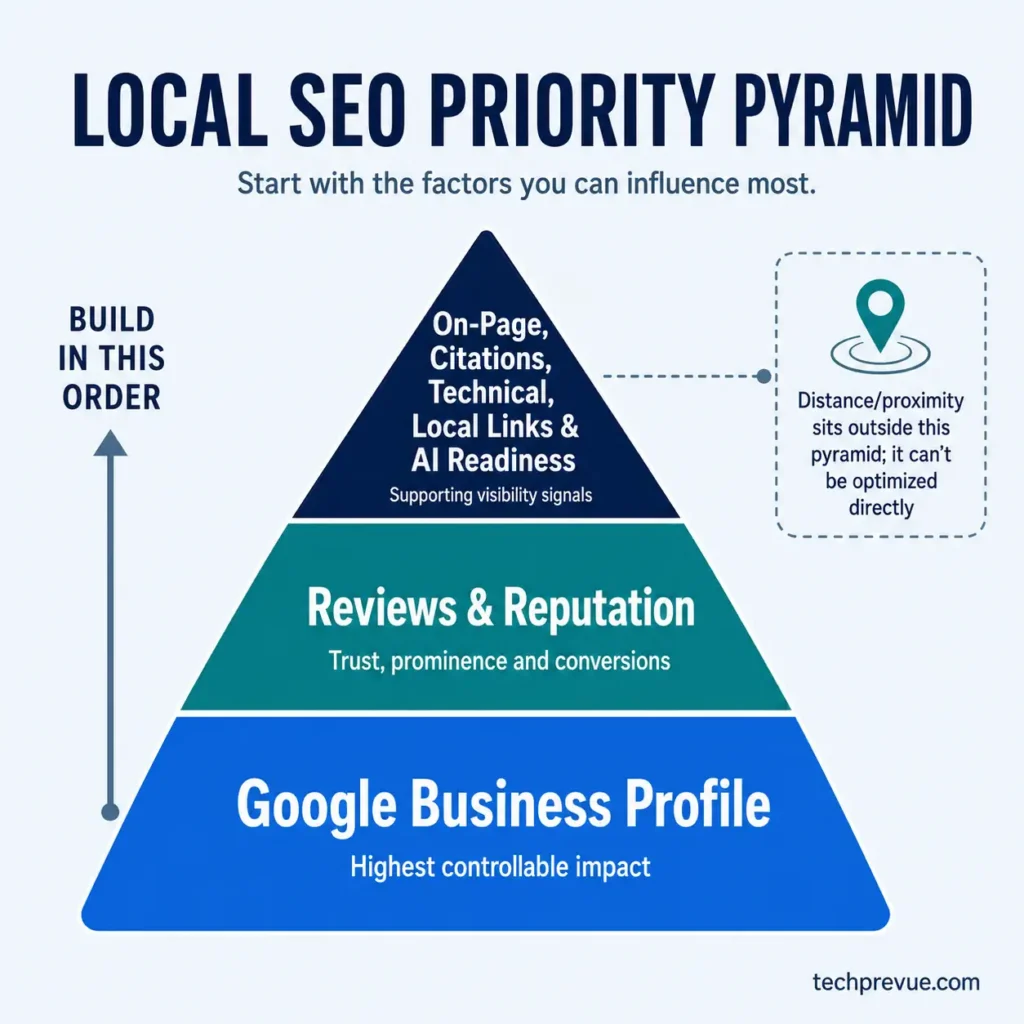
Most local SEO checklists list 20 to 190 tasks with equal visual weight. That’s the wrong mental model.
Some tasks move rankings within weeks. Others do nothing measurable at all, no matter how often they’re repeated in blog posts.
Google itself names three official ranking inputs for local results: relevance, distance, and prominence. Relevance is how well a profile matches what someone searched for.
Distance is exactly what it sounds like — proximity to the searcher, which no amount of optimization overrides. Prominence covers everything else: how well-known and well-reviewed a business is, both online and off.
Whitespark’s 2026 Local Search Ranking Factors survey — an annual analysis where 47 local SEO experts score 187 individual ranking factors — consistently places Google Business Profile signals and review signals as the two heaviest categories a business can actually control within that “prominence” bucket. On-page signals come next. Distance outweighs all of them combined, but a business can’t optimize its way around where someone is physically standing when they search.
That’s the logic behind the order below: GBP first, reviews second, on-page third, then citations, technical schema, local links, AI search readiness, and tracking last (because tracking only matters once there’s something to track).
How to Use This Local SEO Checklist
Work through the eight sections in order, not by picking whichever task feels easiest. Log each item as you go in the free interactive tracker — it mirrors these exact 35 tasks, split into the same sections, with priority filtering and progress saved in your browser.
Give yourself a full pass through all 35 tasks before circling back to fix anything imperfectly done the first time. A rough first pass across everything beats a perfect first pass through only Section A.
Local SEO Priority Tiers at a Glance
| Tier | Category | Example Tasks | Typical Time to See Movement |
|---|---|---|---|
| 1 — Highest impact | Google Business Profile | Category selection, profile completeness, services | 2–4 weeks |
| 2 — Highest impact | Reviews & reputation | Review velocity, response rate, recency | 4–8 weeks |
| 3 — High impact | On-page & local content | Location pages, NAP, local modifiers, FAQ | 6–12 weeks |
| 4 — Supporting | Citations & NAP consistency | Directory listings, duplicate cleanup | 8–16 weeks |
| 5 — Supporting | Technical & schema | LocalBusiness schema, page speed | Ongoing, compounding |
| 6 — Supporting | Local link building | Local sponsorships, local press | 3–6 months |
| 7 — Emerging | AI search readiness | AI accuracy checks, quotable content | Ongoing, compounding |
| 8 — Maintenance | Tracking & reporting | Rank tracking, GBP Insights, benchmarking | Continuous |
Section A: Google Business Profile (Tasks 1–7)
Your Google Business Profile (GBP) is the single highest-impact asset in local SEO. Get this section right before touching anything else on this local SEO checklist.
A note for service-area businesses: if you don’t have a public storefront — plumbers, electricians, mobile groomers, and similar trades — Google’s own guidelines instruct you to hide your street address on your profile. Local SEO researchers, including Whitespark, have documented this guideline itself as one of the more frustrating quirks in local search: hiding the address is often correlated with weaker Map Pack visibility, even though the business is following Google’s instructions exactly as written. There’s no clean workaround, but knowing this going in prevents a confusing, unexplained ranking dip from feeling like something you did wrong.
1. Claim and fully verify your Google Business Profile
Goal: Establish a verified, Google-confirmed presence. Effort: 30–60 minutes, plus verification wait time.
Search for your business name before creating a new listing — a duplicate is one of the fastest ways to split your reviews and rankings across two profiles. Claim the existing one if it’s there. Verification methods vary (phone, email, video, or postcard), and an unverified profile rarely shows up in the Map Pack at all.
2. Choose the single most accurate primary category
Goal: Match the exact intent Google uses to decide who shows up for what. Effort: 15 minutes, revisit quarterly.
Your primary GBP category is the single strongest relevance signal in the Local Pack, according to multiple independent breakdowns of Whitespark’s 2026 survey. Pick the narrowest category that’s still accurate — “Italian Restaurant” beats “Restaurant” if that’s genuinely what you are. Add secondary categories for real additional services, not for keyword coverage.
3. Complete every profile field to 100%
Goal: Remove every reason Google has to show a competitor with a fuller profile instead. Effort: 1–2 hours once.
Hours, attributes, service area, opening date, accessibility features — fill in every field GBP offers. Profiles sitting at 100% completion consistently outperform partially filled ones in local ranking analyses. This is boring, unglamorous work, and it’s also some of the highest-impact work on this entire list.
4. List and describe your services individually
Goal: Capture a ranking factor that’s rising fast and most competitors skip. Effort: 1–2 hours.
Don’t just pick a category and stop. Add each individual service with its own short description.
One breakdown of the 2026 Whitespark data found that adding Google’s predefined services to a profile jumped from the 81st most important ranking factor to the 22nd — a 59-position climb in a single year. Most local businesses still haven’t done this.
A dentist, for example, gains more from listing “teeth whitening,” “root canal,” and “pediatric dentistry” as separate services than from a single “Dentist” category and a generic tagline. Each entry gives Google another exact-match hook to surface the profile for.
5. Upload real photos on a fixed schedule
Goal: Keep the profile visibly active. Effort: 15 minutes weekly.
Photos matter for click-through and trust, not for the reason most guides claim. A rigorous 10-week test across 27 local businesses found geotagging photos gives a real, statistically significant lift to “near me” rankings in the specific town you tag — but it simultaneously drags down rankings for “[service] + city name” searches in that same town, and the agency that ran it still recommends skipping the tactic.
Chasing that trade-off means spamming every town in your service area with images, which degrades the real photo quality that actually earns clicks. Upload real, current photos anyway — for the humans deciding whether to visit, not for a metadata trick with a built-in downside (Search Engine Land, 2025).
6. Post updates for engagement, not rankings
Goal: Keep the profile active and improve click-through rate. Effort: 20 minutes weekly.
A 9-week Sterling Sky study tracking 441 keywords found zero direct ranking movement from GBP posts. Post anyway, but for the right reason: posts raise engagement and give searchers a reason to choose you over a dormant competitor in the same Map Pack. Treat this as a CTR tactic, not a rankings tactic.
A seasonal promotion, a new team member, a before-and-after project photo, or a note about extended holiday hours all work better than a generic “we’re open for business” post. The goal is giving someone comparing three Map Pack listings a reason to pick the one that looks actively run.
7. Monitor and answer your Q&A section before someone else does
Goal: Control the narrative on your own profile. Effort: 10 minutes weekly.
Anyone can post a question — and anyone can post an answer — on a GBP listing, including someone with no relationship to your business. Seed your own FAQ answers proactively, and check weekly for anything that needs a correction.
Section B: Reviews & Reputation (Tasks 8–13)
Reviews are the second-heaviest category in local ranking research, and the one most businesses treat as an afterthought instead of a system.
8. Build a systematic review-generation process
Goal: Stop relying on random, unprompted reviews. Effort: 2–3 hours to set up, then automatic.
A short link sent by text or email right after a completed job or purchase outperforms a generic “please review us” sign at the counter. Ninety-seven percent of consumers now read reviews before choosing a local business, per BrightLocal’s 2026 survey — a passive approach to earning them isn’t good enough anymore.
Timing matters more than most businesses realize. A request sent the same day, while the experience is still fresh, converts at a noticeably higher rate than one sent a week later as part of a batch email — by then, the moment that would have prompted a review has already passed.
9. Respond to every review — positive and negative
Goal: Show engagement to both future customers and the platform. Effort: 15–30 minutes weekly.
A short, specific, human reply beats a copy-pasted template every time. “Thanks for the kind words about Sarah’s work on your kitchen remodel” reads as genuine in a way “Thank you for your business!” never will, because it references something only a real reader of that specific review would know to mention.
Responding to negative reviews calmly and factually often does more for trust than the five-star reviews do. A prospective customer reading a one-star complaint alongside a measured, non-defensive business response frequently trusts the business more, not less, because the response demonstrates how problems actually get handled.
10. Protect your review recency — don’t let velocity stall
Goal: Keep a steady flow of fresh reviews, not just a large historical total. Effort: Ongoing, tied to Task 8.
Whitespark founder Darren Shaw has ranked review recency among his top five local ranking factors in recent years, even though it scored much lower in earlier survey editions. A business with 200 reviews from three years ago is not automatically stronger than one with 20 reviews from the last month.
11. Never buy, incentivize, or fake reviews
Goal: Avoid a policy violation that can wipe out months of work in one sweep. Effort: N/A — this is a “don’t.”
The FTC’s 2024 rule on consumer reviews and testimonials makes paid or incentivized reviews a real legal exposure, not just a platform-policy risk. Google’s own fake-review detection has also gotten aggressive enough that a single enforcement action can strip a profile’s entire review history at once.
12. Track your rating against the rising star-rating bar
Goal: Know where you stand against rising consumer expectations. Effort: 10 minutes monthly.
Thirty-one percent of consumers now say they’ll only use a business rated 4.5 stars or higher, per BrightLocal’s 2026 data. If you’re sitting at 4.2, that’s not a rounding error — it’s a chunk of demand you’re not converting.
13. Build reviews beyond Google
Goal: Show up wherever your customers are actually looking. Effort: 2–3 hours to set up profiles, then folded into Task 8.
The average consumer now checks six different review sources before choosing a local business, and Google’s own share of that discovery process fell from 83% to 71% in a single year as AI tools and other platforms picked up share (BrightLocal, 2026). Yelp, Apple Maps, Facebook, and industry-specific platforms all deserve a presence, not just Google.
Section C: On-Page & Local Content (Tasks 14–19)
Your website still matters. It’s just not the first lever to pull.
14. Put NAP in the footer of every page, sitewide
Goal: Give Google and visitors an unambiguous, consistent identity signal. Effort: 30 minutes, once, in your site template.
Name, address, and phone number, exactly as they appear on your Google Business Profile, on every single page. This single small task fixes more inconsistency problems than any citation-building effort will.
15. Build real location or service-area pages, not doorway pages
Goal: Give each area you serve a genuinely useful page. Effort: Several hours per location.
A page that swaps in a city name over otherwise identical content is a doorway page, and Google’s guidelines treat these as manipulative. A real location page answers questions specific to that area — service availability, local team members, area-specific pricing notes, or a client example from that market.
The difference is easy to spot once you know what to look for. A doorway page reads: “We offer plumbing services in Denver. Call us for plumbing in Denver today.”
A real location page mentions the actual Denver neighborhoods served, the technician assigned to that region, and a note about older homes in the area needing specific pipe work — details that couldn’t be copy-pasted onto a page for a different city. For core structural and metadata guidance on any single page, see our full on-page SEO checklist.
16. Embed an interactive map on your contact page
Goal: Reinforce location data and improve user experience at once. Effort: 15 minutes.
A working, embedded Google Map — not just a static image — on your contact page reinforces your address for both visitors and Google’s crawlers.
17. Use local modifiers naturally — don’t stuff city names
Goal: Signal geographic relevance without tripping spam patterns. Effort: Ongoing, folded into content writing.
Mention your service area the way a real business would talk about it in conversation, not by repeating “[City] plumber” in every third sentence. Keyword stuffing performs measurably worse in AI-generated answers as well as traditional rankings, since generative search systems penalize repetitive, low-information phrasing more than classic keyword-matching algorithms did.
18. Internally link service pages and location pages both ways
Goal: Help Google (and visitors) understand how your services and locations connect. Effort: 1–2 hours.
A plumbing company with pages for “emergency repair” and “Austin, TX” should link between them contextually, not just through a generic navigation menu. This directly reinforces topical and geographic relevance in the same pass.
19. Build an FAQ section that answers real local questions
Goal: Capture long-tail local questions and strengthen answer-engine visibility. Effort: 2–3 hours, revisit quarterly.
Answer the specific questions customers in your area actually ask — parking availability, whether you serve a particular neighborhood, what happens after hours — not generic industry FAQs copied from a template. Add FAQPage schema if you use it, but know it stopped generating rich results in the SERP as of May 2026; the real value now is giving AI systems a clean, structured answer they can lift directly, not a rich snippet.
Section D: Citations & NAP Consistency (Tasks 20–23)
Citations build trust through consistency, not volume. Ten accurate listings on directories that matter beat fifty scattered across low-quality ones nobody checks.
Running more than one location? Duplicate risk multiplies with every additional address. A five-location business needs five distinct, correctly-mapped GBP listings — not one profile with five addresses stuffed into the description, and not five near-identical listings that a directory’s deduplication system flags as one business gaming the system. Audit each location as its own separate unit throughout this section.
20. Audit NAP consistency across your existing citations
Goal: Find every place your business information doesn’t match. Effort: 2–4 hours for the first pass.
Log every directory where your business currently appears, and check name, address, and phone number character-for-character against your Google Business Profile. This is the task to run through the tracker for — it’s built exactly for this kind of line-by-line check.
The mismatches that cause real damage are usually small: “St.” on one directory and “Street” on another, an old suite number that never got updated after a move, or a landline listed in one place and a forwarded mobile number in another. None of these look like errors to a human skimming past them, but they read as three different businesses to a system cross-referencing data at scale.
21. Build citations on directories that matter in your market
Goal: Prioritize quality and relevance over sheer directory count. Effort: 3–5 hours for the initial build.
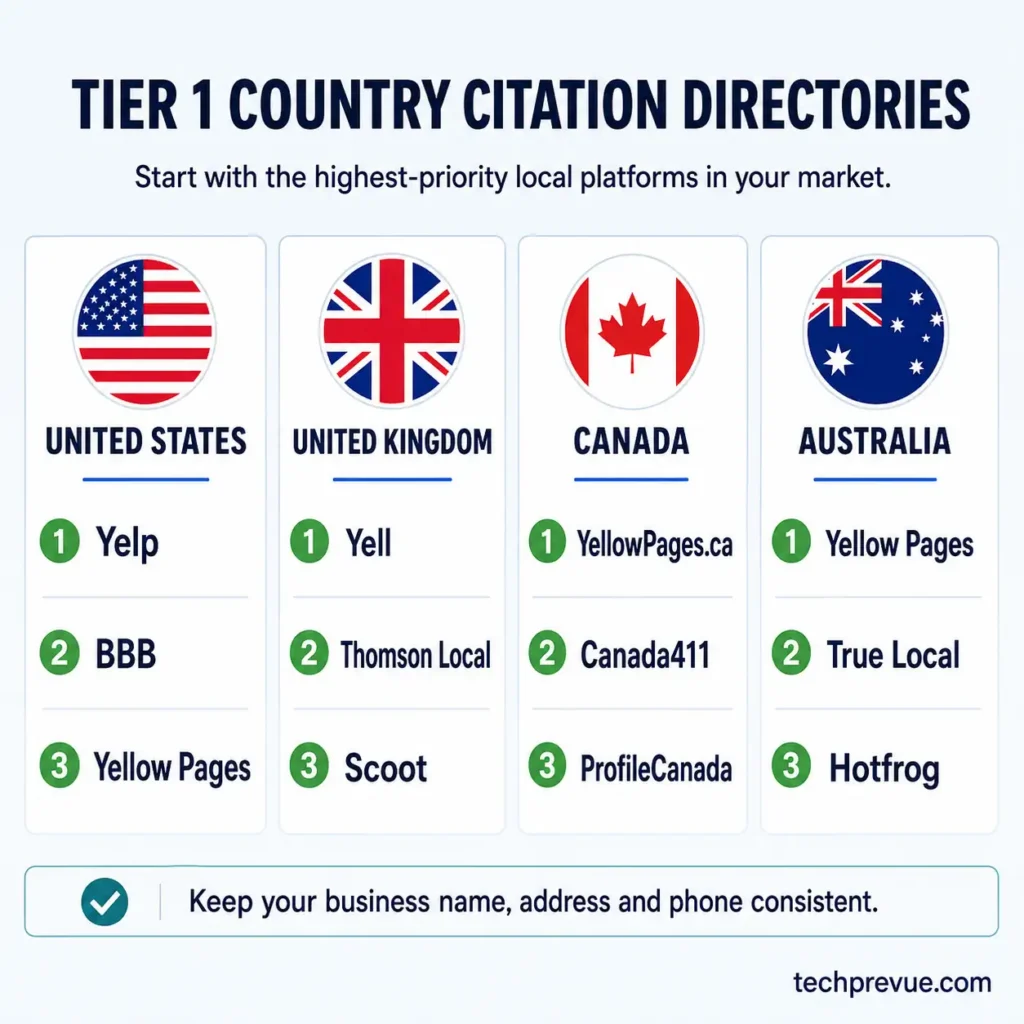
The directories worth prioritizing differ by country. Focus on the ones below for Tier 1 English-speaking markets rather than submitting to generic global directory lists.
| Market | Priority Directories |
|---|---|
| United States | Google Business Profile, Yelp, Apple Maps, Bing Places, Better Business Bureau, Nextdoor |
| United Kingdom | Google Business Profile, Yell.com, Bing Places, Thomson Local, Scoot, FreeIndex |
| Canada | Google Business Profile, YellowPages.ca, Bing Places, Canada411, DexKnows |
| Australia | Google Business Profile, True Local, Yellow Pages Australia, Hotfrog, StartLocal |
22. Standardize formatting across markets
Goal: Catch NAP mismatches that only show up when you serve more than one country. Effort: 1 hour to audit, ongoing to maintain.
A business operating across Tier 1 markets runs into a quieter consistency problem: postal formats and spelling conventions differ by country, and a mismatch reads as an inconsistency to both citation platforms and to Google.
| Element | US | UK | Canada | Australia |
|---|---|---|---|---|
| Postal code term | ZIP code | Postcode | Postal code | Postcode |
| Phone prefix | +1 | +44 | +1 | +61 |
| Spelling convention | Optimize, color | Optimise, colour | Optimise/Optimize (mixed) | Optimise, colour |
23. Find and merge duplicate listings
Goal: Stop splitting your review count and ranking signals across two profiles. Effort: 1–2 hours, plus platform resolution time.
Duplicate listings happen more often than most business owners realize — a previous owner’s listing, an old address, or a well-meaning employee creating a second profile. Search your business name and address on each major platform, and request a merge or removal wherever a duplicate turns up.
Section E: Technical SEO & Schema (Tasks 24–27)
24. Add LocalBusiness schema correctly
Goal: Help search engines and AI systems parse your business identity with certainty. Effort: 1–2 hours.
Mark up your name, address, phone number, hours, and geo-coordinates using schema.org’s LocalBusiness type, and validate it against Google’s structured data guidelines. This is foundational entity SEO — it removes ambiguity about who you are and where you operate.
25. Skip self-serving review schema — it won’t get you stars
Goal: Avoid wasted implementation effort on a rich-result type that no longer applies. Effort: N/A — this is a “don’t.”
Since a 2019 policy change reinforced through 2026, Google will not display review-snippet stars for LocalBusiness or Organization schema when the business controls the reviews about itself — whether marked up directly or through an embedded third-party widget. A technically flawless AggregateRating block on your own homepage will not produce stars in the search results. This applies specifically to LocalBusiness and Organization types; Product, Recipe, and a handful of other schema types are unaffected.
A few other tactics still circulating in local SEO content are worth skipping too:
| Tactic still recommended elsewhere | Why it doesn’t work | Do this instead |
|---|---|---|
| HowTo schema | Deprecated by Google in September 2023 | Use Article or LocalBusiness schema instead |
| llms.txt for local rankings | Google confirmed (June 2026) it has zero effect on Search rankings or AI Overviews | Skip it, or ship one only for AI coding-agent use cases unrelated to local rankings |
| Geotagging photos for city-name rankings | A 27-business study found it lifts “near me” rankings in the tagged town but hurts city-name rankings there | Skip it — the trade-off isn’t worth spamming every town with images |
| Keyword-stuffing the GBP description | Google has confirmed this field isn’t used in ranking | Write it for customers deciding whether to click |
26. Fix mobile speed and Core Web Vitals on local pages
Goal: Remove a technical drag on both rankings and conversion. Effort: Varies — see full audit.
Local landing pages get disproportionate mobile traffic from “near me” searches, often on weaker connections than desktop and from someone standing outside deciding whether to walk in. A slow-loading location page loses that decision before the content even has a chance to make the case. For the full technical audit process — Core Web Vitals, crawlability, indexation — see our complete technical SEO checklist.
27. Use HTTPS and clean, human-readable URLs
Goal: Remove baseline technical friction. Effort: One-time setup.
/locations/austin-tx/ reads clearly to both users and crawlers. A parameter-heavy URL with tracking strings and IDs doesn’t, and it undermines trust signals that matter more in local search than in general organic results.
Section F: Local Link Building (Tasks 28–29)
28. Earn links from genuinely local sources
Goal: Build authority signals that are specific to your service area. Effort: Ongoing.
A sponsorship of a local youth league, a guest post on a regional industry blog, or a mention from a local chamber of commerce carries more local relevance than a generic national directory link. A scholarship for a nearby high school, a co-hosted event with another local business, or a quote given to a regional news outlet covering a community story all produce the same kind of geographically specific link that’s harder for a competitor two states over to replicate. This is a small slice of a much larger discipline — for the complete link-building and off-page playbook, see our full off-page SEO checklist.
29. Keep citations and link building as separate tactics
Goal: Avoid wasting effort chasing the wrong metric from the wrong activity. Effort: N/A — this is a mindset check.
A citation on a local directory is a trust and consistency signal, not a backlink strategy. Treating the two as interchangeable leads to submitting your business to hundreds of low-quality directories chasing a link benefit that citations were never built to provide.
Section G: AI Search Readiness (Tasks 30–31)
Local search doesn’t end at Google’s Map Pack anymore. A meaningful share of local discovery now happens inside ChatGPT, Gemini, and AI Overviews — and until this section, nothing on this local SEO checklist explicitly accounted for that.
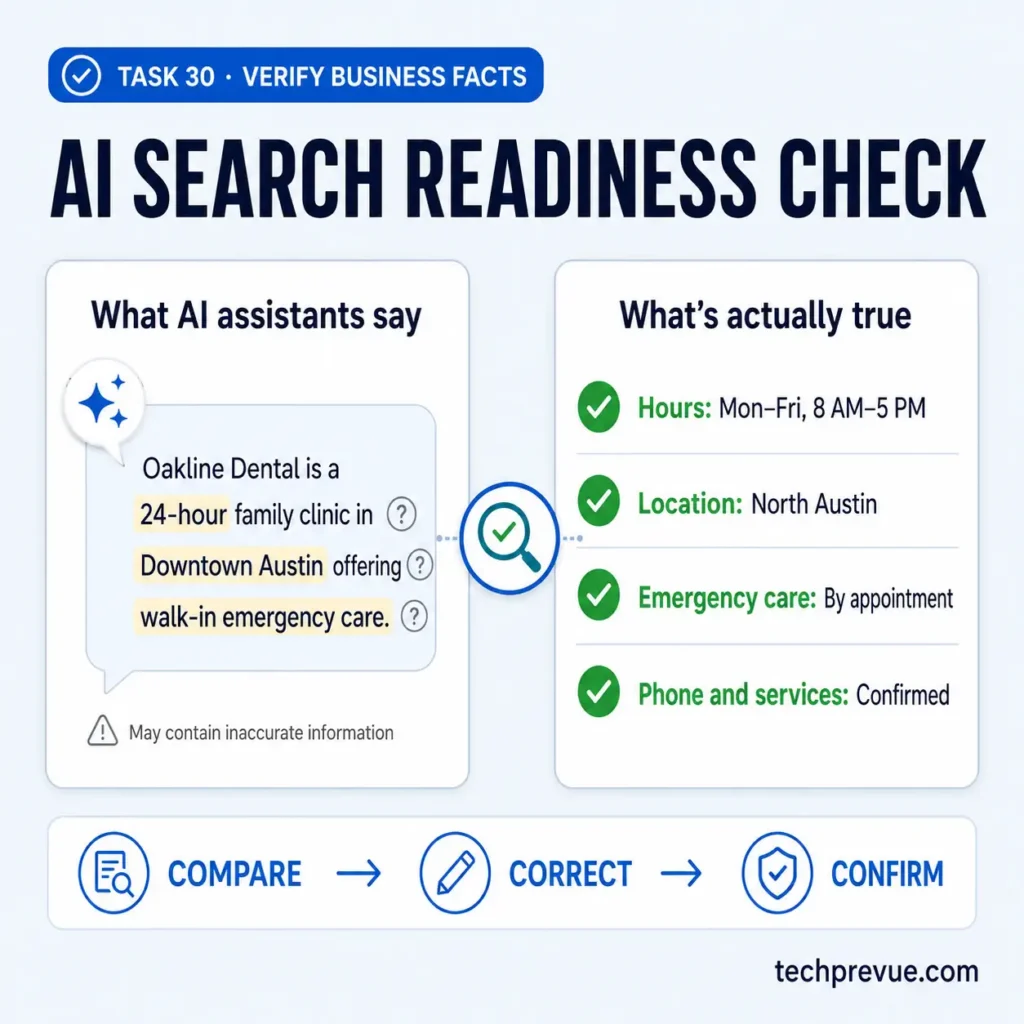
30. Verify AI assistants describe your business accurately
Goal: Catch and correct wrong information before it costs you a customer. Effort: 20 minutes, quarterly.
Ask ChatGPT, Gemini, and Perplexity “what is [your business] known for” and “who is the best [your service] in [your city].” These tools draw heavily on the same signals this checklist already prioritizes — your GBP, your reviews, your site — so wrong hours, an old address, or a discontinued service repeated confidently by an AI assistant usually traces back to stale source data somewhere earlier in this checklist. Fix the source, not just the symptom.
31. Write your key facts as short, quotable, standalone sentences
Goal: Make your business easy for AI systems to extract and cite directly. Effort: Ongoing, folded into content writing.
“We’ve served [area] since [year] and specialize in [service]” is a sentence an AI system can lift whole. A paragraph that buries the same fact under marketing language is not. This is the same declarative, answer-first writing this checklist itself uses throughout — apply it to your own site’s About and service pages.
Section H: Tracking & Reporting (Tasks 32–35)
32. Set a recurring audit cadence
Goal: Treat local SEO as a system, not a one-time project. Effort: Set once; run quarterly.
Local search results shift with algorithm updates, competitor activity, and your own review velocity. A quarterly re-run of this exact checklist — using the tracker linked throughout this guide — catches drift before it costs you Map Pack visibility.
33. Track the metrics that actually indicate progress
Goal: Measure outcomes, not vanity signals. Effort: 15 minutes monthly.
Rank position matters, but Google Business Profile Insights — calls, direction requests, and website clicks generated directly from your profile — often tells a more honest story about real business impact than position alone.
34. Run a geo-grid rank check, not just a single rank check
Goal: See how visibility actually varies across your service area. Effort: 30 minutes, monthly.
A single “where do I rank for X” check only shows one point on the map. Tools built for this — Local Falcon and Places Scout are the two most commonly used — generate a grid of simulated searches across your service area, showing exactly which neighborhoods you’re winning and which you’re invisible in. A business that “ranks #2” at its own address can still be invisible three miles away.
35. Benchmark your review count and rating against your top 3 competitors
Goal: Know if you’re actually winning or just standing still. Effort: 15 minutes, monthly.
A rating climbing from 4.3 to 4.5 means nothing if your top competitor moved from 4.4 to 4.7 in the same window. Track their review count and rating alongside yours every month, in the same place you’re logging the rest of this checklist, so the two numbers sit side by side instead of living in separate mental notes.
The 5-Task Local SEO Fast Start (If You’re Short on Time)
Short on time this week? Start here, in this order:
- Task 1 — Claim and verify your GBP.
- Task 2 — Fix your primary category.
- Task 8 — Set up a review-request process.
- Task 14 — Add NAP to your site footer.
- Task 24 — Add correct LocalBusiness schema.
These five cover the two heaviest-weighted categories in local ranking research and take a single afternoon combined. The remaining 30 tasks compound from there — track all of them in the tracker below.
Local SEO Checklist FAQs
What is a local SEO checklist?
This is a structured, prioritized list of the tasks that influence how a business ranks in Google’s Map Pack, local organic results, and increasingly, AI-generated answers. A good one is ordered by measured ranking impact — Google Business Profile and reviews first — rather than listed alphabetically or by how easy each task is to explain in a blog post.
How do I build a checklist for local SEO from scratch?
Start with the three highest-weighted categories from ranking-factor research: Google Business Profile completeness, review management, and on-page local signals. Add citations, technical schema, local link building, and AI search readiness after those three are solid, then set a recurring cadence to re-check everything quarterly.
How do I audit my own local SEO for free?
Work through this checklist section by section, logging each task’s status in the free interactive tracker. No paid tool is required for most of these tasks — GBP, your own website, and a free rank-tracking tool cover the majority of the work.
How long does local SEO take to show results?
Google Business Profile changes can show measurable movement within 2–4 weeks. Review-based improvements typically take 4–8 weeks to shift a rating meaningfully. Citation and link-building work tends to compound over 2–6 months rather than producing a sudden jump.
A new business in a low-competition category might see Map Pack movement faster than an established competitor squeezing out the last few ranking factors in a crowded market — total timeline depends heavily on how competitive the category and location already are.
Can I use review schema to get star ratings for my business?
No, not for a LocalBusiness or Organization page. Google’s structured data guidelines exclude self-serving reviews — reviews about a business that appear on that same business’s own site — from the review-snippet rich result, a policy in place since 2019 and reinforced through 2026.
Does llms.txt help local SEO or AI visibility?
Not for Google. Google’s own June 2026 guidance states plainly that llms.txt has no effect on Search rankings or AI Overviews. It has a narrow, separate use case for AI coding agents and a small number of AI assistants that fetch it directly, but it is not a local SEO ranking tactic.
How do I check what AI assistants say about my business?
Ask ChatGPT, Gemini, and Perplexity directly — “what is [business] known for” and “who is the best [service] in [city]” both surface how an AI currently describes you. If the answer is wrong or outdated, the fix is almost always correcting the source data (GBP, website, top citations) rather than the AI itself.
How many Google reviews do I need to rank in the map pack?
There’s no fixed number, but review velocity and recency matter more than total count. A profile with 20 reviews earned steadily over the last two months tends to outperform one with 200 reviews that stopped accumulating a year ago.
What’s the difference between local SEO and regular SEO?
Regular (organic) SEO ranks a website for a search term regardless of the searcher’s location. Local SEO adds geographic relevance signals — Google Business Profile, citations, proximity, and location-specific content — that determine ranking in the Map Pack and “near me” results specifically.
A national e-commerce brand mostly needs organic SEO. A single-location dentist or a regional HVAC company needs both, with local SEO carrying disproportionate weight for how customers actually find and choose them.
How often should I redo a local SEO audit?
Quarterly, at minimum, using the same checklist each time so you can compare against your last pass. Rerun it sooner after any Google algorithm update that affects local results, a change in business hours or address, or a noticeable drop in calls or direction requests.
Do Google Business Profile posts affect rankings?
Not directly. A controlled Sterling Sky study tracking 441 keywords over 9 weeks found no ranking movement from GBP posts. They still help engagement and click-through rate, which makes them worth doing for the right reason.
Track This Local SEO Checklist in the Live Tracker
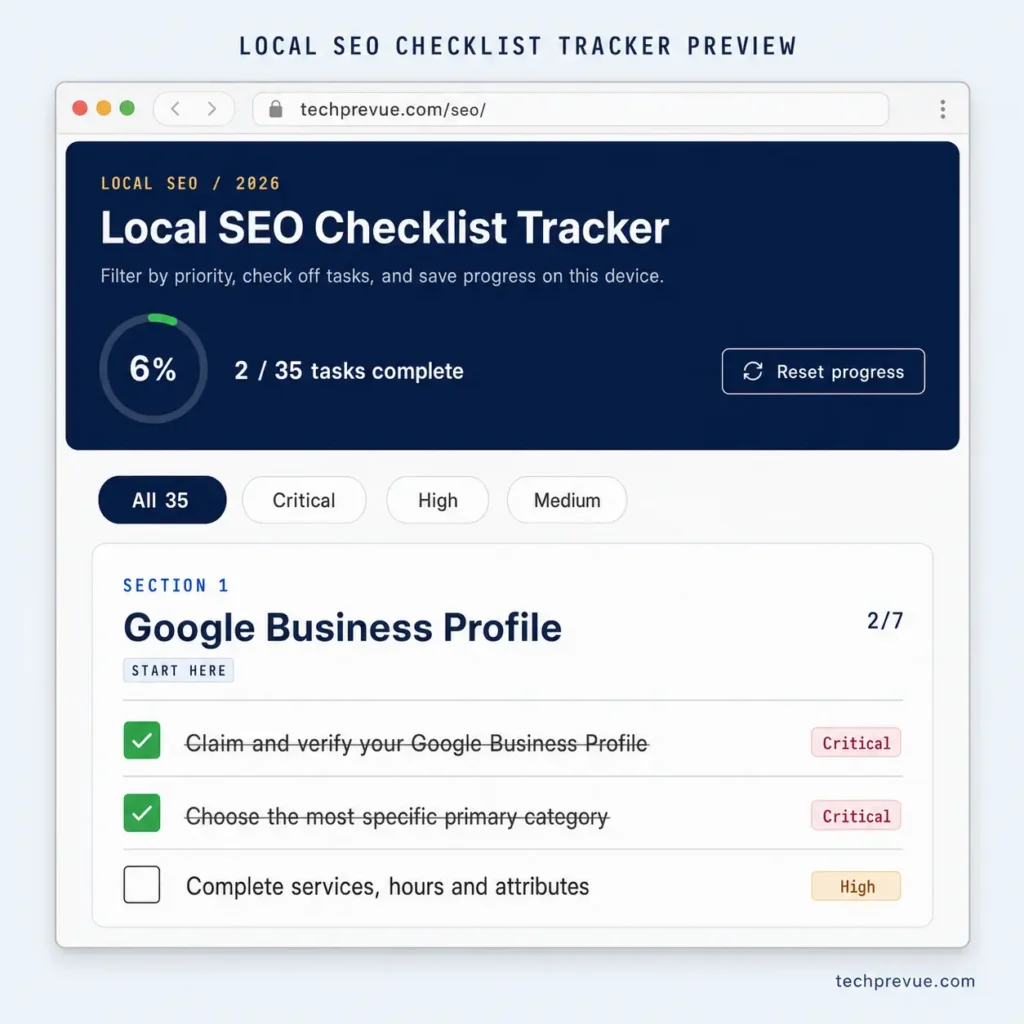
Reading this checklist and running a local SEO audit are two different activities. The first takes twenty minutes. The second takes a real pass through your own Google Business Profile, your own reviews, and your own site — task by task, with somewhere to log what you find.
The free interactive tracker is built for exactly that: the same Local SEO 35 tasks, the same eight sections, with priority filtering and progress saved in your browser — so a first pass turns into something you can revisit next quarter instead of a page you skimmed once.
