
Every brand you trust online earned that trust somewhere.
Maybe it was a blog post that solved your problem at 2 a.m. A YouTube tutorial that saved you money. A newsletter you actually open.
That is content marketing at work. And it is still one of the most reliable growth channels a business can build.
Quick answer: Content marketing is a strategic approach focused on creating and distributing valuable, relevant content — blog posts, videos, podcasts, emails and more — to attract a clearly defined audience and drive profitable customer action, instead of pitching products directly.
In this guide, you will learn the full definition, how the model works across the buyer journey, the main content types, and a step-by-step strategy you can start today.
You will also see how to write copy that converts, how social media fits in, and how to stay visible now that AI answers half of all searches.
Everything here reflects how our team at TechPrevue plans and executes content for clients across the US, India, and beyond.
One promise before we start: near the end, you’ll find the one-metric rule that quietly decides whether a content program survives its first year. Keep it in mind as you read.
What Is Content Marketing?
Content marketing means earning your audience’s attention by being useful, not interruptive.
You publish material your ideal customers genuinely want — answers, tutorials, research, entertainment. In return, they give you their time, their trust, and eventually their business.
Three words in that definition carry all the weight:
- Valuable. The content must solve a real problem or answer a real question. If it only talks about your product, it is an advertisement.
- Relevant. It must match your target audience and their search intent, not just chase traffic from anyone.
- Consistent. One viral post builds a spike. A publishing rhythm builds an audience.
Sounds simple. So why do most programs still fail?
Because most teams get the first two words right and quietly skip the third. Value and relevance are easy to attempt. Consistency is where good intentions go to die — and where the winners separate.
This is a form of inbound marketing. Paid ads push a message out and stop working the moment you stop paying.
Useful content pulls people in and keeps compounding. A well-optimized guide can generate organic traffic and leads for years after you hit publish. That is why smart brands treat content as an asset, not an expense.
It also powers every other channel you run. SEO needs pages worth ranking. Email marketing needs something worth opening. Social media needs something worth sharing. PPC needs landing pages worth clicking.
Remove the content, and each of those channels goes hollow.
Content marketing strategy vs. content strategy vs. content plan
These terms get mixed up constantly — and mixing them up has a real cost. Confuse them, and you end up with a beautiful publishing calendar attached to no engine.
Here’s the clean separation:
- Content marketing strategy answers why: the business goal, the audience, and the outcome your content must produce.
- Content strategy answers how: governance, workflows, quality standards, and how content is managed across its lifecycle.
- Content plan answers what and when: the specific topics, formats, owners, and dates.
- Editorial calendar is simply the schedule that holds the plan together.
You need all four, but they are built in that order.
Teams that jump straight to a calendar without the strategy layer usually produce a lot of content and very few results.
How Does Content Marketing Work?
Think about the last big purchase you made. You noticed a problem. You Googled. You watched a comparison video. You read a review. Then — days or weeks later — you bought.
Your customers do exactly the same thing. Content works by showing up at every one of those moments with the format that moment demands.
Think of the marketing funnel in four stages: awareness, consideration, decision, and retention.
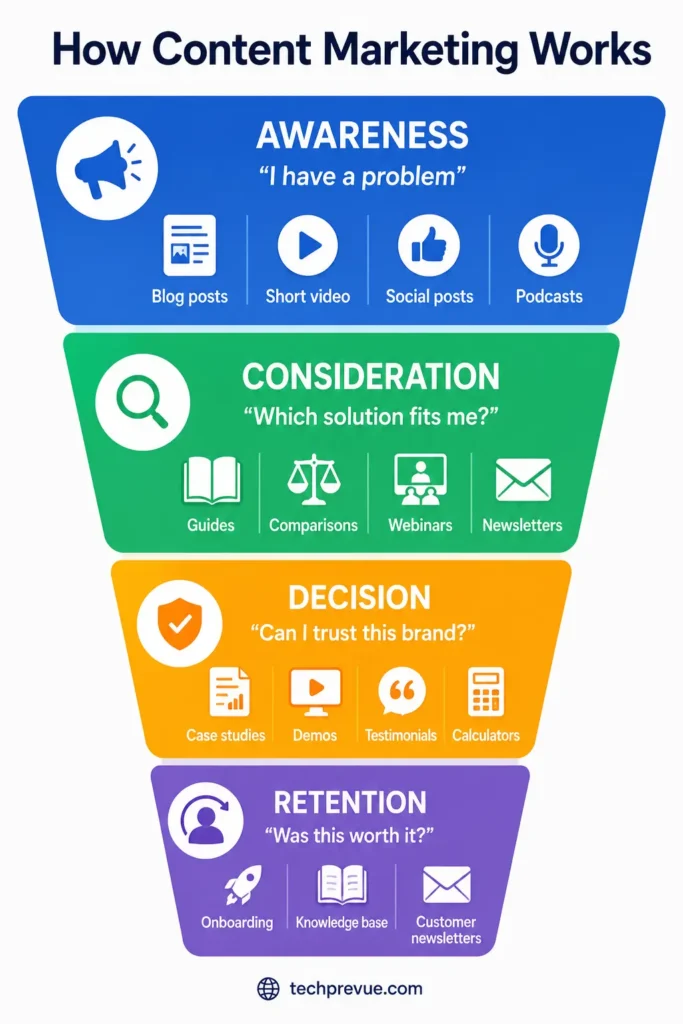
Awareness stage
Here, potential customers are just realizing they have a problem. They are not researching brands yet.
Your job is education and reach.
Best formats: blog posts, short-form video, infographics, social media posts, podcasts.
Example: a fitness studio publishes “5 desk exercises for back pain” instead of “Join our gym.” The reader gets help first. The brand gets remembered.
Squarespace runs the same play at scale. Its blog teaches entrepreneurs how to build an online presence — and thousands of those readers eventually build it on Squarespace.
Consideration stage
Now the prospect is comparing solutions. They want depth and proof, not slogans.
Content should explain what to look for and honestly position where you fit.
Best formats: how-to guides, comparison articles, webinars, checklists, email newsletters.
This is where honest comparison content shines. A software brand that publishes a fair “us vs. the alternatives” page earns more trust than one that pretends competitors don’t exist. It also captures buyers at the exact moment they are weighing options.
Decision stage
The prospect is ready to buy and needs confidence, not more theory. Show evidence.
Best formats: case studies, product demos, customer testimonials, user-generated content, ROI calculators.
A prospect reading a case study wants specifics: the client’s starting point, what was done, and the measured result. Vague success stories convince nobody. Numbers close deals.
Retention stage
Most funnels stop at the sale. The best content programs do not.
Onboarding guides, knowledge bases, and customer-only newsletters turn buyers into repeat customers and advocates. Retention is where loyalty and lifetime value are actually built.
One more thing about the modern buyer journey: most of it happens without you.
The bulk of research now happens before anyone talks to sales. Your content is doing the selling long before your team knows the prospect exists. If your pages are not present at each stage, a competitor’s pages are.
Why Content Marketing Still Works
You might be thinking: “We published for months and got nothing.”
Fair. Most people asking whether this still works have been burned before — usually by content that was produced, but never strategized, promoted, or measured.
So does it still pay off in an AI-saturated internet? The data says yes — but only for teams that treat quality as the strategy. Here’s the evidence, then the reason.
The benefits of content marketing
- It builds trust and authority at scale. Educating people before selling to them positions your brand as a thought leader. Trust converts, and it compounds with every useful piece you publish.
- It lowers customer acquisition cost. Evergreen content keeps producing lead generation long after publication, while ad costs reset to zero every month. Research compiled by Demand Metric has long shown content generates roughly three times the leads of outbound at a fraction of the cost.
- It increases online visibility. Every well-optimized page is another chance to appear in search engine rankings, AI answers, and social feeds. Companies with active blogs consistently attract more indexed pages, more organic traffic, and more entry points to the site.
- It improves lead quality. The topics you choose act as a filter. Content built around your ideal customer’s specific problems attracts exactly those people — and repels poor-fit leads before they ever reach your sales team.
- It builds an owned audience. Email subscribers, community members, and returning readers are first-party assets. No algorithm change or ad-price spike can take them away.
- It supports the sales team. Case studies, comparison pages, and FAQ content answer objections before the sales call, shortening the sales cycle.
- It strengthens customer retention. Helpful post-purchase content — tutorials, knowledge bases, customer newsletters — reduces churn and increases lifetime value, the cheapest revenue a business will ever earn.
- It earns links and PR. Original research and strong opinions attract backlinks and media mentions that paid campaigns simply cannot buy.
Why it survives the AI era
The numbers back this up.
In the Content Marketing Institute’s 16th annual research (a survey of over 1,000 B2B marketers for 2026), the teams rating themselves effective credited two factors above everything else: content relevance and quality (65%) and team skills (53%). Not budget. Not tools.
Meanwhile, HubSpot’s 2026 State of Marketing report found that 80% of marketers now use AI for content creation — yet over half struggle to make their content stand out in the resulting flood of sameness.
Read those two findings together and the conclusion is obvious.
Producing content is now easy for everyone. Producing content worth trusting is the remaining competitive advantage.
There is a second reason this approach matters more now, not less. AI assistants and answer engines have to cite sources. Original, well-structured, expert content is what they cite. Generic content gets summarized into invisibility; trustworthy sources get named.
Types of Content Marketing
Ten-plus formats exist. You need two, maybe three.
That reframe matters, because format overwhelm is where most beginners stall. Not every format suits every business — choose based on where your target audience spends time and what you can produce consistently.
Here are the main types, organized by the job each one does.
| Function | Content types | Best for |
|---|---|---|
| Discovery | Blog posts, short-form video, social media posts, podcasts | Reaching new audiences, brand awareness |
| Education | Long-form guides, webinars, newsletters, courses | Building trust and authority |
| Evaluation | Comparison pages, case studies, product demos, reviews | Helping buyers choose |
| Conversion | Landing pages, free tools, templates, lead magnets | Turning readers into leads |
| Retention | Onboarding content, knowledge bases, customer newsletters | Loyalty and repeat purchase |
| Authority | Original research, expert commentary, data studies | Earning links, citations, and AI mentions |
The best content formats — and why each one works
- Blog posts — Why: they capture search demand at every funnel stage, cost the least to produce, and compound. A post published today can still drive organic traffic three years from now.
- Short-form video (Reels, Shorts, TikTok) — Why: it currently delivers the highest ROI of any format for reach, according to HubSpot’s 2026 data. Platforms push it to non-followers, so it finds new audiences organically.
- Long-form video and YouTube tutorials — Why: seeing and hearing a person builds trust faster than text. For “how to” queries, video often ranks above written pages — especially in India, where YouTube frequently dominates the SERP.
- Podcasts — Why: listening becomes routine — the commute, the gym, the kitchen. Depth of attention beats breadth of reach, and loyal listeners convert at high rates.
- Email newsletters — Why: it is the only channel you fully own. Algorithms cannot take your list away, and subscribers have already raised their hands.
- Infographics and visual content — Why: people share visuals far more readily than paragraphs, which multiplies reach on social platforms and WhatsApp.
- Lead magnets (ebooks, white papers, checklists, templates) — Why: they convert anonymous readers into contacts you can nurture. A useful template exchanged for an email is the fairest trade in marketing.
- Webinars and courses — Why: someone who gives you 45 minutes of live attention is far closer to buying than someone who skimmed a post. Peak trust-building format.
- Case studies and original research — Why: unique numbers earn links, media citations, and AI mentions that recycled advice never will. Marketers publishing original data report significantly higher conversion rates and stronger SEO performance.
- Free tools and calculators — Why: a tool solves the problem instantly, gets bookmarked, and earns links for years. The highest effort, and often the highest payoff.
One warning from experience: pick two or three formats you can sustain, not seven you will abandon.
Consistency in one channel beats sporadic presence in five.
How to Create a Content Marketing Strategy (Step by Step)
New to all this? Good news: getting started and building a strategy are the same seven steps.
This is the section to bookmark. A documented strategy is the single strongest predictor of results in this discipline — and it’s exactly the framework we use for client projects.
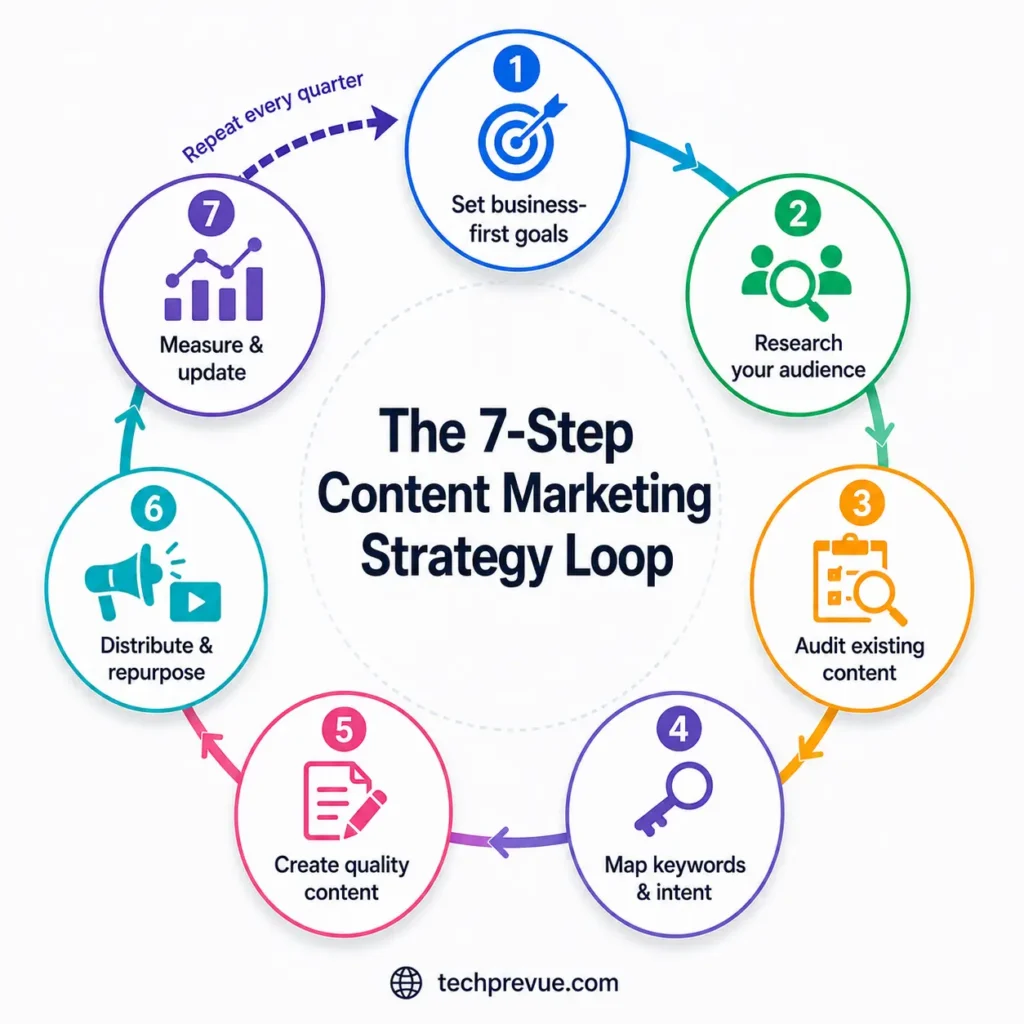
Step 1: Set business-first goals
Start from revenue, not from “we should blog more.”
Define what content must contribute: leads per month, pipeline value, organic traffic to money pages, or reduced support tickets.
Make each goal SMART — specific, measurable, achievable, relevant, and time-bound. “Generate 100 qualified leads from organic search by Q4” beats “get more traffic” every time.
Step 2: Research your audience like you mean it
Buyer personas built from guesswork produce content nobody needs.
Build yours from evidence: Google Analytics and Search Console data, customer interviews, sales-call notes, community discussions, and competitor audiences.
Then add two questions most templates skip. Which language and platforms does your audience prefer? And do they discover content through search, YouTube, social feeds, or messaging apps? The answers change everything downstream.
Step 3: Audit what you already have
Before creating anything new, inventory existing pages. Mark each as keep, update, consolidate, or delete.
Look for keyword cannibalization — two pages competing for the same search intent — and merge or differentiate them.
An honest audit usually reveals that 20% of your pages drive 80% of results. Updating proven pages often beats publishing new ones.
Step 4: Map topics to keywords and intent
Do keyword research to find what your audience actually searches. Then group keywords by intent into topic clusters: one pillar page per core topic, supported by focused articles interlinked around it.
Match format to intent. A “what is” query wants a clear definition up top. A “best tools” query wants a comparison. A “how to” query wants steps.
Run a content gap analysis against competitors to find questions they answer and you don’t. Every gap is a ranking opportunity.
Check both directions: gaps where rivals rank and you are absent, and gaps where nobody has written the definitive answer yet. The second kind is gold.
Step 5: Create content people would pay for
Quality standards worth enforcing on every piece:
- Answer the query directly in the first 100 words, then go deeper.
- Add something no competitor has: your data, your client results, your tested opinion. Google’s guidance on helpful content asks whether a page offers original information or analysis beyond the obvious — first-hand experience is the bar.
- Write like a human talks. Short sentences. Plain words. No filler.
- Show your work: cite primary sources, name your authors, display real credentials, and keep a visible last-updated date. These E-E-A-T signals decide whether readers, search engines, and AI models treat you as a source worth trusting.
Step 6: Distribute like it matters
Publishing is not promotion.
Plan content distribution before you write: organic social, email to your list, communities where your audience gathers, digital PR for research pieces, and paid boosts for proven winners.
Repurposing multiplies output. One webinar becomes a blog post, five short clips, an infographic, and a newsletter.
A simple ratio keeps teams honest: spend as much effort promoting a piece as you spent producing it. Most programs invert this — 95% creation, 5% promotion — and then wonder why nothing moves.
Step 7: Measure, learn, and update
Review performance monthly against the goals from Step 1.
Double down on formats and topics that convert. Update decaying content before rankings slide.
This discipline is a loop, not a launch. The teams that win treat every quarter’s data as next quarter’s brief.
Set expectations honestly: compounding results typically take six to twelve months. Some niches see traction in three. If someone promises page-one rankings in two weeks, run.
Social Media and Content Marketing
Here’s an uncomfortable truth: your best article is invisible until someone shares it.
Social media is where most content gets discovered, judged, and shared — so treat it as a first-class part of the plan, not an afterthought.
Here is the process we follow:
1. Pick the channels your audience actually uses
Do not try to be everywhere. Two channels done well beat six done badly.
For US audiences, that often means LinkedIn for B2B, plus Instagram, TikTok, or YouTube for consumer brands. Reddit and niche communities matter more every year as people search for human opinions.
For Indian audiences, Instagram, YouTube, and WhatsApp dominate — and WhatsApp forwards inside trade and professional groups carry a peer endorsement no algorithm can match.
2. Adapt the content to each platform
Social platforms punish copy-paste.
The same idea should become a text post on LinkedIn, a carousel on Instagram, a 45-second vertical video on Reels or Shorts, and a thread-style post on X. Native format wins the algorithm; identical cross-posting loses it.
3. Remember that social search is real search
People now search inside TikTok, Instagram, YouTube, and Pinterest the way they search Google.
Write captions, on-screen text, and video titles with the same keyword discipline you apply to blog posts.
4. Engage — don’t just broadcast
Reply to comments. Ask questions. Join conversations in communities before dropping links.
Social algorithms reward interaction, and audiences trust brands that behave like participants rather than billboards.
5. Track what social actually contributes
Measure beyond likes: profile visits, link clicks, branded search lift, and leads that started on social.
We covered the trade-offs in depth in our guide to the advantages and disadvantages of social media marketing.
Copywriting for Content Marketers
Readers decide in about three seconds whether your work deserves their attention. Brutal, but useful — because it tells you exactly where to invest.
Great research dies in bad writing. Copywriting is the skill that makes people actually read, remember, and act on your content.
Four rules cover most of it:
1. Obsess over headlines
The headline decides whether anything else gets read.
A good one is clear, specific, and makes a promise the content keeps. “How We Cut a Client’s Ad Spend 40% With Content” beats “Thoughts on Marketing Efficiency” every single time.
Write 5–10 options for every piece. Pick the one a stranger would click — and that qualifies the right reader, not just any reader.
2. Write to one specific person
Copy aimed at everyone connects with no one.
Picture one real reader — a persona or an actual customer — and write as if you were explaining this across a coffee table. What do they struggle with? What words do they use?
Your writing instantly becomes more personal, and personal writing builds a loyal audience.
3. Keep it simple
Complexity is the fastest way to lose a reader.
Short sentences. Plain words. One idea per paragraph. No jargon your reader would not use themselves.
If a sentence needs to be read twice, rewrite it.
4. Format for scanners, close with one action
Most visitors scan before they read. Use descriptive subheadings, bullets, bold key phrases, and white space so scanners can find their way in.
Then end every piece with exactly one call to action. Subscribe, download, book a call — one clear next step. Three CTAs equal zero CTAs.
Content Marketing Tips From Agency Practice
The strategy above gets a program running. What follows is different: the notes we find ourselves writing after client audits, again and again.
Consider them the difference between doing content and doing content well:
- Hang out where your customers complain. Slack groups, Reddit threads, WhatsApp communities, Facebook groups. Their unfiltered questions are a content calendar written for you.
- Pitch your product tastefully. Educate first, then present your product as one honest option among alternatives, with specifics on when it fits. Readers reward the honesty; pushy pitches get the back button.
- Capture every reader you attract. Traffic without capture is rented attention. Offer a genuinely useful template, checklist, or mini-course in exchange for an email, then nurture that list.
- Mine competitors’ ads for topics. Their longest-running ads reveal messages that provably convert. Tools like the Meta Ads Library show exactly what they have been paying to say — turn those angles into organic content.
- Publish with a point of view. Restating consensus gets skipped by readers and summarized away by AI. A defensible opinion, backed by your experience, is what gets shared, cited, and remembered.
- Batch and systemize production. Decide topics monthly, produce weekly, and use a simple workflow board so nothing stalls in drafts. Consistency is a systems problem, not a motivation problem.
Content Marketing in the US and India: What Changes
Same strategy, different battlefield.
Most guides quietly assume one market. We build content for both, and the playbook genuinely differs — sometimes in ways that surprise teams on either side.
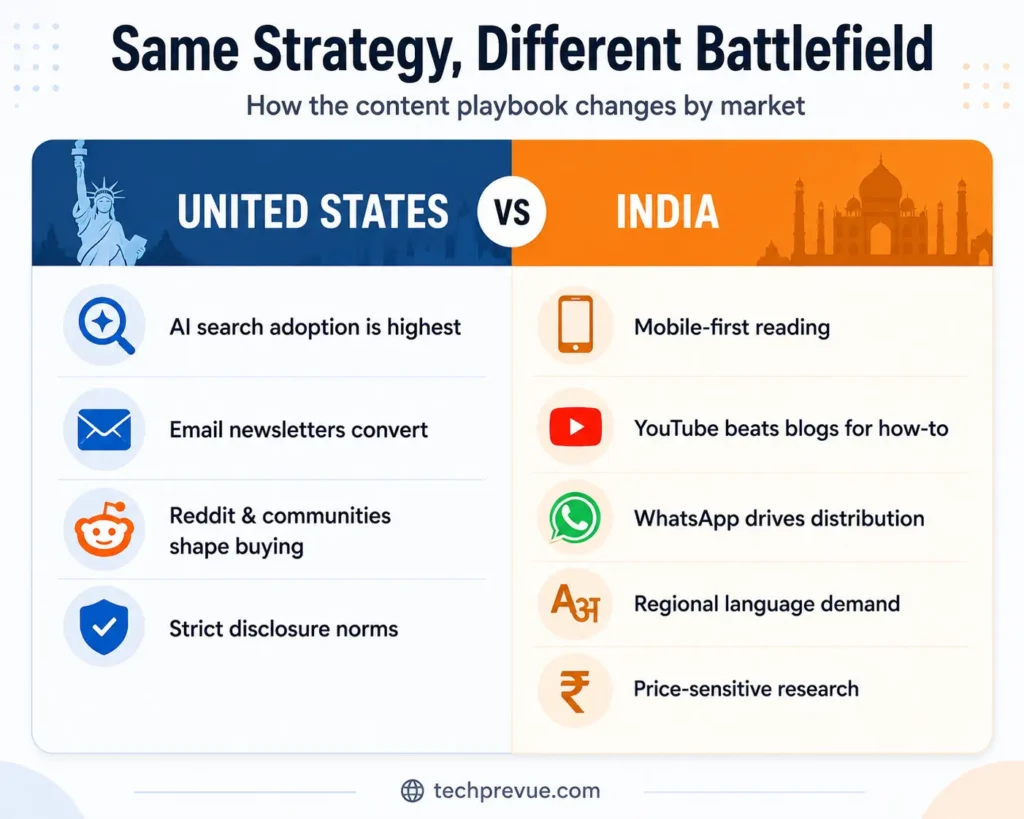
For US audiences:
- Search behavior is shifting to AI fastest. US consumers lead adoption of AI-powered search and AI Overviews, so extractable answers and cited expertise matter most here.
- Email and newsletters carry unusual weight. US audiences still buy from their inbox; a strong newsletter is often the highest-converting B2B asset.
- Communities and Reddit shape decisions. US buyers cross-check brands against real user opinions. Earning genuine mentions there beats another blog post.
- Compliance and disclosure expectations are stricter. Sponsored content, affiliate links, and AI usage should be disclosed plainly.
For Indian audiences:
- Mobile-first is not optional. The overwhelming majority read on smartphones, often on mid-range devices and variable networks. Fast pages, short paragraphs, and compressed images are ranking factors and courtesy at once.
- YouTube often beats the blog. For “how to” and process queries, Indian SERPs surface video prominently. Pair written guides with matching videos to capture both result types.
- WhatsApp is a distribution channel. Trade groups, alumni networks, and professional communities forward genuinely useful content with built-in peer trust. Design shareable one-page assets with this in mind.
- Regional language content is a wide-open lane. English dominates supply while huge demand searches in Hindi and other Indian languages. For local services and consumer brands, regional content reaches audiences English pages never will.
- Price sensitivity shapes intent. Indian buyers research harder before spending. Cost breakdowns, comparisons, and “is it worth it” content earn outsized engagement.
None of this replaces the fundamentals above. It tells you where to aim them.
How AI Search Changes the Game
If AI Overviews make you nervous about your traffic, that instinct is healthy. Channel it here instead of into panic.
The discovery landscape shifted fast. Half of consumers now use AI-powered search, and roughly half of Google searches show an AI Overview, according to HubSpot’s 2026 research. Among B2B buyers, 94% used large language models during their purchase research, per 6sense’s Buyer Experience Report.
Your content now has to win in two arenas at once: classic rankings and AI-generated answers.
The good news: you do not need a bag of tricks. Google’s official guidance for its AI search features says the foundation is unchanged — solid technical SEO, clear structure, genuinely helpful pages, and demonstrated first-hand expertise. It explicitly warns against chasing artificial “AEO/GEO hacks” over fundamentals.
Here is what actually moves the needle:
- Answer first, elaborate second. Put a direct, extractable answer under each question-style heading. AI Overviews and answer engines lift concise, well-scoped passages.
- Structure for machines and humans alike. Descriptive headings, tight paragraphs, tables for comparisons, and valid schema markup make your page easy to parse and cite.
- Be the primary source. Original statistics, surveys, and documented client outcomes get cited; paraphrased common knowledge gets skipped.
- Build entity-level authority. Consistent author profiles, an about page that proves expertise, and mentions across trusted sites teach AI systems who you are.
- Use AI as a drafting partner, not a ghostwriter. CMI’s 2026 data shows almost every marketing team now uses AI somewhere, yet only around four in ten report it actually improving performance. The gap is human judgment: research, fact-checking, brand voice, and lived experience still have to come from people.
We use AI to accelerate research and outlines. Every claim, number, and recommendation ships only after human review.
How to Measure Content Marketing ROI
Vanity metrics kill more content programs than bad writing does.
Measure against the objective each piece was built for:
| Objective | Primary metrics |
|---|---|
| Awareness | Impressions, reach, branded search volume, direct traffic |
| Engagement | Engaged sessions, scroll depth, returning visitors, subscribers |
| Authority | Earned backlinks, media mentions, AI citations of your pages |
| Lead generation | Form fills, lead magnet downloads, qualified leads |
| Sales support | Content-assisted conversions, sales cycle length, close rates |
| Revenue | Conversion value, customer acquisition cost, attributed revenue |
| Retention | Repeat visits, product adoption, renewal influence |
Tools for the job: Google Analytics 4 for behavior and conversions, Google Search Console for query and ranking data, your CRM for lead-to-revenue attribution, and heatmap tools for on-page behavior.
Add a simple check for AI visibility: ask the major assistants the questions your customers ask, and note whether your brand appears in the answers.
And now, the rule promised at the start of this guide — the one-metric rule.
Every piece of content gets one primary KPI assigned before it is published. If you cannot name the metric, you are not ready to create the piece. This single habit keeps measurement honest and kills vanity projects before they consume a quarter.
Review the numbers monthly. Report them quarterly against business goals. Prune the reports of anything nobody acts on.
Content Marketing Examples Worth Studying
Theory is cheap. Here are brands — Indian and global — doing this exceptionally well, and the lesson each one teaches.
Zerodha Varsity (India). India’s largest stockbroker built Varsity, a free, structured education platform covering everything from candlesticks to taxation. No signup walls, no hard selling. It made Zerodha the default brand a new investor trusts. Lesson: teach your market from zero, and you own the customers it produces.
Zomato (India). Zomato’s social feeds turn moment marketing into an art form — witty, culturally fluent posts that people share voluntarily. Lesson: entertainment is a valid content goal when your product is high-frequency and consumer-facing.
Nykaa (India). Beauty tutorials, ingredient explainers, and routine guides make Nykaa a beauty education destination, not just a store. The content answers the exact questions shoppers have right before purchase. Lesson: decision-stage education converts.
HubSpot (global). HubSpot built a marketing education empire — blog, academy, certifications, free tools — that feeds its CRM business. Lesson: free education plus free tools is the most durable lead engine in B2B.
GoPro (global). GoPro’s channels run on user-generated content: customers submit their best footage for contests. The product markets itself through its users’ creativity. Lesson: your customers can be your content team if you give them a stage.
Notice what all five share: none of them lead with their product.
They lead with something the audience wants, and the product follows.
Common Content Marketing Mistakes
We audit content programs regularly, and the same failures appear again and again.
Some of these will feel uncomfortably familiar. That’s the point — recognizing yourself in this list is cheaper than another year of learning it the hard way:
- Publishing without a documented strategy. Random acts of content produce random results.
- Chasing volume over quality. Ten thin AI-drafted posts lose to one genuinely useful guide — in rankings, in AI citations, and in trust.
- Ignoring search intent. Ranking content that does not match what searchers wanted converts nobody.
- Selling too early. Awareness-stage readers who get pitched leave. Give value first.
- No distribution plan. Great pages die unseen when promotion is an afterthought.
- Set-and-forget publishing. Content decays. Refreshing proven pages is often the highest-ROI task on the roadmap — this very article is an example of that practice.
- Measuring everything, learning nothing. Track the few metrics tied to your goal, and act on them.
Frequently Asked Questions
What is content marketing in simple words?
It means attracting customers by publishing helpful or entertaining content — like blog posts, videos, or newsletters — instead of interrupting them with ads. You help first; sales follow the trust you build.
What is the difference between content marketing and digital marketing?
Digital marketing is the umbrella covering every online channel: SEO, PPC, email, social media, and more. Content-led marketing is one discipline inside it — and the one that supplies the substance those other channels distribute.
Does content marketing still work in the age of AI?
Yes — arguably better than ever for quality publishers. AI assistants answer questions by citing trustworthy sources, so original, expert content now earns visibility in both classic search results and AI-generated answers. What no longer works is generic, mass-produced content, because AI made that free for everyone.
How long does Content Marketing take to see results?
Typically six to twelve months for meaningful organic traction, with compounding gains after that. Distribution channels like email, social, and WhatsApp can produce results within weeks while search visibility builds.
How much does Content Marketing cost?
It scales with ambition. A small business can start meaningfully with one well-researched article or video per week produced in-house. Larger companies invest anywhere from a modest freelancer budget to five figures a month — lakhs, for our Indian readers — for a full engine of writing, video, design, and promotion. The constant across every budget: quality and consistency beat spend.
Which type of content should a beginner start with?
Start where your audience already looks for answers. For most businesses that means blog posts targeting real search queries, plus short-form video if your audience is on YouTube or Instagram. Master one format before adding another.
Is blogging still worth it for a small business?
Yes, if each post targets a real query with a genuinely useful answer. A local business with 20 well-chosen, well-written pages will outperform one with 200 thin posts. Blogs also feed every other channel — the newsletter, the social calendar, the sales conversations.
Final Thoughts
None of this is a hack, a trend, or a quick fix. It is a compounding system: understand your audience, publish genuinely useful material consistently, distribute it deliberately, and measure what matters.
The brands winning in search — and in AI answers — are simply the ones their audiences would miss if they stopped publishing.
That’s the real test. Not rankings, not traffic: would anyone notice if you went quiet? Build toward yes, and everything else in this guide follows.
If you want a content engine built on that standard, our team at TechPrevue plans, produces, and measures content programs for businesses in India, the US, and worldwide. Start with a free consultation, or explore our SEO services to see how content and search work together.