
Originally published: 2015, 22 September · Date Updated: 2026, 15 August
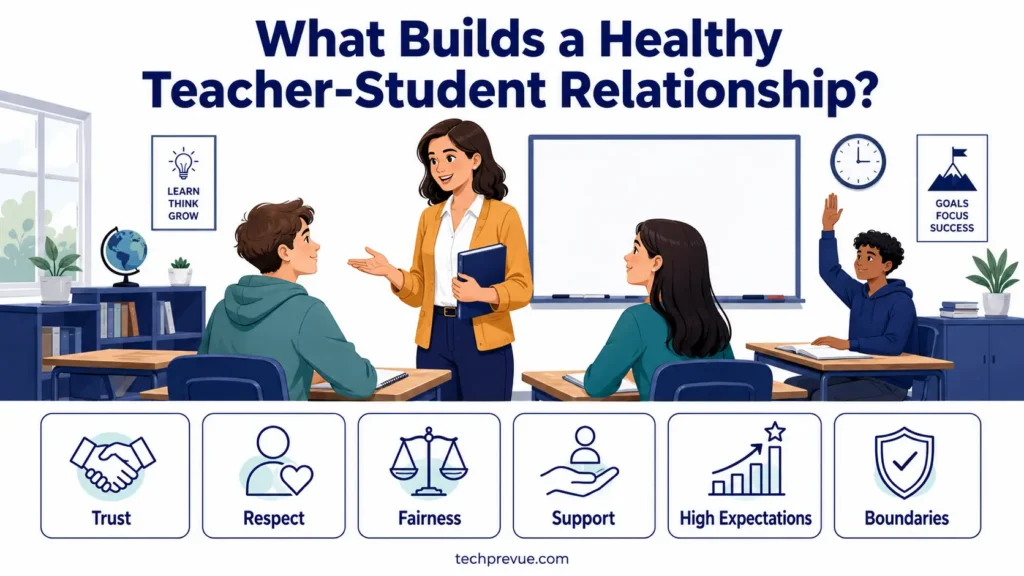
A healthy teacher student relationship is more than being friendly in the classroom. A strong teacher and student relationship combines trust, respect, fairness, care, guidance, high expectations, and the confidence that a student can approach a teacher when learning or life becomes difficult.
Modern research supports the importance of that bond. A 2025 Psychological Bulletin review by Valentin Emslander and colleagues synthesized more than 70 years of research across 26 meta-analyses, 119 meta-analytic effect sizes, and about 2.64 million pre-K and K–12 students. It found large, significant relationships between teacher student relationship quality and eight groups of student outcomes.
But research tells only part of the story. In countries such as India, the relationship between teacher and student also carries a long cultural tradition in which a respected teacher may become a mentor and guide whose influence continues well beyond the classroom.
What Is the Relationship Between Teacher and Student?
The relationship between teacher and student is the continuing academic, social, and interpersonal connection that develops through everyday interactions.
It is shaped not by one inspiring speech or one difficult day but by repeated experiences. Does the teacher listen? Are expectations predictable? Can the student make a mistake without humiliation? Does the student believe the teacher genuinely wants them to improve?
A positive relationship does not require a teacher to agree with the student or make learning easy. Students can respect teachers who demand better work, correct inappropriate behavior, and set firm limits when those expectations are applied fairly.
The Australian Education Research Organisation describes positive teacher student relationships as supportive and fair, developing where students feel safe, understood, and appreciated. It also emphasizes that trust is built on the structure, predictability, reliability, and dependability that routines and consistency provide.
That gives us a useful definition:
A positive teacher student relationship is a respectful and dependable connection in which a teacher supports a student’s learning and development while maintaining clear expectations and appropriate professional responsibility.
What Makes a Teacher Student Relationship Healthy?
Warmth matters, but warmth alone is not enough.
A teacher can be kind and still be inconsistent. Another can be highly organized but make students afraid to ask questions. Healthy relationships usually combine several qualities at the same time.
| Quality | What students experience |
|---|---|
| Trust | “My teacher means what they say.” |
| Respect | “I will be treated with dignity even when I make a mistake.” |
| Fairness | “Rules are not changed according to who I am.” |
| Support | “I can ask for help when I need it.” |
| High expectations | “My teacher believes I can improve.” |
| Interest | “My teacher sees me as an individual.” |
| Consistency | “I generally know what will happen next.” |
| Listening | “My concerns will be heard before conclusions are drawn.” |
| Guidance | “My teacher helps me find a better path.” |
| Boundaries | “The relationship remains safe and responsible.” |
Students do not need teachers who never say no. They need teachers whose support and authority can be trusted.
What Does Research Say About Teacher-Student Relationships?
The 2025 second-order meta-analysis by Emslander and colleagues provides one of the broadest views available because it does not rely on a single school, country, age group, or outcome.
Across the previous meta-analyses it reviewed, teacher student relationship quality was significantly related to eight broad groups of outcomes: academic achievement, academic emotions, appropriate behavior, behavior problems, executive function or self-control, motivation, school belonging and engagement, and well-being.
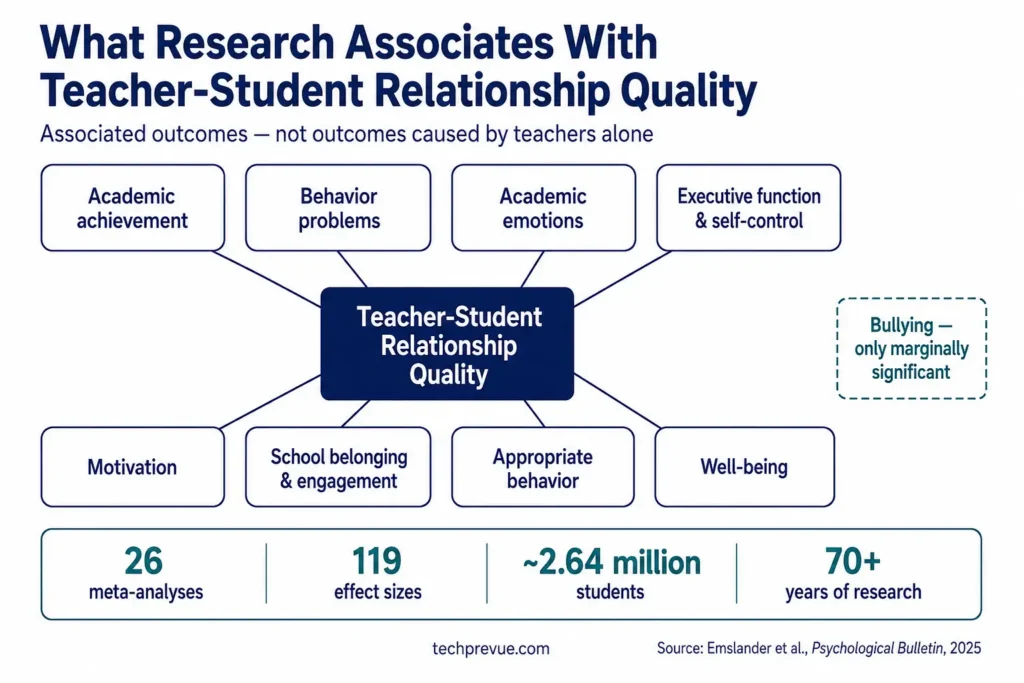
One finding deserves particular attention. The review’s moderator analyses suggested a larger relationship-outcome link for middle and high school students — the very stage at which schools often assume relationship-building matters less than covering content.
That does not mean a positive relationship automatically causes higher grades or solves every behavioral problem. Family circumstances, prior learning, teaching quality, school resources, health, peers, curriculum, attendance, and many other factors also influence student outcomes.
The evidence instead tells us that relationships are an important part of the conditions in which learning takes place.
One correction is also worth making. The same review found only a marginally significant relationship with bullying, so it would be too strong to claim that a poor teacher student relationship by itself causes bullying.
Why Is the Student Teacher Relationship Important?
The student teacher relationship matters because students do not experience teaching as information alone. They experience it through another person.
A technically excellent explanation can lose its effect if a student is too anxious to admit confusion. A difficult lesson can become manageable when the student believes that asking for another explanation will be met with patience rather than embarrassment.
1. It encourages engagement
Students are more likely to participate when they feel that their contribution is welcome and their effort is noticed.
The Learning Policy Institute notes that positive school-based relationships can support engagement, motivation, healthy attachment, and school connectedness. It also highlights everyday practices such as greeting students, short individual conversations, active listening, and authentic affirmation.
2. It supports academic learning
A relationship is not a substitute for subject knowledge or effective teaching.
Its value is that it can make productive learning behaviors easier: attending class, attempting difficult work, asking questions, accepting correction, using feedback, and persisting when an answer is not immediately obvious.
The 2025 meta-analytic review found a significant association between relationship quality and academic achievement.
3. It strengthens motivation
Students often work harder for teachers whose expectations they understand and whose judgment they respect.
That does not mean every lesson must be entertaining. Motivation can also come from progress, challenge, competence, responsibility, and the knowledge that a teacher believes the student is capable of better work.
4. It can build school belonging
Belonging answers a simple but powerful question: Do I feel that I matter here?
The CDC defines school connectedness around students feeling that adults and peers care about them and about their learning. Students who feel more connected to school are more likely to have better attendance, higher grades and test scores, and to graduate from high school.
One supportive teacher can contribute to that wider sense of connection.
5. It makes feedback easier to accept
Correction feels different when students believe it is intended to help them rather than humiliate them.
Compare:
“You never understand anything.”
with:
“This part isn’t working yet. Show me how you reached this answer.”
Both communicate that something needs to change. Only one protects the student’s dignity while keeping the academic standard intact.
6. It helps students ask for help
Some students announce that they are struggling. Others become quiet, stop submitting work, joke their way out of tasks, become disruptive, or simply disappear into the back of the classroom.
A trusted teacher has a better chance of discovering what sits behind the behavior.
7. It supports social and emotional development
Teachers regularly model disagreement, patience, accountability, listening, fairness, and conflict repair.
Students observe not only what teachers teach but how they respond when something goes wrong.
8. It can improve classroom climate
Relationships are visible.
Students notice who receives patience, whose ideas are respected, whether rules are consistent, and how the teacher reacts when someone makes a mistake.
A classroom in which those interactions feel fair can become safer for participation. Attention to relationship-building can create a ripple effect that shapes the wider culture of a class or school.
How to Build a Positive Teacher Student Relationship
Strong relationships are normally built through small actions repeated consistently.
1. Learn students’ names and use them
Knowing a student’s preferred name is a basic form of recognition.
In a large class, a seating chart, introductory activity, attendance routine, or brief one-to-one exchange can make remembering names easier.
AERO specifically recommends greeting students warmly and consistently using their names in interactions.
2. Learn who the student is, not just how they score
A teacher can learn about students’ interests, strengths, goals, preferred ways of participating, and areas in which they need support.
That is different from pressuring them to reveal private information.
A useful question is, “What would you like me to know that could help you learn better?”
3. Greet students
A short greeting can look insignificant, yet it creates a recurring moment of acknowledgment.
Relationship-centered school guidance specifically identifies greeting students as they arrive as a simple way to make students feel noticed and valued.
4. Teach with interest and enthusiasm
Students usually recognize whether the teacher still finds the subject worth thinking about.
Enthusiasm does not require constant performance. It can appear through a good question, a surprising example, genuine curiosity, or the willingness to explain an idea from another angle.
5. Make it safe to ask questions
A classroom can appear quiet because everyone understands, or because nobody wants to risk looking foolish.
Teachers can normalize questions by responding calmly, admitting when something is genuinely difficult, and thanking students for identifying unclear explanations.
6. Give specific praise
Praise is more useful when it tells students what they did well.
“You supported your answer with evidence” teaches more than “Excellent.”
AERO notes that praise works best when it is timely, genuine, informative, and specific. Specific recognition also makes praise more credible, because the student knows what behavior or thinking is worth repeating.
7. Correct behavior without attacking character
There is a large difference between:
“You are disrespectful.”
and:
“Talking while she is answering makes it difficult for the class to hear her.”
The second identifies a behavior that can change. Restorative approaches similarly recommend focusing on what happened and its effect rather than turning an incident into a judgment about the person.
8. Remain fair, especially when personalities differ
Some students are naturally easier for an individual teacher to connect with.
Fairness matters most when that natural connection is absent.
Teachers can ask themselves whether the same behavior receives the same interpretation from different students, whether quieter students receive enough attention, and whether high-performing students are given more patience than others.
9. Maintain high expectations
A positive relationship should not communicate, “I care about you, so I will expect less.”
A better message is, “I care about you, so I will help you meet the standard.”
AERO’s classroom-management guidance places positive relationships alongside clear expectations, routines, and consistently maintained rules.
10. Use humor without using students as the joke
Shared laughter can lower unnecessary tension and make a teacher more approachable.
Humor becomes damaging when it humiliates a student, repeatedly targets the same person, mocks an error, or depends on sarcasm the student cannot safely answer.
11. Listen before deciding what happened
The same behavior can have different causes.
A student who stops working may be confused, bored, overwhelmed, distracted, testing a limit, experiencing conflict with classmates, or dealing with something outside school.
Listening does not require believing every explanation. It means gathering enough information to respond to the real problem.
12. Repair the relationship after conflict
Good relationships still contain disagreement.
After a difficult interaction, a teacher can maintain the rule while repairing how the conversation occurred:
“The expectation still stands, but I could have spoken to you more calmly yesterday.”
That demonstrates something students also need to learn: accountability does not require surrendering your position.
The Teacher Student Relationship in Indian Tradition
The modern research language of trust, belonging, support, and boundaries explains much about healthy educational relationships. It does not fully capture the cultural meaning that the teacher has traditionally carried in India.
Indian thought has long given the teacher, or guru, an unusually respected place.
The expression “Acharya Devo Bhava” comes from the Taittiriya Upanishad (Shikshavalli I.11.2), where it appears alongside instructions to regard one’s mother, father, and guest as divine. It is commonly understood as treating the teacher with the reverence given to a deity.
This is not merely an archaic phrase. Government of India communications continue to invoke it. In a Press Information Bureau release dated 14 May 2020, the then Union Human Resource Development Minister, Ramesh Pokhriyal ‘Nishank’, told teachers across the country that in India the importance of a Guru has always been greater than God, and that teachers should be respected in the spirit of Acharya Devo Bhava.
This reverence is closely connected with the guru-shishya tradition, in which education was not understood only as the delivery of a subject. A guru could influence knowledge, discipline, character, values, judgment, and the student’s direction in life.
That cultural idea helps explain why many Indian students continue to remember an influential teacher decades after leaving school.
A former student may return to a teacher for guidance about higher education, a career choice, a difficult decision, or simply because the teacher remains someone whose judgment they trust.
The language may sound stronger than the professional language used in many Western education systems, but the underlying insight remains valuable:
A teacher can influence much more than a student’s examination result.
Reverence does not remove responsibility
Respect for teachers should never mean that a teacher cannot be questioned, that students must disclose every private matter, or that professional boundaries disappear.
A cultural ideal becomes stronger, not weaker, when the responsibility attached to the respected position is acknowledged.
The more trust a student places in a teacher, the more carefully that teacher must use their influence.
Can a Teacher Be a Student’s Best Friend?
Students sometimes describe a favorite teacher as a friend, best friend, guardian, mentor, or even a second parent.
Usually they are not describing friendship in the ordinary peer-to-peer sense. They mean that the teacher listened when others did not, guided them through a difficult period, believed in them, corrected them, or remained available when an important decision had to be made.
There is real value in that kind of connection.
A best friend and a teacher, however, serve different roles. Friends can provide companionship and emotional support, while a teacher brings educational experience, adult responsibility, professional judgment, and often a wider view of the consequences of a student’s choices.
That means the strongest version of the idea is not:
“A teacher is better than a best friend.”
It is:
“A great teacher can become a trusted friend and lifelong guide without ceasing to be a responsible teacher.”
This distinction preserves closeness without turning a professional relationship into a peer relationship.
How Teachers Can Guide Students Beyond Academics
Many of the most remembered conversations between teachers and students are not about the syllabus.
A student may ask whether to continue a subject, apply to a particular course, apologize after a mistake, handle a conflict, prepare for an interview, cope with failure, or reconsider a decision.
Teachers can be valuable in such moments because they often know both the student’s abilities and the student’s patterns of behavior.
Good guidance does not mean deciding the student’s life for them. It means helping the student see choices, consequences, strengths, weaknesses, and questions they may not yet have considered.
The final decision should increasingly belong to the student as maturity grows.
When Warmth Becomes a Boundary Problem
A close teacher and student relationship can be healthy. Closeness becomes a problem when responsibility, privacy, or professional judgment begins to disappear.
| Healthy connection | Boundary problem |
|---|---|
| Knowing a student’s interests | Pressuring them for unnecessary private details |
| Being approachable | Expecting emotional dependence |
| Listening to personal concerns | Trying to become the student’s only source of support |
| Being friendly | Acting as a peer |
| Offering guidance | Controlling personal decisions |
| Giving extra academic help | Showing favoritism |
| Using approved communication channels | Secret or inappropriate private communication |
| Taking disclosures seriously | Promising to keep every disclosure secret regardless of safety |
Professional codes of conduct make the same point in formal terms. In India, the National Council for Teacher Education’s Code of Professional Ethics for School Teachers — revised in light of the Right of Children to Free and Compulsory Education Act, 2009 — frames teaching around obligations to students, parents, colleagues, and the community. It includes maintaining the confidentiality of information concerning students, treating all students impartially regardless of caste, creed, religion, sex, economic status, disability, language, or place of birth, and refraining from subjecting any child to fear, trauma, physical punishment, sexual abuse, or emotional harassment.
Current research uses gentler language for the same principle. The Monash University team behind the 2026 review describes a teacher student relationship as one that develops within professional boundaries, growing over time through mutual respect and reciprocal effort.
Respect and boundaries are therefore not competing ideas.
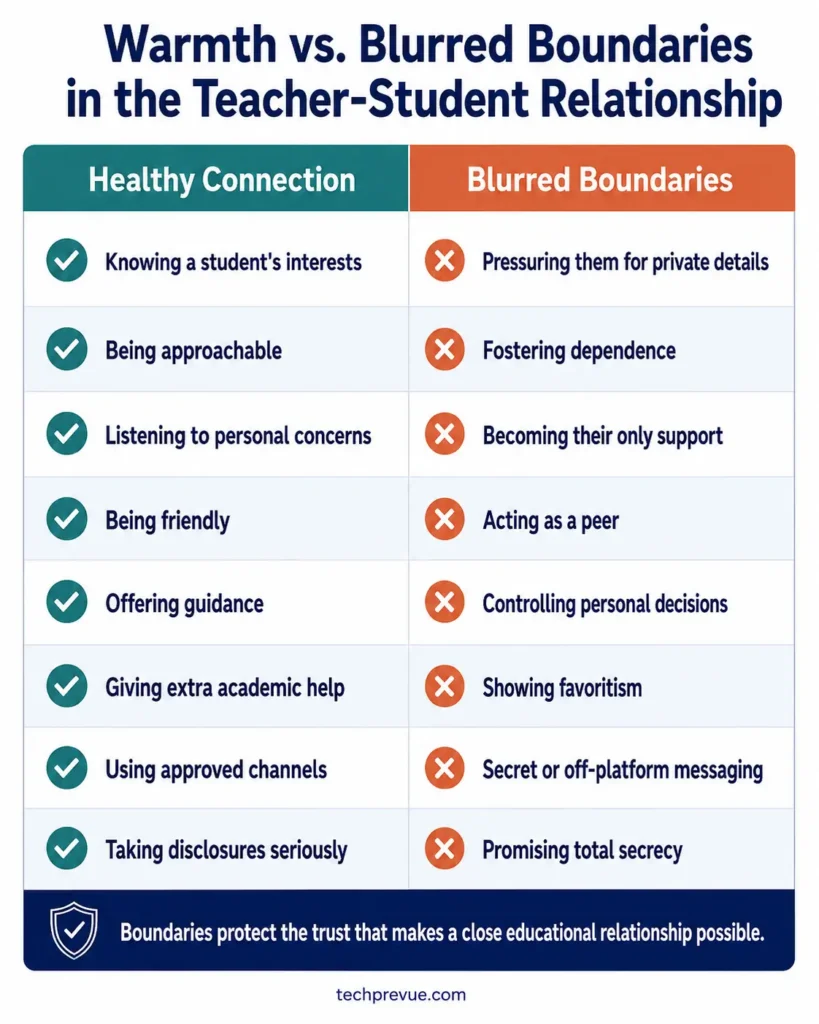
Boundaries protect the trust that makes a close educational relationship possible.
What If a Student Shares a Serious Personal Problem?
Sometimes students tell teachers about problems far beyond homework.
The first responsibility is to listen calmly and take the concern seriously. A teacher should not immediately dismiss, interrogate, or publicly discuss what has been shared.
But a teacher also should not promise unlimited secrecy.
If a disclosure suggests abuse, exploitation, self-harm, danger, or another safeguarding concern, the teacher should follow the applicable school procedures and local reporting requirements and involve the appropriate safeguarding or support professionals.
The teacher’s role is not to personally solve every problem.
A strong relationship can instead become the bridge that helps the student reach the right support.
How to Build a Relationship With a Student Who Frequently Misbehaves
Labels such as “problem child” are rarely useful because they turn behavior into identity.
Start with what actually happened.
A private conversation can often reveal whether a student understood the expectation, whether the work was too difficult, whether another conflict was involved, or whether the behavior served another purpose.
The teacher can then describe the behavior, explain its effect, listen to the student’s perspective, restate the expectation, agree on the next step, and notice genuine improvement when it occurs.
The Learning Policy Institute describes brief impromptu conferences as one way teachers can redirect a student without removing them from learning or damaging the relationship. A short private exchange — “Is there anything going on today that I should know about?” — often achieves more than a public correction.
Persistent or serious behavior may require additional school, family, learning, behavioral, disability, counseling, or safeguarding support. Relationship-building should complement those systems rather than replace them.
What Are the Effects of a Negative Teacher Student Relationship?
A negative relationship is not simply one in which a student occasionally dislikes a teacher.
Teachers must sometimes give low marks, reject excuses, enforce deadlines, challenge poor effort, or stop inappropriate behavior. Disagreement can exist inside a healthy relationship.
The warning sign is a repeated pattern of hostility, humiliation, favoritism, unfairness, unpredictability, low expectations, stereotyping, unresolved conflict, or indifference.
Because the 2025 review measured relationship quality across a spectrum, its findings apply at both ends: where quality is poor, the same eight outcome areas — including behavior problems, motivation, achievement, academic emotions, engagement, self-control, and well-being — are the ones most likely to be affected.
Students may withdraw from participation when they expect ridicule. Others may resist authority more openly.
The aim should not be a classroom without conflict. It should be a classroom in which conflict does not destroy respect.
Teacher Student Relationships Affect Teachers Too
The benefits are not one-directional.
A 2026 systematic review published in Educational Psychology Review by Rhoda Lai and colleagues at Monash University examined 55 studies on teacher student relationship quality and the well-being of middle- and secondary-school teachers. Positive relationships were associated with teachers’ positive emotions, engagement, sense of meaning, and accomplishment, as well as overall well-being.
The picture is genuinely encouraging but not uniform, and the authors are careful about this. Included studies were generally of medium quality and used widely varying measures, so they advise interpreting the findings with caution. Some studies found no correlation for secondary teachers specifically. Others found that supporting students through serious difficulties carried an emotional cost, and that not every teacher regarded these relationships as central to their own well-being.
What the researchers state plainly is that teaching is relational work.
That matters because relationship-building requires emotional energy. Teachers working with large classes, persistent conflict, administrative demands, marking, family communication, and limited time may find that maintaining patient individual relationships becomes harder.
Schools therefore share responsibility.
Supporting teacher well-being, planning time, professional development, behavior systems, and collegial support can help teachers sustain the relationships expected of them.
Teacher-Student Relationships in the Digital Classroom
Relationships no longer exist only inside a physical classroom.
Learning management systems, school email, video lessons, digital assignments, parent portals, and messaging tools have expanded the places where students and teachers interact. The way technology has changed education has also changed where these relationships are formed and maintained, and the growing role of ICT in education means most teachers now manage part of every relationship through a screen.
The principles remain largely the same: be responsive, respectful, predictable, and clear.
Digital communication also makes boundaries more visible. Teachers should use school-approved channels, protect student information, follow institutional policies, and avoid secret or overly personal online communication.
Technology can extend access to a teacher.
It should not remove the professional structure surrounding that access.
A Teacher-Student Relationship Checklist
Teachers can periodically ask themselves:
- Do my students know what I expect from them?
- Do I know and use their preferred names?
- Can students ask me questions without fear of embarrassment?
- Do I listen before deciding why a student behaved in a certain way?
- Is my praise specific and genuine?
- Do I correct behavior without attacking character?
- Do I apply expectations fairly?
- Do quieter students receive enough attention?
- Do I hold high expectations for students who are struggling?
- Do I know something meaningful about each student’s learning needs or interests?
- Can I acknowledge when I handled an interaction poorly?
- Are my personal and digital boundaries clear?
- Do students know where else they can seek help when a problem is beyond my role?
No teacher will answer yes to every question every day.
The goal is not perfection. It is a consistent pattern that tells students: you matter here, your learning matters, and the expectations still matter too.
Frequently Asked Questions
What is a teacher-student relationship in simple words?
A teacher-student relationship is the connection that develops through repeated interactions between a teacher and a student. A healthy relationship combines trust, respect, fairness, guidance, support, high expectations, and appropriate boundaries.
Why is the student-teacher relationship important?
The student teacher relationship is important because research links its quality with academic achievement, motivation, engagement and belonging, behavior, self-control, academic emotions, and well-being. It can also influence whether students feel comfortable participating, asking questions, accepting feedback, and seeking help.
What makes a good relationship between teacher and student?
A good relationship between teacher and student is supportive without being permissive, warm without becoming inappropriate, and demanding without becoming humiliating. Trust, fairness, consistency, listening, respect, clear expectations, and genuine interest in student progress are central features.
Can a teacher and student be friends?
A teacher can be friendly, trusted, and even remembered by a student as a lifelong friend or mentor. However, the relationship is not identical to ordinary peer friendship because teachers retain professional responsibilities, authority, and boundaries.
Why are teachers given such high respect in Indian culture?
Indian educational tradition has historically treated the guru as more than a person who transmits academic knowledge. The phrase Acharya Devo Bhava, from the Taittiriya Upanishad, expresses exceptional reverence for teachers because of their role in shaping knowledge, character, values, and judgment. Government of India communications continue to invoke this tradition when describing the importance of teachers.
The Relationship That Students Remember
Students may forget the exact lesson in which they first met a teacher. They often remember how that teacher made them see themselves.
A teacher who notices ability before the student recognizes it, corrects without humiliating, offers direction during uncertainty, celebrates genuine progress, and remains worthy of trust can influence a life long after the examination has ended.
That is where modern research and the older Indian idea of the guru meet.
A strong student and teacher relationship does not require the teacher to become a parent, counselor, or peer. It asks for something both simpler and more demanding: teach well, care sincerely, expect growth, guide responsibly, and use the student’s trust with wisdom.
Sources:
- Emslander, V., Holzberger, D., Ofstad, S. B., Fischbach, A., & Scherer, R. (2025). Teacher-student relationships and student outcomes: A systematic second-order meta-analytic review. Psychological Bulletin, 151(3), 365–397. https://pubmed.ncbi.nlm.nih.gov/39928458/
- Lai, R., Southam, J., Mageean, L., Roffey, S., & Allen, K.-A. (2026). Associations between teacher-student relationship quality and middle and secondary school teachers’ wellbeing: A systematic review. Educational Psychology Review, 38, article 4. https://link.springer.com/article/10.1007/s10648-025-10107-2
- Monash University (20 January 2026). Research finds teacher-student relationships key driver for teacher wellbeing. https://www.monash.edu/news/articles/research-finds-teacher-student-relationships-key-driver-for-teacher-wellbeing
- Australian Education Research Organisation. Positive teacher–student relationships: Their role in classroom management. https://www.edresearch.edu.au/summaries-explainers/explainers/positive-teacher-student-relationships-their-role-classroom-management
- Hernández, L. E., & Darling-Hammond, L. (with Nielson, N.) (2024). Cultivating relationships in secondary classrooms: Practices that matter. Learning Policy Institute. https://learningpolicyinstitute.org/product/cultivating-relationships-secondary-classrooms-brief
- Centers for Disease Control and Prevention. School connectedness helps students thrive. https://www.cdc.gov/youth-behavior/school-connectedness/index.html
- Press Information Bureau, Government of India (14 May 2020). Union HRD Minister interacts with the teachers across the country through webinar. https://www.pib.gov.in/PressReleasePage.aspx?PRID=1623822
- Taittiriya Upanishad, Shikshavalli I.11.2 (source of Acharya Devo Bhava).
- National Council for Teacher Education. Code of Professional Ethics for School Teachers (revised in light of the RTE Act, 2009). Official NCTE-hosted URL to be confirmed.
