
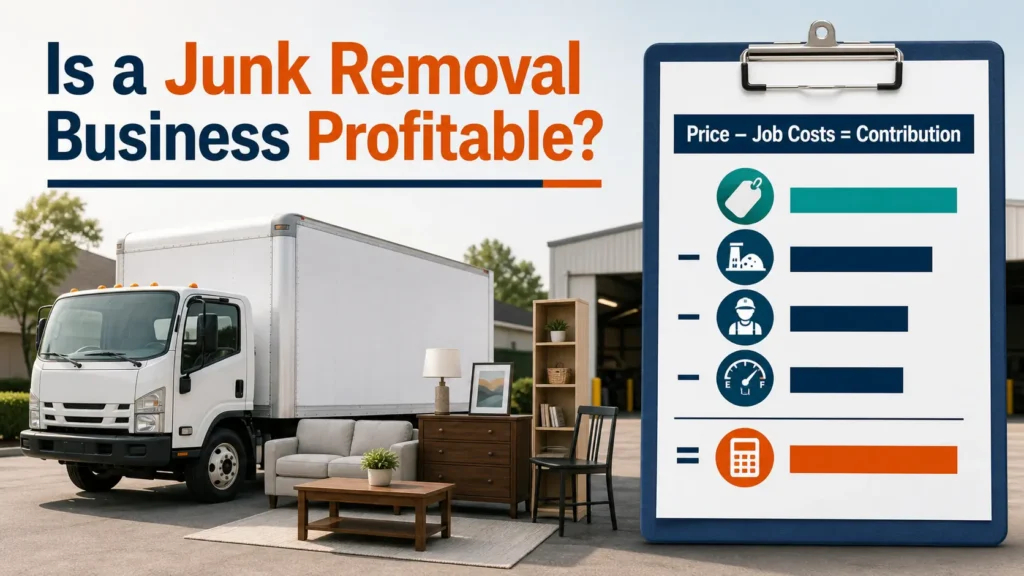
Is a junk removal business profitable? It can be — but the invoice total isn’t the answer. A job only makes money once its price has covered disposal, labor, travel, vehicle wear, customer acquisition, and a slice of the month’s fixed overhead.
That’s a longer list than most people expect walking in. Profit depends on local disposal costs, how accurately you estimate a load, how tightly you route your day, and whether you can book the right jobs without overpaying to find them.
| Question | Practical answer |
|---|---|
| Can junk removal produce a profit? | Yes, when average job contribution exceeds fixed overhead and the owner’s time is counted as a real cost. |
| Is junk removal a good business for everyone? | No. It demands physical work, sales skill, cost discipline, lawful disposal, and tolerance for uneven demand. |
| What usually kills the profit? | Underquoting, dense or restricted material, long routes, disposal surprises, vehicle downtime, and untracked advertising spend. |
| What should a new operator test first? | The real economics of a handful of local jobs, using actual disposal, travel, labor, and lead costs — not a national average. |
How a Junk Removal Business Actually Makes Money
The core revenue source is simple: a household or business pays to have unwanted items hauled away. What the quote reflects is less simple — truck volume, item type, material weight, crew time, access difficulty, and travel distance all factor in, usually in combination.
Some operators add disclosed fees for stairs, unusually heavy material, rush service, or disposal categories that cost more to process. Those fees only protect your margin if the customer sees them before the truck shows up, not after.
Recurring work is where the real efficiency gains live. Property managers, real estate agents, contractors, movers, and storage facilities all generate repeat cleanout needs. A standing relationship can lower your customer-acquisition cost.
But only if the negotiated rate still covers waiting time, payment delays, disposal, and crew requirements. A contract that looks good on volume can quietly lose money on terms.
Resale and recycling add a third revenue layer, though it’s the one new operators tend to overestimate. You need clear ownership of the item, and you need to subtract the time spent sorting, storing, cleaning, listing, and delivering it — plus whatever doesn’t sell.
Calculate What One Job Actually Earns
Monthly revenue is the wrong starting point. Start smaller: job contribution — what’s left after subtracting the costs a specific job caused.
Job contribution = customer payment − disposal − labor − travel and vehicle use − payment fees − job-acquisition cost
Labor has to include your own time. If a job only looks profitable because the owner’s estimating, driving, lifting, unloading, invoicing, and follow-up are all unpaid, that number is measuring free labor, not business profit.
Vehicle cost runs deeper than the fuel gauge, too. Maintenance, tires, repairs, registration, depreciation, and eventual replacement all belong in the allocation, scaled to how hard the truck actually works.
An Illustrative Job Calculation
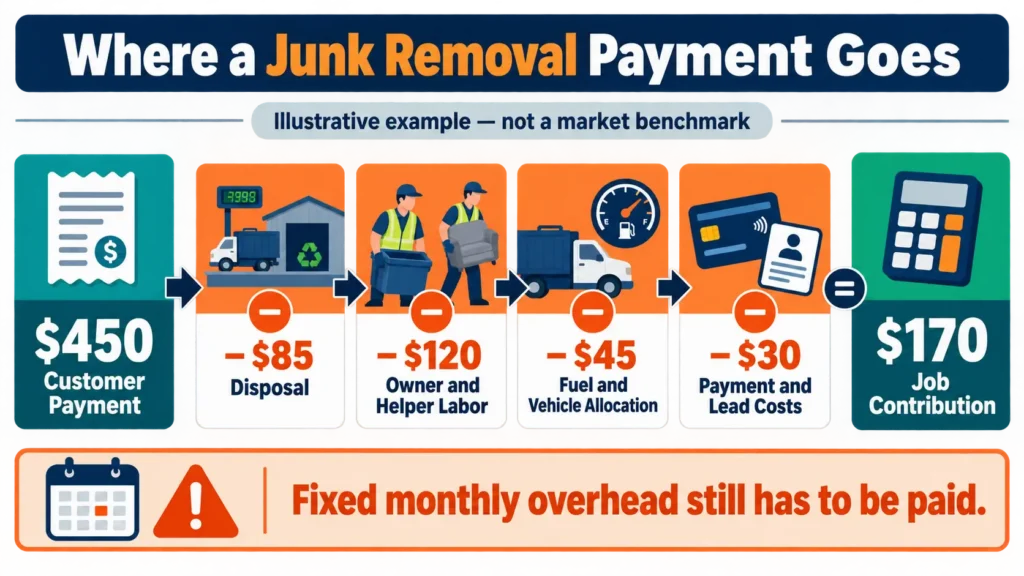
This example shows how the math works. It isn’t a market price or an industry benchmark — your disposal fees, labor cost, and lead cost will differ.
| Item | Amount |
|---|---|
| Customer payment | $450 |
| Disposal charge | −$85 |
| Owner and helper labor | −$120 |
| Fuel and vehicle allocation | −$45 |
| Payment and lead costs | −$30 |
| Job contribution | $170 |
That $170 isn’t final profit yet. Insurance, software, phone service, permits, accounting, storage, and advertising overhead still come out of the month before anything counts as real profit.
Monthly operating profit = total job contribution − fixed monthly overhead
From there, the break-even point follows directly:
Break-even jobs = fixed monthly overhead ÷ average job contribution
Build this estimate from a realistic mix of jobs — including the weak quotes, the long drives, and the loads that take longer to unload than expected — not from your best day of the month.
Price Junk Removal for Profit, Not Just Activity
A packed schedule can hide underpricing for months before it shows up in the bank account. Every quote should weigh truck space used, material weight, loading time, crew size, access conditions, distance, and the receiving facility’s fee.
Volume-based pricing works well for mixed household loads, since most customers can picture “half a truck.” Weight-based pricing is often safer for concrete, soil, roofing debris, and other dense material that can max out a truck — or a landfill’s weight limit — long before it looks full.
A minimum charge protects small jobs from eating more travel and admin time than they’re worth. Stairs, disassembly, long carries, wait time, and distant disposal trips can all justify a separate line item, as long as you say so upfront.
Margin and Markup Are Not the Same Thing
Markup adds a percentage on top of cost. Margin measures profit as a percentage of the selling price. Mixing the two up is one of the fastest ways to underprice a job without realizing it.
Say a job costs $300 to run, and you want a 25% margin. The price isn’t $375 — that’s a 25% markup, which only nets a 20% margin. To hit an actual 25% margin, divide cost by one minus the target margin: $300 ÷ 0.75 = $400.
This formula doesn’t tell you what margin to aim for. Local competition, risk, capacity, taxes, service quality, and demand still shape that number — it just keeps the math honest once you’ve picked one.
Compare Jobs by Their Profit Risk
No single job category wins every time. A useful mix balances truck space, weight, crew time, travel, disposal access, and how reliably you can book more of that same type of work.
| Job type | Possible advantage | Main profit risk |
|---|---|---|
| Single furniture item | Easy to describe and estimate | Travel and two-person lifting can eat the minimum charge |
| Mixed household cleanout | Larger ticket, more reusable items | Customer underestimates volume or includes restricted material |
| Estate or move-out cleanout | Substantial scope, referral potential | Ownership, access, timing, and emotional circumstances need extra care |
| Student move-out | Concentrated seasonal demand | Discounted rates and narrow pickup windows can shrink the margin |
| Construction debris | Repeat contractor demand possible | Dense material raises weight, damage, safety, and disposal costs |
| Commercial or property work | Repeat bookings lower lead cost | Payment terms, site rules, and documentation add overhead |
| Appliances and electronics | Customers accept item-specific pricing | Refrigerants, batteries, and local facility rules can add cost |
The biggest invoice isn’t automatically the best job. Compare contribution per crew-hour and per vehicle-hour, then weigh how consistently you can book that category again.
Seven Ways to Improve Junk Removal Profit
1. Set a cost-based minimum charge. Work out the smallest job that still covers travel, loading, unloading, payment processing, and admin time. A competitor’s posted minimum tells you nothing about their vehicle cost, route, or disposal deal — don’t anchor to it.
Revisit your own minimum whenever fuel, facility fees, wages, or vehicle costs shift.
2. Tighten your quote accuracy. Ask for photos, dimensions, access details, and material type before you arrive, and be clear about what would justify a revised price on-site.
Then track your estimates against the final result. Repeated misses usually point to one estimator, one job type, or one neighborhood.
3. Cut empty driving and waiting. Grouping nearby appointments reduces backtracking and puts more of the day toward paid work. Waiting counts too — blocked loading areas, missing decision-makers, and transfer-station queues can turn a solid quote into a weak job.
4. Build lawful disposal and recovery relationships. Know exactly which local facilities take mixed waste, clean construction material, metal, electronics, donations, and appliances — along with their hours, fees, and rejected materials. The cheapest posted fee isn’t always the cheapest trip once drive time and unloading speed are factored in.
5. Develop repeat referral sources. Property managers, real estate agents, contractors, movers, and storage operators are natural repeat business. Earn the relationship with accurate arrival windows and clean documentation.
But don’t accept a low contract rate just to lock in volume. Measure each partner by contribution, payment speed, and repeat frequency, not just booking count.
6. Measure marketing by booked contribution, not lead volume. A cheap lead that turns into an unprofitable job isn’t actually cheap. Track where each inquiry came from, what share becomes paid work, what it cost to acquire, and what’s left after that cost.
An eligible hauler can set up a free Google Business Profile as a service-area business. Google’s own guidance says a business that visits customers, rather than serving them on-site, should remove its address and define a service area instead. TechPrevue’s local SEO checklist walks through how business information, reviews, and citations work together once that’s set up.
Only spend on paid ads once call tracking and quote tracking show the spend is actually turning a profit.
7. Add capacity only after demand is proven. A second truck or a new hire adds fixed cost before it adds a dollar of revenue. Expand once your current setup is repeatedly turning away work you could have booked, existing jobs show reliable contribution, and you’ve got cash set aside for repairs and slow stretches.
Growth that raises revenue while shrinking your own take-home isn’t progress. It’s a bigger operation making less money per hour.
Treat Resale and Recycling as Net Value, Not Free Money
Before you set anything aside to resell, confirm ownership transferred and get clear customer authorization. Items with personal information on them, rented goods, and anything left behind by a tenant or employee can turn into a privacy or ownership problem fast.
Run every item through a simple test before deciding it’s worth keeping:
Net resale value = expected sale proceeds − sorting − cleaning − storage − listing and selling fees − delivery − risk of no sale
Donating or recycling can still cut your disposal costs even without a sale — just keep honest records of where the load actually went, rather than where you hoped it would go.
Some categories need special handling regardless. The EPA lists paints, cleaners, oils, batteries, and pesticides among common household hazardous wastes, and its appliance-disposal guidance covers refrigerants and other hazardous components in old appliances.
Costs New Operators Consistently Miss
The SBA’s startup-cost guidance recommends listing both one-time and recurring expenses before you start — good general advice, but for a hauling business, the recurring list runs longer than most people plan for: commercial insurance, permits, protective equipment, downtime, maintenance, card processing fees, bookkeeping, storage, marketing, rejected loads, damage claims, and the occasional invoice that never gets paid.
Sourcing those figures is part of the launch sequence, not something to estimate after the fact.
Owner time belongs on that list too, and it’s the easiest cost to forget. Quoting, customer messages, route planning, disposal research, vehicle cleaning, bookkeeping, and collecting payment all take real hours — not just the minutes spent actually lifting something.
Taxes, financing, and how you take money out of the business all affect what you actually keep after operating profit. An accountant familiar with your business structure can help separate wages, profit, cash flow, and taxable income before it becomes a year-end surprise.
Follow the US Waste and Transport Rules
Licensing and disposal requirements shift by state, city, vehicle type, and material — a general article can’t tell you whether your specific operation needs a municipal hauler permit, state registration, commercial vehicle filing, or special insurance. That part is local homework.
What’s consistent nationally: regulated hazardous-waste transporters can trigger EPA identification and manifest requirements under the hazardous-waste transportation rules, and the FMCSA explains when cargo vehicles and hazardous-material operations may need a USDOT number — with individual states sometimes reaching further into intrastate operations than the federal floor.
Before quoting a job, confirm what the destination facility accepts and what paperwork it requires. If you’re not authorized, equipped, or insured to move it, that’s a load to turn down, not a shortcut to figure out later.
Is Junk Removal a Good Business for You?
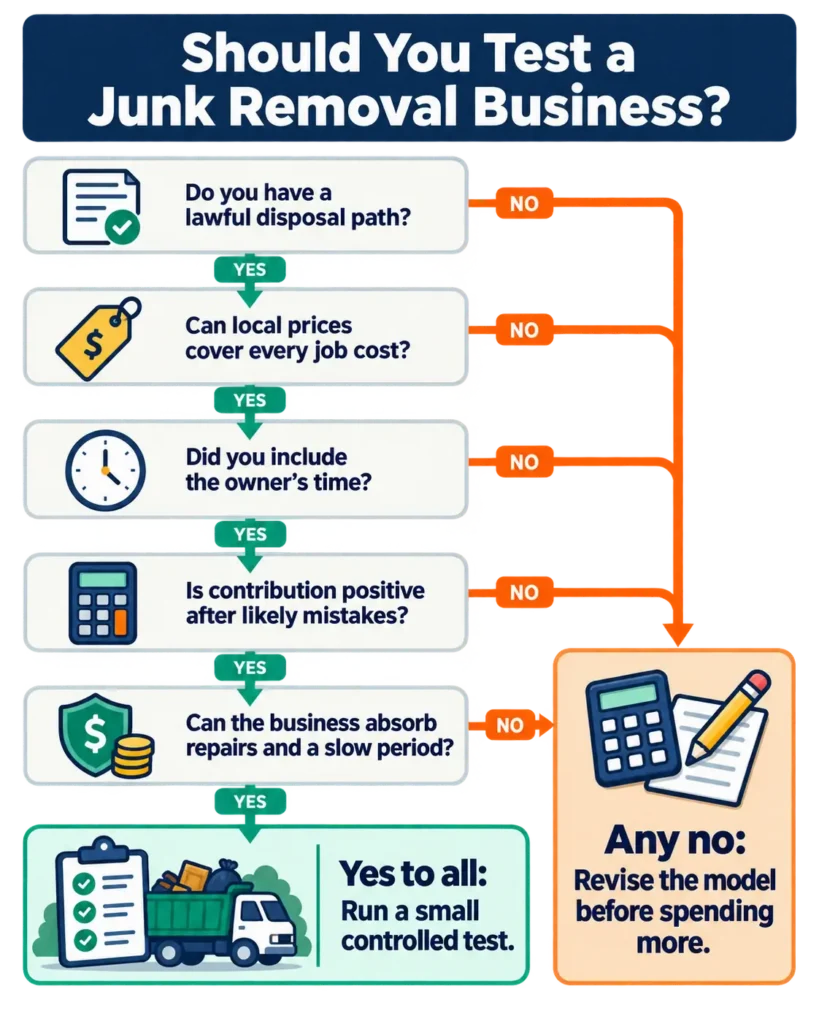
Junk removal tends to suit someone who can handle physical work safely, sell a local service, price uncertain loads on the fly, manage a vehicle, and track costs without letting a busy week paper over a bad one. It also suits someone willing to walk away from work that can’t be handled lawfully or priced profitably.
It’s a poor fit for anyone who needs predictable income right away, assumes every item collected has resale value, or plans to win purely on being the cheapest option in town. It gets riskier still when a truck purchase is financed on hoped-for demand instead of proven, profitable bookings.
Model a handful of realistic jobs using your own local numbers. If contribution stays positive after paying yourself, budgeting for the mistakes that happen anyway, covering fixed overhead, and setting aside a cash reserve — that’s worth a small, controlled test.
If the model only works with perfect routes, unpaid owner labor, zero repairs, and best-case resale income, it isn’t financially sound yet. Adjust the service area, job mix, equipment plan, or pricing before putting more money into it.
Frequently Asked Questions
Is a junk removal business profitable to start with little money?
It can be. Solo operators using an owned truck have the lowest fixed cost and the fastest path to positive contribution, but “low startup cost” doesn’t mean “guaranteed profit” — the job-level math above still has to work before volume matters.
What’s a realistic profit margin for a junk removal business?
It varies too much by market, disposal cost, and crew size to state as a single national number responsibly. Calculate it directly from your own job contribution and fixed overhead rather than anchoring to a figure from a different city’s cost structure.
Is junk removal a good side hustle?
It can work part-time, since jobs are typically booked individually rather than requiring a fixed schedule. The same cost discipline applies, though — a side-hustle job that skips the labor cost of your own time isn’t actually profitable, it’s just unpaid.
What’s the biggest mistake new junk removal operators make?
Pricing off a competitor’s rate card instead of their own costs. A rate that works for a paid-off pickup and a nearby disposal facility can lose money for someone financing a truck and driving further to dump.
The Bottom Line
A junk removal business can be genuinely profitable — but only once you separate revenue from job contribution, price for the real cost of each load, and treat your own time as an expense rather than a freebie. Model your local numbers before you commit to equipment, and let the math tell you whether junk removal is a good business for you, not the size of the invoice on your best day.
