
An engineer can spend years solving difficult problems and still feel trapped by one: What comes next when engineering no longer fits? The answer is rarely to erase your experience and restart from zero. The better move is to identify which parts of your background still have market value, then carry them into a role with a better match for your interests, lifestyle, and long-term goals.
Quick answer: Strong second careers for engineers usually preserve high-value skills such as systems thinking, quantitative analysis, project delivery, technical communication, and risk assessment. Strong options include project management, product management, technical sales, operations research, data science, consulting, patent work, technical writing, teaching, digital marketing, and entrepreneurship. Test one target role through a small project and industry conversations before paying for another degree or resigning.
This guide compares realistic paths, shows what each transition demands, and gives you a 90-day plan for changing direction without making an expensive blind leap. The goal is to make second careers for engineers easier to evaluate before money or stability is put at risk.
Data checked: August 4, 2026.
Second Careers for Engineers Begin With the Right Career Diagnosis
Successful second careers for engineers begin with an accurate diagnosis. You need to know whether the problem is your employer, your engineering discipline, your daily tasks, or the profession itself before choosing a solution.
Career Change for Engineers: Are You Leaving the Job or the Profession?
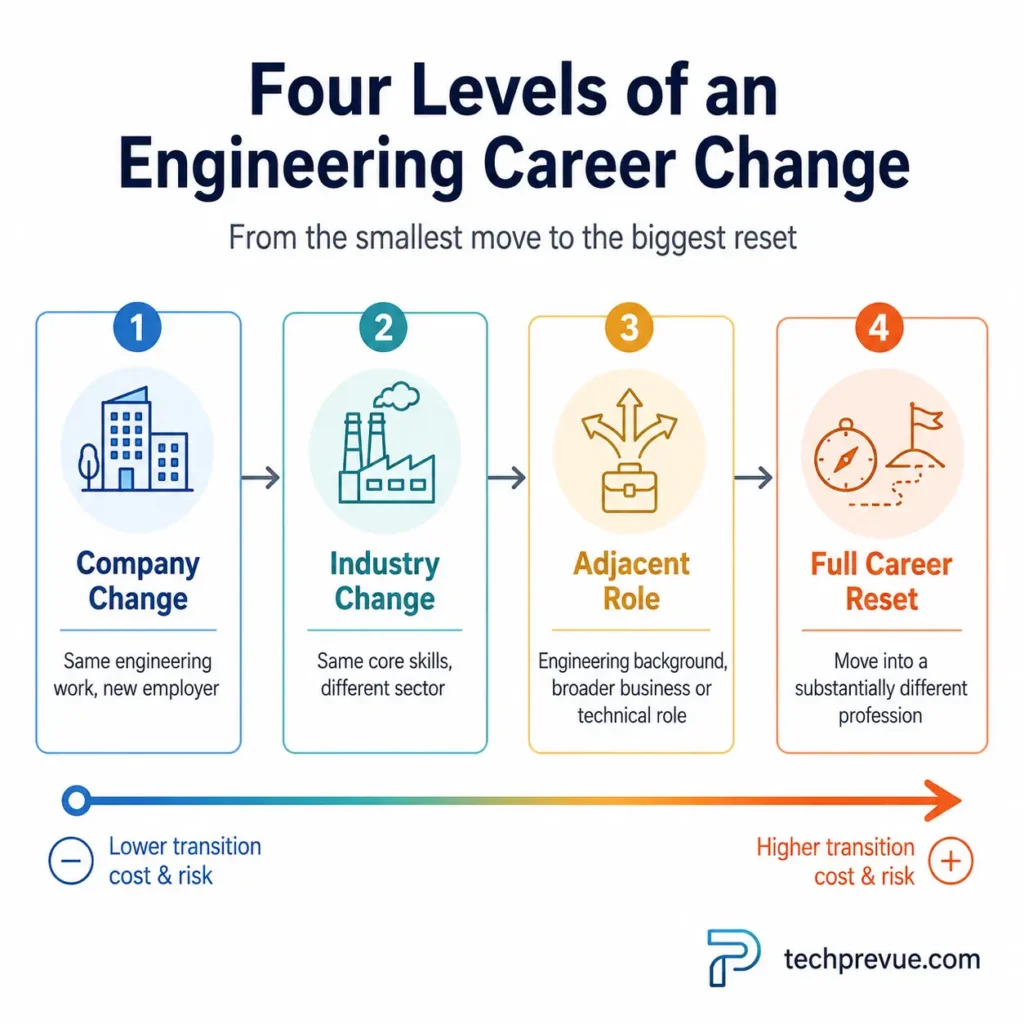
This decision may involve changing employers, industries, functions, or professions. Treating every complete professional reset as the same decision can make useful experience look less valuable than it is.
List the five activities that consume most of your week and mark each as energizing, tolerable, or draining. If technical work still engages you, test an employer or industry change before pursuing a full reset.
Transferable Skills for Engineers That Employers Already Value
These transferable abilities are more specific than “problem-solving.” O*NET’s Industrial Engineers profile lists complex problem-solving, systems analysis, systems evaluation, coordination, judgment and decision-making, instructing, and time management among the occupation’s transferable skills.
That overlap explains why second careers for engineers often work best where ambiguous problems must become plans. Your advantage is the ability to define constraints, test assumptions, document decisions, and anticipate failure.
Build an evidence-based skills inventory. Replace “good communicator” with “presented design trade-offs to clients,” and “leader” with “coordinated six functions during a plant shutdown.”
Source: O*NET’s Industrial Engineers profile.
Engineering Burnout and Career Dissatisfaction Need Different Responses
Persistent workplace exhaustion can make every alternative look attractive, including choices that would recreate the same pressure in another industry. WHO describes burnout as an occupational phenomenon linked to chronic workplace stress, with exhaustion, greater mental distance or cynicism toward the job, and reduced professional efficacy.
Use a two-week task-and-energy audit as a career-reflection exercise, not as a diagnosis. Before committing to second careers for engineers, consider workload changes, leave, flexible hours, a team transfer, or support from a qualified health professional when distress persists.
Source: World Health Organization on burnout in ICD-11.
Career Change Preparation for Engineers Before Choosing a New Path
A career transition becomes safer when it is divided into decisions that can be tested. This staged approach makes second careers for engineers easier to evaluate through recognition, selection, and action rather than one dramatic resignation.
Preparation also prevents an engineer from confusing discomfort with direction. Before comparing second careers for engineers, define what must improve, what experience should remain valuable, and what evidence would make the next employer take the transition seriously. This keeps second careers for engineers tied to a measurable improvement rather than an attractive title.
Three Stages of an Engineering Career Transition
Stage 1: Recognize what is no longer working. Separate temporary frustration from a repeated pattern by reviewing workload, learning, autonomy, compensation, management quality, location, travel, physical demands, and advancement. Write a one-sentence problem statement such as, “I still enjoy technical decisions, but I no longer want daily site supervision and unpredictable travel.”
Stage 2: Select a direction that preserves leverage. Compare no more than three paths at first, then study actual vacancies, talk with practitioners, and identify how each role creates value. A useful target should reuse part of your experience while improving the conditions that triggered the transition.
Stage 3: Validate the choice through action. Build a small proof project, perform a related assignment inside your current organization, volunteer for a relevant responsibility, or complete a paid pilot. Move forward only after the work itself—not merely the job title—still feels attractive.
Each stage needs a visible output. Finish the recognition stage with a career problem statement, the selection stage with a ranked shortlist, and the validation stage with evidence that another person can review.
Three Questions for Evaluating a New Career for Engineers
The old article asked what is valued, what must be learned, and what should be forgotten. For second careers for engineers, the first two questions remain useful, but professionals rarely need to erase their knowledge; they need to stop overusing habits that do not fit the new role.
What does the target career value most?
Read at least 20–30 current job descriptions and underline repeated outcomes, not only tools. Successful second careers for engineers begin by identifying whether the target role values prioritization, customer insight, discovery, commercial judgment, or another specific result.
Create a two-column evidence sheet. In the first column, write the outcomes employers request; in the second, match each outcome with a project, decision, or result from your engineering background.
What new skills must an engineer learn?
Classify every gap as required before entry, learnable on the job, or optional differentiation. This prevents an attractive course catalogue from becoming a substitute for checking what employers actually require.
Close the smallest high-impact gap first. A prospective technical writer may need three strong documentation samples, while a data candidate may need statistics, SQL, and one decision-focused analysis rather than a long collection of unrelated certificates.
What habits should an engineer stop overusing?
Some engineering habits are strengths in one context and limitations in another. Excessive jargon, waiting for perfect information, solving before asking customer questions, or treating every disagreement as a technical calculation can weaken performance in commercial and people-focused roles.
Do not discard rigor. Second careers for engineers become more credible when rigor is adapted: translate specifications into outcomes, replace unnecessary detail with decision-ready summaries, and involve stakeholders before committing to a solution.
Skills Gap Analysis for Engineers Entering a New Career
A useful gap analysis compares evidence rather than self-confidence. Build one spreadsheet with four columns: employer requirement, current evidence, missing capability, and the smallest action that could close or prove the gap.
Use the following sequence:
- Collect representative vacancies from the target country, industry, and seniority level.
- Group repeated requirements into technical, commercial, communication, leadership, and regulatory categories.
- Mark each requirement as proven, partially proven, or unproven.
- Choose one proof project that addresses several important gaps at once.
- Ask two practitioners whether the finished evidence would influence an interview decision.
This method protects second careers for engineers from endless preparation. Learning should produce evidence that can be inspected, discussed, or measured.
Career Change Goals Engineers Should Compare
The older article listed higher pay, creativity, travel, invention, social contribution, and helping others as possible benefits. These are useful decision criteria, but no career change guarantees them.
Turn each desired outcome into a testable question:
- Compensation: Does the realistic local pay range meet your minimum, including benefits and variable income?
- Creative control: Will you influence problems and priorities, or only execute instructions under a different title?
- Meaning: Can you identify who benefits from the work and how the outcome matters?
- Learning: Will the role build skills that remain valuable beyond one employer?
- Lifestyle: Does the schedule, travel, location, physical demand, and flexibility fit your life?
- Stability: Is demand spread across employers and industries, or concentrated in a narrow market?
- Advancement: What would the role lead to after two or five years?
Rank these criteria before comparing offers. A title that looks impressive can still be a poor move when it recreates the same workload, weak management, or limited autonomy that motivated the change.
Career Change Readiness Checklist for Engineers
Before applying, confirm that the transition has moved beyond wishful thinking. The best second careers for engineers have a clear problem statement, a realistic target, visible evidence, and a financial boundary.
Use this checklist:
- You can explain what must improve without insulting your current profession or employer.
- You have compared at least three possible roles and rejected weaker options for specific reasons.
- You have reviewed representative vacancies in the location and industry you intend to target.
- You can connect existing achievements with outcomes valued in the new function.
- You have completed or scheduled one role-relevant proof project.
- You know which qualification is legally required, commonly preferred, or merely optional.
- You have set a minimum acceptable salary, transition budget, and job-search runway.
- You have spoken with practitioners who described the difficult parts of the work, not only its advantages.
A candidate does not need perfect certainty before pursuing second careers for engineers. The goal is enough evidence to make the next step reversible, affordable, and informed.
Best Second Careers for Engineers With the Smallest Career Reset
The strongest adjacent paths do not require a dramatic exit. They let you keep industry knowledge, professional credibility, and salary leverage while changing the work you perform each day.
Some alternative jobs for engineers change the responsibilities, customers, or working environment without discarding technical credibility. Other bridge roles worth checking include business analysis, implementation consulting, solutions engineering, technical customer success, and UX research for technical products.
Research and Development as an Engineering-Adjacent Career Option
Research and development deserves consideration when comparing second careers for engineers before leaving the profession completely. Depending on the industry, R&D work can involve applied research, product experiments, prototype testing, simulation, materials development, process innovation, reliability, laboratory systems, or technology transfer.
This path suits people who still enjoy investigation but want less routine delivery, site work, production pressure, or client administration. It is not counted among the 15 core second careers because many R&D positions remain within engineering, although the daily work may feel substantially different.
Start by identifying a problem your present industry has not solved well. Prepare a short research proposal defining the problem, existing approaches, testable hypothesis, required resources, safety or regulatory constraints, and the decision the experiment would support.
Qualification requirements vary widely. Some scientist or university research positions require an advanced degree, while applied product, testing, process-development, and innovation roles may value an engineering degree plus domain experience. As with other second careers for engineers, representative job descriptions should decide whether further study is necessary.
1. Project Management Careers for Engineers
This route fits professionals who enjoy schedules, budgets, risk registers, stakeholder decisions, and cross-functional delivery. Technical experience helps you challenge unrealistic deadlines without relying on guesswork.
The BLS reports a 2024 US median annual wage of $100,750 and projects 6% growth from 2024 to 2034. It also notes that some employers prefer a technical degree related to their industry.
Test this route by leading a contained initiative and documenting scope, risks, decisions, and results. Check job descriptions before pursuing the PMP credential; certification supports, but does not replace, delivery evidence.
Source: BLS Project Management Specialists.
2. Product Management Careers for Engineers
This role suits people who want to decide what should be built, for whom, and why. It combines customer research, prioritization, business judgment, technical feasibility, and communication rather than focusing only on implementation.
Among second careers for engineers, product management is easiest to enter near a familiar technology or industry. Build proof by interviewing five users and writing a product brief that defines the problem, priorities, success metrics, and trade-offs.
3. Technical Sales Careers for Engineers
This path rewards people who enjoy explaining complicated products, diagnosing customer needs, and connecting features with business outcomes. Technical credibility can reduce the gap between a sales promise and what the product can actually deliver.
The BLS reports a 2024 US median annual wage of $121,520 for sales engineers and projects 5% growth from 2024 to 2034. Compensation may include commissions or bonuses.
Turn one project into a five-slide customer presentation covering the problem, cost of inaction, solution, technical proof, and expected result. Among second careers for engineers, technical sales rewards value communication rather than a specification dump.
Source: BLS Sales Engineers.
4. Operations and Supply Chain Careers for Engineers
This direction fits professionals who like throughput, quality, procurement, capacity, logistics, and continuous improvement. Mechanical, industrial, manufacturing, and civil backgrounds often transfer well because the work depends on constraints and real-world systems.
Start with a measurable operational problem: map the process, identify the bottleneck, calculate the cost, and propose an experiment. Among second careers for engineers, operations rewards a documented improvement more than a long software list.
5. Engineering Consulting Careers for Experienced Professionals
Experienced professionals can solve narrower, higher-value problems for multiple clients through independent or firm-based consulting. The work may remain technical, become management-focused, or combine both through audits, feasibility studies, compliance, cost reduction, and implementation support.
Among second careers for engineers, consulting favors depth. Define one expensive problem, one buyer, and one measurable outcome, then create a diagnostic checklist and a low-risk pilot.
High-Paying Alternative Careers for Engineers
The most lucrative alternatives usually pay for scarce judgment, commercial responsibility, or difficult quantitative work. The trade-off is that many demand visible evidence beyond an engineering degree.
6. Data Science Careers for Engineers
This option attracts people who already use mathematical reasoning, experimentation, modeling, and imperfect data. The transition still requires statistics, programming, data cleaning, model evaluation, and clear business interpretation.
The BLS reports a 2024 US median annual wage of $112,590 and projects 34% growth from 2024 to 2034. Some employers prefer advanced degrees, so inspect target job descriptions before assuming a short course is enough.
Build one domain project—equipment failure, energy demand, construction delay, or inventory risk—and explain the decision it supports, not only the code.
Source: BLS Data Scientists.
7. Operations Research Careers for Engineers
This quantitative path uses mathematics and logic to improve scheduling, routing, resource allocation, pricing, inventory, and strategic decisions. It is one of the most natural second careers for engineers who enjoy optimization more than physical design.
The BLS projects 21% US growth from 2024 to 2034 and reports a 2024 median wage of $91,290. Create a transparent scheduling, routing, staffing, or inventory model that converts constraints into a usable recommendation.
Source: BLS Operations Research Analysts.
8. Management Consulting Careers for Engineers
This route suits structured thinkers who can investigate unclear problems, communicate with executives, and work under tight deadlines. Industry expertise can be a stronger differentiator than a purely general business profile.
The BLS projects 9% US growth for management analysts from 2024 to 2034, while noting deadline pressure and potentially long hours. Prepare two cases connecting analysis with revenue, cost, risk, adoption, or change management; among second careers for engineers, management consulting demands visible business impact.
Source: BLS Management Analysts.
9. Finance and Quantitative Careers for Engineers
Possible destinations include risk analysis, financial modeling, fintech, insurance analytics, investment research, and quantitative development. Strong mathematics helps, but financial concepts, regulation, market behavior, and communication must be learned deliberately.
Review ten representative job descriptions before choosing a qualification. Build a model around project valuation, scenario analysis, credit risk, or portfolio exposure; among second careers for engineers, finance demands an understanding of money and incentives, not only formulas.
10. Patent Agent and Intellectual Property Careers for Engineers
This regulated path can suit engineers who enjoy technical reading, precise writing, research, and legal reasoning. Work may involve prior-art searches, patent drafting, examination responses, licensing support, or portfolio analysis.
Requirements differ by country. Under Section 126 of India’s Patents Act, a person seeking registration as a patent agent must be an Indian citizen, be at least 21, hold a qualifying degree in science, engineering, or technology or a recognized equivalent, and satisfy the applicable examination or statutory route.
Review the latest examination notice, registration procedure, and fees before investing. As one of the regulated second careers for engineers, intellectual property requires current legal guidance rather than general career advice alone.
Sources: India Code, Patents Act Section 126 and Intellectual Property India’s Patent Agent Examination page.
Meaningful Non-Engineering Jobs for Engineers
Roles outside traditional engineering often use technical experience in service of communication, education, policy, marketing, or independent work. They may offer more autonomy or human interaction, but they still require professional proof.
11. Technical Writing Careers for Engineers
This work suits people who enjoy turning complex systems into instructions, explanations, specifications, and decision-ready documents. Domain expertise is useful because good technical communication depends on understanding what can go wrong.
The BLS reports a 2024 US median wage of $91,670 and projects 1% growth from 2024 to 2034, noting that AI productivity may slow growth. Create a beginner guide, troubleshooting document, and executive explanation, then study TechPrevue’s content marketing strategy guide.
Source: BLS Technical Writers.
12. Teaching and Corporate Training Careers for Engineers
This direction fits professionals who enjoy explaining concepts, coaching others, and designing learning experiences. Options range from school or college teaching to software training, industrial safety instruction, customer education, and internal capability development.
Formal teaching may require licenses or advanced qualifications, while corporate training can be accessible through subject expertise. When comparing second careers for engineers, test education by running a workshop, recording a lesson, and collecting feedback; compare the pros and cons of online classes before retraining online.
13. Sustainability and Public Policy Careers for Engineers
These roles connect technical evidence with regulation, infrastructure, climate risk, energy, transport, water, safety, and public investment. The strongest candidates can explain both physical systems and the consequences of policy choices.
Choose a sector where your experience matters, then write a two-page brief covering the problem, stakeholders, evidence, trade-offs, and recommendation. Among second careers for engineers, policy work demands especially concise reasoning for nontechnical readers.
14. Digital Marketing Careers for Engineers
Possible roles include analytics, conversion optimization, marketing operations, search engine optimization, automation, product marketing, and technical content. Engineers often bring experimental discipline and a healthy suspicion of vanity metrics.
Start with one channel and measurable objective: build a small site, publish useful pages, track discovery and conversions, and document each test. Among second careers for engineers, marketing rewards measured experiments; TechPrevue’s guide to what SEO is and how it works offers a practical foundation.
15. Entrepreneurship and Freelance Consulting for Engineers
Independent work offers autonomy but removes the certainty of a monthly salary. It includes customer discovery, positioning, proposals, sales, delivery, cash flow, and reputation management—not only solving technical problems.
When your employment contract permits, interview buyers and pre-sell a small service before building a product. Business ownership is one of the riskier second careers for engineers, so use TechPrevue’s guide on how to start a professional blog to publish case studies after demand is tested.
Second Careers for Engineers by Engineering Branch
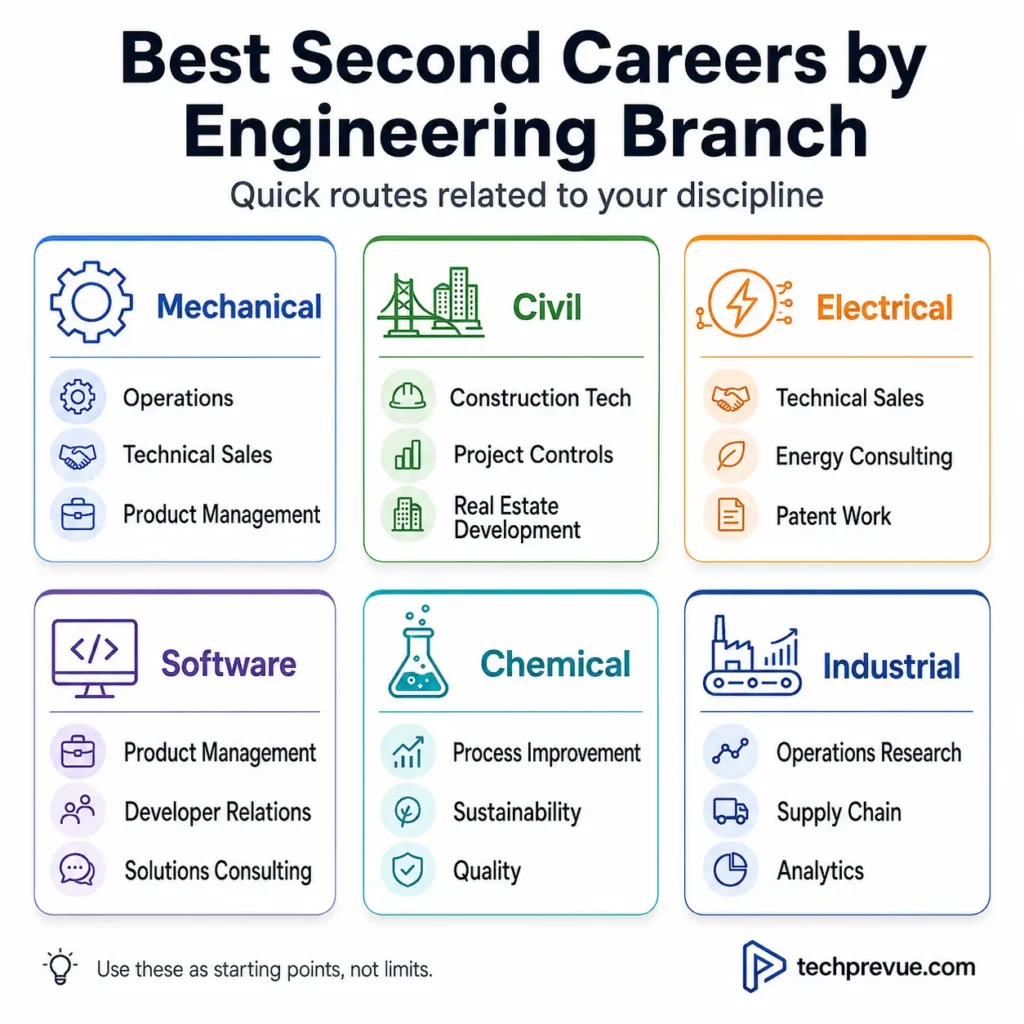
Second careers for engineers should reflect the problems each discipline already knows. Branch-specific experience can reduce retraining time and give you a defensible niche.
Second Careers for Mechanical Engineers
Strong options include operations, supply chain, technical sales, product management, energy auditing, quality, reliability, and manufacturing consulting. Experience with equipment, materials, tolerances, maintenance, and production is valuable in businesses that sell or operate physical systems.
A bridge project might analyze downtime, redesign maintenance, or explain an industrial product to customers. These second careers for engineers preserve practical judgment.
Second Careers for Civil Engineers
Promising routes include construction technology, project controls, estimating, procurement, real estate development, infrastructure policy, risk, sustainability, and contract administration. Site experience can transfer into roles where plans must survive budgets, regulations, contractors, and weather.
Build a case around schedule recovery, cost variance, stakeholder coordination, or permitting. Among second careers for engineers, built-environment roles reward knowledge of drawings and delivery.
Second Careers for Electrical Engineers
Practical routes include technical sales, product management, patent work, energy consulting, cybersecurity for operational technology, telecom strategy, data analysis, and training. Systems knowledge is especially useful in industries where hardware, software, networks, and safety interact.
Compare energy options, map a control-system risk, or explain a complex product to a buyer. These second careers for engineers remain close to technology with less hands-on design.
Second Careers for Software Engineers
Common routes include product management, developer relations, solutions consulting, technical writing, cybersecurity, data science, digital marketing, and entrepreneurship. Software professionals can also move into domain-heavy roles where automation knowledge improves business decisions.
Build evidence around the new function: a product brief, customer workshop, security assessment, technical guide, or growth experiment.
Alternative Careers for Chemical and Industrial Engineers
Useful options include operations research, process improvement, sustainability, safety, quality, supply chain, analytics, consulting, and regulated-industry roles. Process orientation can transfer well into healthcare, logistics, energy, food, pharmaceuticals, and manufacturing.
Map one process from inputs to outcomes and quantify waste, risk, delay, or variability. Such second careers for engineers are easier to sell when employers can see the economic value.
How to Plan a Career Change From Engineering Without Quitting Too Early
A staged transition is less about making one brave decision and more about reducing uncertainty through evidence. The following process turns second careers for engineers into experiments rather than guesses.
Career Transition Scorecard for Engineers
Rate each option from one to five on interest, skill overlap, demand, proof-building speed, retraining cost, salary risk, lifestyle fit, and network access. Weight your non-negotiables; second careers for engineers should improve the whole career equation, not only the title.
| Career path | Skill overlap | Proof you can build | Typical reset risk | Best first experiment |
|---|---|---|---|---|
| Project management | High | Delivery case study | Low | Lead a contained project |
| Product management | Medium-high | Product brief | Medium | Interview users and prioritize a problem |
| Technical sales | High | Customer presentation | Low-medium | Run a discovery and demo session |
| Data science | Medium | Domain analysis | Medium-high | Complete one decision-focused project |
| Operations research | High for quantitative engineers | Optimization model | Medium | Model a scheduling or routing problem |
| Consulting | High with industry depth | Diagnostic report | Medium | Offer a narrow pilot |
| Technical writing | High for strong communicators | Documentation portfolio | Medium | Publish three different sample formats |
| Patent work | High technical overlap | Search or drafting sample | Medium-high | Review jurisdiction-specific requirements |
| Digital marketing | Medium | Measured campaign | Medium | Grow one small site or project |
| Entrepreneurship | Variable | Paid pilot | High | Pre-sell before building |
90-Day Career Change Plan for Engineers
A 90-day plan is for collecting evidence, not mastering a profession.
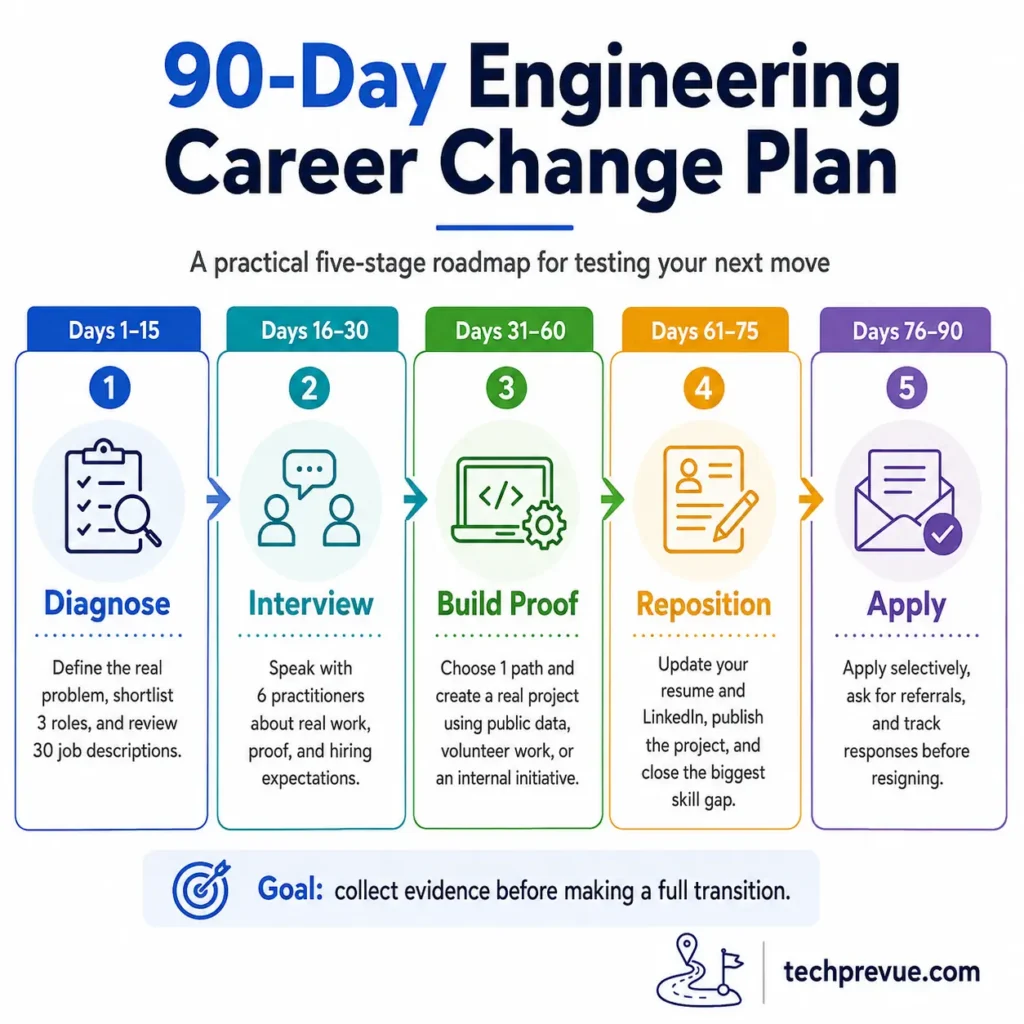
Days 1–15: Diagnose the problem, choose three roles, and review 30 current job descriptions.
Days 16–30: Interview six practitioners about difficult tasks, trusted proof, and hiring expectations.
Days 31–60: Choose one path and create a tangible project using public data, volunteer work, or an internal initiative.
Days 61–75: Reposition your resume and LinkedIn profile, publish the project, and close the largest skill gap.
Days 76–90: Apply selectively, request referrals, and track responses. Second careers for engineers should face market feedback before resignation.
Indian professionals can review current courses, skill credentials, jobs, and apprenticeship opportunities through the government-backed Skill India Digital Hub. Availability, eligibility, fees, and recognition vary by program, so confirm each listing before enrolling.
Career Change Resume for Engineers
Lead with relevant outcomes rather than a chronology of technical duties. The reader should understand why your past makes you useful in the new role within the first third of the page.
Use a target headline, value statement, selected achievements, and transition projects. Translate results into cost, speed, quality, risk, adoption, revenue, safety, or customer value; second careers for engineers become believable when old evidence connects to new responsibilities.
Portfolio Projects for Engineers Entering a New Field
Portfolio projects for engineers should resemble the decisions made in the target role. A product manager needs a product case, a writer needs published documents, and an analyst needs a recommendation supported by data.
Explain the problem, constraints, alternatives, decision, result, and what you would validate next. One business-relevant project is stronger than five copied tutorials; second careers for engineers are won through proof, not certificate volume.
Networking Strategy for Engineers Changing Careers
Begin with learning rather than asking strangers for jobs. People are more likely to respond to a focused question than a vague request to “pick their brain.”
Send a brief message with your background, target transition, and one specific question. Apply the advice and report back; many second careers for engineers begin through weak ties that reveal how employers describe adjacent work.
Financial Runway for an Engineering Career Change
Financial runway determines how much career risk you can absorb. Estimate essential monthly expenses, retraining costs, benefits you may lose, expected job-search duration, and the salary floor you can realistically accept.
Prefer reversible steps such as internal transfers, part-time learning, paid pilots, and staged applications. TechPrevue’s guide to the benefits of blogging for a professional portfolio can help you publish proof of work; second careers for engineers are easier from stability than from a financial emergency.
Second-Career Mistakes Engineers Should Avoid
Second-career mistakes usually come from acting before collecting evidence. Avoiding these errors protects your time, money, and confidence.
Unnecessary Degrees During an Engineer Career Change
An unnecessary degree can delay the transition without fixing the real hiring gap. Education is valuable when the target occupation requires it, employers consistently demand it, or the program provides access you cannot create independently.
Before enrolling, inspect job descriptions and test whether a smaller project or credential earns interviews. Second careers for engineers should not begin with debt by default.
Entry-Level Applications From Experienced Engineers
Applying only to entry-level roles can erase the value of your domain experience. Search for bridge titles such as technical program manager, solutions consultant, product operations manager, industry analyst, implementation lead, or subject-matter specialist.
A lower title may be rational when it buys faster learning, industry access, or a clear advancement path. Second careers for engineers should preserve at least one form of seniority.
Salary Expectations for Former Engineers
Salary expectations should be based on the new function, location, industry, and level—not the prestige of an engineering degree. Published US occupational medians are not entry-level salaries and do not predict an individual offer in India, a specific city, or another sector.
Compare total compensation, flexibility, travel, stability, and progression. A temporary pay cut may be rational, but vague promises should not replace numbers.
Certifications Without Career-Change Evidence
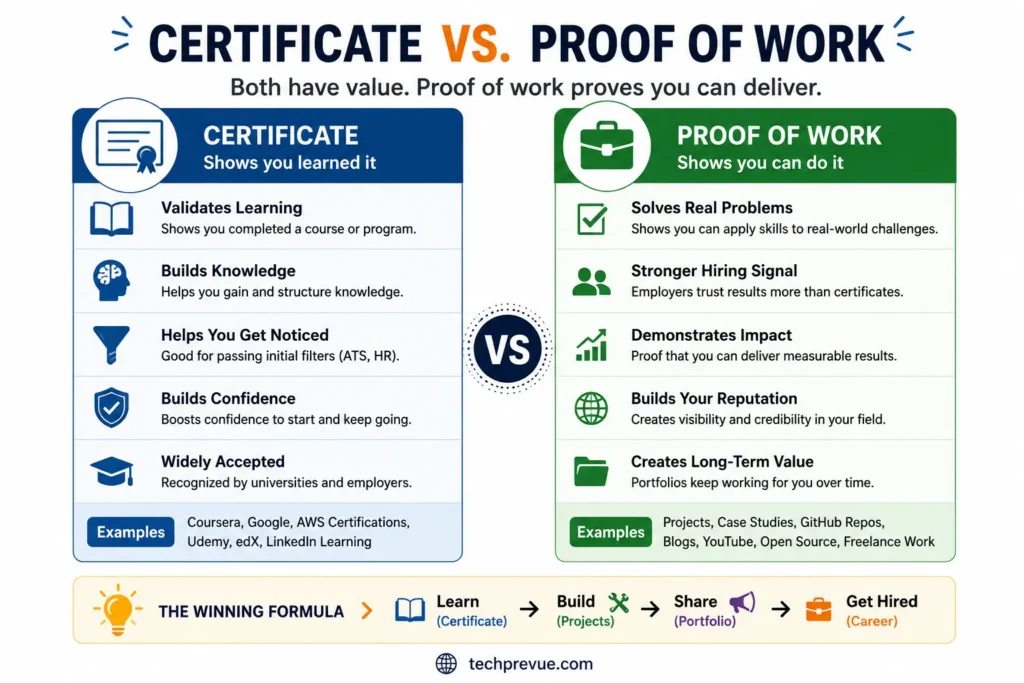
Certifications can organize learning and pass an initial screening filter, but they rarely prove that you can perform the work. Hiring managers still need evidence of judgment, communication, and results.
Choose a credential when it appears repeatedly in target jobs or provides regulated eligibility. For most second careers for engineers, one credential plus a relevant project beats several unused certificates.
Second Careers for Engineers FAQs
These frequently asked questions address the decisions readers commonly face before making a transition.
What Is a Good Second Career for an Engineer?
A good second career reuses valuable experience while improving the work that no longer fits. Common options include project management, product management, technical sales, operations, consulting, data analysis, teaching, and technical writing.
What Jobs Can Engineers Switch To?
Engineers can switch to product or project management, operations research, data science, supply chain, consulting, patent work, technical sales, education, policy, marketing, or entrepreneurship. The easiest second careers for engineers are adjacent roles in a familiar industry.
Can Engineers Change Careers Without Getting Another Degree?
Yes, especially for adjacent roles supported by relevant proof. A new degree may be necessary for regulated or highly specialized work, so confirm requirements with official bodies and representative employers.
Which Non-Engineering Jobs Pay Well for Engineers?
Technical sales, project management, data science, operations research, consulting, product leadership, finance, and intellectual-property roles can pay well. Compare current local listings because compensation varies by country, industry, experience, and incentives.
Is 40 Too Late for an Engineer to Change Careers?
No fixed age makes a change impossible. At 40, domain knowledge and leadership evidence can help, but retraining time, family obligations, salary risk, and age bias favor a staged transition.
How Should an Engineer Explain a Career Change on a Resume?
Present the change as a deliberate move toward a role that uses specific strengths, then support it with achievements and a recent project. Show how engineering experience solves the target employer’s problems.
Should an Engineer Change Careers Because of Burnout?
Burnout is a reason to reassess, not proof of a destination. Address health and workload where possible, seek qualified support when distress persists, identify energizing tasks, and test a new role before assuming every problem will disappear outside engineering.
Choosing Among Second Careers for Engineers
The strongest second careers for engineers are built through subtraction and proof. Remove options that fail your financial or lifestyle requirements, then test the remaining path through conversations, a real project, and selective applications.
Your engineering degree is not a contract that forces you to perform the same work forever. It is evidence that you learned to work with constraints—and the most effective second careers for engineers apply that experience deliberately.